 GET THE BOOK
 GET THE BOOK




Podcast
EP. 329
Stop Waiting for Inheritance; Start Farming Now (Ep. 329)
Nov 21, 2025 ·
22 min
0:00 / 21:56
EPISODE OVERVIEW
ABOUT THIS EPISODE
Are you waiting on an inheritance, a government program, or the bank to finally let you farm “for real”? In this episode, Mary Jo shows how that thinking is exactly what’s holding you back, and how Nelson Nash warned us about it years ago.
In Episode 329, Mary Jo dives into Nelson Nash’s second book, “Building Your Warehouse of Wealth,” and unpacks why how you think about money, wealth, and government programs determines everything about your financial future.
From government “police actions” to farm programs and waiting on Mom & Dad’s land, she connects Nelson’s ideas, Austrian economics, and real farm/ranch stories to show why the top 3% think — and act — differently.
If you’ve ever said, “Farming is too hard,” “I’ll never get a chance without the bank,” or “I’m just waiting for my share,” this episode is your wake-up call.
Key Takeaways
- How you think is everything – your mindset around money and wealth literally dictates your results.
- Government programs change behavior and keep people standing in line for handouts instead of producing.
- Jealousy kills curiosity – as soon as you resent someone successful, you stop asking how they did it.
- Top 3% vs the 97% – the top performers are actively learning, reading, traveling, and thinking for themselves.
- Stop waiting for inheritance – go lease ground, get an off-farm job, build your own base instead of hoping.
- Infinite Banking is a concept first, numbers second – Nelson’s second book is all about changing how you think.
- You become what you think about – Earl Nightingale, Nelson Nash, and basic human behavior all agree on this.
(Timestamps are from the video version. Audio-only edits are always shorter since they have had more fluff removed, so the timestamps are not accurate to this version.)
👉 Ready to See if Infinite Banking Works for Your Farm or Ranch?
- ⓵ Get the books & bundles: 📚 farmingwithoutthebank.com/book
- ⓶ Read the book before you book a call – that’s how we make sure you’re in the thinking 3%, not the complaining 97%.
- ⓷ Set up your appointment (link will be in your email), and let’s see if this concept fits your operation.
Even if we don’t end up working together, you’ll walk away with a better way to think about money, wealth, and your farm future.
Resources Mentioned
- “Building Your Warehouse of Wealth” – Nelson Nash
- “Economics in One Lesson” – Henry Hazlitt
- Earl Nightingale – “The Strangest Secret”
- Words & Numbers Podcast
- FEE (Foundation for Economic Education) / Austrian Economics resources
CHAPTER TIMESTAMPS
- 00:00Nobody cares about you more than you (and why that matters)
- 01:03Nelson Nash's second book: Building Your Warehouse of Wealth
- 04:35Korean "police action," government language & how we're taught to think
- 08:37"You become what you think about" (Earl Nightingale, pilots & Al Capone)
- 11:17Jealousy vs curiosity: TikTok farmer, excuses, and the 3% who actually change
- 17:42Top 3% vs 97%: farming is "hard"... and why some win anyway
- 19:20Stop waiting for the farm: building your own wealth & farming future
- 23:43What to read next & how to work with Mary Jo
YOUTUBE EPISODE
TRANSCRIPTION
"Nobody cares about you as much as you do. Just letting you know. People are always concerned about what everybody else is thinking about. And the only people actually thinking about you are the people that want to be you or that are jealous of you. Nobody above you is thinking about you. Nobody that wants to be you isn't thinking about you. Literally, not a thing. And so we're more concerned about what everybody else is going to think. How about we just think ourselves? And if we want to farm, then we don't wait for the handout. And we go and we lease our own ground. Now, a lot of you are going to say, oh, yeah, as if that's easy. Nobody said it's easy. I didn't say it was easy. I said, go do it and figure out how to do it. Because we have to think about it. How we think determines where we're at."
Hello, hello, and welcome back to the podcast. Thank you very much for being here. We are going to go over Nelson's second book. I had a suggestion that we do this. And it was a great idea. So Nelson wrote Building Your Warehouse of Wealth. And so I don't talk about this book a lot. And I'm not going to lie. It's been a minute since I have read it. And so we're going to go over it because it's a very good book. It does not have numbers. So a lot of people don't understand that infinite banking is a concept. And instead, they want to go right to the numbers of everything. And they want to start comparing rates of return. And what if I had this? Or what if I had that? Instead of having a whole life insurance policy. And so they don't quite understand the concept piece of it. And so that is what this book goes over. And I absolutely love that. Because people that are stuck, this is maybe where we need to go.
I'm going to go over the introduction because it's very, very good. I'm going to read a few parts out of here. And a lot of times I skip the introduction of books. Because frankly, most introductions suck. But Nelson's introductions are always really good. And ask me how I know. Because I skipped the introduction of BYOB for like a decade. Just learn from me, you know. I'm just over here making mistakes and doing Mary Jo stuff. And so if you're like me, just be like, yeah, let me just listen to her. Because if she does everything wrong, then she does it right. Okay.
So he starts out by talking about the Korean conflict. And that the government called it a police action. He said, somehow or another, government leaders try to change the meaning of words and still accomplish their objectives. 54,246 American men and women lost their lives in this event. The worst result of that war was the thought process that it produced in the minds of American citizens. How you think is everything. It determines your behavior. I thought that was very interesting. Because I hadn't read this in a minute. I forgot that he had even... I probably didn't read the intro. Let's be honest.
Interesting that I read this in a time where we have all this crap going on with the government shutdown. And they want to tell us how to think about that. Right? So they're going to lead us to believe that it is this party versus that party. And we're going to make you fight. We're going to cause you to think this way. And they do that with everything. They manipulate us so badly that we just continue to fight amongst one another. That is my belief. I am more of the middle ground type person. Like, I want to see all aspects and all avenues. And I want to hear stories about everything so that I can make my determination on something. But that's not what the government wants. Right? Right? Right? And 54,000 people died. And they called this a police action. Not a war. Because Congress has to declare a war on another country. And Congress said, no, we're not declaring that a war. So that's just a police action. We still have that crap going on today.
If you guys don't listen to the Words and Numbers podcast, you should do that. Because that podcast is so good. I really, really enjoy those two. They're more libertarian based. They're Austrian thought pros about everything. And we're going to get into that a little bit here too. But they really point out a lot of things in there that I appreciate.
So let me set this up. Nelson was a forester by trade. He went to college to be a forester. So when he got out of college, he started his own business. And he would go to tobacco farms, large tobacco farms. And they had to have like an example here. He said that his large farmer owned 5,000 acres of land. And 1,000 of that was in tobacco. But 4,000 was timberland. So Nelson would go into him and say, hey, Mr. Smith, I work privately. For a fee, I will come in and inventory your timber. And I will divide it into good, bad, and indifferent. And you can take the bad and indifferent. And I'll tell you what to do with it. And then the proceeds can rejuvenate the forest land with good trees. Make this procedure an ongoing practice. And you will have a constant source of income for the future.
And the farmer would say, I can't do that. Nelson's like, what do you mean I can't do that? What are you talking about? Why can't you do that? And the farmer would say, by the time you consider the value of what little the government would allocate. So basically, by the time you figure the little amount the government would pay me to do that, plus the time and effort of the landowner abiding by the bureaucratic procedures, any landowner has spent more than the value received, not to mention the time value of all the loss of production on the land containing bad to marginal timber. And Nelson said, I ran into this line of thinking, the majority of cases, when he had landowners with a lot of acreage. And he's like, why would they think this way? It doesn't even make any sense.
And so he was running his mouth, as he said, at a party. And this radiologist said, sounds like you need to read the book, Economics in One Lesson by Henry Hazlitt. If you guys have not read that book, highly, highly suggest it. I need to reread it because of everything that's going on right now. Super, super good book. So that really got Nelson into Austrian economics and the Leonard E. Read Foundation and into FEE.org. So he went down this entire rabbit hole of economics that he was not planning to go down. And then it tells you that Nelson was on the board of some of these organizations and he really did make Austrian economics part of his life. It was very, very much part of his life.
But he goes on to say here, Whenever there is a government program of any kind, normally intelligent people will abandon their productive activity and go stand in line for their share of a measly handout and watch each other starve to death. It all depends on how one thinks. In order to become a free man, you cannot do that. It will dominate your thinking and that will determine your action. Hmm, isn't that interesting?
He says, It is true. You do become what you think about. So if you guys haven't heard of Earl Nightingale, he had a video series called The Strangest Secret. Nelson bought a copy of that and listened to it to the point where he could just repeat everything. And really in Earl Nightingale's Strangest Secret, it talks about how you think. What you think about is what's going to happen. And Nelson said he would think about being a pilot and he didn't know how he was going to be a pilot someday, but he wanted to be a pilot. And lo and behold, six years later, he's a pilot. His parents didn't pay for that, but that is all he could think about was wanting to be a pilot. And so he became a pilot.
He said, Al Capone thought that his activity was a benefit to mankind. Plant bad thoughts and you will become bad. Plant nothing and you will become nothing. Al Capone thought that his activity was a benefit to mankind. Obviously, he truly believed that. And those thoughts determined his behavior. All the events listed in this introduction led me to many years of study of human behavior and why people behave the way they do. A vital item in their behavior revolves around how they look at money and wealth. Conventional wisdom has led the world into financial slavery. Any necessary change in your life will involve the way you think and your willingness to change the way you go about it.
Well, I could just say, All right, we're good. We're good there, but I'm 11 minutes in you guys. And you'd be like, Mary Jo, you sure suited us today. So I'm going to add some commentary. This is 100% true. I have absolutely no doubt ever that your thought process determines where you're at in life. If you are somebody that thinks that life is hard, life is hard. If you are somebody that is jealous of somebody else that has gotten further in life, that jealousy just killed everything because it's a negative thought process. Right? And I talk about that a lot, that jealousy kills curiosity. You're so jealous that you cannot even think about what people have done to make money or to get to where they're at or to be better farmers or to be better ranchers.
I saw something on TikTok yesterday about... It was a pyramid. And it was talking to salespeople. And it said the top 3% are people looking for whatever it is that you're selling. And those top 3% are pretty easy because they're here, they're looking, those are easy. But how do you sell to the other 97% that don't think that they have a problem or they're not thinking at all? Right?
I was doing a TikTok live and there was a guy in the TikTok live that was talking about how hard it is. He's going to get screwed. His sisters are going to get everything. He's not going to get anything. He's worked there for free. He's never been married. He's never had these opportunities. Blah, blah, blah. Right? I wish I could farm without the bank. I said, oh, there's people in Canada that can help you with that. Oh, that's two-day drive. Everything was so hard. And I'm like, well, you're never going anywhere in life. You are wasting your time on TikTok complaining. I have a solution for every one of your problems, but you came back with a new problem, a new excuse. So it is no wonder that you are in the position that you're in. I'm not questioning it because I know why it's there. Everyone else in that TikTok live was asking questions and we were going back and forth and having nice conversation, right? About how they could be better, how they could buy the farm differently, what strategies I had, all that stuff. And they were looking for answers.
The reason that we have a difference between wealthy and our country and not wealthy is literally a thought process. Now, some of you out there are going to send me hate mail and that's fine. You can send me hate mail all you want. You are never going to convince me otherwise. I have friends that grew up in the worst environments ever. Like horrible, horrible environments. And they are great members of society. They are positive thinkers. They have great careers, great businesses. They have overcome it all. I don't know if you guys have ever seen the little tale of two twin brothers that grew up, obviously, in the same house. One was an alcoholic and an addict with no job and the other one was very successful. It is a difference of how you think because you grew up, they grew up in the same family with the same parents. We all did. Now, our parents were different as we grew up, right? Because you're the first versus the third or the fourth or the fifth. Parents were a little bit different. They learned some stuff along the way. But we grew up essentially in the same environment. So these twins were a good example of that. It is 100% how you think.
I am not really a negative thinker. I'm always wondering, how can we get ahead? How can we do this? How can we do that? And so people will say, well, Mary Jo, don't you see that? It's so hard. You can't farm without the bank. You can't do this. We can't do that. We need more government. We need less government. Blah, blah, blah. And I'm like, no, you need to think. You need to think. You need to sit down and read something that makes you think. You need to be open-minded. You need to get out of your county, right? Just talked about that on another podcast. The top 3% are doing that. The rest of us are not thinking. The other 97% are not thinking. They're wanting something.
And do we really want government involved in anything? Look at what's happening right now. We have a government shutdown that is stopping planes from flying, stopping people from getting help. Unfortunately, there are people that truly do need that help. And then there are a lot of people abusing the system. And so is there a better way than doing what we're doing right now? I would say probably, probably. But it's so interesting, even what's happening in the cattle industry right now. Some people are okay with it and some people are screaming about it. And the people that are okay with it tend to be the deeper thinkers. They're thinking about exactly what's happening. They're reading about what's happening. They're trying not to get false narratives. A lot of the people that I follow are in Washington, talking to those in Washington. And everything I take is with a grain of salt because I want to be able to logically think about what is happening on every front. Are we lowering interest rates? Are we printing more money? Do we have more national debt? What is going on in the whole worldview?
I listen to a lot of podcasts and I love Mike Gross podcast. And he had somebody on that managed the Federal Reserve and the printing of money. And it was super interesting because according to this guy, all the gold is there. So we've all been like, hey, we want to see the gold. And they say, no, you can't see the gold. And we're like, well, then you don't have our money isn't backed by gold, right? And we know it's not backed by gold. But how much gold is there? Is there any gold there? And he's like, yeah, the gold is there. And I'm like, well, that's very interesting because we've never heard from these people before. I've never heard from these people before. And so it adds a different perspective. It makes you think.
So we can think that farming is really hard. And then the next person is going to say, no, it's not. So people will say to me, well, farming is so hard and you can't do it. And yet all I see are people that are doing it. The people that meet with me are doing it and they're making money doing it. And the millennials and the Gen Zs meeting with me aren't lazy. But I'm getting the top 1%. Right? I'm getting the people that learn. I'm getting the people that think. I'm getting the people that research. Those are my clients. I'm not talking to people that don't read because you have to read the book before you can make an appointment with me. I've already set my standard.
And so while the rest of the world is out there and they're saying, no, it's really, really hard. There are the top 3% that got through the hard and got themselves where they're at. They didn't get it handed to them. That is such a misconception. Right? That, oh, they just got it handed to them. Okay, even if they did, they have to maintain it. And if you read my book, you know that by the third generation, that's all gone. So they still have to maintain it. They still have to understand what they're doing. And so people will say, yeah, I built it from scratch. And I see those people all the time. Or they're not waiting to get it from mom and dad. They will go out and rent their own ground. They'll start buying their own ground because they have an off-the-farm job to do so. They are making themselves better, not waiting to get something from somebody else.
So Nelson's talking about the government. I've been talking about the government up to this point. But let's just sit back and say, okay, I'm the kid on the farm or the ranch, and I'm hoping to just get it. And so I'm going to wait. I'm not going to do anything of my own. I'm not going to build anything of my own. I'm just hoping that I get it. Therein lies the problem. Now, should you get it because you've been helping? Yeah, probably. But you're just going to sit around and wait for that? It's like saying, I'm going to wait for my SNAP money. And these people aren't, they're shut down. They don't care. You're hoping that somebody else does that for you.
Nobody cares about you as much as you do. Just letting you know. People are always concerned about what everybody else is thinking about. And the only people actually thinking about you are the people that want to be you or that are jealous of you. Nobody above you is thinking about you. Nobody that wants to be you isn't thinking about you. Literally. Not a thing. And so we're more concerned about what everybody else is going to think. How about we just think ourselves? And if we want to farm, then we don't wait for the handout. And we go and we lease our own ground. Now, a lot of you are going to say, oh, yeah, as if that's easy. I didn't say it was easy. I said, go do it and figure out how to do it because we have to think about it. How we think determines where we're at.
Agents do not survive in this business because they think it's going to be easy. And then it's not easy. And so they quit because they're like, well, Mary Jo did it. Looks easy. It's not easy. Nobody said it was easy. Nobody's asked my story of how hard was it to get started. It was hard. It was five years of hell. Nobody sat here watching that. You guys only see the success of it.
So what is your thought process? If you have to plug something in or download Earl Nightingale or you need to download positive things, I don't care if it's music. I don't frankly care what it is. But surrounding yourself with a bunch of negative thinkers is not going to get you anywhere. And that is what we have in this country. It's not just agriculture. It's not just blue collar workers. It's everywhere. It's so hard. It's so hard. Yeah, it's hard. How are you going to do it? Pick your hard. How you think is everything. And it maybe sounds goofy and it sounds goofy to a lot of people until they actually start making the changes to surround themselves with good information and open up their mindset. And then all of a sudden, it's game changer.
Nelson is not talking about this stuff because he was all woo woo. He's talking about this stuff because he's setting this up for the rest of the book to understand the concept. And you guys know that you are here listening that when you go talk about this concept to somebody else and they tell you that you're an idiot, it's because they are negative thinkers. They've not done the research. They've not looked at anything. And so then you just back off thinking it's you when in fact, you're just surrounding yourself with the wrong people. I don't want to be in a room full of people that are broke and hoping that I can get out of that. You're not going to. You're going to stay at the level of the people around you.
So that is the introduction. And it probably didn't need this much commentary. And I've talked about this before, but because Nelson had it in the introduction, I'm talking about it again. And I don't know that it's bad to be reminding ourself of that, right?
All right. You guys know the routine. maryjo@withoutthebank.com. Email me if you have questions, comments, concerns, whatever. Let me know. If you have not gotten this book or even Economics in One Lesson, go grab them. It's important to understand this thought process and get out of what we have been taught to believe. I do believe I have this as a bundle on the website, I believe. So go to farmingwithoutthebank.com, grab it, set up your appointment. Let's see if this works for you. If not, I made new friends. I made some new friends last week that sent me treats. They couldn't do anything, but they sent me treats and a nice thank you card. And that was fantastic. Okay, you guys, you let me know if you need me. Otherwise, you have a fantastic rest of your day.
Thanks for listening to the Farming Without the Bank podcast. We hope today's episode has inspired you to take control of your finances in new ways. Don't forget to check out our website, farmingwithoutthebank.com, and engage with us on our Facebook page, Farming Without the Bank. Join us next week as we smash more financial myths and empower you to accomplish your financial goals.
View MoreHello, hello, and welcome back to the podcast. Thank you very much for being here. We are going to go over Nelson's second book. I had a suggestion that we do this. And it was a great idea. So Nelson wrote Building Your Warehouse of Wealth. And so I don't talk about this book a lot. And I'm not going to lie. It's been a minute since I have read it. And so we're going to go over it because it's a very good book. It does not have numbers. So a lot of people don't understand that infinite banking is a concept. And instead, they want to go right to the numbers of everything. And they want to start comparing rates of return. And what if I had this? Or what if I had that? Instead of having a whole life insurance policy. And so they don't quite understand the concept piece of it. And so that is what this book goes over. And I absolutely love that. Because people that are stuck, this is maybe where we need to go.
I'm going to go over the introduction because it's very, very good. I'm going to read a few parts out of here. And a lot of times I skip the introduction of books. Because frankly, most introductions suck. But Nelson's introductions are always really good. And ask me how I know. Because I skipped the introduction of BYOB for like a decade. Just learn from me, you know. I'm just over here making mistakes and doing Mary Jo stuff. And so if you're like me, just be like, yeah, let me just listen to her. Because if she does everything wrong, then she does it right. Okay.
So he starts out by talking about the Korean conflict. And that the government called it a police action. He said, somehow or another, government leaders try to change the meaning of words and still accomplish their objectives. 54,246 American men and women lost their lives in this event. The worst result of that war was the thought process that it produced in the minds of American citizens. How you think is everything. It determines your behavior. I thought that was very interesting. Because I hadn't read this in a minute. I forgot that he had even... I probably didn't read the intro. Let's be honest.
Interesting that I read this in a time where we have all this crap going on with the government shutdown. And they want to tell us how to think about that. Right? So they're going to lead us to believe that it is this party versus that party. And we're going to make you fight. We're going to cause you to think this way. And they do that with everything. They manipulate us so badly that we just continue to fight amongst one another. That is my belief. I am more of the middle ground type person. Like, I want to see all aspects and all avenues. And I want to hear stories about everything so that I can make my determination on something. But that's not what the government wants. Right? Right? Right? And 54,000 people died. And they called this a police action. Not a war. Because Congress has to declare a war on another country. And Congress said, no, we're not declaring that a war. So that's just a police action. We still have that crap going on today.
If you guys don't listen to the Words and Numbers podcast, you should do that. Because that podcast is so good. I really, really enjoy those two. They're more libertarian based. They're Austrian thought pros about everything. And we're going to get into that a little bit here too. But they really point out a lot of things in there that I appreciate.
So let me set this up. Nelson was a forester by trade. He went to college to be a forester. So when he got out of college, he started his own business. And he would go to tobacco farms, large tobacco farms. And they had to have like an example here. He said that his large farmer owned 5,000 acres of land. And 1,000 of that was in tobacco. But 4,000 was timberland. So Nelson would go into him and say, hey, Mr. Smith, I work privately. For a fee, I will come in and inventory your timber. And I will divide it into good, bad, and indifferent. And you can take the bad and indifferent. And I'll tell you what to do with it. And then the proceeds can rejuvenate the forest land with good trees. Make this procedure an ongoing practice. And you will have a constant source of income for the future.
And the farmer would say, I can't do that. Nelson's like, what do you mean I can't do that? What are you talking about? Why can't you do that? And the farmer would say, by the time you consider the value of what little the government would allocate. So basically, by the time you figure the little amount the government would pay me to do that, plus the time and effort of the landowner abiding by the bureaucratic procedures, any landowner has spent more than the value received, not to mention the time value of all the loss of production on the land containing bad to marginal timber. And Nelson said, I ran into this line of thinking, the majority of cases, when he had landowners with a lot of acreage. And he's like, why would they think this way? It doesn't even make any sense.
And so he was running his mouth, as he said, at a party. And this radiologist said, sounds like you need to read the book, Economics in One Lesson by Henry Hazlitt. If you guys have not read that book, highly, highly suggest it. I need to reread it because of everything that's going on right now. Super, super good book. So that really got Nelson into Austrian economics and the Leonard E. Read Foundation and into FEE.org. So he went down this entire rabbit hole of economics that he was not planning to go down. And then it tells you that Nelson was on the board of some of these organizations and he really did make Austrian economics part of his life. It was very, very much part of his life.
But he goes on to say here, Whenever there is a government program of any kind, normally intelligent people will abandon their productive activity and go stand in line for their share of a measly handout and watch each other starve to death. It all depends on how one thinks. In order to become a free man, you cannot do that. It will dominate your thinking and that will determine your action. Hmm, isn't that interesting?
He says, It is true. You do become what you think about. So if you guys haven't heard of Earl Nightingale, he had a video series called The Strangest Secret. Nelson bought a copy of that and listened to it to the point where he could just repeat everything. And really in Earl Nightingale's Strangest Secret, it talks about how you think. What you think about is what's going to happen. And Nelson said he would think about being a pilot and he didn't know how he was going to be a pilot someday, but he wanted to be a pilot. And lo and behold, six years later, he's a pilot. His parents didn't pay for that, but that is all he could think about was wanting to be a pilot. And so he became a pilot.
He said, Al Capone thought that his activity was a benefit to mankind. Plant bad thoughts and you will become bad. Plant nothing and you will become nothing. Al Capone thought that his activity was a benefit to mankind. Obviously, he truly believed that. And those thoughts determined his behavior. All the events listed in this introduction led me to many years of study of human behavior and why people behave the way they do. A vital item in their behavior revolves around how they look at money and wealth. Conventional wisdom has led the world into financial slavery. Any necessary change in your life will involve the way you think and your willingness to change the way you go about it.
Well, I could just say, All right, we're good. We're good there, but I'm 11 minutes in you guys. And you'd be like, Mary Jo, you sure suited us today. So I'm going to add some commentary. This is 100% true. I have absolutely no doubt ever that your thought process determines where you're at in life. If you are somebody that thinks that life is hard, life is hard. If you are somebody that is jealous of somebody else that has gotten further in life, that jealousy just killed everything because it's a negative thought process. Right? And I talk about that a lot, that jealousy kills curiosity. You're so jealous that you cannot even think about what people have done to make money or to get to where they're at or to be better farmers or to be better ranchers.
I saw something on TikTok yesterday about... It was a pyramid. And it was talking to salespeople. And it said the top 3% are people looking for whatever it is that you're selling. And those top 3% are pretty easy because they're here, they're looking, those are easy. But how do you sell to the other 97% that don't think that they have a problem or they're not thinking at all? Right?
I was doing a TikTok live and there was a guy in the TikTok live that was talking about how hard it is. He's going to get screwed. His sisters are going to get everything. He's not going to get anything. He's worked there for free. He's never been married. He's never had these opportunities. Blah, blah, blah. Right? I wish I could farm without the bank. I said, oh, there's people in Canada that can help you with that. Oh, that's two-day drive. Everything was so hard. And I'm like, well, you're never going anywhere in life. You are wasting your time on TikTok complaining. I have a solution for every one of your problems, but you came back with a new problem, a new excuse. So it is no wonder that you are in the position that you're in. I'm not questioning it because I know why it's there. Everyone else in that TikTok live was asking questions and we were going back and forth and having nice conversation, right? About how they could be better, how they could buy the farm differently, what strategies I had, all that stuff. And they were looking for answers.
The reason that we have a difference between wealthy and our country and not wealthy is literally a thought process. Now, some of you out there are going to send me hate mail and that's fine. You can send me hate mail all you want. You are never going to convince me otherwise. I have friends that grew up in the worst environments ever. Like horrible, horrible environments. And they are great members of society. They are positive thinkers. They have great careers, great businesses. They have overcome it all. I don't know if you guys have ever seen the little tale of two twin brothers that grew up, obviously, in the same house. One was an alcoholic and an addict with no job and the other one was very successful. It is a difference of how you think because you grew up, they grew up in the same family with the same parents. We all did. Now, our parents were different as we grew up, right? Because you're the first versus the third or the fourth or the fifth. Parents were a little bit different. They learned some stuff along the way. But we grew up essentially in the same environment. So these twins were a good example of that. It is 100% how you think.
I am not really a negative thinker. I'm always wondering, how can we get ahead? How can we do this? How can we do that? And so people will say, well, Mary Jo, don't you see that? It's so hard. You can't farm without the bank. You can't do this. We can't do that. We need more government. We need less government. Blah, blah, blah. And I'm like, no, you need to think. You need to think. You need to sit down and read something that makes you think. You need to be open-minded. You need to get out of your county, right? Just talked about that on another podcast. The top 3% are doing that. The rest of us are not thinking. The other 97% are not thinking. They're wanting something.
And do we really want government involved in anything? Look at what's happening right now. We have a government shutdown that is stopping planes from flying, stopping people from getting help. Unfortunately, there are people that truly do need that help. And then there are a lot of people abusing the system. And so is there a better way than doing what we're doing right now? I would say probably, probably. But it's so interesting, even what's happening in the cattle industry right now. Some people are okay with it and some people are screaming about it. And the people that are okay with it tend to be the deeper thinkers. They're thinking about exactly what's happening. They're reading about what's happening. They're trying not to get false narratives. A lot of the people that I follow are in Washington, talking to those in Washington. And everything I take is with a grain of salt because I want to be able to logically think about what is happening on every front. Are we lowering interest rates? Are we printing more money? Do we have more national debt? What is going on in the whole worldview?
I listen to a lot of podcasts and I love Mike Gross podcast. And he had somebody on that managed the Federal Reserve and the printing of money. And it was super interesting because according to this guy, all the gold is there. So we've all been like, hey, we want to see the gold. And they say, no, you can't see the gold. And we're like, well, then you don't have our money isn't backed by gold, right? And we know it's not backed by gold. But how much gold is there? Is there any gold there? And he's like, yeah, the gold is there. And I'm like, well, that's very interesting because we've never heard from these people before. I've never heard from these people before. And so it adds a different perspective. It makes you think.
So we can think that farming is really hard. And then the next person is going to say, no, it's not. So people will say to me, well, farming is so hard and you can't do it. And yet all I see are people that are doing it. The people that meet with me are doing it and they're making money doing it. And the millennials and the Gen Zs meeting with me aren't lazy. But I'm getting the top 1%. Right? I'm getting the people that learn. I'm getting the people that think. I'm getting the people that research. Those are my clients. I'm not talking to people that don't read because you have to read the book before you can make an appointment with me. I've already set my standard.
And so while the rest of the world is out there and they're saying, no, it's really, really hard. There are the top 3% that got through the hard and got themselves where they're at. They didn't get it handed to them. That is such a misconception. Right? That, oh, they just got it handed to them. Okay, even if they did, they have to maintain it. And if you read my book, you know that by the third generation, that's all gone. So they still have to maintain it. They still have to understand what they're doing. And so people will say, yeah, I built it from scratch. And I see those people all the time. Or they're not waiting to get it from mom and dad. They will go out and rent their own ground. They'll start buying their own ground because they have an off-the-farm job to do so. They are making themselves better, not waiting to get something from somebody else.
So Nelson's talking about the government. I've been talking about the government up to this point. But let's just sit back and say, okay, I'm the kid on the farm or the ranch, and I'm hoping to just get it. And so I'm going to wait. I'm not going to do anything of my own. I'm not going to build anything of my own. I'm just hoping that I get it. Therein lies the problem. Now, should you get it because you've been helping? Yeah, probably. But you're just going to sit around and wait for that? It's like saying, I'm going to wait for my SNAP money. And these people aren't, they're shut down. They don't care. You're hoping that somebody else does that for you.
Nobody cares about you as much as you do. Just letting you know. People are always concerned about what everybody else is thinking about. And the only people actually thinking about you are the people that want to be you or that are jealous of you. Nobody above you is thinking about you. Nobody that wants to be you isn't thinking about you. Literally. Not a thing. And so we're more concerned about what everybody else is going to think. How about we just think ourselves? And if we want to farm, then we don't wait for the handout. And we go and we lease our own ground. Now, a lot of you are going to say, oh, yeah, as if that's easy. I didn't say it was easy. I said, go do it and figure out how to do it because we have to think about it. How we think determines where we're at.
Agents do not survive in this business because they think it's going to be easy. And then it's not easy. And so they quit because they're like, well, Mary Jo did it. Looks easy. It's not easy. Nobody said it was easy. Nobody's asked my story of how hard was it to get started. It was hard. It was five years of hell. Nobody sat here watching that. You guys only see the success of it.
So what is your thought process? If you have to plug something in or download Earl Nightingale or you need to download positive things, I don't care if it's music. I don't frankly care what it is. But surrounding yourself with a bunch of negative thinkers is not going to get you anywhere. And that is what we have in this country. It's not just agriculture. It's not just blue collar workers. It's everywhere. It's so hard. It's so hard. Yeah, it's hard. How are you going to do it? Pick your hard. How you think is everything. And it maybe sounds goofy and it sounds goofy to a lot of people until they actually start making the changes to surround themselves with good information and open up their mindset. And then all of a sudden, it's game changer.
Nelson is not talking about this stuff because he was all woo woo. He's talking about this stuff because he's setting this up for the rest of the book to understand the concept. And you guys know that you are here listening that when you go talk about this concept to somebody else and they tell you that you're an idiot, it's because they are negative thinkers. They've not done the research. They've not looked at anything. And so then you just back off thinking it's you when in fact, you're just surrounding yourself with the wrong people. I don't want to be in a room full of people that are broke and hoping that I can get out of that. You're not going to. You're going to stay at the level of the people around you.
So that is the introduction. And it probably didn't need this much commentary. And I've talked about this before, but because Nelson had it in the introduction, I'm talking about it again. And I don't know that it's bad to be reminding ourself of that, right?
All right. You guys know the routine. maryjo@withoutthebank.com. Email me if you have questions, comments, concerns, whatever. Let me know. If you have not gotten this book or even Economics in One Lesson, go grab them. It's important to understand this thought process and get out of what we have been taught to believe. I do believe I have this as a bundle on the website, I believe. So go to farmingwithoutthebank.com, grab it, set up your appointment. Let's see if this works for you. If not, I made new friends. I made some new friends last week that sent me treats. They couldn't do anything, but they sent me treats and a nice thank you card. And that was fantastic. Okay, you guys, you let me know if you need me. Otherwise, you have a fantastic rest of your day.
Thanks for listening to the Farming Without the Bank podcast. We hope today's episode has inspired you to take control of your finances in new ways. Don't forget to check out our website, farmingwithoutthebank.com, and engage with us on our Facebook page, Farming Without the Bank. Join us next week as we smash more financial myths and empower you to accomplish your financial goals.
ready to start?
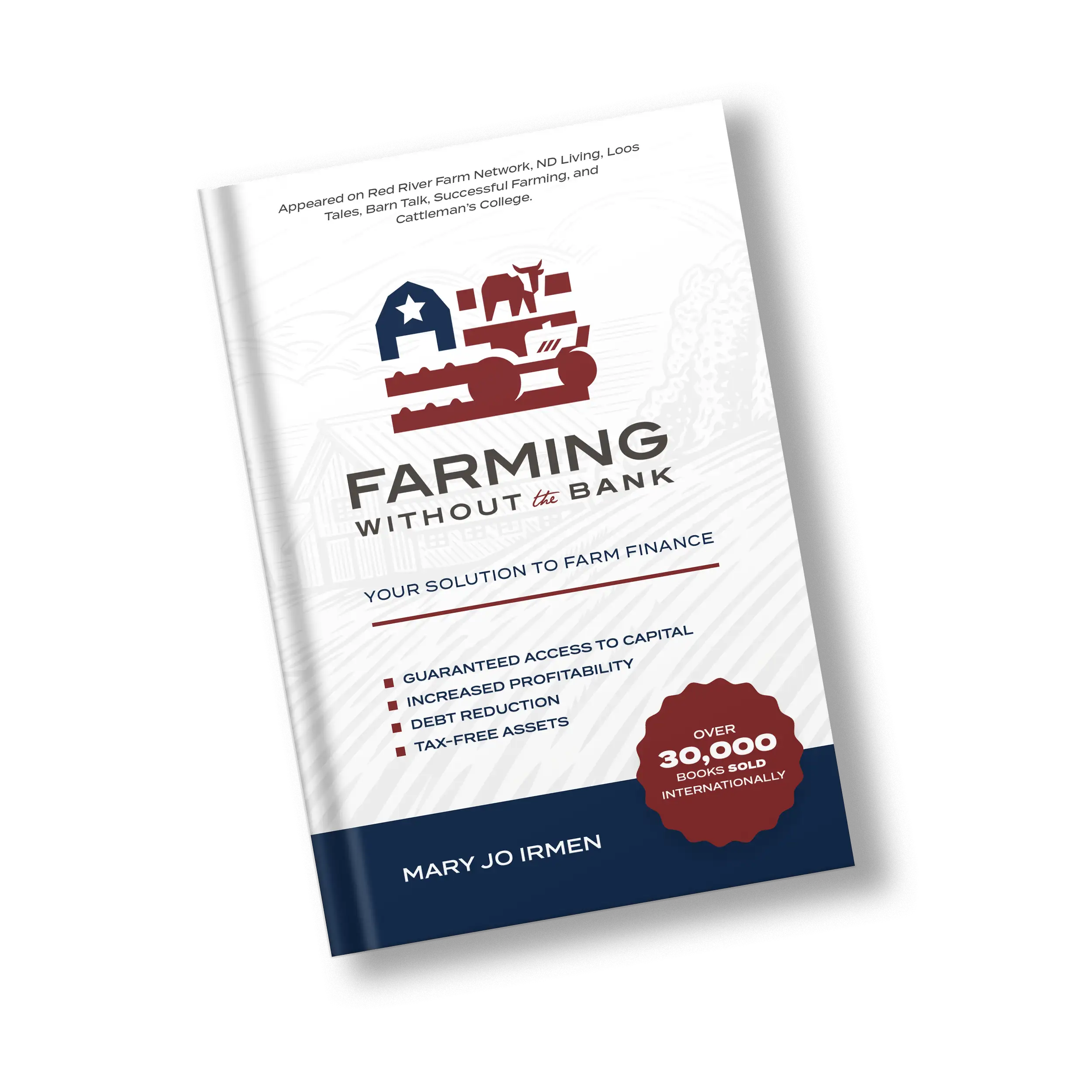
Your farm’s financial independence starts with one book.
30,000 farmers and ranchers have already made the shift. The only question is how long you’ll keep paying interest you could be keeping yourself.