 GET THE BOOK
 GET THE BOOK



Podcast
EP. 322
Ep. 322 – Why Liquidity Beats Paying Off Debt
Oct 3, 2025 ·
19 min
0:00 / 18:33
EPISODE OVERVIEW
ABOUT THIS EPISODE
Cattle checks look big with the current cattle prices, so why are so many farmers and ranchers still getting squeezed by the bank with farm loans?
Because paying everything off kills your liquidity and hands control back to the lender. Let’s fix that.
Here's a look into the complexities of farm finance and why banks often limit farmers to three years of operating debt.
Understanding debt management is critical for farmers navigating the current agricultural finance landscape. This video offers insights for farmers seeking to improve their farm management practices.
In this episode, Mary Jo breaks down how to utilize money (not just spend or “pay it off”) so you keep control through tough years.
We walk through real-world ranch scenarios: a $100k calf check, 9% side-by-side loans, operating at 9%, banks dragging their feet on bull purchases, and the hard line many banks draw after three years of termed-out operating.
You’ll learn why keeping cash liquid can beat extra principal payments, when fixed rates make sense, and how “one pool of money” thinking (including infinite banking) helps you plan for 3–4 lean years without hitting the panic button.
🔑 Key Takeaways
- Liquidity outweighs extra principal: don’t pay off notes if it forces you back to a 9% operating line.
- “One pool of money” mindset: location of dollars matters less than control of dollars.
- Operating notes often carry the highest rate and the tightest terms—prioritize flexibility.
- Many banks tolerate only about 3 years of termed-out operating before pushing hard measures.
- Consider fixed-rate land notes for peace of mind; you can always refinance if rates drop.
- If ROI is more than the loan rate (e.g., competent sell-buy cattle marketing at 25–35%), keep the debt and deploy cash.
- Plan in 3–4 year cycles; align payments, operating needs, and cash-in from calf sales.
👉 Grab the book, then schedule your strategy session to map your 3–4 year liquidity plan and stop letting the bank run your ranch.
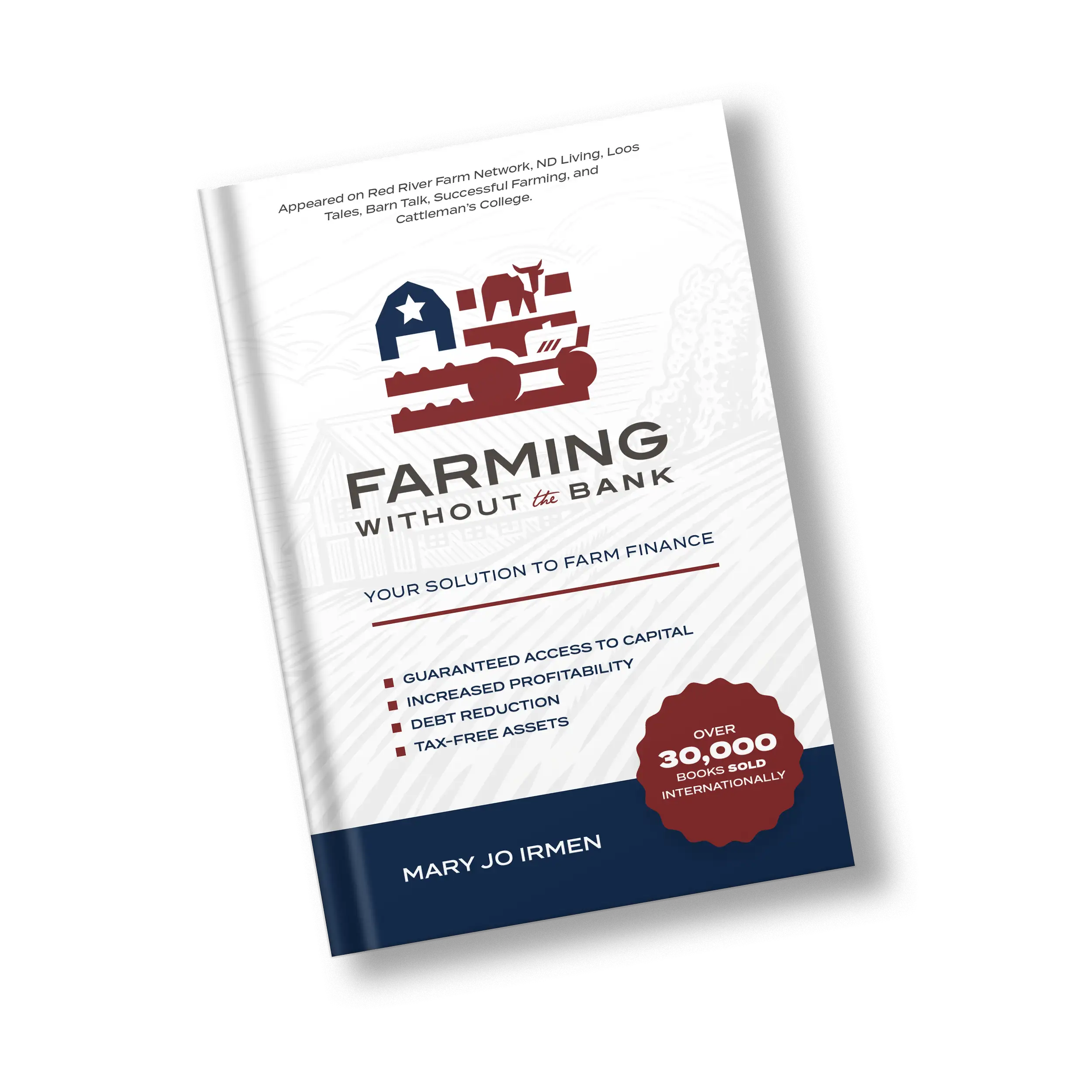
Book: Farming Without the Bank
Read the book, then schedule a call.
Email Mary Jo: maryjo@withoutthebank.com
CHAPTER TIMESTAMPS
- 00:00The 3-year "term-out" cliff on operating notes
- 01:01Welcome + today's topic: how to utilize money
- 01:38Cash flow obsession (for good reason)
- 01:51Cattle guys have cash, now what?
- 02:23The urge to pay everything off (and why it backfires)
- 03:53Banker delays & why liquidity beats permission
- 04:32Rates at 6–9%: what to actually pay
- 05:11The $100k calf check example (don't give it all to the bank)
- 06:05Keep cash for operating; borrow less later
- 07:119% side-by-side vs 9% LOC: same rate, different control
- 08:08"One pool of money," explained
- 09:26Operating on cash vs buying land—hidden 9% cost
- 10:19Think in 4–5 year plans, not one-off payments
- 11:09Operating notes = highest strain + annual payoff pressure
- 11:31Most banks won't term out operating beyond ~3 years
- 12:37Year three decision point: quit or keep going?
- 13:05What to pay (and what not to overpay)
- 14:00ROI greater than 9%? Then don't rush to pay off
- 14:53Fixed vs variable: lock it in and sleep at night
- 16:28Lessons learned: moving from variable to fixed
- 17:01Infinite banking = using money correctly
- 17:32"I found your premium": funding policies by re-routing cash
- 18:09How to work with me + next steps
YOUTUBE EPISODE
TRANSCRIPTION
"I have never talked to anybody that has had more than 3 years of operating termed out. I don't know if it's an unwritten rule. I'm assuming the banks—it's too much risk for them that if we do not pay our operating and we have to carry that forward and we have to term that out on a 10-year note. Three years of that and we're calling bankruptcy. The bank's going to start calling land, doing whatever they need to do. People are going to quit farming at year four. That's exactly what I'm seeing happening right now. I talked to a couple bankers in this last week. I've heard people talking about it as well. Even my own existing clients are talking about, hey, we're in the third bad year. This is it. We're either done or we're going to keep going. If we can control and have some of that money liquid, we can plan for a three- to four-year period and then hopefully commodity prices come back."
Hello. Hello and welcome back to the podcast. Thank you very much for being here today. Let's talk about how to utilize money. This is something that we probably don't talk about enough.
Not everybody totally understands the thought process. I know that I have talked about it a little bit in the past, but I have talked about it a lot with potential clients in the last couple of weeks. And I'm going to use just one case that I've had because it or a couple cases I've had because it might make more sense to you. Now, if I have to get a whiteboard and draw it all out, I'll do that. But let's start here and see how it goes.
Okay? So, when I talk about I'm always talking about cash flow, right? We have to—we have to produce cash flow. We have to produce cash flow. Well, who's got some cash flow right now?
The cattle guys, right? They're going to You guys are going to sell calves. Cattle prices are at an all-time high. And so, what are we going to do with this excess money that we have? And I am seeing and talking to a lot of people that are like, "Oh, I'm going to pay off the side-by-side.
I'm going to pay off that land note. I'm going to pay off my vehicle payment. I'm going to pay off credit cards." And some of those things are great. We want to pay some of those things off, but not everything should be paid off. So, hear me out.
Those of you that are like the debt-free, that's what makes me sleep at night. That's what makes me feel good. We need to have a conversation about utilizing money and think that through long term, not just how does that going to make you feel today. So, here's an example. I had a guy last week that's like, "Mary Jo, I don't have any money.
I don't ever have any cash. The bank is causing me problems." And the bank was pulling, they were just pulling strings because they could in this situation. The guy did not have a ton of things paid off. Like he doesn't have a ton of debt, don't get me wrong, but when he needed a loan, and here was his example, he needed them to advance him operating so that he could go buy two bulls. Well, by the time the sale was over, they advanced him the money after I shouldn't say it that way.
They advanced him the money after the sale was over and said, "Okay, yep, you're approved." No, no, no. We don't—we can't wait 24 hours or 48 hours to decide if we can buy a bull or not. The sale is this day. Okay? We have to know if we can be bidding on that bull that day while we're in the sale barn.
And so when the banker is playing games like that, what becomes important is liquid money that we have control of. So in his situation, he's going to have he's going to sell calves and he's going to have a lot of money coming in, more money than normal. So, in his head, he's like, "I'm going to take all of this money and I'm going to pay off all these loans," which would then leave him with no liquid cash. And the loans weren't like they were like one was 6%, one was 7%, like they were up there, but they weren't astronomical loan rates.
So, I said, "Please don't pay those off. when you sell calves, you're going to have I think it was like $100,000 extra. Okay, I said you're going to have $100,000 coming in. Make the payments you need to make. Do not put extra money down. Then that is going to leave you with I don't remember what it was like $40,000 to $60,000 $90,000, whatever the number was.
Let's just say that he for easy sake, Mary Jo, good lord. Let's just say that he sells calves and he has $100,000 coming in and he has $20,000 worth of payments to make. Fantastic. You take the $20,000. That leaves you with $80,000.
People will say, "Well, Mary Jo, let's take that $80,000 and pay all these things off." Why? Why? Because if you pay if you take that $80,000 and you pay off land and equipment and cattle notes and all these other things, you then have no money to operate with. That was his situation. So now he's going back to the bank and asking for an operating note of $80,000 at 8 or 9% interest.
And this is where the bank is controlling him, right? Saying, "Oh, well, I don't I don't know. took me 48 hours to decide if you could buy a bull or not." If he keeps that $80,000 and does not give it to them in payments, then he has it for operating next year. Well, guess what happens next year? He sells calves. And even if the calves are go down in price a little bit, guess what?
He can get paid for the calves. He can make all of his note payments. And then he maybe just has less to operate on cuz his payments are only $20,000. So now he has less money to operate on. So now if he needs to go back to the bank for operating the next year, he can do that.
But he's not going to most likely need to borrow the full $80,000. So if he has to borrow $40,000, then he only has to borrow $40,000 because maybe he has some cash. So, we have to look at how we want to utilize money. I had a somebody yesterday that I talked to and she said, "Okay, well, I we're we can't pay that much in premium right away because we have to sell calves and then we have to pay pay for our feed bill and we have to pay the side-by-side off." And the side-by-side had a 9% interest rate on it.
And I said, "Okay." And they needed to buy a couple bulls. And I said, "Okay, so why don't you pay your premium, put the extra in year one, turn around 10 days later, pay for your feed bill, buy your bulls whenever you need to buy your bulls, whenever the sale is, but do not pay your side-by-side off. Take some of that cash from selling your calves and pay the payment on the side-by-side. I understand it's 9%. But so is your line of credit.
And so if you give them $20,000 to pay off your side-by-side, you now don't have the $20,000. And you're going to go back to your line of credit and borrow it at 9%." It's utilizing money. It's how are we moving that money through our system. That's why I always say it's one pool of money. It frankly doesn't matter where it's at.
I don't care if it's in an IRA. I don't care if it's in a checking account, a savings account, a CD. It's one pool of money. And if we're going to have to if we're going to use money to pay off a note, that's going to leave us with no liquid money, we get to go back to the bank and borrow money again. Why would we do that?
If we can, if they've already given us the loan, I already have the side-by-side loan. I already have the land note. I already have the cattle note. I already have those. I'm making payments on them.
If it's at 4% or 5%, I don't think we're ever going to see rates that low again. I hope I'm wrong. I hope I'm wrong for a buyer standpoint. I don't hope I'm wrong for the economy standpoint. But we're if we're not going to see rates that low anytime soon, even then let's let that rate go.
Let that one float out there. Make your payment on it and use that money to buy more cattle to pay for operating costs that come at 9% because otherwise we're going back to the bank at 9%. It's no different than somebody saying, "Oh, you know what? I'm operating the entire farm on cash. So, I have a million dollar of cash or $2 million of cash that I'm operating the farm on, but there's some ground for sale.
And so I want to buy that ground. So we use the million dollar as a down payment for ground. Now we don't have the million of operating. So now our ground might be paid for. Let's just say we paid cash for it.
So we paid a million of cash for this ground, but then we had to go back to operating. That ground actually cost us 9%. Because if that's what operating's at, it was one pool of money. We just had to. Now we have to go back to operating.
Could have we maybe borrowed money on the land at 7% instead and kept our cash so we could operate on less interest?" Yeah. So we have to think we have to think that through and we need to think it through not just for the year but for long term. And when I say longer term I mean four or five years. If I have a payment on a side-by-side, if I have a mortgage, whatever that looks like, I'm going to say, you know, yes, I'm going to lose some interest, absolutely, but I'm going to gain liquidity and control of money, and I'm not going to have to go back to the bank and ask permission to borrow against that again.
And so, some people get this and some people don't. Some people just want to feel warm and cozy inside that everything's paid off. and we can have everything paid off when we have the surplus that we don't have to leverage the bank. But operating notes, from what I'm seeing, operating notes are causing the biggest financial strain. It's the highest interest rate. It's the thing that has to be paid off every single year.
And if it's not paid off or paid down, they're not going to renew it. They may not let you have it as a revolving line. They're going to amortize it out. And I don't I have never that I'm aware of or that I remember I have never talked to anybody that has had more than three years of operating termed out. It is it I don't know if it's an unwritten rule.
I don't I'm assuming the banks—it's too much risk for them that if we do not pay our operating and we have to carry that forward and we have to term that out on a 10-year note. Three years of that and we're calling bankruptcy, right? We're the bank's going to start calling land, doing whatever they need to do. People are going to quit farming at year four. I think I even mentioned that in my book.
I have to look. But that's exactly what I'm seeing happening right now. I talked to a couple bankers in this last week. I've heard people talking about it as well, either on social media or other people that I talked to talking to people or even my own existing clients are talking about, hey, we're in the third bad year. This is it.
We're either done or we're going to keep going. And so we have to—if we can control and have some of that money liquid, we can plan for a three- to four-year period and then hopefully commodity prices come back or maybe at year three or four we have to go back to the bank for operating. But in the meantime, we've used cash and that's not on our books. And so we have to really think about how we're using our money, what we're paying off, what we're not paying off, why are we paying extra to stuff, because if we're going to pay extra, so in the bad times we don't have that payment, that's still going to lead us back to the bank to borrow money for operating. um or lead us back to the bank to borrow against that mortgage or borrow against that land we have paid off because now we need it.
Sometimes it makes sense to pay it off. Sometimes it does not. In these scenarios, everybody I've talked to, it's a matter of just walking them off the ledge to make them feel good that it's paid off, but they literally have to turn around and go back to the bank to borrow money. There is no reason to pay that off. And in this one scenario that the I don't like 9% loan rates, but if we can make money more than 9% you if I can take that $20,000 and make a higher rate of return on it somewhere else, then I'm going to leave that 9% where it's at.
So in their case, they're doing some sell-buy marketing for cattle. And so once they go to Doug's class and if they do it correctly, I know that they're going to have a built-in profit margin of anywhere between 25 to 35% return. Well, that is then let's just leave the side-by-side out there at 9%. Maybe we can see if we can refinance it at a lower rate. There's a lot of things that we can do that way as well.
I know. I talked to my banker last week because I have a five-year renewal on one of my land notes and he said, "Well, let's just get all the finances started and then we'll talk about, you know, we can renew the loan or refigure it or whatever." And I said, "Okay, well, what's a fixed rate right now?" Cuz I think the rate he gave me was like 6.5% or 6.75% or something. And I said, "Well, what's a locked-in rate right now?" And he's like, "Oh, well, if rates go down, you're going to want one that's not locked in." And I said, "I can just refinance." He's like, "Well, yeah, we'll talk about that later." Yes, we will.
Yes, we will, Brian. Love him. Super super nice guy, but I don't like where I'm at right now. Nobody offered me a locked in rate. I made a mistake and was not smart enough to ask for that because of all the clients I've ever worked with.
I had a brain fart. I just didn't think about having a locked-in 25-year note. I was thinking commercial and I've never been offered a commercial note that was locked in for 25 years. So, my bad. I made a stupid mistake which now I get to share with you guys cuz my new land note that I have, I lock that sucker in for 25 years.
That's not variable because I'll just refinance it if I need to. And the banks obviously don't like that and they think, oh, rates are going to go higher, so let's leave it variable. Or maybe they think, well, it's going to save you some money. I don't really know what they're thinking. I just should have never did a variable rate.
Stupid me. So now I'm going from about 4.76% to 6.75%, but I want it locked in. Typically a variable rate will be just a little bit less. So that's kind of how they sell you on it, but I want some peace of mind there that I'm not going to have to adjust. And I'm running—I'm running across a lot of people that have those adjustable rates.
And so now we're seeing it jump up. our land payment's going to be more all that good stuff. Anyway, that was a—that was a bit of a rabbit hole squirrel. Um, so think about how you're utilizing money because a lot of what infinite banking is thinking about utilizing money correctly. When we really start to look at how wealthy people utilize their money, it is not by paying things off and being debt-free. So, we have to be smart about how we do those things and which one is going to be the best method.
And those are all the things that I work with my clients on, right? We want to figure out a lot of people will say, "Well, Mary Jo, I don't even know where this money is going to come from for premium." Well, I may, right? Because my brain is looking at using money differently than your brain. And so I found money for this guy to start a policy because we're not going to pay things off. And in his head, he was like, "Well, I'm not be able to start a policy." Yeah, you will.
We're not going to be astronomically huge about it, but you will be able to start a policy. All is going to be fantastic and great. We just need to figure out where the money is going and how the cash is flowing through. So, let me know if you guys have questions, comments, concerns. Otherwise, grab your book, schedule your appointment, and let me know how I can help.
All right, you have a fantastic rest of your day.
View MoreHello. Hello and welcome back to the podcast. Thank you very much for being here today. Let's talk about how to utilize money. This is something that we probably don't talk about enough.
Not everybody totally understands the thought process. I know that I have talked about it a little bit in the past, but I have talked about it a lot with potential clients in the last couple of weeks. And I'm going to use just one case that I've had because it or a couple cases I've had because it might make more sense to you. Now, if I have to get a whiteboard and draw it all out, I'll do that. But let's start here and see how it goes.
Okay? So, when I talk about I'm always talking about cash flow, right? We have to—we have to produce cash flow. We have to produce cash flow. Well, who's got some cash flow right now?
The cattle guys, right? They're going to You guys are going to sell calves. Cattle prices are at an all-time high. And so, what are we going to do with this excess money that we have? And I am seeing and talking to a lot of people that are like, "Oh, I'm going to pay off the side-by-side.
I'm going to pay off that land note. I'm going to pay off my vehicle payment. I'm going to pay off credit cards." And some of those things are great. We want to pay some of those things off, but not everything should be paid off. So, hear me out.
Those of you that are like the debt-free, that's what makes me sleep at night. That's what makes me feel good. We need to have a conversation about utilizing money and think that through long term, not just how does that going to make you feel today. So, here's an example. I had a guy last week that's like, "Mary Jo, I don't have any money.
I don't ever have any cash. The bank is causing me problems." And the bank was pulling, they were just pulling strings because they could in this situation. The guy did not have a ton of things paid off. Like he doesn't have a ton of debt, don't get me wrong, but when he needed a loan, and here was his example, he needed them to advance him operating so that he could go buy two bulls. Well, by the time the sale was over, they advanced him the money after I shouldn't say it that way.
They advanced him the money after the sale was over and said, "Okay, yep, you're approved." No, no, no. We don't—we can't wait 24 hours or 48 hours to decide if we can buy a bull or not. The sale is this day. Okay? We have to know if we can be bidding on that bull that day while we're in the sale barn.
And so when the banker is playing games like that, what becomes important is liquid money that we have control of. So in his situation, he's going to have he's going to sell calves and he's going to have a lot of money coming in, more money than normal. So, in his head, he's like, "I'm going to take all of this money and I'm going to pay off all these loans," which would then leave him with no liquid cash. And the loans weren't like they were like one was 6%, one was 7%, like they were up there, but they weren't astronomical loan rates.
So, I said, "Please don't pay those off. when you sell calves, you're going to have I think it was like $100,000 extra. Okay, I said you're going to have $100,000 coming in. Make the payments you need to make. Do not put extra money down. Then that is going to leave you with I don't remember what it was like $40,000 to $60,000 $90,000, whatever the number was.
Let's just say that he for easy sake, Mary Jo, good lord. Let's just say that he sells calves and he has $100,000 coming in and he has $20,000 worth of payments to make. Fantastic. You take the $20,000. That leaves you with $80,000.
People will say, "Well, Mary Jo, let's take that $80,000 and pay all these things off." Why? Why? Because if you pay if you take that $80,000 and you pay off land and equipment and cattle notes and all these other things, you then have no money to operate with. That was his situation. So now he's going back to the bank and asking for an operating note of $80,000 at 8 or 9% interest.
And this is where the bank is controlling him, right? Saying, "Oh, well, I don't I don't know. took me 48 hours to decide if you could buy a bull or not." If he keeps that $80,000 and does not give it to them in payments, then he has it for operating next year. Well, guess what happens next year? He sells calves. And even if the calves are go down in price a little bit, guess what?
He can get paid for the calves. He can make all of his note payments. And then he maybe just has less to operate on cuz his payments are only $20,000. So now he has less money to operate on. So now if he needs to go back to the bank for operating the next year, he can do that.
But he's not going to most likely need to borrow the full $80,000. So if he has to borrow $40,000, then he only has to borrow $40,000 because maybe he has some cash. So, we have to look at how we want to utilize money. I had a somebody yesterday that I talked to and she said, "Okay, well, I we're we can't pay that much in premium right away because we have to sell calves and then we have to pay pay for our feed bill and we have to pay the side-by-side off." And the side-by-side had a 9% interest rate on it.
And I said, "Okay." And they needed to buy a couple bulls. And I said, "Okay, so why don't you pay your premium, put the extra in year one, turn around 10 days later, pay for your feed bill, buy your bulls whenever you need to buy your bulls, whenever the sale is, but do not pay your side-by-side off. Take some of that cash from selling your calves and pay the payment on the side-by-side. I understand it's 9%. But so is your line of credit.
And so if you give them $20,000 to pay off your side-by-side, you now don't have the $20,000. And you're going to go back to your line of credit and borrow it at 9%." It's utilizing money. It's how are we moving that money through our system. That's why I always say it's one pool of money. It frankly doesn't matter where it's at.
I don't care if it's in an IRA. I don't care if it's in a checking account, a savings account, a CD. It's one pool of money. And if we're going to have to if we're going to use money to pay off a note, that's going to leave us with no liquid money, we get to go back to the bank and borrow money again. Why would we do that?
If we can, if they've already given us the loan, I already have the side-by-side loan. I already have the land note. I already have the cattle note. I already have those. I'm making payments on them.
If it's at 4% or 5%, I don't think we're ever going to see rates that low again. I hope I'm wrong. I hope I'm wrong for a buyer standpoint. I don't hope I'm wrong for the economy standpoint. But we're if we're not going to see rates that low anytime soon, even then let's let that rate go.
Let that one float out there. Make your payment on it and use that money to buy more cattle to pay for operating costs that come at 9% because otherwise we're going back to the bank at 9%. It's no different than somebody saying, "Oh, you know what? I'm operating the entire farm on cash. So, I have a million dollar of cash or $2 million of cash that I'm operating the farm on, but there's some ground for sale.
And so I want to buy that ground. So we use the million dollar as a down payment for ground. Now we don't have the million of operating. So now our ground might be paid for. Let's just say we paid cash for it.
So we paid a million of cash for this ground, but then we had to go back to operating. That ground actually cost us 9%. Because if that's what operating's at, it was one pool of money. We just had to. Now we have to go back to operating.
Could have we maybe borrowed money on the land at 7% instead and kept our cash so we could operate on less interest?" Yeah. So we have to think we have to think that through and we need to think it through not just for the year but for long term. And when I say longer term I mean four or five years. If I have a payment on a side-by-side, if I have a mortgage, whatever that looks like, I'm going to say, you know, yes, I'm going to lose some interest, absolutely, but I'm going to gain liquidity and control of money, and I'm not going to have to go back to the bank and ask permission to borrow against that again.
And so, some people get this and some people don't. Some people just want to feel warm and cozy inside that everything's paid off. and we can have everything paid off when we have the surplus that we don't have to leverage the bank. But operating notes, from what I'm seeing, operating notes are causing the biggest financial strain. It's the highest interest rate. It's the thing that has to be paid off every single year.
And if it's not paid off or paid down, they're not going to renew it. They may not let you have it as a revolving line. They're going to amortize it out. And I don't I have never that I'm aware of or that I remember I have never talked to anybody that has had more than three years of operating termed out. It is it I don't know if it's an unwritten rule.
I don't I'm assuming the banks—it's too much risk for them that if we do not pay our operating and we have to carry that forward and we have to term that out on a 10-year note. Three years of that and we're calling bankruptcy, right? We're the bank's going to start calling land, doing whatever they need to do. People are going to quit farming at year four. I think I even mentioned that in my book.
I have to look. But that's exactly what I'm seeing happening right now. I talked to a couple bankers in this last week. I've heard people talking about it as well, either on social media or other people that I talked to talking to people or even my own existing clients are talking about, hey, we're in the third bad year. This is it.
We're either done or we're going to keep going. And so we have to—if we can control and have some of that money liquid, we can plan for a three- to four-year period and then hopefully commodity prices come back or maybe at year three or four we have to go back to the bank for operating. But in the meantime, we've used cash and that's not on our books. And so we have to really think about how we're using our money, what we're paying off, what we're not paying off, why are we paying extra to stuff, because if we're going to pay extra, so in the bad times we don't have that payment, that's still going to lead us back to the bank to borrow money for operating. um or lead us back to the bank to borrow against that mortgage or borrow against that land we have paid off because now we need it.
Sometimes it makes sense to pay it off. Sometimes it does not. In these scenarios, everybody I've talked to, it's a matter of just walking them off the ledge to make them feel good that it's paid off, but they literally have to turn around and go back to the bank to borrow money. There is no reason to pay that off. And in this one scenario that the I don't like 9% loan rates, but if we can make money more than 9% you if I can take that $20,000 and make a higher rate of return on it somewhere else, then I'm going to leave that 9% where it's at.
So in their case, they're doing some sell-buy marketing for cattle. And so once they go to Doug's class and if they do it correctly, I know that they're going to have a built-in profit margin of anywhere between 25 to 35% return. Well, that is then let's just leave the side-by-side out there at 9%. Maybe we can see if we can refinance it at a lower rate. There's a lot of things that we can do that way as well.
I know. I talked to my banker last week because I have a five-year renewal on one of my land notes and he said, "Well, let's just get all the finances started and then we'll talk about, you know, we can renew the loan or refigure it or whatever." And I said, "Okay, well, what's a fixed rate right now?" Cuz I think the rate he gave me was like 6.5% or 6.75% or something. And I said, "Well, what's a locked-in rate right now?" And he's like, "Oh, well, if rates go down, you're going to want one that's not locked in." And I said, "I can just refinance." He's like, "Well, yeah, we'll talk about that later." Yes, we will.
Yes, we will, Brian. Love him. Super super nice guy, but I don't like where I'm at right now. Nobody offered me a locked in rate. I made a mistake and was not smart enough to ask for that because of all the clients I've ever worked with.
I had a brain fart. I just didn't think about having a locked-in 25-year note. I was thinking commercial and I've never been offered a commercial note that was locked in for 25 years. So, my bad. I made a stupid mistake which now I get to share with you guys cuz my new land note that I have, I lock that sucker in for 25 years.
That's not variable because I'll just refinance it if I need to. And the banks obviously don't like that and they think, oh, rates are going to go higher, so let's leave it variable. Or maybe they think, well, it's going to save you some money. I don't really know what they're thinking. I just should have never did a variable rate.
Stupid me. So now I'm going from about 4.76% to 6.75%, but I want it locked in. Typically a variable rate will be just a little bit less. So that's kind of how they sell you on it, but I want some peace of mind there that I'm not going to have to adjust. And I'm running—I'm running across a lot of people that have those adjustable rates.
And so now we're seeing it jump up. our land payment's going to be more all that good stuff. Anyway, that was a—that was a bit of a rabbit hole squirrel. Um, so think about how you're utilizing money because a lot of what infinite banking is thinking about utilizing money correctly. When we really start to look at how wealthy people utilize their money, it is not by paying things off and being debt-free. So, we have to be smart about how we do those things and which one is going to be the best method.
And those are all the things that I work with my clients on, right? We want to figure out a lot of people will say, "Well, Mary Jo, I don't even know where this money is going to come from for premium." Well, I may, right? Because my brain is looking at using money differently than your brain. And so I found money for this guy to start a policy because we're not going to pay things off. And in his head, he was like, "Well, I'm not be able to start a policy." Yeah, you will.
We're not going to be astronomically huge about it, but you will be able to start a policy. All is going to be fantastic and great. We just need to figure out where the money is going and how the cash is flowing through. So, let me know if you guys have questions, comments, concerns. Otherwise, grab your book, schedule your appointment, and let me know how I can help.
All right, you have a fantastic rest of your day.
ready to start?
Your farm’s financial independence starts with one book.
30,000 farmers and ranchers have already made the shift. The only question is how long you’ll keep paying interest you could be keeping yourself.