 GET THE BOOK
 GET THE BOOK




Podcast
EP. 321
Ep. 321 – Why You Need More Than One Policy
Sep 26, 2025 ·
18 min
0:00 / 18:03
EPISODE OVERVIEW
ABOUT THIS EPISODE
💡 Why would anyone need more than one life insurance policy? Having multiple life insurance policies can provide more premiums, earning compound interest and dividends, which in turn lead to greater death benefits.
This insurance strategy enhances financial security and builds generational wealth. Effective financial planning utilizes such strategies for long-term wealth building.
In this episode of the Farming Without the Bank Podcast, Mary Jo dives into the real reasons behind starting multiple policies and why it’s not just a nice-to-have, but often necessary for building wealth and avoiding tax traps.
Drawing on lessons from Nelson Nash and her own experience, she explains how multiple policies protect against MEC limits, expand your cash value growth, and help create true generational wealth.
If you’ve ever wondered, “Do I need more than one policy?” this episode is for you.
🔑 What You’ll Learn in This Episode
- Why multiple policies are essential for long-term wealth building
- The role of MECs (Modified Endowment Contracts) and how to avoid them
- How to think about extra interest and premium payments
- The pros and cons of managing multiple policies
- When to start another policy (and when to wait)
📘 Resources & Links
👉 If this episode helped you rethink your financial strategy, don’t forget to like, subscribe, and share this podcast.
Drop your questions in the comments. I may cover them in a future episode!
CHAPTER TIMESTAMPS
- 00:00Why Multiple Policies Matter
- 01:15Nelson Nash’s 49 Policies
- 02:59MEC Rules and the 7-Pay Test
- 05:18Extra Interest vs. Loan Repayment
- 07:36Benefits of Having Multiple Policies
- 09:09Managing Premiums and Multiple Loans
- 11:28The Danger of Staying With Only One Policy
- 13:29Redirecting Paid-Off Debt Into New Policies
- 15:26Planning for Income Fluctuations (Like Cattle Markets)
- 16:40Closing Thoughts & Listener Questions
YOUTUBE EPISODE
TRANSCRIPTION
"What is the benefit of having multiple policies? A, it's necessary because we have the MEC. But when we have multiple policies, we have more premium earning compound interest and dividends. We have more death benefit. We have more generational wealth. And so we really have to kind of look at what are we trying to accomplish. It is very similar to the banking system and saying why do they have one branch over multiple branches? They have multiple branches around town and across states and across the United States because the more money that's being deposited, the more money they can lend out. So, we want to have more money growing for us, creating generational wealth for us because if we just have the one policy, that's it. That's all we have."
Hello. Hello, and welcome back to the podcast. Thank you very much for being here. All right. Today, let's talk about why you need multiple policies.
Somebody messaged me and said, "Hey, Mary Jo, you haven't talked about this." And I don't know that I have. And I don't know that I've talked about when you need an extra policy and when you need to start policy. So, what a great subject for today. Okay. If you have read or listened to anything that Nelson has done, he talks about this probably a lot more than I do.
And I just kind of assume people are going to read Nelson's stuff and so I don't talk about it a lot. But Nelson had 49 life insurance policies. I have colleagues that have many policies. I have I don't know eight or nine something like that. And so as our—as we want to try to get as much money through the policy as we can.
And if you read Becoming Your Own Banker, Nelson talks about that. Get as much of your income through the policy as you can, but he also says it's going to take like 25 years to get there. So, some people read that in the book and they think, well, I'm just going to start a as big a policy as I possibly can right away. Well, typically our income rises, right? And as our income rises, we should be trying to get that through policies.
We can only put so much in a policy without it becoming a modified endowment contract. So let's reverse time and go back to the late '70s, '60s. People would take money and they would just pay a single premium. Okay? anything before like the mid80s you could just and I forget what year the MEC was created the modified endowment contract. Oh, I forget it was like '81, '83 something like that.
And so prior to that we I think it was '81, '83. Anyway, probably should have did my research before I hit record. Regardless, prior to that, we had the ability to stick a single premium into a policy and say, "Hey, we just came into a half a million dollars or we just came into $100,000 and we're going to buy a life insurance policy and that's going to grow income tax-free and we're going to be able to use it income tax-free." And that is not the case today. So the case today is if you have if cash value is accumulating too quickly and there's a seven-pay test that the government you know created and so it would become a modified endowment contract which means that it would grow taxable.
So if we were to go borrow money we're going to have to pay tax on the growth and that's what's going to come out of that policy first. It's a it would be a a last-in, first-out scenario much like an IRA. And so in order to avoid that, we start multiple policies. So as soon as one policy hits that modified endowment contract line, I call it the MEC. As soon as one policy hits that MEC, then we start another policy.
We can't add more money to an existing policy. So now if we have more money we have to start an extra policy. So if we look at what Nelson is talking about we look at what I have in my book and that says hey pay extra interest. So if the if the bank is charging you 10% pay 10% back to yourself. So in Nelson's book specifically I did not do this in my book.
In Nelson's book specifically, if we look at the illustrations that he has with the buying semis and so we're going to buy a semi every year and we're going to add extra. People think, oh, that is me getting my interest back. No, it is you taking your extra interest, the difference between what the insurance company is charging and what you're paying yourself. You are taking that difference and you are putting it into a policy as premium. So people say to me all the time, "Well, Mary Jo, if I'm going to pay extra interest, where does that go?" It goes into the policy as extra premium.
It does not go in as a loan repayment because if you've borrowed $10,000, you can only pay $10,000 back, right? That's all you can put in there. You can't put extra money into in as a loan repayment. That would be like saying to the bank, "Hey, I borrowed $10,000, but I want to pay you $11,000 plus interest." No, they're going to say, "What what are you doing? I don't I'll take your $1,000, but I'll put it into savings as a deposit, right?
Or I'll take it from I'll you can put it into your checking." And so in this scenario, we are saying, "Hey, you're going to pay an extra $1,000 that goes in as a premium payment, not a loan repayment." But if my policy premium is $20,000 a year and I want to pay an extra thousand, can I? Nope. Because it would MEC the policy and it would all grow taxable. We've got too much money in cash value. We broke the seven-pay test for the MEC.
And so now what do we do with that extra $1,000? We're going to start another policy with it. And maybe we'll start, we have to have enough to do that, right? So, we have to have enough income to continue to pay that premium. Some of my clients will just put it in a savings account.
I've paid myself extra interest. The extra interest is going to go to a separate account. Once we have enough in there, we'll start another policy or we'll use it to pay extra year 1 because when I structure my policies, we can put extra premium in year one. Now, what is the benefit of having multiple policies? Well, a it's necessary because we have the MEC, but when we have multiple policies, we have more premium earning compound interest and dividends, right?
We have more death benefit. We have more generational wealth. And so, we really have to kind of look at what are we trying to accomplish. It is very similar to the banking system and saying why do they have one branch over multiple branches. They have multiple branches around town and across states and across the United States because the more money that's being deposited, the more money they can lend out.
So, we want to have more money growing for us, creating generational wealth for us. Because if we just have the one policy, that's it. That's it. That's all we have. That's like saying, I'm going to buy this one piece of ground and I'm going to try I'm going to make as much money as I can, but we're capped, right?
We can't make any more money because we didn't have any more ground. I'm only going to have five head of cattle. I'm not going to have more. Even though I know I could make more, I'm not going to have anymore. And so we are building our banking system.
So we have multiple branches to go to. When we do that, we have to make sure we can pay premium on all of them. We can't just willy-nilly be starting policies and then go, "Oh, well, I have to pay premium on all these and I can't because I got a little overzealous, right? I got—I—I got a little excited and I started more than I should have." And so we have to make sure that we can pay those premiums. The other side of that is we have more policies to manage.
We have more loans to manage. And so we have to make sure that we're keeping good records at that point when we have more than one policy. So, when we're starting with one policy, it's a lot easier because it's one to manage. If it's a husband and a wife, typically I start with two. I'll do 50% on the husband, 50% on the wife.
That's how I like to do it in most cases. That's not a hard and fast rule, but that's how I like to do it in most cases. And so, now you have two policies to manage. Now, I can tell you I've got, you know, the eight or nine or whatever I have. It's a lot to manage.
I have colleagues that talk about having 50 policies. Uh, no thank you. No thank you. That's my personal objective. I'm not going to start a $1,000 policy.
I'm going to wait until I have enough money to start a decent-sized policy so that I am not constantly managing all these little policies. Okay? In their scenarios, they have wives, cuz let's be honest, the majority of my colleagues are men. They have wives that do not work, and those wives manage the household finances. Those wives are managing those policies.
I don't have a wife, okay? I have a husband that doesn't know how to turn on a computer. And so, I have enough stuff to do. That's what works for me. So you might see people that say, "Oh my god, you need to have 20, 30, 40 policies." Well, what works for them in their household?
There is no steadfast rule about how a policy should be structured. There's no steadfast rule about when to start another policy. There's no steadfast rule about how many policies you need. It is about what works for you. Now, there are a lot of people that only have one policy.
They didn't—they started a bank, but they didn't keep the banking system up. They're not going to have this excessive growth. They're not going to have a ton of money to put through a retire—or to use at retirement. And here's something to think about. It's like saying, "Hey, I'm going to contribute 3% to my 401(k), but I'm never going to increase that.
I'm never going to put more money away to save. I just hope that that keeps up with inflation." And that's not going to be the case. And so if we want to get away from the banking system and we want to make the bank plan B, then we do need multiple policies and multiple systems and we need to start moving that money through. What that looks like, how that's going to work, that's all the stuff that I'm going to go through with you. If you're a client, you're like, "Oh, do I start another policy?
Do I not start another policy?" I go over all of that stuff with our clients. We revisit finances. We look at where money is going. all of that stuff. Can we redirect dollars? Did we pay off a note that we were used to paying and now can that money go through a life insurance policy?
A lot of people will say, "No, I just got done making that $100,000 land payment. I don't want that going through a policy because I finally am going to have money." Yes, you're going to have it anyway, even if we put it in a policy. Remember, you have access to money in 10 days. You're going to have access to about 70% of your money in 10 days. So, we can look at that and go, "Oh, can we run that through the system, start capitalizing?" Because before it was gone.
It was $100,000 completely gone to the bank. Now we're putting it in a policy earning compound interest dividends and creating some generational wealth with it. So do—should we have multiple policies? Yes. But in order to get multiple policies, we have to have more income and we have to beat—we have to beat Parkinson's law, right?
We have to look at what we're doing and how we're funneling money and utilizing money. So I don't know that I have a whole lot extra to add to that. Multiple policies should just—everybody should have them unless your income has stayed stagnant or has gone down. Most people are paying stuff off along the way. They've got more income coming in.
They should have multiple policies. I have met with a lot of people in the last year, existing clients that we have not been able to start policies. They want to start policies, but we're right on the verge. Like, we're going to need to wait another year or two because we've got other plans, something else going on. Everybody's got different circumstance.
And so, if you are an existing client, make sure that you're setting up your meeting with me because you have access to me whenever you want. And so, make sure you're setting up that time with me so that we can visit about do you start another policy? Think—start thinking about what have I paid off? Where am I? How is money flowing through the system that we can get that started?
We can maybe start another one. But multiple policies just make you more money and we can't do it all in one. And so when people I had this happen just yesterday. Somebody said, "Well, that's not going to get us where we need to go fast enough, so we need to do more premium." And I said, "I understand that that is your goal, but where is the money going to come from to do more premium? I'm not seeing it." And so, we're going to have to start a policy maybe in a year or two when finances are a little bit in a better position.
Then we can start more policies. And so, some people want to do it all at once and they're excited about it. And I like that and I appreciate that. But I'm also wanting to make sure that we're not making things worse and that we're not causing you to lose sleep at night. So for those particular people, we had to pull back the reins a little bit and say, "You'll still get there, but we're not going to get there overnight because where is the money coming from to pay that every year?" Especially the situation that they were in where they were all cattle.
And so if it's a cattle income, I am preparing right now for the downturn in the cattle market because nothing stays up forever. Nothing. So I want to make sure that we're setting this up with worst case scenario in mind that oh hey, we've got a cattle market that's going to drop. All the other finances of what's happening were questionable and so let's just play it safe for now and make sure. Could have I sold a bigger policy?
Absolutely. Could have been a better bank. Absolutely. But we want to make sure that we can pay that premium. So, there's that.
Let me know if you guys have other questions or any other topics that you've not heard me talk about that you want to hear me talk about cuz I'm absolutely happy to do that. I like suggestions. Even if I've talked about it, I might say, "Yeah, I thought I talked about that." But happy to do it again if I haven't just talked about it because, you know, I've got what 300 and some podcasts. I don't know. I've lost count.
I don't count. I've got a ton of podcasts and I don't remember what I've talked about in the past and I don't have a spreadsheet tracking it. And sometimes repetition is the best way to learn. So, let me know if you want to hear anything. maryjo@withoutthebank.com. If you've not got your book yet, get your book.
Schedule your appointment. I am only booked out like five weeks or something. It's awesome. You guys can get in a lot sooner. Six weeks, a lot sooner than you used to be able to get in.
So, that's good. I am not traveling as much and I'm not having to be gone as much. So, things are looking good for you guys. Enough time to get the book, schedule your appointment, read the book, and then we can meet. All right.
You let me know if there's anything else you want me to talk about. If there's any other way I can help you. Happy to do that. But you have a fantastic rest of your day.
Thanks for listening to the Farming Without the Bank podcast. We hope today's episode has inspired you to take control of your finances in new ways. Don't forget to check out our website, farmingwithoutthebank.com, and engage with us on our Facebook page, Farming Without the Bank. Join us next week as we smash more financial myths and empower you to accomplish your financial goals.
View MoreHello. Hello, and welcome back to the podcast. Thank you very much for being here. All right. Today, let's talk about why you need multiple policies.
Somebody messaged me and said, "Hey, Mary Jo, you haven't talked about this." And I don't know that I have. And I don't know that I've talked about when you need an extra policy and when you need to start policy. So, what a great subject for today. Okay. If you have read or listened to anything that Nelson has done, he talks about this probably a lot more than I do.
And I just kind of assume people are going to read Nelson's stuff and so I don't talk about it a lot. But Nelson had 49 life insurance policies. I have colleagues that have many policies. I have I don't know eight or nine something like that. And so as our—as we want to try to get as much money through the policy as we can.
And if you read Becoming Your Own Banker, Nelson talks about that. Get as much of your income through the policy as you can, but he also says it's going to take like 25 years to get there. So, some people read that in the book and they think, well, I'm just going to start a as big a policy as I possibly can right away. Well, typically our income rises, right? And as our income rises, we should be trying to get that through policies.
We can only put so much in a policy without it becoming a modified endowment contract. So let's reverse time and go back to the late '70s, '60s. People would take money and they would just pay a single premium. Okay? anything before like the mid80s you could just and I forget what year the MEC was created the modified endowment contract. Oh, I forget it was like '81, '83 something like that.
And so prior to that we I think it was '81, '83. Anyway, probably should have did my research before I hit record. Regardless, prior to that, we had the ability to stick a single premium into a policy and say, "Hey, we just came into a half a million dollars or we just came into $100,000 and we're going to buy a life insurance policy and that's going to grow income tax-free and we're going to be able to use it income tax-free." And that is not the case today. So the case today is if you have if cash value is accumulating too quickly and there's a seven-pay test that the government you know created and so it would become a modified endowment contract which means that it would grow taxable.
So if we were to go borrow money we're going to have to pay tax on the growth and that's what's going to come out of that policy first. It's a it would be a a last-in, first-out scenario much like an IRA. And so in order to avoid that, we start multiple policies. So as soon as one policy hits that modified endowment contract line, I call it the MEC. As soon as one policy hits that MEC, then we start another policy.
We can't add more money to an existing policy. So now if we have more money we have to start an extra policy. So if we look at what Nelson is talking about we look at what I have in my book and that says hey pay extra interest. So if the if the bank is charging you 10% pay 10% back to yourself. So in Nelson's book specifically I did not do this in my book.
In Nelson's book specifically, if we look at the illustrations that he has with the buying semis and so we're going to buy a semi every year and we're going to add extra. People think, oh, that is me getting my interest back. No, it is you taking your extra interest, the difference between what the insurance company is charging and what you're paying yourself. You are taking that difference and you are putting it into a policy as premium. So people say to me all the time, "Well, Mary Jo, if I'm going to pay extra interest, where does that go?" It goes into the policy as extra premium.
It does not go in as a loan repayment because if you've borrowed $10,000, you can only pay $10,000 back, right? That's all you can put in there. You can't put extra money into in as a loan repayment. That would be like saying to the bank, "Hey, I borrowed $10,000, but I want to pay you $11,000 plus interest." No, they're going to say, "What what are you doing? I don't I'll take your $1,000, but I'll put it into savings as a deposit, right?
Or I'll take it from I'll you can put it into your checking." And so in this scenario, we are saying, "Hey, you're going to pay an extra $1,000 that goes in as a premium payment, not a loan repayment." But if my policy premium is $20,000 a year and I want to pay an extra thousand, can I? Nope. Because it would MEC the policy and it would all grow taxable. We've got too much money in cash value. We broke the seven-pay test for the MEC.
And so now what do we do with that extra $1,000? We're going to start another policy with it. And maybe we'll start, we have to have enough to do that, right? So, we have to have enough income to continue to pay that premium. Some of my clients will just put it in a savings account.
I've paid myself extra interest. The extra interest is going to go to a separate account. Once we have enough in there, we'll start another policy or we'll use it to pay extra year 1 because when I structure my policies, we can put extra premium in year one. Now, what is the benefit of having multiple policies? Well, a it's necessary because we have the MEC, but when we have multiple policies, we have more premium earning compound interest and dividends, right?
We have more death benefit. We have more generational wealth. And so, we really have to kind of look at what are we trying to accomplish. It is very similar to the banking system and saying why do they have one branch over multiple branches. They have multiple branches around town and across states and across the United States because the more money that's being deposited, the more money they can lend out.
So, we want to have more money growing for us, creating generational wealth for us. Because if we just have the one policy, that's it. That's it. That's all we have. That's like saying, I'm going to buy this one piece of ground and I'm going to try I'm going to make as much money as I can, but we're capped, right?
We can't make any more money because we didn't have any more ground. I'm only going to have five head of cattle. I'm not going to have more. Even though I know I could make more, I'm not going to have anymore. And so we are building our banking system.
So we have multiple branches to go to. When we do that, we have to make sure we can pay premium on all of them. We can't just willy-nilly be starting policies and then go, "Oh, well, I have to pay premium on all these and I can't because I got a little overzealous, right? I got—I—I got a little excited and I started more than I should have." And so we have to make sure that we can pay those premiums. The other side of that is we have more policies to manage.
We have more loans to manage. And so we have to make sure that we're keeping good records at that point when we have more than one policy. So, when we're starting with one policy, it's a lot easier because it's one to manage. If it's a husband and a wife, typically I start with two. I'll do 50% on the husband, 50% on the wife.
That's how I like to do it in most cases. That's not a hard and fast rule, but that's how I like to do it in most cases. And so, now you have two policies to manage. Now, I can tell you I've got, you know, the eight or nine or whatever I have. It's a lot to manage.
I have colleagues that talk about having 50 policies. Uh, no thank you. No thank you. That's my personal objective. I'm not going to start a $1,000 policy.
I'm going to wait until I have enough money to start a decent-sized policy so that I am not constantly managing all these little policies. Okay? In their scenarios, they have wives, cuz let's be honest, the majority of my colleagues are men. They have wives that do not work, and those wives manage the household finances. Those wives are managing those policies.
I don't have a wife, okay? I have a husband that doesn't know how to turn on a computer. And so, I have enough stuff to do. That's what works for me. So you might see people that say, "Oh my god, you need to have 20, 30, 40 policies." Well, what works for them in their household?
There is no steadfast rule about how a policy should be structured. There's no steadfast rule about when to start another policy. There's no steadfast rule about how many policies you need. It is about what works for you. Now, there are a lot of people that only have one policy.
They didn't—they started a bank, but they didn't keep the banking system up. They're not going to have this excessive growth. They're not going to have a ton of money to put through a retire—or to use at retirement. And here's something to think about. It's like saying, "Hey, I'm going to contribute 3% to my 401(k), but I'm never going to increase that.
I'm never going to put more money away to save. I just hope that that keeps up with inflation." And that's not going to be the case. And so if we want to get away from the banking system and we want to make the bank plan B, then we do need multiple policies and multiple systems and we need to start moving that money through. What that looks like, how that's going to work, that's all the stuff that I'm going to go through with you. If you're a client, you're like, "Oh, do I start another policy?
Do I not start another policy?" I go over all of that stuff with our clients. We revisit finances. We look at where money is going. all of that stuff. Can we redirect dollars? Did we pay off a note that we were used to paying and now can that money go through a life insurance policy?
A lot of people will say, "No, I just got done making that $100,000 land payment. I don't want that going through a policy because I finally am going to have money." Yes, you're going to have it anyway, even if we put it in a policy. Remember, you have access to money in 10 days. You're going to have access to about 70% of your money in 10 days. So, we can look at that and go, "Oh, can we run that through the system, start capitalizing?" Because before it was gone.
It was $100,000 completely gone to the bank. Now we're putting it in a policy earning compound interest dividends and creating some generational wealth with it. So do—should we have multiple policies? Yes. But in order to get multiple policies, we have to have more income and we have to beat—we have to beat Parkinson's law, right?
We have to look at what we're doing and how we're funneling money and utilizing money. So I don't know that I have a whole lot extra to add to that. Multiple policies should just—everybody should have them unless your income has stayed stagnant or has gone down. Most people are paying stuff off along the way. They've got more income coming in.
They should have multiple policies. I have met with a lot of people in the last year, existing clients that we have not been able to start policies. They want to start policies, but we're right on the verge. Like, we're going to need to wait another year or two because we've got other plans, something else going on. Everybody's got different circumstance.
And so, if you are an existing client, make sure that you're setting up your meeting with me because you have access to me whenever you want. And so, make sure you're setting up that time with me so that we can visit about do you start another policy? Think—start thinking about what have I paid off? Where am I? How is money flowing through the system that we can get that started?
We can maybe start another one. But multiple policies just make you more money and we can't do it all in one. And so when people I had this happen just yesterday. Somebody said, "Well, that's not going to get us where we need to go fast enough, so we need to do more premium." And I said, "I understand that that is your goal, but where is the money going to come from to do more premium? I'm not seeing it." And so, we're going to have to start a policy maybe in a year or two when finances are a little bit in a better position.
Then we can start more policies. And so, some people want to do it all at once and they're excited about it. And I like that and I appreciate that. But I'm also wanting to make sure that we're not making things worse and that we're not causing you to lose sleep at night. So for those particular people, we had to pull back the reins a little bit and say, "You'll still get there, but we're not going to get there overnight because where is the money coming from to pay that every year?" Especially the situation that they were in where they were all cattle.
And so if it's a cattle income, I am preparing right now for the downturn in the cattle market because nothing stays up forever. Nothing. So I want to make sure that we're setting this up with worst case scenario in mind that oh hey, we've got a cattle market that's going to drop. All the other finances of what's happening were questionable and so let's just play it safe for now and make sure. Could have I sold a bigger policy?
Absolutely. Could have been a better bank. Absolutely. But we want to make sure that we can pay that premium. So, there's that.
Let me know if you guys have other questions or any other topics that you've not heard me talk about that you want to hear me talk about cuz I'm absolutely happy to do that. I like suggestions. Even if I've talked about it, I might say, "Yeah, I thought I talked about that." But happy to do it again if I haven't just talked about it because, you know, I've got what 300 and some podcasts. I don't know. I've lost count.
I don't count. I've got a ton of podcasts and I don't remember what I've talked about in the past and I don't have a spreadsheet tracking it. And sometimes repetition is the best way to learn. So, let me know if you want to hear anything. maryjo@withoutthebank.com. If you've not got your book yet, get your book.
Schedule your appointment. I am only booked out like five weeks or something. It's awesome. You guys can get in a lot sooner. Six weeks, a lot sooner than you used to be able to get in.
So, that's good. I am not traveling as much and I'm not having to be gone as much. So, things are looking good for you guys. Enough time to get the book, schedule your appointment, read the book, and then we can meet. All right.
You let me know if there's anything else you want me to talk about. If there's any other way I can help you. Happy to do that. But you have a fantastic rest of your day.
Thanks for listening to the Farming Without the Bank podcast. We hope today's episode has inspired you to take control of your finances in new ways. Don't forget to check out our website, farmingwithoutthebank.com, and engage with us on our Facebook page, Farming Without the Bank. Join us next week as we smash more financial myths and empower you to accomplish your financial goals.
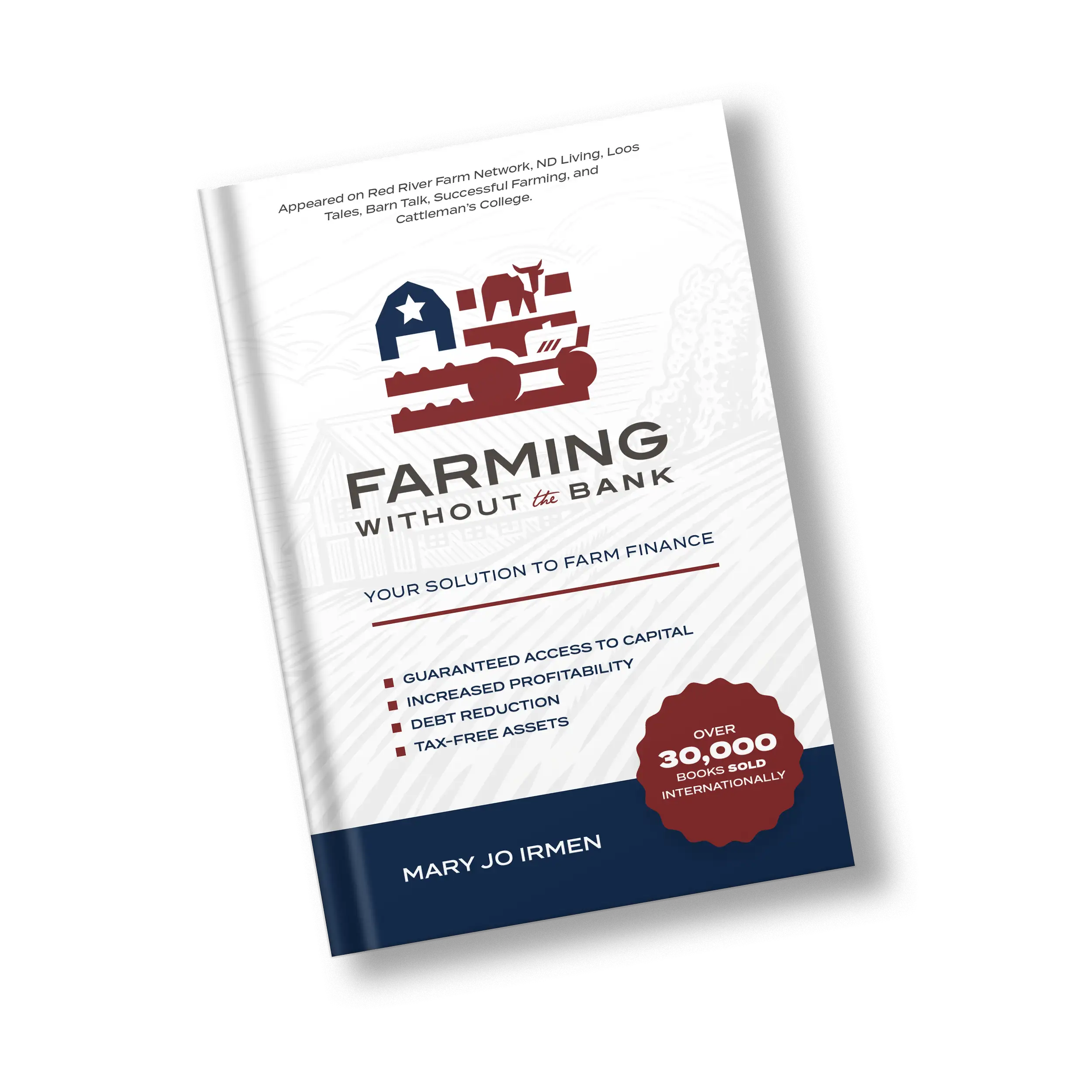
ready to start?
Your farm’s financial independence starts with one book.
30,000 farmers and ranchers have already made the shift. The only question is how long you’ll keep paying interest you could be keeping yourself.