 GET THE BOOK
 GET THE BOOK




Podcast
EP. 318
Ep. 318 – Get Out of Your County (and Your Own Way)
Sep 5, 2025 ·
17 min
0:00 / 16:48
EPISODE OVERVIEW
ABOUT THIS EPISODE
Too many farmers and ranchers limit their success by staying stuck in their own bubble, relying only on local advice, neighbor gossip, and the county coffee shop crew.
In this episode, Mary Jo explains why getting out of your county (and your own way) is critical to building a stronger business, protecting your operation from risk, and learning strategies that actually work.
From drought planning with hay storage to seeing how other regions handle completely different climates, this episode is all about opening your mind, learning from others, and setting yourself up for long-term success.
👉 If you’re serious about farming smarter, not harder, this one’s for you.
Key Takeaways
- Numbers and business fundamentals never change, but strategies do.
- Why learning from farmers outside your county/state gives you an edge.
- The danger of “coffee shop” advice and judgmental attitudes.
- How farm conferences and workshops help build success.
- Infinite banking: why bad examples don’t mean the system doesn’t work.
- Success comes from surrounding yourself with growth-minded people.
If you’re still judging what works based on what your neighbor did (or didn’t do), this episode is for you.
Mary Jo calls out the small-town mindset that keeps farmers stuck, from refusing to leave the county to writing off ideas without understanding them.
She dives into why it’s dangerous to assume something “doesn’t work” when you’ve never asked the right questions, never left your operation, and never learned what others across the country are doing differently.
Whether it’s grazing practices, estate planning, or Infinite Banking, it’s time to stop sitting at the coffee shop and start expanding your thinking. Because if you want to grow, you’ve gotta go. Literally.
(Timestamps are from the video version. Audio-only edits are always shorter since they have had more fluff removed, so the timestamps are not accurate to this version.)
- ✅ Grab the book
- ✅ Read the book…
- ✅ Schedule your appointment today!
- ✅ Follow us on Facebook
CHAPTER TIMESTAMPS
- 00:00The Numbers Don't Change, but Methods Do
- 01:20The Hay Question: Preparing for Drought
- 03:12Why Local-Only Thinking Holds Farmers Back
- 04:06Different States, Different Challenges
- 05:25Learning from Travel and Farm Visits
- 07:01Short-Sighted Farming Mindsets
- 09:02Why You Need to Get Out of Your County
- 11:00Infinite Banking Misconceptions
- 12:18Client Success Stories and Networking
- 13:34Surrounding Yourself with Successful People
- 15:12The Cost of Closed-Mindedness
- 16:23Final Thoughts & Call to Action
YOUTUBE EPISODE
TRANSCRIPTION
“Numbers are the same everywhere. Two plus two equals four. The numbers and the math doesn’t change. Running the business piece doesn’t change. What’s gonna change is maybe how we have to graze, how we have to grow crops. How is somebody else doing it? Has somebody else tried it? You know, I hear a lot of people say, well, this isn’t gonna work because the neighbor tried it and it didn’t work for the neighbor. Okay, so it didn’t work for the neighbor because you’re on the other side of the fence watching from afar. Did you actually talk to the neighbor to see what he did? Who he learned from? Did he have a consultant helping him? What did that all look like? Because if that all was not in place, then how do you know his failure was not due to lack of knowledge? You’re just watching from the other side of the fence saying, oh, that didn’t work. But you still didn’t leave your county. You still didn’t go talk to him. You still didn’t go try to educate yourself.”
Hello, hello, hello, and welcome back to the podcast. Thank you very much for being here. You guys, if you like these podcasts, share them out. That would be super helpful. All right, today, let’s talk about how long has it been since you left your county? Have you visited a farm in another state? Are you looking at what farmers are doing in other states?
And I think that this is interesting because I am seeing some comments and I have people commenting on all kinds of the socials that I’m on and they all act like I’m a complete moron and I don’t know what’s happening and I don’t, you know, like, why are you asking that stupid question? I think they’re like trying to stick me with a, hey, you actually don’t know anything about farming. And so I ask something and I see this a lot, but this is what triggered today’s podcast is I asked a while back on the book of faces and said, hey, how long do you hold over hay? Are you holding it over for a year or two years? Like, how long are you holding over hay? Because I am seeing a lot of people with rotten hay and I’m just wondering, like, why are you spending the time to put that hay up if you’re not gonna actually use it or sell it for them?
Anywho, okay, so I had some lady who commented about how you don’t sell hay or you don’t hold over hay because you make hay every year. And I’m like, well, okay, that sort of makes sense, but like, you got a drought. And so I responded and said, I understand that you make hay every year, but you have to prepare for droughts. And so are you holding hay for just a year or are you selling every bale you have that you don’t need, not preparing for the drought? And then when the drought hits, you’re having to buy it at astronomical prices, right? Like, to me, this was just common sense. And she was kind of snarky in her comment. And she said, oh, I don’t live in an area where there’s drought. We don’t ever have that problem.
And it made me think, there are a lot of people that have a lot of snarky comments. And it’s not just on my socials, it’s on other people’s socials that are online, okay? And in most of the time, it is the people that don’t actually ever post a video. They never post anything. They probably don’t even have a profile picture. And the question becomes, when is the last time you actually left your county to see what the rest of the world is doing? Or are you only getting your information from the coffee shop and what’s happening at the local extension office? Because that’s not how the world works. That’s maybe how it works in your county. That’s maybe how it works in your state.
But even from one side of the state to the other, even if you take a state like North Dakota, the Western side of the state is ranch country, right? We have Badlands. Eastern side of the state is sugar beets. Like, it is 100% different. Eastern side of the state has really good ground. Really, really wet. Western side of the state, super, super dry. And so you have to open your mind and really look at what are other people doing.
And this is something that I had to do very early on. I got a call from somebody down in the South. I think it was like Alabama, Georgia, something like that. And they’re like, yeah, we’re a pretty big farmer. We have 300 acres down here. And I was like, 300 acres, that’s funny. And then I talked and said, 300 acres is really big down there. And I started asking questions. And of course, my mind did not go to, they have hills and trees. And so they can’t just farm everything because of that. We have no hills or trees. And so we have wide open spaces. Thousands and thousands and thousands of acres can be farmed. And 300 acres is a hobby farm here. And so it is not, it’s a matter of like, why do we become so judgmental? And I see this on other people’s socials, is that we think that we know everything because it’s our county information that we know. We’re not actually looking outside and going to visit other counties and seeing other things.
When I was on the Barn Talk podcast, I drove to Iowa. Now, I had a plane ticket. I had a plane ticket. I was like, I’m flying in. Then I figured it out. And I was like, shoot, by the time I fly in, get a rental car, do whatever I need to do, it’s going to cost, it’s going to take just as much time as if I drive. I am so glad that I drove. And now I want to drive everywhere. Because I got to see how they farm in Iowa. I got to get off the interstate. I loved it.
We went from, a friend and I flew into Chicago, and then we went up to the Smokies. We went to Nashville. And then we took all back roads down to Georgia because I spoke at a Georgia Cattlemen’s Convention. It was amazing because I saw all these little farms, what we consider little. I saw all these little operations and their towns just run from one to the other. I didn’t know we were in a new town. There was no space in between. You can’t really see past the ditches, is what I say, because there’s so many trees. It’s very much a different environment. You have to understand the people. You have to understand the way of life. You need to understand the climate. You have to understand the landscape. And a lot of times, we think everything is done like it is in our home.
And I truly feel in agriculture, there are people that don’t want to leave their operation. And that is being very short-sighted. You don’t want to leave your operation. Why? Because nobody can take care of it besides you? Okay, maybe that’s true. You can’t teach somebody to do that. So you can go out and better yourself to understand what other people are doing. In the world of business, I go to events with other business owners. I learn what they’re doing. I learn how they’re marketing. I learn how they’re running their business. I learn how they’re hiring people, how they’re training people. I am learning all of this stuff so I can better run my business to help you.
In the world of agriculture, we have all of these shows. We have like you should be getting together to connect. I frankly don’t care if you even leave for vacation and see the country. Leave for vacation. See the country. Go to a beach. I don’t care if you don’t like beaches. Go to a beach so that you can see that. And a lot of times this younger generation is okay to do that. Like we want to go places. We want to do things. The older generation seems to be the ones that think that you have to work 24-7 because they got their self-worth from staying at home. But now we stayed at home and we become judgmental of what everybody else is doing in the country and we go on to social media and we make comments and we look like a fool.
That person was probably trying to make me look like a fool saying, Hey chick, you don’t know what you’re talking about with farming and ranching. You don’t actually have cattle. So you don’t know anything about it. Okay, so that’s a stupid misunderstanding, right? If that’s what you think, just based on some short videos you’ve seen, because you’ve not listened, another piece of being short-sighted.
We have got to get out of our counties. We should be gathering with other people in agriculture. And that is why things like Ranching for Profit are so nice because now you’re mixed with people from all over the country. If Ranching for Profit is… I know they have a Billings class, for example. So not only people from Montana should be going to Billings. Like you shouldn’t have a bunch of people in that class from Montana. There should be a bunch of people in that class from all over the country to see what other people are doing. Because things like Ranching for Profit are based on numbers.
Numbers are the same everywhere, right? Two plus two equals four. The numbers and the math doesn’t change. The business running, the business piece doesn’t change. What’s going to change is maybe how we have to graze, how we have to grow crops. How is somebody else doing it? Has somebody else tried it? You know, I hear a lot of people say, well, this isn’t going to work because the neighbor tried it. And it didn’t work for the neighbor. Okay, so it didn’t work for the neighbor because you’re on the other side of the fence watching from afar. Did you actually talk to the neighbor to see what he did? Who he learned from? Did he have a consultant helping him? What did that all look like? Because if that all was not in place, then how do you know his failure was not due to lack of knowledge? You’re just watching from the other side of the fence saying, oh, that didn’t work. But you still didn’t leave your county. You still didn’t go talk to him. You still didn’t go try to educate yourself. It’s just mind-boggling to me.
And you might say, Mary Jo, how does this relate to infinite banking? Well, it’s the same thing as infinite banking, right? People say, well, that’s stupid. That’s not going to work. That’s never worked. No, it’s only a 200-year-old product. Of course, it’s not going to work. Yes, it works. So-and-so tried it. It didn’t work. So-and-so used a variable universal life, and they used an agent that didn’t understand how to structure the policy. Right? I talk about this stuff all the time. Bad policies. Constantly. Saw one last week. Did a TikTok about it. I’ll have to do a podcast on it. It is… We have to understand that if we want to get better, we need to do that by educating ourselves, talking to other people, going places, seeing things, doing things.
I have a client-only summit. The first one we had was in 2024. Okay? We’re going to have another one in 2027. And I will have clients from all over the country. This is the funny thing. I had my summit in Texas. The majority of… Not the majority. The biggest group there from a state was North Dakota. I’m right here. They can… Any one of them could have driven two to three hours and seen me. Some of them live right in my own town. And they flew all the way to Texas to learn, to be around other people, that are doing infinite banking, to talk to them about how they’re using their policies, so on and so forth. Learn from other people.
So when we look at why are people successful, why are some people more successful than others? Is it because they’re opening their mind and saying, hey, I want to learn how other people are doing this? I maybe can’t apply it exactly the same, but it can possibly be applied in some shape or form, right? It’s very interesting to me that we, in this, I feel like this industry in particular, we are stewards of our land. We do a really good job with our animals. We care about everything that we’re doing, but we are very judgmental of other people because we have never left the county. And without leaving the county, we don’t even know what’s out there. We don’t know how other people are doing things. And then we become very critical because it is nothing like anybody in our county and who we surround ourselves with. Nothing like they do.
You are who you surround yourself with. If you’re going to surround yourself with a bunch of broke ranchers and farmers, you’re probably going to be broke. If you surround yourself with successful people, you will be successful because you will feed off of one another. I help those. I help a lot of agents that are not in my situation that are coming up in this industry. I help them. I love helping them. But guess what? If you don’t put in the effort, I am done helping you. Your neighbors are going to be the exact same way. They may have talked to you about something and you just poo-pooed it and said, oh, that doesn’t work. And they moved on. And you’re wondering why they don’t want to have a conversation with you. Why are the people successful that are around you? And why are they less judgmental?
I know there are a lot of farm conferences, award banquets, those sort of things. I get asked to speak at a lot of these things. Why are there only certain people there? And I can guarantee you the majority of those people are going to be successful because they do not have a negative mindset. They are not going to comment, well, we don’t hold over any hay because there’s hay every year. No kidding, Sherlock. Thanks for the observation. It was insane how many people commented they hold up. They have enough for a year. They have enough for two years. And I thought, now what does she think as she’s reading these comments? Does she think she’s foolish? Or does she still have the arrival syndrome and think, well, that’s dumb. Why would people do that? Does she even try to understand agriculture in a different state?
Get out of your county. Look at what other people are doing. Talk to other people. Ask questions of other people. Make friends with other people in other states so that you have an open mind and you can say, hey, they’re doing that. That’s working. Why don’t we apply the same thing? And I don’t care if it’s business practices, if it’s practices for planting, harvesting, cattle, estate planning. I don’t care. But if we never do anything, where do we go? Local coffee shop.
Okay, you guys. I beat that dead horse. So let me know if you have comments, questions, concerns. maryjo@withoutthebank.com. Make it a point every year to get off of your place and go to something educational somewhere outside of where you’re at. That’s all I’ll say about that. Go grab the book, schedule your appointment. I’m excited to talk to you or you can talk to John, whichever one of us you choose. But let me know how I can help. You have a fantastic rest of your day.
Thanks for listening to the Farming Without the Bank podcast. We hope today’s episode has inspired you to take control of your finances in new ways. Don’t forget to check out our website, farmingwithoutthebank.com, and engage with us on our Facebook page, Farming Without the Bank. Join us next week as we smash more financial myths and empower you to accomplish your financial goals.
View MoreHello, hello, hello, and welcome back to the podcast. Thank you very much for being here. You guys, if you like these podcasts, share them out. That would be super helpful. All right, today, let’s talk about how long has it been since you left your county? Have you visited a farm in another state? Are you looking at what farmers are doing in other states?
And I think that this is interesting because I am seeing some comments and I have people commenting on all kinds of the socials that I’m on and they all act like I’m a complete moron and I don’t know what’s happening and I don’t, you know, like, why are you asking that stupid question? I think they’re like trying to stick me with a, hey, you actually don’t know anything about farming. And so I ask something and I see this a lot, but this is what triggered today’s podcast is I asked a while back on the book of faces and said, hey, how long do you hold over hay? Are you holding it over for a year or two years? Like, how long are you holding over hay? Because I am seeing a lot of people with rotten hay and I’m just wondering, like, why are you spending the time to put that hay up if you’re not gonna actually use it or sell it for them?
Anywho, okay, so I had some lady who commented about how you don’t sell hay or you don’t hold over hay because you make hay every year. And I’m like, well, okay, that sort of makes sense, but like, you got a drought. And so I responded and said, I understand that you make hay every year, but you have to prepare for droughts. And so are you holding hay for just a year or are you selling every bale you have that you don’t need, not preparing for the drought? And then when the drought hits, you’re having to buy it at astronomical prices, right? Like, to me, this was just common sense. And she was kind of snarky in her comment. And she said, oh, I don’t live in an area where there’s drought. We don’t ever have that problem.
And it made me think, there are a lot of people that have a lot of snarky comments. And it’s not just on my socials, it’s on other people’s socials that are online, okay? And in most of the time, it is the people that don’t actually ever post a video. They never post anything. They probably don’t even have a profile picture. And the question becomes, when is the last time you actually left your county to see what the rest of the world is doing? Or are you only getting your information from the coffee shop and what’s happening at the local extension office? Because that’s not how the world works. That’s maybe how it works in your county. That’s maybe how it works in your state.
But even from one side of the state to the other, even if you take a state like North Dakota, the Western side of the state is ranch country, right? We have Badlands. Eastern side of the state is sugar beets. Like, it is 100% different. Eastern side of the state has really good ground. Really, really wet. Western side of the state, super, super dry. And so you have to open your mind and really look at what are other people doing.
And this is something that I had to do very early on. I got a call from somebody down in the South. I think it was like Alabama, Georgia, something like that. And they’re like, yeah, we’re a pretty big farmer. We have 300 acres down here. And I was like, 300 acres, that’s funny. And then I talked and said, 300 acres is really big down there. And I started asking questions. And of course, my mind did not go to, they have hills and trees. And so they can’t just farm everything because of that. We have no hills or trees. And so we have wide open spaces. Thousands and thousands and thousands of acres can be farmed. And 300 acres is a hobby farm here. And so it is not, it’s a matter of like, why do we become so judgmental? And I see this on other people’s socials, is that we think that we know everything because it’s our county information that we know. We’re not actually looking outside and going to visit other counties and seeing other things.
When I was on the Barn Talk podcast, I drove to Iowa. Now, I had a plane ticket. I had a plane ticket. I was like, I’m flying in. Then I figured it out. And I was like, shoot, by the time I fly in, get a rental car, do whatever I need to do, it’s going to cost, it’s going to take just as much time as if I drive. I am so glad that I drove. And now I want to drive everywhere. Because I got to see how they farm in Iowa. I got to get off the interstate. I loved it.
We went from, a friend and I flew into Chicago, and then we went up to the Smokies. We went to Nashville. And then we took all back roads down to Georgia because I spoke at a Georgia Cattlemen’s Convention. It was amazing because I saw all these little farms, what we consider little. I saw all these little operations and their towns just run from one to the other. I didn’t know we were in a new town. There was no space in between. You can’t really see past the ditches, is what I say, because there’s so many trees. It’s very much a different environment. You have to understand the people. You have to understand the way of life. You need to understand the climate. You have to understand the landscape. And a lot of times, we think everything is done like it is in our home.
And I truly feel in agriculture, there are people that don’t want to leave their operation. And that is being very short-sighted. You don’t want to leave your operation. Why? Because nobody can take care of it besides you? Okay, maybe that’s true. You can’t teach somebody to do that. So you can go out and better yourself to understand what other people are doing. In the world of business, I go to events with other business owners. I learn what they’re doing. I learn how they’re marketing. I learn how they’re running their business. I learn how they’re hiring people, how they’re training people. I am learning all of this stuff so I can better run my business to help you.
In the world of agriculture, we have all of these shows. We have like you should be getting together to connect. I frankly don’t care if you even leave for vacation and see the country. Leave for vacation. See the country. Go to a beach. I don’t care if you don’t like beaches. Go to a beach so that you can see that. And a lot of times this younger generation is okay to do that. Like we want to go places. We want to do things. The older generation seems to be the ones that think that you have to work 24-7 because they got their self-worth from staying at home. But now we stayed at home and we become judgmental of what everybody else is doing in the country and we go on to social media and we make comments and we look like a fool.
That person was probably trying to make me look like a fool saying, Hey chick, you don’t know what you’re talking about with farming and ranching. You don’t actually have cattle. So you don’t know anything about it. Okay, so that’s a stupid misunderstanding, right? If that’s what you think, just based on some short videos you’ve seen, because you’ve not listened, another piece of being short-sighted.
We have got to get out of our counties. We should be gathering with other people in agriculture. And that is why things like Ranching for Profit are so nice because now you’re mixed with people from all over the country. If Ranching for Profit is… I know they have a Billings class, for example. So not only people from Montana should be going to Billings. Like you shouldn’t have a bunch of people in that class from Montana. There should be a bunch of people in that class from all over the country to see what other people are doing. Because things like Ranching for Profit are based on numbers.
Numbers are the same everywhere, right? Two plus two equals four. The numbers and the math doesn’t change. The business running, the business piece doesn’t change. What’s going to change is maybe how we have to graze, how we have to grow crops. How is somebody else doing it? Has somebody else tried it? You know, I hear a lot of people say, well, this isn’t going to work because the neighbor tried it. And it didn’t work for the neighbor. Okay, so it didn’t work for the neighbor because you’re on the other side of the fence watching from afar. Did you actually talk to the neighbor to see what he did? Who he learned from? Did he have a consultant helping him? What did that all look like? Because if that all was not in place, then how do you know his failure was not due to lack of knowledge? You’re just watching from the other side of the fence saying, oh, that didn’t work. But you still didn’t leave your county. You still didn’t go talk to him. You still didn’t go try to educate yourself. It’s just mind-boggling to me.
And you might say, Mary Jo, how does this relate to infinite banking? Well, it’s the same thing as infinite banking, right? People say, well, that’s stupid. That’s not going to work. That’s never worked. No, it’s only a 200-year-old product. Of course, it’s not going to work. Yes, it works. So-and-so tried it. It didn’t work. So-and-so used a variable universal life, and they used an agent that didn’t understand how to structure the policy. Right? I talk about this stuff all the time. Bad policies. Constantly. Saw one last week. Did a TikTok about it. I’ll have to do a podcast on it. It is… We have to understand that if we want to get better, we need to do that by educating ourselves, talking to other people, going places, seeing things, doing things.
I have a client-only summit. The first one we had was in 2024. Okay? We’re going to have another one in 2027. And I will have clients from all over the country. This is the funny thing. I had my summit in Texas. The majority of… Not the majority. The biggest group there from a state was North Dakota. I’m right here. They can… Any one of them could have driven two to three hours and seen me. Some of them live right in my own town. And they flew all the way to Texas to learn, to be around other people, that are doing infinite banking, to talk to them about how they’re using their policies, so on and so forth. Learn from other people.
So when we look at why are people successful, why are some people more successful than others? Is it because they’re opening their mind and saying, hey, I want to learn how other people are doing this? I maybe can’t apply it exactly the same, but it can possibly be applied in some shape or form, right? It’s very interesting to me that we, in this, I feel like this industry in particular, we are stewards of our land. We do a really good job with our animals. We care about everything that we’re doing, but we are very judgmental of other people because we have never left the county. And without leaving the county, we don’t even know what’s out there. We don’t know how other people are doing things. And then we become very critical because it is nothing like anybody in our county and who we surround ourselves with. Nothing like they do.
You are who you surround yourself with. If you’re going to surround yourself with a bunch of broke ranchers and farmers, you’re probably going to be broke. If you surround yourself with successful people, you will be successful because you will feed off of one another. I help those. I help a lot of agents that are not in my situation that are coming up in this industry. I help them. I love helping them. But guess what? If you don’t put in the effort, I am done helping you. Your neighbors are going to be the exact same way. They may have talked to you about something and you just poo-pooed it and said, oh, that doesn’t work. And they moved on. And you’re wondering why they don’t want to have a conversation with you. Why are the people successful that are around you? And why are they less judgmental?
I know there are a lot of farm conferences, award banquets, those sort of things. I get asked to speak at a lot of these things. Why are there only certain people there? And I can guarantee you the majority of those people are going to be successful because they do not have a negative mindset. They are not going to comment, well, we don’t hold over any hay because there’s hay every year. No kidding, Sherlock. Thanks for the observation. It was insane how many people commented they hold up. They have enough for a year. They have enough for two years. And I thought, now what does she think as she’s reading these comments? Does she think she’s foolish? Or does she still have the arrival syndrome and think, well, that’s dumb. Why would people do that? Does she even try to understand agriculture in a different state?
Get out of your county. Look at what other people are doing. Talk to other people. Ask questions of other people. Make friends with other people in other states so that you have an open mind and you can say, hey, they’re doing that. That’s working. Why don’t we apply the same thing? And I don’t care if it’s business practices, if it’s practices for planting, harvesting, cattle, estate planning. I don’t care. But if we never do anything, where do we go? Local coffee shop.
Okay, you guys. I beat that dead horse. So let me know if you have comments, questions, concerns. maryjo@withoutthebank.com. Make it a point every year to get off of your place and go to something educational somewhere outside of where you’re at. That’s all I’ll say about that. Go grab the book, schedule your appointment. I’m excited to talk to you or you can talk to John, whichever one of us you choose. But let me know how I can help. You have a fantastic rest of your day.
Thanks for listening to the Farming Without the Bank podcast. We hope today’s episode has inspired you to take control of your finances in new ways. Don’t forget to check out our website, farmingwithoutthebank.com, and engage with us on our Facebook page, Farming Without the Bank. Join us next week as we smash more financial myths and empower you to accomplish your financial goals.
ready to start?
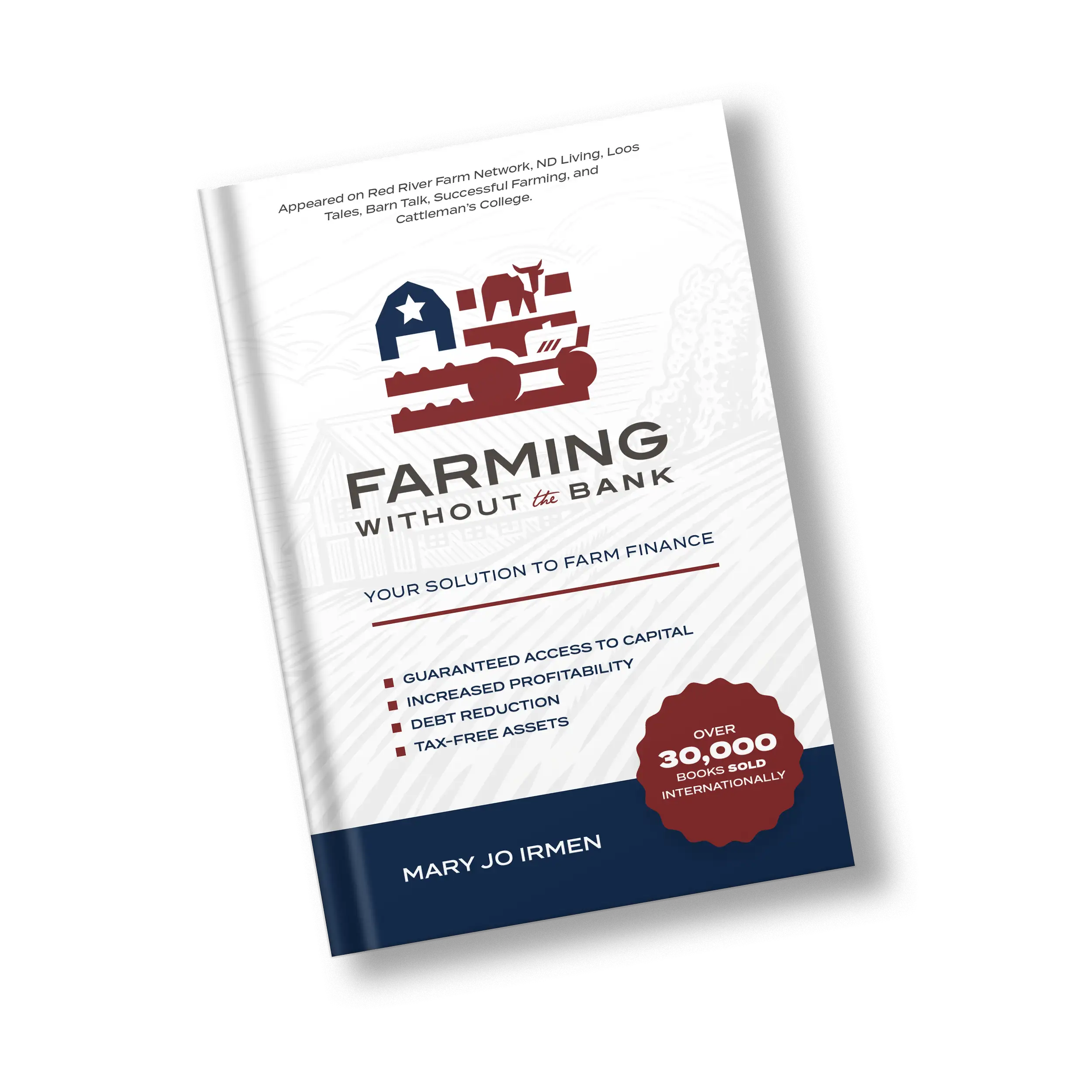
Your farm’s financial independence starts with one book.
30,000 farmers and ranchers have already made the shift. The only question is how long you’ll keep paying interest you could be keeping yourself.