 GET THE BOOK
 GET THE BOOK




Podcast
EP. 313
Ep. 313 – Avoiding the Bank Doesn’t Mean Debt-Free or Using Cash
Aug 1, 2025 ·
21 min
0:00 / 20:31
EPISODE OVERVIEW
ABOUT THIS EPISODE
Too many farmers assume “Farming Without the Bank” means living cash-only and staying debt-free.
In this episode, Mary Jo Irmen sets the record straight. She breaks down why using cash only could be costing you thousands in lost opportunity, why paying interest isn’t the enemy, and how uninterrupted compound interest is the secret sauce behind the Infinite Banking Concept (IBC).
Whether you’ve read the book or you’re hearing this for the first time, this episode will completely shift how you think about using cash, debt, and life insurance in your farming operation.
🔑 Key Takeaways
- Why paying with cash isn’t always the smartest move
- How borrowing against whole life policies preserves your wealth
- The myth of “cash is king” vs. the truth about cash flow and liquidity
- Why term insurance isn’t cheaper over the long run
- How uninterrupted compound interest actually works (and why it’s a game-changer)
- The arrival syndrome and why most people don’t “get” IBC without reading the book
📚 Resources & Links
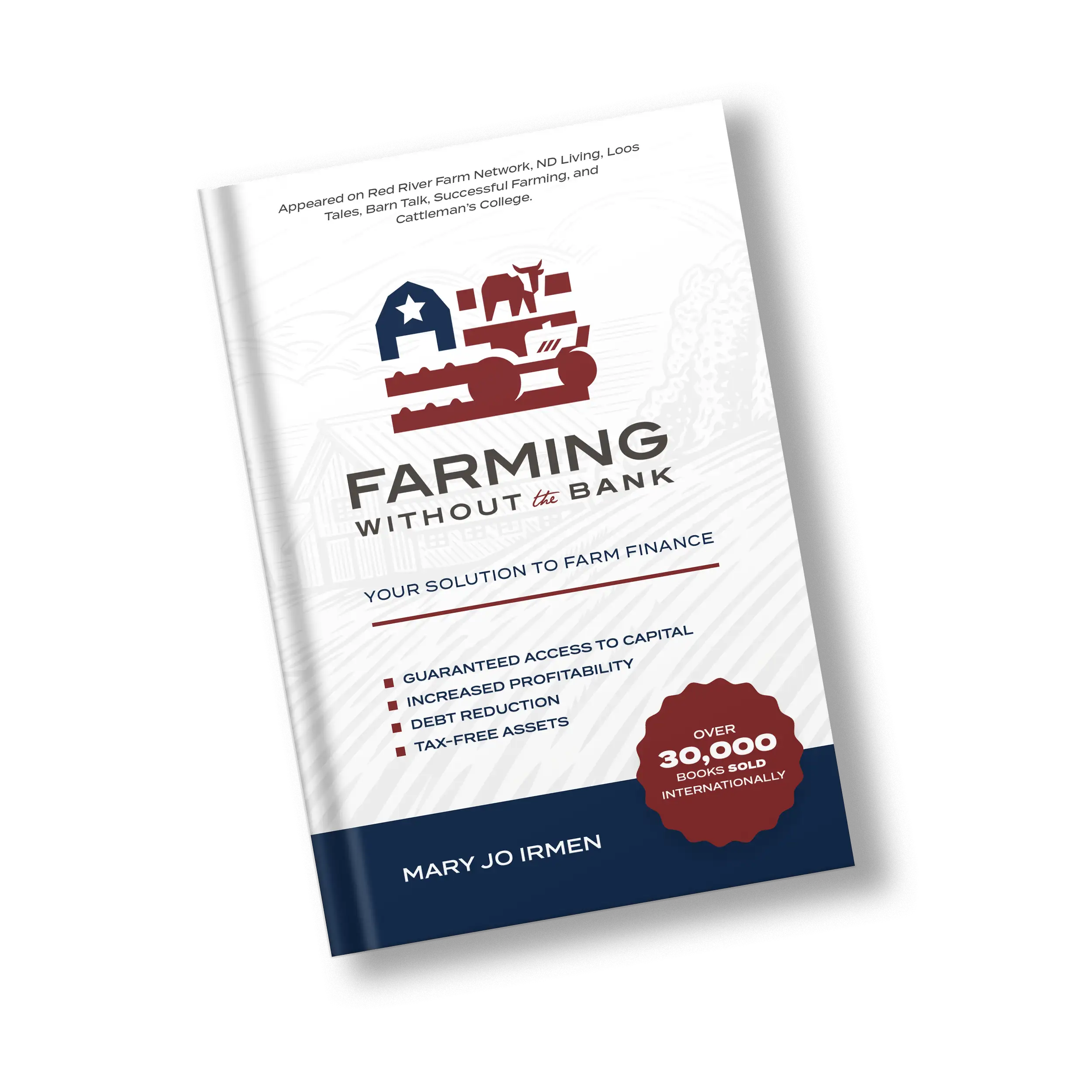
- 📘 Grab your copy of Farming Without the Bank: farmingwithoutthebank.com/book
- 📅 Read the book? Book a meeting with Mary Jo
- 🎧 Listen to the Without the Bank podcast for more IBC episodes (available on all podcast platforms)
- 💬 Email your questions: maryjo@withoutthebank.com
- 👍 Follow on Facebook: Farming Without the Bank
🔥 Want to Keep Learning?
Binge past episodes and learn how real farmers are using IBC to transform their operations. You’ll never look at money the same way again.
CHAPTER TIMESTAMPS
- 00:00Why Most People Don't Understand IBC
- 00:40Clarifying What "Farming Without the Bank" Really Means
- 01:55Using Cash vs. Borrowing Against a Life Insurance Policy
- 03:02Why Insurance Companies Charge Interest
- 03:49Power of Uninterrupted Compound Interest Explained
- 05:04The Long-Term View: Thinking Like a Forester
- 06:57Are You Paying Yourself Back with Interest?
- 07:27The Flawed "Buy Term, Invest the Difference" Argument
- 08:12Why Mutual Insurance Companies Are Good at Making Money
- 10:03The Rising Cost of Term Insurance Over Time
- 12:01Why Cash Buyers Are Ideal IBC Candidates
- 13:04Uninterrupted vs. Interrupted Compound Interest
- 14:43How to Talk About IBC with Skeptical Friends
- 15:32Why Mary Jo Requires Reading the Book Before Meetings
- 19:14Where to Get the Book and Connect with Mary Jo
YOUTUBE EPISODE
TRANSCRIPTION
“People need to be ready to hear it and ready to educate themselves and do their own due diligence. Otherwise, they’re going to still think cash is king and they’re not going to understand uninterrupted compound interest. They’re not going to understand why the insurance company charges interest to take a loan. They’re not going to understand dividends. They’re not going to understand death benefit. They’re just going to repeat the rhetoric that they hear. Buy term and invest the difference. They’re not going to understand it’s not about a rate of return. They’re not going to understand it’s about liquidity, control, guarantees. They’re not going to get any of that.”
Hello, hello, hello, and welcome back to the podcast. Thank you very much for being here. Okay, today let’s talk about Farming Without the Bank does not mean farming with cash or being debt free. So many people see my stuff and they’re like, well, I’m already doing that. Farming Without the Bank does not mean, hey, we’re paying cash for everything. I actually just had a client email me this week and say, Mary Jo, I have somebody asking me, why would I use a life insurance policy when I can just use cash? Why would I borrow money instead of using cash? And so I thought, hey, I think I’ve done a podcast on this. Probably time to revisit it.
Because a lot of people think that when they see the title of the book, they just assume that means, hey, I’ve got everything paid for. My equipment is super, super old. I don’t have any debt. I’m already farming without the bank. And I heard this a lot when corn was $7 a bushel, right? Cattle prices are high. Same thing on the ranch side. Oh, I don’t need this. And so let’s talk about it.
Why would we use a life insurance policy instead of using cash? So if we use cash, we exchange that cash for whatever the item was. Okay. So if I’m going to buy a tractor with cash, I gave the dealership my cash in exchange for said tractor. Now I have the tractor. Cash is gone. Tractor is depreciating in value. Tractor is depreciating because I’m using it. It’s not increasing in value. Let’s just use a year where it’s not increasing in value because then you guys are going to come at me for that. Sometimes it does. Okay. Most of the time it does not. So you’ve got this tractor. It’s depreciating in value. The money is gone. That is called lost opportunity. We lost the opportunity to make money on our money.
So if we’re going to use a life insurance policy, the reason we’re using whole life, dividend-paying whole life, is because we borrow against our money and we use the life insurance company’s money. When we use their money, they’re going to charge us interest. Because why? They had to take money out of what they were earning on and they gave it to us. So that would be a really bad idea if they lent us money at 0%, right? They are in the business of making money so they can pay claims. So what happens with our money? Because we borrow their money, our money continues to stay in our cash value and it earns interest. It earns dividends. All uninterrupted. So what’s happening is our money is just adding on and adding on and adding on.
So if you guys have ever heard the scenario of doubling a penny, every day you double a penny. You don’t interrupt it. Every day it doubles. By day 28, you get to a million dollars. So if we were to interrupt that and then we have to start over, we have lost opportunity on that, right? So and that doubling a penny scenario is in the Life Without the Bank book. So if you don’t have that book, you can get it or you can just Google it. It’s not earth shattering. It’s been around. That scenario has been around forever. What that scenario does is it teaches you the power of compounding. So short term, you went from one penny to two pennies to four pennies to eight pennies, right? Eh, okay. But what happens long term? What happens up here?
What we’re looking at and what most people are looking at is the short term. Well, am I earning in this year, year number one, am I earning the same as what I’m paying to the insurance company? No, absolutely not. I’m not going to sit here and pretend that you are. Absolutely not. If you read Nelson’s book, you will see that it’s going to take about 13 years to outperform a CD because the CD is going to earn you day one, right? And so it’s going to take time to capitalize the system. He talks about that as well. I talk about that a lot. And so it takes time to get going. You need to think like a forester.
The first half of everything Nelson teaches us within infinite banking is what most people ignore. And they go to the back of my book. They go to the back of Nelson’s book and they look at the numbers and go, yeah, but. Yeah, but what? You aren’t looking long term. You’re looking at the very short-term capitalization period. People have said to me, oh, there’s lost opportunity cost there too. Yes, there is. There’s also lost opportunity cost if you’re putting money in a 401(k) or an IRA till you’re 59 and a half, right? There was lost opportunity cost on that tractor that we purchased. And so if we can get back our lost opportunity cost long term on these policies, why would we not do that?
If we’re going to use cash, we gave up the opportunity to continue to earn interest and dividends on our money in exchange for whatever the item is. So a lot of people that are using cash think, A, I’m already doing Farming Without the Bank. Wrong. B, why would I pay interest to somebody else when I can just earn, I can just use my money? Okay. If you don’t want to pay interest to the bank, are you paying interest to yourself? Because if you’re using cash, because you’re going to buy this tractor with cash, that cash got there from saving of some sort. Did you pay yourself back plus interest? Were you honest enough to do that? You’re already playing banker. What you’re losing is the uninterrupted compound interest over your lifetime.
We’re also losing the death benefit. Oh, Mary Jo, I can buy term and invest the difference. Okay. You go do that then with your bad self. Term is not cheaper. Per dollar of death benefit, term is not cheaper. And I also go over that in my book. Because if we’re going to compare whole life to term insurance, we need to try to make it as close to the same as we can. And what I mean by that is term is only going to go to 80, maybe 85 years old. Whole life is going to go until you’re 121. And so you’re most likely going to die at the expense of the insurance company. They’re going to pay a death claim.
And a lot of people will say the insurance company is just getting rich. Well, first of all, I am happy that the insurance company I use is getting rich. Because if my insurance company is making money, then they share that in the form of a dividend. So I am part owner of that business and I am thrilled that they are making money. For heaven’s sakes, I surely don’t want to own a term policy or whole life with a company that doesn’t know how to manage their money. That comment is just ignorance at its finest. Because every business in this country is in business to make money. If they’re not making money, they’re mismanaging their money and we can call them government. Okay.
So they’re going to pay out a death claim. They know that. You’ve paid these premiums in for years and years and years. And in some cases, depending on how old you are, you’ve maybe put 20 cents to every dollar. They have to pay out a dollar and you gave them 20 cents. Do they need to have money so they can pay said death claim? Yes, absolutely. They are one of the best money managers of anybody out there because they know they’re on the hook till you’re 121. The term, they’re only on the hook till you’re 80. So in order for us to compare the price of what it’s costing you for death benefit, we have to look at not how much premium is paid in, but how much premium compared to how much death benefit. And here’s the thing with term, when you get to 65 and older, it is going to triple to quadruple in price. It’s not going to double. It’s going to triple to quadruple in price for every dollar of death benefit. And so now people are saying, I don’t need it. You don’t need it? You’re not going to die? Oh, okay. Okay. So we have that piece of it as well, guaranteed.
We’re not talking about that, though, when we say, hey, we just are looking at interest rates solely. That’s what we’re concerned about is I have to pay the insurance company interest. Yes, you do. Because you used their money so they can continue to pay you on your money. It’s no different than going to the bank and saying, hey, I’m going to buy a CD at 5% or 4% interest. And I’m going to go to the bank and borrow money at 6% or 7%. What happens with your CD? You continue to earn interest on it. And the bank is the one lending you the money. People use their CDs as collateral all the time. And it’s become more prevalent now that CDs are 3%, 4% interest. What are you doing, though? You’re using the bank. That bank isn’t sharing their dividends. They’re not a profit-sharing bank, right? So when they make a profit, that goes to the bank. With the life insurance company, when they make a profit, that’s why we use a mutual company. They share that profit with you, the policyholder.
So all these things are super important. But people think, well, I have cash, so I don’t need to use infinite banking. I was also a cash purchaser. I loved paying cash for everything. I didn’t want to have any debt. I’m extremely frugal. And so I was very aware of what was happening. But I did not have the arrival syndrome. I read the book and was like, whoa, this is insane. How can this even be true? And I did my due diligence. What’s happening with a lot of people that use cash, this is actually ideal for those people. Because they’re already good with their money. They’re already paying themselves back for stuff when they buy it. They’re already practicing the concept. They’re missing out on the uninterrupted compound interest. Because they’re scared of the word interest. Oh, I have to pay somebody else interest. If we can leverage our dollar and we can make more long term than what we pay the company, is that not a win for us? 100% it is.
And so let’s not mix up Farming Without the Bank as cash. And let’s not think that, oh, cash is king. Because cash is not king. Cash flow is king. Cash value is amazing. Uninterrupted compound interest is amazing. And let’s not confuse uninterrupted compound interest with compound interest. Because if you have an IRA or an investment, they’re going to say, oh, I also have compound interest. You have interrupted compound interest. The market goes up, the market goes down. The market goes up, the market goes down. You have a savings account. You put money in, you take money out. You put money in, you take money out. You are interrupting that. Inside cash value, it’s uninterrupted compound interest.
And nobody is using that word except myself and a couple other colleagues. And it is something that I’ve talked about for years and years and years now. They are not saying, hey, is it interrupted compound interest or uninterrupted? We need to talk about that like average versus actual rates of return. They’re not the same thing. There’s different types of compound interest. I wouldn’t even call an IRA compounding because it’s not… Yes, it’s building onto itself. But how much of that are you sticking in? If you want to call it that, call it that. I would call compound interest what happens inside of a life insurance policy. It’s uninterrupted. That to me would be compound interest. I would find a new word for all the other stuff that’s interrupted. So all I’m doing is adding another word in front of compound interest. Right? It’s either interrupted or uninterrupted. And uninterrupted compound interest is why this works.
Now, if you are like my lovely client who reached out and said, what do I tell them? Well, you can tell them as much as you want. If you are somebody that’s excited about the infinite banking concept and you’re sharing it with people, be prepared. You’re going to get whacked over the head almost every single time. Because you’re talking to people that most likely have the arrival syndrome. And as you talk to them, the more and more you talk to them, you become somebody that’s trying to convince them of snake oil. That this snake oil is going to work. Unless they actually pick up one of the books and they read it and they understand the mindset behind it and they can see the numbers, it’s not going to make sense. They will continually come back with uneducated questions.
That is the whole reason why I have everybody read the book before they meet with me. If I would meet with just every single person that saw me online, they would not have the information they need. And I would be convincing them through an entire meeting of why this is going to work. And then they would forget about why it’s going to work. If you’ve read the book, you should be able to answer and understand why uninterrupted compound interest is the key factor with a company that pays dividends. Okay. You mix those two things together and it’s a winning equation. You have to have the right policy structure. You have to have the right agent. You have to have the right company. There’s all those factors that come into play.
And if you listen to my podcast, I don’t know when this is going to air. One podcast back, two podcasts back, I don’t know. If you listen to the podcast about me addressing the Nebraska Farmer magazine and Farm Progress, whatever they got going there. If you heard that podcast, I made it abundantly clear. Why is it important to work with the right people? And they also, the authors, were so incorrect. They made it abundantly clear. Why, if you work with the wrong people, you’re going to get misinformation? Because they’re not educated.
And so, you have to ask. If people continually ask you questions without reading the book, without doing their due diligence, are you making progress by answering those questions or are you banging your head against a wall? If people don’t read the book, I’m out. I’m out. I’m not going to talk to you any further. Because all you’re doing is trying to have me convince you this is going to work. You’re not actually trying to understand why it works. If they read the book, 90% of those questions are answered in the book. And then we just have to answer a few questions outside of that. If they read my book and Nelson’s book, they’re going to get 95% of their questions answered. Right? Most people that read both books come in and are ready to go. And then you mix some podcasts in there. You guys are super well educated.
So, you’re educating yourself, but you’re not asking whoever you’re talking to to do the same. Because if somebody else can’t take time out to read the book like you did, is it worth the conversation? I appreciate you sharing it. Don’t get me wrong. Absolutely love that you’re sharing it. But people need to be ready to hear it and ready to educate themselves and do their own due diligence. Otherwise, they’re going to still think cash is king. And they’re not going to understand uninterrupted compound interest. They’re not going to understand why the insurance company charges interest to take a loan. They’re not going to understand dividends. They’re not going to understand death benefit. Right? They’re just going to repeat the rhetoric that they hear. Buy term and invest the difference. They’re not going to understand it’s not about a rate of return. They’re not going to understand it’s about liquidity, control, guarantees. They’re not going to get any of that.
Okay. That’s what I had for today. You let me know if you guys have anything that I’ve not answered. If I have not addressed something on the podcast that you have a question on, please let me know. And I would be happy to address it. You can email me, maryjo@withoutthebank.com. Go to farmingwithoutthebank.com. Grab your book and set up your appointment. If you are not listening to the Without the Bank podcast, go over there because I’ve had a couple of really good podcasts just on IBC. It has nothing to do with anything else. And so I’m not repeating podcasts on both of my podcasts. I’m not repeating them on each podcast. So you got to listen to both. So you get a whole whopping, you know, 40 minutes of me every week. Lucky you. All right. Let me know if you need anything. Otherwise, you have a fantastic rest of your day.
Thanks for listening to the Farming Without the Bank podcast. We hope today’s episode has inspired you to take control of your finances in new ways. Don’t forget to check out our website, farmingwithoutthebank.com, and engage with us on our Facebook page, Farming Without the Bank. Join us next week as we smash more financial myths and empower you to accomplish your financial goals.
View MoreHello, hello, hello, and welcome back to the podcast. Thank you very much for being here. Okay, today let’s talk about Farming Without the Bank does not mean farming with cash or being debt free. So many people see my stuff and they’re like, well, I’m already doing that. Farming Without the Bank does not mean, hey, we’re paying cash for everything. I actually just had a client email me this week and say, Mary Jo, I have somebody asking me, why would I use a life insurance policy when I can just use cash? Why would I borrow money instead of using cash? And so I thought, hey, I think I’ve done a podcast on this. Probably time to revisit it.
Because a lot of people think that when they see the title of the book, they just assume that means, hey, I’ve got everything paid for. My equipment is super, super old. I don’t have any debt. I’m already farming without the bank. And I heard this a lot when corn was $7 a bushel, right? Cattle prices are high. Same thing on the ranch side. Oh, I don’t need this. And so let’s talk about it.
Why would we use a life insurance policy instead of using cash? So if we use cash, we exchange that cash for whatever the item was. Okay. So if I’m going to buy a tractor with cash, I gave the dealership my cash in exchange for said tractor. Now I have the tractor. Cash is gone. Tractor is depreciating in value. Tractor is depreciating because I’m using it. It’s not increasing in value. Let’s just use a year where it’s not increasing in value because then you guys are going to come at me for that. Sometimes it does. Okay. Most of the time it does not. So you’ve got this tractor. It’s depreciating in value. The money is gone. That is called lost opportunity. We lost the opportunity to make money on our money.
So if we’re going to use a life insurance policy, the reason we’re using whole life, dividend-paying whole life, is because we borrow against our money and we use the life insurance company’s money. When we use their money, they’re going to charge us interest. Because why? They had to take money out of what they were earning on and they gave it to us. So that would be a really bad idea if they lent us money at 0%, right? They are in the business of making money so they can pay claims. So what happens with our money? Because we borrow their money, our money continues to stay in our cash value and it earns interest. It earns dividends. All uninterrupted. So what’s happening is our money is just adding on and adding on and adding on.
So if you guys have ever heard the scenario of doubling a penny, every day you double a penny. You don’t interrupt it. Every day it doubles. By day 28, you get to a million dollars. So if we were to interrupt that and then we have to start over, we have lost opportunity on that, right? So and that doubling a penny scenario is in the Life Without the Bank book. So if you don’t have that book, you can get it or you can just Google it. It’s not earth shattering. It’s been around. That scenario has been around forever. What that scenario does is it teaches you the power of compounding. So short term, you went from one penny to two pennies to four pennies to eight pennies, right? Eh, okay. But what happens long term? What happens up here?
What we’re looking at and what most people are looking at is the short term. Well, am I earning in this year, year number one, am I earning the same as what I’m paying to the insurance company? No, absolutely not. I’m not going to sit here and pretend that you are. Absolutely not. If you read Nelson’s book, you will see that it’s going to take about 13 years to outperform a CD because the CD is going to earn you day one, right? And so it’s going to take time to capitalize the system. He talks about that as well. I talk about that a lot. And so it takes time to get going. You need to think like a forester.
The first half of everything Nelson teaches us within infinite banking is what most people ignore. And they go to the back of my book. They go to the back of Nelson’s book and they look at the numbers and go, yeah, but. Yeah, but what? You aren’t looking long term. You’re looking at the very short-term capitalization period. People have said to me, oh, there’s lost opportunity cost there too. Yes, there is. There’s also lost opportunity cost if you’re putting money in a 401(k) or an IRA till you’re 59 and a half, right? There was lost opportunity cost on that tractor that we purchased. And so if we can get back our lost opportunity cost long term on these policies, why would we not do that?
If we’re going to use cash, we gave up the opportunity to continue to earn interest and dividends on our money in exchange for whatever the item is. So a lot of people that are using cash think, A, I’m already doing Farming Without the Bank. Wrong. B, why would I pay interest to somebody else when I can just earn, I can just use my money? Okay. If you don’t want to pay interest to the bank, are you paying interest to yourself? Because if you’re using cash, because you’re going to buy this tractor with cash, that cash got there from saving of some sort. Did you pay yourself back plus interest? Were you honest enough to do that? You’re already playing banker. What you’re losing is the uninterrupted compound interest over your lifetime.
We’re also losing the death benefit. Oh, Mary Jo, I can buy term and invest the difference. Okay. You go do that then with your bad self. Term is not cheaper. Per dollar of death benefit, term is not cheaper. And I also go over that in my book. Because if we’re going to compare whole life to term insurance, we need to try to make it as close to the same as we can. And what I mean by that is term is only going to go to 80, maybe 85 years old. Whole life is going to go until you’re 121. And so you’re most likely going to die at the expense of the insurance company. They’re going to pay a death claim.
And a lot of people will say the insurance company is just getting rich. Well, first of all, I am happy that the insurance company I use is getting rich. Because if my insurance company is making money, then they share that in the form of a dividend. So I am part owner of that business and I am thrilled that they are making money. For heaven’s sakes, I surely don’t want to own a term policy or whole life with a company that doesn’t know how to manage their money. That comment is just ignorance at its finest. Because every business in this country is in business to make money. If they’re not making money, they’re mismanaging their money and we can call them government. Okay.
So they’re going to pay out a death claim. They know that. You’ve paid these premiums in for years and years and years. And in some cases, depending on how old you are, you’ve maybe put 20 cents to every dollar. They have to pay out a dollar and you gave them 20 cents. Do they need to have money so they can pay said death claim? Yes, absolutely. They are one of the best money managers of anybody out there because they know they’re on the hook till you’re 121. The term, they’re only on the hook till you’re 80. So in order for us to compare the price of what it’s costing you for death benefit, we have to look at not how much premium is paid in, but how much premium compared to how much death benefit. And here’s the thing with term, when you get to 65 and older, it is going to triple to quadruple in price. It’s not going to double. It’s going to triple to quadruple in price for every dollar of death benefit. And so now people are saying, I don’t need it. You don’t need it? You’re not going to die? Oh, okay. Okay. So we have that piece of it as well, guaranteed.
We’re not talking about that, though, when we say, hey, we just are looking at interest rates solely. That’s what we’re concerned about is I have to pay the insurance company interest. Yes, you do. Because you used their money so they can continue to pay you on your money. It’s no different than going to the bank and saying, hey, I’m going to buy a CD at 5% or 4% interest. And I’m going to go to the bank and borrow money at 6% or 7%. What happens with your CD? You continue to earn interest on it. And the bank is the one lending you the money. People use their CDs as collateral all the time. And it’s become more prevalent now that CDs are 3%, 4% interest. What are you doing, though? You’re using the bank. That bank isn’t sharing their dividends. They’re not a profit-sharing bank, right? So when they make a profit, that goes to the bank. With the life insurance company, when they make a profit, that’s why we use a mutual company. They share that profit with you, the policyholder.
So all these things are super important. But people think, well, I have cash, so I don’t need to use infinite banking. I was also a cash purchaser. I loved paying cash for everything. I didn’t want to have any debt. I’m extremely frugal. And so I was very aware of what was happening. But I did not have the arrival syndrome. I read the book and was like, whoa, this is insane. How can this even be true? And I did my due diligence. What’s happening with a lot of people that use cash, this is actually ideal for those people. Because they’re already good with their money. They’re already paying themselves back for stuff when they buy it. They’re already practicing the concept. They’re missing out on the uninterrupted compound interest. Because they’re scared of the word interest. Oh, I have to pay somebody else interest. If we can leverage our dollar and we can make more long term than what we pay the company, is that not a win for us? 100% it is.
And so let’s not mix up Farming Without the Bank as cash. And let’s not think that, oh, cash is king. Because cash is not king. Cash flow is king. Cash value is amazing. Uninterrupted compound interest is amazing. And let’s not confuse uninterrupted compound interest with compound interest. Because if you have an IRA or an investment, they’re going to say, oh, I also have compound interest. You have interrupted compound interest. The market goes up, the market goes down. The market goes up, the market goes down. You have a savings account. You put money in, you take money out. You put money in, you take money out. You are interrupting that. Inside cash value, it’s uninterrupted compound interest.
And nobody is using that word except myself and a couple other colleagues. And it is something that I’ve talked about for years and years and years now. They are not saying, hey, is it interrupted compound interest or uninterrupted? We need to talk about that like average versus actual rates of return. They’re not the same thing. There’s different types of compound interest. I wouldn’t even call an IRA compounding because it’s not… Yes, it’s building onto itself. But how much of that are you sticking in? If you want to call it that, call it that. I would call compound interest what happens inside of a life insurance policy. It’s uninterrupted. That to me would be compound interest. I would find a new word for all the other stuff that’s interrupted. So all I’m doing is adding another word in front of compound interest. Right? It’s either interrupted or uninterrupted. And uninterrupted compound interest is why this works.
Now, if you are like my lovely client who reached out and said, what do I tell them? Well, you can tell them as much as you want. If you are somebody that’s excited about the infinite banking concept and you’re sharing it with people, be prepared. You’re going to get whacked over the head almost every single time. Because you’re talking to people that most likely have the arrival syndrome. And as you talk to them, the more and more you talk to them, you become somebody that’s trying to convince them of snake oil. That this snake oil is going to work. Unless they actually pick up one of the books and they read it and they understand the mindset behind it and they can see the numbers, it’s not going to make sense. They will continually come back with uneducated questions.
That is the whole reason why I have everybody read the book before they meet with me. If I would meet with just every single person that saw me online, they would not have the information they need. And I would be convincing them through an entire meeting of why this is going to work. And then they would forget about why it’s going to work. If you’ve read the book, you should be able to answer and understand why uninterrupted compound interest is the key factor with a company that pays dividends. Okay. You mix those two things together and it’s a winning equation. You have to have the right policy structure. You have to have the right agent. You have to have the right company. There’s all those factors that come into play.
And if you listen to my podcast, I don’t know when this is going to air. One podcast back, two podcasts back, I don’t know. If you listen to the podcast about me addressing the Nebraska Farmer magazine and Farm Progress, whatever they got going there. If you heard that podcast, I made it abundantly clear. Why is it important to work with the right people? And they also, the authors, were so incorrect. They made it abundantly clear. Why, if you work with the wrong people, you’re going to get misinformation? Because they’re not educated.
And so, you have to ask. If people continually ask you questions without reading the book, without doing their due diligence, are you making progress by answering those questions or are you banging your head against a wall? If people don’t read the book, I’m out. I’m out. I’m not going to talk to you any further. Because all you’re doing is trying to have me convince you this is going to work. You’re not actually trying to understand why it works. If they read the book, 90% of those questions are answered in the book. And then we just have to answer a few questions outside of that. If they read my book and Nelson’s book, they’re going to get 95% of their questions answered. Right? Most people that read both books come in and are ready to go. And then you mix some podcasts in there. You guys are super well educated.
So, you’re educating yourself, but you’re not asking whoever you’re talking to to do the same. Because if somebody else can’t take time out to read the book like you did, is it worth the conversation? I appreciate you sharing it. Don’t get me wrong. Absolutely love that you’re sharing it. But people need to be ready to hear it and ready to educate themselves and do their own due diligence. Otherwise, they’re going to still think cash is king. And they’re not going to understand uninterrupted compound interest. They’re not going to understand why the insurance company charges interest to take a loan. They’re not going to understand dividends. They’re not going to understand death benefit. Right? They’re just going to repeat the rhetoric that they hear. Buy term and invest the difference. They’re not going to understand it’s not about a rate of return. They’re not going to understand it’s about liquidity, control, guarantees. They’re not going to get any of that.
Okay. That’s what I had for today. You let me know if you guys have anything that I’ve not answered. If I have not addressed something on the podcast that you have a question on, please let me know. And I would be happy to address it. You can email me, maryjo@withoutthebank.com. Go to farmingwithoutthebank.com. Grab your book and set up your appointment. If you are not listening to the Without the Bank podcast, go over there because I’ve had a couple of really good podcasts just on IBC. It has nothing to do with anything else. And so I’m not repeating podcasts on both of my podcasts. I’m not repeating them on each podcast. So you got to listen to both. So you get a whole whopping, you know, 40 minutes of me every week. Lucky you. All right. Let me know if you need anything. Otherwise, you have a fantastic rest of your day.
Thanks for listening to the Farming Without the Bank podcast. We hope today’s episode has inspired you to take control of your finances in new ways. Don’t forget to check out our website, farmingwithoutthebank.com, and engage with us on our Facebook page, Farming Without the Bank. Join us next week as we smash more financial myths and empower you to accomplish your financial goals.
ready to start?
Your farm’s financial independence starts with one book.
30,000 farmers and ranchers have already made the shift. The only question is how long you’ll keep paying interest you could be keeping yourself.