 GET THE BOOK
 GET THE BOOK




Podcast
EP. 323
Banks Are Quietly Changing the Rules — Are You Ready? (Ep. 323)
Oct 10, 2025 ·
21 min
0:00 / 20:33
EPISODE OVERVIEW
ABOUT THIS EPISODE
Banks are already tightening up on ag lending, and that’s your red alarm. This creates instability as banks pull out of lending due to perceived high risk.
Farming Without the Bank: Book & resources
Understanding sound farm management and agricultural finance is now more important than ever to mitigate risk management. Let’s navigate the ag lending landscape together.
Mary Jo breaks down when (and if) you should use the minimum premium option on policies with Paid-Up Additions (PUA) and why, in most cases, paying the full premium and then borrowing against cash value is the smarter play, especially when banks are pulling back, collateral requirements are rising, and commodity prices are shaky.
If you’ve been tempted to “just pay the minimum” on your whole life premium, this episode explains why that move can quietly cost you years of growth.
She shares a personal $2,000 short-pay mistake that still drags on her policy 16 years later, and revisits Nelson Nash’s strategy during 23% interest rates: premium in, borrow, pay notes down, and migrate debt to the policy over time.
Key Takeaways
- Full premium today = more dividends + faster compounding tomorrow
- Minimum premium “flexibility” is for worst-case cash flow crunches, not a habit
- Policy loans can make tractor/land/operating payments while keeping your policy compounding
- Banks pulling back = expect harder renewals + more collateral requirements
- Consider how (or whether) to list cash value on bank forms; educate your banker
- Nelson Nash moved high-interest bank debt to his policy over ~13 years; start where you are
- 📘 Read Nelson Nash’s Becoming Your Own Banker and Mary Jo’s Farming Without the Bank
- 🗓️ Clients: Email to get on Mary Jo or John’s calendar for a strategy session
- ✉️ Quick question? Email us and request a call-back
- ✅ Before you cut premiums, talk it through. Don’t starve your compounding.
Links Mentioned
- Becoming Your Own Banker by Nelson Nash (official resource)
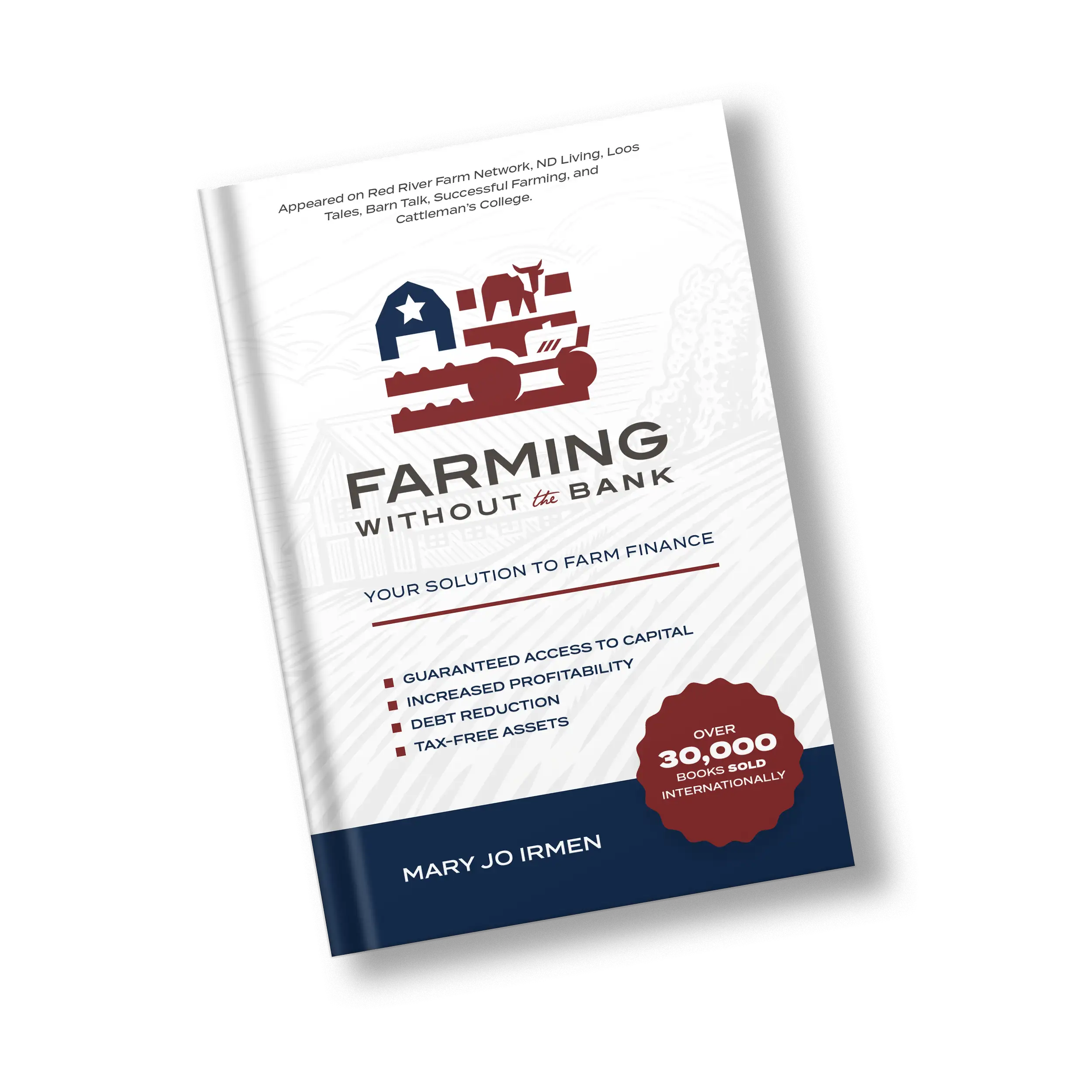
- Farming Without the Bank: Book & resources
CHAPTER TIMESTAMPS
YOUTUBE EPISODE
TRANSCRIPTION
"The banks are also running scared. I actually was talking to Doug Ferguson about this the other day. He is also getting calls from people, stories about banks. This is what happened during the last downturn of the commodity market. And what happened is these lenders that weren’t typically in agriculture moved over to agriculture because prices were great. They were going to make a bunch of money. And then prices fell and they were like, ‘We’re out. We are out of agriculture. This is too risky. We don’t want anything to do with it.’
We want to make sure that we’re working with a good bank, that they understand agriculture. And we’re starting to see them pull out already. And so when the bank is pulling back, kind of red alarms should be going for us. We should be prepared for them to either call some note, not renew a note, ask for more collateral, because they’re thinking land prices are going to fall. In their heads, they’re like, ‘Oh, 1980s is happening again. And we’re going to prepare. We’re not going to get caught with a bunch of land,’ because they don’t want your land.
They want cash flow.”
Hello, hello, and welcome back to the podcast. Thank you very much for being here. All right. Today, we are joined by the wiener. That is our little wiener dog, Winnie. And so if you’ve not seen her before, but she is loving this new podcast room. And she has made a lot of appearances.
So, you know, I don’t know. I feel bad. She wants to sit on my lap. So that’s what we’re going to do. She thinks it’s a living room. So anyway, welcome to the Winnie.
So let’s talk today about paying your full premium or having a flexible premium. If any of you have a policy with paid-up additions, especially if you are one of my clients, and you have a policy with paid-up additions, you know that there is a minimum premium that you can pay. Should you be paying the minimum premium? Commodity prices are iffy right now.
Everything that’s going on with the tariffs and all the stuff. I’m paying attention to it. I’m not talking about it because I don’t know enough about it to, you know, I know enough to be dangerous. I have my opinion.
But unless I have all the facts and know everything in and out, I’ll just shut up about it. You guys have enough other people to listen to. You don’t need to hear me spew about that.
But prices are scary. What’s happening is scary. And so I’ve had quite a few people say, “Mary Jo, what’s my minimum premium?” And I just want to remind everybody that if you have a minimum premium, and you have that flexibility with your paid-up additions rider, should you be taking it?
And I’m going to say probably not. Because if we pay premium, we make money. Now, some people might think, “Oh, well, you get less commission.” Nope. The amount of commission that I get off of any of this is absolutely not even enough to buy me groceries. Okay, way less than groceries.
And so if you want to have that flexibility, great, have it. But if you don’t pay that full premium, it slows the entire growth of that policy down. We’re not going to have as much compound interest. We’re not going to have as many dividends. And the dividend gets moved over to the guaranteed side, right? And it’s assumed. And so now we’re earning interest and dividends on the previous interest and dividends, compounding uninterrupted.
So what a lot of people are thinking is, “Oh my gosh, this is a bill. This life insurance policy has become a bill, and I don’t have the money to pay it.” That is not the case. Your life insurance policy is your pass-through entity.
And so put the money into your policy. Pay your premium in full. Turn around 10 days later and borrow against it to make a tractor payment, to make a land payment, to whatever.
If yes, you didn’t pay. If you need that money to make a bank payment, all we did is we moved that payment into the policy. I do not, under ideal circumstances like that. You guys know that. Because all we’re doing is moving it from one hand to the other.
I like it when we’re doing is moving it from one hand to the other.
I like it when we can pay something off, not pay it down. But if you can move it over, you can pay that back over your lifetime if you need to. But at least we got the premium in there to make more money.
If we don’t get it in, it slows down that policy. And I’m just going to use myself as an example here. There was one year early on that I was like, “Oh, I can’t pay my premium.”
And so I guess I’ll just not pay the full premium. The amount, it was only like two grand. I was short. It has hurt my policy significantly.
And we’re 16 years in. So why not pay that full premium if you can, just to turn around and borrow against it?
I was making the same mistake that a lot of you guys are thinking about, is this is a payment. This is an expense. I don’t have money for this expense. So I’m just going to put in as much as I need.
When in fact, I should have been putting in the full amount. I should have been paid… I should have paid the full, the extra $2,000, and then turned around, borrowed against it, and used it to pay down my credit card.
Used it to make vehicle payments. Use it for whatever it was that I was doing at the time. Right?
Then I could have paid that all back when times are good, commodity prices come back up. Because they will. They always do. Commodity prices come back up and we’re good to go.
And so if things are tough, and I know that they are, I get it. If things are tough right now, and you have soybeans and we don’t know what that’s going to be.
We don’t know what, you know, the administration is going to do as far as any kind of bailouts, those kinds of things. If we don’t, if we take that money and put it through the policy, borrow against it, when we get that government money, we can pay that stuff back.
If we don’t get the government money, we can pay it back over our lifetime.
Ideally, we should be putting the money through the policy. We’re going to sell grain. We’re going to pay the full premium. We’re going to, 10 days later, turn around, borrow against it.
A lot of people that are saying to me, “Well, Mary Jo, I can’t pay that full premium,” they’re not actually even using cash value. They’re not using their system. They’re treating it like a savings account.
Okay. And we don’t want to treat it like a savings account. It’s not a savings account. It is there for us to finance major things. And think about Nelson’s book. If you’ve not read Becoming Your Own Banker, read it.
Nelson talks about the fact that when he had interest at 32%, 23%, sorry. When he had interest at 23%, he was paying his premium, borrowing against that, and paying down notes. He wasn’t paying them off. He was paying them down until they slowly got moved over to his policy.
And then he started paying his policy back at 5% to 8%. And so if we need to use this time to do that, let’s do that. But let’s not just avoid the premium in full, because that is not going to be ideal. We do not want to do that.
The long-term effect of that is huge. Like it is in my policy with a mere $2,000. Okay. So if you have, and I know you have flexibility, if you are a client, call and let’s talk through it. Because unless you have zero money coming in and zero ability to even get money anywhere, then maybe we can’t pay the premium. Right?
But let’s have that conversation instead of just saying, “Oh, well, I’m going to do this all myself.” You can do it yourself. But you know, you did a policy with me. And so I’m here to help coach you through that.
This really becomes the make-it-or-break-it type situation. And we also have to remember that Nelson started at the very worst time. He started when interest rates were 23%. He had $800,000 of debt. The book says he had a half a million. He had $800,000 of debt because he inherited his business partner’s $300,000.
And he got all of the banks paid off in 13 years. And so we have the opportunity to do something different. And we have to take that opportunity and make sure our system and our building continues. Obviously, have somebody help you through it. Again, that’s what I’m here for. But we have to make sure that this all continues.
So at the end of the day, we have built what we needed. If we stop building, basically what we’ve done is said, “You know what, we’re going to build this bank.” And it’s under construction. And all it needs is some windows and some doors. You’re like, “Well, I can’t. I don’t have any money. I can’t continue to do this. So we’re just going to vacate the building.” Right?
We’re just going to say, “Well, that’s, this isn’t going to work.” And we’re going to move on. You’ve done the majority of the work already. Let’s figure out how we can continue to pay everything.
I let you guys know flexibility. There are a lot of agents out there that do not tell you that your premiums are flexible. Like, it’s crazy to me how many people come with infinite banking, structured type policies, and they are not being told that their paid-up additions is flexible.
So in, like, the worst of worst times, meaning we have absolutely no money to run through the system, and we’ve paid all and we haven’t paid our bills, and if we put it in, we don’t have access to it. Like the worst of the worst, because we don’t have the income. They don’t know that.
And everybody’s paid-up additions rider is flexible with the mutual companies that I know. OneAmerica, Lafayette, Ameritas, Security Mutual, all the companies that really work with the Nelson Nash Institute and work with us agents that teach infinite banking. Those PUAs are flexible. And so if your agent has not told you, then you need to ask them. I would imagine some of your bigger carriers as well. Your Northwestern Mutual, New York Life, those guys, well, some of them don’t even have paid-up additions. But if they did, I would assume that they’re flexible as well.
If their agent does not know, then you’re probably with the wrong agent, and they should know their product better. My two cents.
So anyway, just because I’ve gotten a few emails on this and I’ve had a few phone calls, and I’m really having to start walking clients through this because we are not in a good position right now. The first thing we do is we freak out and say, “I’m getting rid of this whole life insurance policy,” or, “I’m only paying what I have to to keep it, because it’s become an expense.” It’s not an expense. It’s a tool. And we have to change that mindset.
So some people may not tune into this, but I just wanted everybody within the farming sector to understand that, because you guys are kind of in a shitty spot right now. And so we have to figure out how we should still be preparing now. So when times get good, we have a place to warehouse this wealth. Right. And then when times are good, we should be preparing for when everything falls again, because it will. It’s all up and down. It always has been up and down. It’s not going to change now.
All right. Let me know if that helped. Let me know if you guys have questions, concerns. Email me. If you are a client, make sure you are emailing me or you’re emailing Tiara to get access to my calendar, because that is what I’m here for, is to help. If you just have a quick question on something, email me and I will make sure that I call you back. That happens, like, you know, within 24 hours unless I’m out. So don’t be scared to reach out to me. That is why you did business with me.
If you have questions, reach out to John. He also is available for questions. If you need stuff right away, you can call the same office number if you’re a client and talk to John. He has access to all of my stuff and all of my client records. So if for some whatever reason, if it’s an emergency, you know, let me know.
On a little side note, I got an email yesterday that I think is kind of funny. So I have a client that is doing some business, obviously, with the bank, because they almost all do. And the banker is emailing me and asking me if it is true that the death benefit is collateral to the cash value loan and that this is his loan. Okay, number one, I’m not talking to your banker, because it’s a private contract between the life insurance company and the client.
And so it’s funny, though, that I didn’t have the best response. I’m sure this person is lovely, but this is like a simple Google search. AI would have given you the answer to this. She could have called the, she could have called anybody. She could have read the damn book and got the answer. Like, this is mind-boggling to me that your lender, your banker does not understand how whole life insurance works and they can’t educate themselves. Like, the mind-boggling piece is not that they don’t know, because they don’t know what it is. It’s that they can’t educate themselves. Instead, you’re going to reach out to me. I’m sure your client told you that I’ve written a book and that you could go read the book or you could do some kind of due diligence. But you’ve chosen not to do that. Really?
So, yeah, I responded with, “I’m not giving you an answer because this is a contract, and I’m not talking to you about your client’s contract. And educate yourself and read the book, or educate yourself just on life insurance. You guys are a bank. I’m sure that you have an insurance department that could answer this question for you.” I don’t. Obviously, this is what this has taught me, because this is only the second time this has happened. And it’s happening now, which means that the banks are also running scared.
And I am seeing this as well. And I was talking to, I actually was talking to Doug Ferguson about this the other day, that he is also getting calls from people about stories about banks. And this is what happened during the last downturn of the commodity market, because I was, I was around then. And what happened is these lenders that weren’t typically in agriculture moved over to agriculture because prices were great. They were going to make a bunch of money. And then prices fell and they were like, “We’re out. We are out of agriculture. This is too risky. We don’t want anything to do with it.” And so they make it really, really hard. They don’t renew notes. It’s a thing.
And so if we want to make, we want to make sure that we’re working with a good bank, right, that they understand agriculture, and we’re starting to see them pull out already. I’ve had a couple of people that I’ve talked to that the bank is making it very hard to renew notes. They’re taking way more collateral than they used to take because they can see it coming. And I’ve said this before and I’ll say it again. When the bank is pulling back, they already know what’s going to happen. They’re sitting at the same table as everybody else with the bigwigs in the financial world, right? They’re all talking to one another.
And so when the bank is pulling back, kind of red alarms should be going for us, that we should be prepared for them to either call some note or to do something. Not renew a note. Ask for more collateral. Because they’re thinking land prices are going to fall, right? They’re already in their heads. They’re like, “Oh, 1980s is happening again. And we’re going to prepare. We’re not going to get caught with a bunch of land.” Because they don’t want your land. They want cash flow. And if they’re concerned that you’re not going to make cash flow, then they’re going to start making it hard for you. So, or if they just want to get out of agriculture because they’re not typically an ag lender, then they’re going to get, they’re going to just completely move out, and they’re going to make it very difficult and push you into another bank. A lot of times they don’t say that. They just make it miserable and hope that you leave. So I am seeing that as well.
But yeah, the fact that this lender is so concerned about the cash value loan, it tells me that they’re starting to pull and that they’re looking at everything where they, this guy’s had policies for years, years and years and years. And now they’re questioning it when they’ve never questioned it before. So yeah, I guess you as a client gets to decide. Do you tell your banker you even have it or not? I had that conversation with somebody last week as well. I put it on all of my stuff. My banker understands it. But if your banker doesn’t understand it, do you even put it on your balance sheet? That’s totally up to you. Most people, you know, if you have a high premium with a lot of cash value, you’re going to want it on your balance sheet. But they’re going to have to be educated. And if you need a book, they should be buying it themselves. But please let me know and we’ll get you a book, and you sell it to them for $20. You don’t give them the book. It is their responsibility to make sure that they’re educating themselves.
If you came to me as a client and said, “Hey, Mary Jo, I heard about this X, Y, and Z thing,” guess what? I’m going to either go buy the book, I’m going to watch the videos, I am going to educate myself on it. I’m not going to just call somebody to verify something. And I told this banker, I said, “You should probably educate yourself, because this isn’t going to be the only one you see.”
I actually talked to somebody last week, and they were filling out, or two weeks ago, they were filling out bank information. And they said, now it’s asking for cash value of life insurance. And they said that’s never been a form. That’s never been a line item on their financial documents that they need for the bank. And now they’re asking for it. So the banks are getting smarter and they’re understanding it’s there. And that’s great. But then they better educate themselves on how it works.
So, yeah, that’s a great way to start my day and see that email. Got me a little fired up. I’m sure you can imagine. All right. Let me know if you guys need anything. Email me. Call, text, whatever. Grab your book. Get Nelson’s book. And let me know if you need help with anything. But, you know, schedule your appointment with John or I, and we are happy to help. All right. You guys have a fantastic rest of your day.
Thanks for listening to the Farming Without the Bank podcast. We hope today’s episode has inspired you to take control of your finances in new ways. Don’t forget to check out our website, farmingwithoutthebank.com, and engage with us on our Facebook page, Farming Without the Bank. Join us next week as we smash more financial myths and empower you to accomplish your financial goals.
View MoreWe want to make sure that we’re working with a good bank, that they understand agriculture. And we’re starting to see them pull out already. And so when the bank is pulling back, kind of red alarms should be going for us. We should be prepared for them to either call some note, not renew a note, ask for more collateral, because they’re thinking land prices are going to fall. In their heads, they’re like, ‘Oh, 1980s is happening again. And we’re going to prepare. We’re not going to get caught with a bunch of land,’ because they don’t want your land.
They want cash flow.”
Hello, hello, and welcome back to the podcast. Thank you very much for being here. All right. Today, we are joined by the wiener. That is our little wiener dog, Winnie. And so if you’ve not seen her before, but she is loving this new podcast room. And she has made a lot of appearances.
So, you know, I don’t know. I feel bad. She wants to sit on my lap. So that’s what we’re going to do. She thinks it’s a living room. So anyway, welcome to the Winnie.
So let’s talk today about paying your full premium or having a flexible premium. If any of you have a policy with paid-up additions, especially if you are one of my clients, and you have a policy with paid-up additions, you know that there is a minimum premium that you can pay. Should you be paying the minimum premium? Commodity prices are iffy right now.
Everything that’s going on with the tariffs and all the stuff. I’m paying attention to it. I’m not talking about it because I don’t know enough about it to, you know, I know enough to be dangerous. I have my opinion.
But unless I have all the facts and know everything in and out, I’ll just shut up about it. You guys have enough other people to listen to. You don’t need to hear me spew about that.
But prices are scary. What’s happening is scary. And so I’ve had quite a few people say, “Mary Jo, what’s my minimum premium?” And I just want to remind everybody that if you have a minimum premium, and you have that flexibility with your paid-up additions rider, should you be taking it?
And I’m going to say probably not. Because if we pay premium, we make money. Now, some people might think, “Oh, well, you get less commission.” Nope. The amount of commission that I get off of any of this is absolutely not even enough to buy me groceries. Okay, way less than groceries.
And so if you want to have that flexibility, great, have it. But if you don’t pay that full premium, it slows the entire growth of that policy down. We’re not going to have as much compound interest. We’re not going to have as many dividends. And the dividend gets moved over to the guaranteed side, right? And it’s assumed. And so now we’re earning interest and dividends on the previous interest and dividends, compounding uninterrupted.
So what a lot of people are thinking is, “Oh my gosh, this is a bill. This life insurance policy has become a bill, and I don’t have the money to pay it.” That is not the case. Your life insurance policy is your pass-through entity.
And so put the money into your policy. Pay your premium in full. Turn around 10 days later and borrow against it to make a tractor payment, to make a land payment, to whatever.
If yes, you didn’t pay. If you need that money to make a bank payment, all we did is we moved that payment into the policy. I do not, under ideal circumstances like that. You guys know that. Because all we’re doing is moving it from one hand to the other.
I like it when we’re doing is moving it from one hand to the other.
I like it when we can pay something off, not pay it down. But if you can move it over, you can pay that back over your lifetime if you need to. But at least we got the premium in there to make more money.
If we don’t get it in, it slows down that policy. And I’m just going to use myself as an example here. There was one year early on that I was like, “Oh, I can’t pay my premium.”
And so I guess I’ll just not pay the full premium. The amount, it was only like two grand. I was short. It has hurt my policy significantly.
And we’re 16 years in. So why not pay that full premium if you can, just to turn around and borrow against it?
I was making the same mistake that a lot of you guys are thinking about, is this is a payment. This is an expense. I don’t have money for this expense. So I’m just going to put in as much as I need.
When in fact, I should have been putting in the full amount. I should have been paid… I should have paid the full, the extra $2,000, and then turned around, borrowed against it, and used it to pay down my credit card.
Used it to make vehicle payments. Use it for whatever it was that I was doing at the time. Right?
Then I could have paid that all back when times are good, commodity prices come back up. Because they will. They always do. Commodity prices come back up and we’re good to go.
And so if things are tough, and I know that they are, I get it. If things are tough right now, and you have soybeans and we don’t know what that’s going to be.
We don’t know what, you know, the administration is going to do as far as any kind of bailouts, those kinds of things. If we don’t, if we take that money and put it through the policy, borrow against it, when we get that government money, we can pay that stuff back.
If we don’t get the government money, we can pay it back over our lifetime.
Ideally, we should be putting the money through the policy. We’re going to sell grain. We’re going to pay the full premium. We’re going to, 10 days later, turn around, borrow against it.
A lot of people that are saying to me, “Well, Mary Jo, I can’t pay that full premium,” they’re not actually even using cash value. They’re not using their system. They’re treating it like a savings account.
Okay. And we don’t want to treat it like a savings account. It’s not a savings account. It is there for us to finance major things. And think about Nelson’s book. If you’ve not read Becoming Your Own Banker, read it.
Nelson talks about the fact that when he had interest at 32%, 23%, sorry. When he had interest at 23%, he was paying his premium, borrowing against that, and paying down notes. He wasn’t paying them off. He was paying them down until they slowly got moved over to his policy.
And then he started paying his policy back at 5% to 8%. And so if we need to use this time to do that, let’s do that. But let’s not just avoid the premium in full, because that is not going to be ideal. We do not want to do that.
The long-term effect of that is huge. Like it is in my policy with a mere $2,000. Okay. So if you have, and I know you have flexibility, if you are a client, call and let’s talk through it. Because unless you have zero money coming in and zero ability to even get money anywhere, then maybe we can’t pay the premium. Right?
But let’s have that conversation instead of just saying, “Oh, well, I’m going to do this all myself.” You can do it yourself. But you know, you did a policy with me. And so I’m here to help coach you through that.
This really becomes the make-it-or-break-it type situation. And we also have to remember that Nelson started at the very worst time. He started when interest rates were 23%. He had $800,000 of debt. The book says he had a half a million. He had $800,000 of debt because he inherited his business partner’s $300,000.
And he got all of the banks paid off in 13 years. And so we have the opportunity to do something different. And we have to take that opportunity and make sure our system and our building continues. Obviously, have somebody help you through it. Again, that’s what I’m here for. But we have to make sure that this all continues.
So at the end of the day, we have built what we needed. If we stop building, basically what we’ve done is said, “You know what, we’re going to build this bank.” And it’s under construction. And all it needs is some windows and some doors. You’re like, “Well, I can’t. I don’t have any money. I can’t continue to do this. So we’re just going to vacate the building.” Right?
We’re just going to say, “Well, that’s, this isn’t going to work.” And we’re going to move on. You’ve done the majority of the work already. Let’s figure out how we can continue to pay everything.
I let you guys know flexibility. There are a lot of agents out there that do not tell you that your premiums are flexible. Like, it’s crazy to me how many people come with infinite banking, structured type policies, and they are not being told that their paid-up additions is flexible.
So in, like, the worst of worst times, meaning we have absolutely no money to run through the system, and we’ve paid all and we haven’t paid our bills, and if we put it in, we don’t have access to it. Like the worst of the worst, because we don’t have the income. They don’t know that.
And everybody’s paid-up additions rider is flexible with the mutual companies that I know. OneAmerica, Lafayette, Ameritas, Security Mutual, all the companies that really work with the Nelson Nash Institute and work with us agents that teach infinite banking. Those PUAs are flexible. And so if your agent has not told you, then you need to ask them. I would imagine some of your bigger carriers as well. Your Northwestern Mutual, New York Life, those guys, well, some of them don’t even have paid-up additions. But if they did, I would assume that they’re flexible as well.
If their agent does not know, then you’re probably with the wrong agent, and they should know their product better. My two cents.
So anyway, just because I’ve gotten a few emails on this and I’ve had a few phone calls, and I’m really having to start walking clients through this because we are not in a good position right now. The first thing we do is we freak out and say, “I’m getting rid of this whole life insurance policy,” or, “I’m only paying what I have to to keep it, because it’s become an expense.” It’s not an expense. It’s a tool. And we have to change that mindset.
So some people may not tune into this, but I just wanted everybody within the farming sector to understand that, because you guys are kind of in a shitty spot right now. And so we have to figure out how we should still be preparing now. So when times get good, we have a place to warehouse this wealth. Right. And then when times are good, we should be preparing for when everything falls again, because it will. It’s all up and down. It always has been up and down. It’s not going to change now.
All right. Let me know if that helped. Let me know if you guys have questions, concerns. Email me. If you are a client, make sure you are emailing me or you’re emailing Tiara to get access to my calendar, because that is what I’m here for, is to help. If you just have a quick question on something, email me and I will make sure that I call you back. That happens, like, you know, within 24 hours unless I’m out. So don’t be scared to reach out to me. That is why you did business with me.
If you have questions, reach out to John. He also is available for questions. If you need stuff right away, you can call the same office number if you’re a client and talk to John. He has access to all of my stuff and all of my client records. So if for some whatever reason, if it’s an emergency, you know, let me know.
On a little side note, I got an email yesterday that I think is kind of funny. So I have a client that is doing some business, obviously, with the bank, because they almost all do. And the banker is emailing me and asking me if it is true that the death benefit is collateral to the cash value loan and that this is his loan. Okay, number one, I’m not talking to your banker, because it’s a private contract between the life insurance company and the client.
And so it’s funny, though, that I didn’t have the best response. I’m sure this person is lovely, but this is like a simple Google search. AI would have given you the answer to this. She could have called the, she could have called anybody. She could have read the damn book and got the answer. Like, this is mind-boggling to me that your lender, your banker does not understand how whole life insurance works and they can’t educate themselves. Like, the mind-boggling piece is not that they don’t know, because they don’t know what it is. It’s that they can’t educate themselves. Instead, you’re going to reach out to me. I’m sure your client told you that I’ve written a book and that you could go read the book or you could do some kind of due diligence. But you’ve chosen not to do that. Really?
So, yeah, I responded with, “I’m not giving you an answer because this is a contract, and I’m not talking to you about your client’s contract. And educate yourself and read the book, or educate yourself just on life insurance. You guys are a bank. I’m sure that you have an insurance department that could answer this question for you.” I don’t. Obviously, this is what this has taught me, because this is only the second time this has happened. And it’s happening now, which means that the banks are also running scared.
And I am seeing this as well. And I was talking to, I actually was talking to Doug Ferguson about this the other day, that he is also getting calls from people about stories about banks. And this is what happened during the last downturn of the commodity market, because I was, I was around then. And what happened is these lenders that weren’t typically in agriculture moved over to agriculture because prices were great. They were going to make a bunch of money. And then prices fell and they were like, “We’re out. We are out of agriculture. This is too risky. We don’t want anything to do with it.” And so they make it really, really hard. They don’t renew notes. It’s a thing.
And so if we want to make, we want to make sure that we’re working with a good bank, right, that they understand agriculture, and we’re starting to see them pull out already. I’ve had a couple of people that I’ve talked to that the bank is making it very hard to renew notes. They’re taking way more collateral than they used to take because they can see it coming. And I’ve said this before and I’ll say it again. When the bank is pulling back, they already know what’s going to happen. They’re sitting at the same table as everybody else with the bigwigs in the financial world, right? They’re all talking to one another.
And so when the bank is pulling back, kind of red alarms should be going for us, that we should be prepared for them to either call some note or to do something. Not renew a note. Ask for more collateral. Because they’re thinking land prices are going to fall, right? They’re already in their heads. They’re like, “Oh, 1980s is happening again. And we’re going to prepare. We’re not going to get caught with a bunch of land.” Because they don’t want your land. They want cash flow. And if they’re concerned that you’re not going to make cash flow, then they’re going to start making it hard for you. So, or if they just want to get out of agriculture because they’re not typically an ag lender, then they’re going to get, they’re going to just completely move out, and they’re going to make it very difficult and push you into another bank. A lot of times they don’t say that. They just make it miserable and hope that you leave. So I am seeing that as well.
But yeah, the fact that this lender is so concerned about the cash value loan, it tells me that they’re starting to pull and that they’re looking at everything where they, this guy’s had policies for years, years and years and years. And now they’re questioning it when they’ve never questioned it before. So yeah, I guess you as a client gets to decide. Do you tell your banker you even have it or not? I had that conversation with somebody last week as well. I put it on all of my stuff. My banker understands it. But if your banker doesn’t understand it, do you even put it on your balance sheet? That’s totally up to you. Most people, you know, if you have a high premium with a lot of cash value, you’re going to want it on your balance sheet. But they’re going to have to be educated. And if you need a book, they should be buying it themselves. But please let me know and we’ll get you a book, and you sell it to them for $20. You don’t give them the book. It is their responsibility to make sure that they’re educating themselves.
If you came to me as a client and said, “Hey, Mary Jo, I heard about this X, Y, and Z thing,” guess what? I’m going to either go buy the book, I’m going to watch the videos, I am going to educate myself on it. I’m not going to just call somebody to verify something. And I told this banker, I said, “You should probably educate yourself, because this isn’t going to be the only one you see.”
I actually talked to somebody last week, and they were filling out, or two weeks ago, they were filling out bank information. And they said, now it’s asking for cash value of life insurance. And they said that’s never been a form. That’s never been a line item on their financial documents that they need for the bank. And now they’re asking for it. So the banks are getting smarter and they’re understanding it’s there. And that’s great. But then they better educate themselves on how it works.
So, yeah, that’s a great way to start my day and see that email. Got me a little fired up. I’m sure you can imagine. All right. Let me know if you guys need anything. Email me. Call, text, whatever. Grab your book. Get Nelson’s book. And let me know if you need help with anything. But, you know, schedule your appointment with John or I, and we are happy to help. All right. You guys have a fantastic rest of your day.
Thanks for listening to the Farming Without the Bank podcast. We hope today’s episode has inspired you to take control of your finances in new ways. Don’t forget to check out our website, farmingwithoutthebank.com, and engage with us on our Facebook page, Farming Without the Bank. Join us next week as we smash more financial myths and empower you to accomplish your financial goals.
ready to start?
Your farm’s financial independence starts with one book.
30,000 farmers and ranchers have already made the shift. The only question is how long you’ll keep paying interest you could be keeping yourself.