 GET THE BOOK
 GET THE BOOK



Podcast
EP. 380
Stop Wanting Land If You Won’t Take the Risk to Buy It (Ep. 380)
Nov 13, 2026 ·
21 min
0:00 / 20:34
EPISODE OVERVIEW
ABOUT THIS EPISODE
In this episode, Mary Jo talks risk tolerance for farmers who want to buy land but are scared to act. She breaks down the viral auction story (a woman who inherited 3 paid-off farms but won’t buy the land next door because she doesn’t want debt) and asks the question no one wants to answer: what’s the worst case scenario?
Mary Jo covers why fear keeps farmers stuck, why a Dave Ramsey cash-only mindset keeps you from growing, why developers and investors aren’t actually pushing you out, why data centers and wind towers don’t raise land values the way people think, and how to make high-priced land cash-flow with hunters, LandTrust, and running custom cows.
If you want to expand, stop waiting on mom and dad and start taking small, smart risks that won’t leave you homeless.
- Buy the book
- Email Mary Jo: maryjo@withoutthebank.com
Audio Production by Podsworth Media
CHAPTER TIMESTAMPS
- 00:00Reward Requires Risk
- 00:26Auction Land Mindset
- 02:37Worst Case Scenario Thinking
- 05:05Debt Free Fear Trap
- 06:53Developers Signal Value
- 08:07Data Centers And Wind Towers
- 10:27Nobody Is Pushing You Out
- 12:12Hunters As Cash Flow
- 15:35Smart Conservative Risk
- 17:20Stop Waiting On Mom And Dad
- 19:49Final Challenge And Next Steps
YOUTUBE EPISODE
TRANSCRIPTION
“Think about it. Instead of being in this mindset of scarcity that we want more, but we’re not willing to take the risk for more. Stop wanting if you’re not going to take the risk. And it doesn’t have to be a lot of risk, but if you want something, there’s going to have to be some risk to get that reward.”
Hello, hello, hello, and welcome back to the podcast. Thank you very much for being here. All right, let’s talk about risk tolerance today. I came across a video where some lady was talking about how land around her was going up for sale, and it’s unfortunate that it’s going up for auction, because it’s going to go to the highest bidder, and all these investors are coming in, and they’re not going to be able to afford this. And she just really wishes that she could afford this. And her grandpa left her three farms, and so they do have some farm, but they would just like to buy the land around them, ’cause it sounds like it all touches.
I found the victim mentality that she has very interesting, because she was talking also about how most likely it’s going to be somebody coming in. They’re going to be creating a development, the way it sounds, or she thinks, and that they’re going to get pushed out because of all the investors coming in. And so I went to the comments, because I really wanted to comment, but I really don’t like people that are rude. And so I was going to ask her, well, like, what’s the risk if you buy this? What would be the worst case scenario? And all kinds of other people were already doing that for me.
And so one lady actually said, “Well, I wish land around us would go for auction, because then at least we would have an opportunity to buy it.” So that’s one perspective, right? This lady’s complaining that it’s going for auction and it’s going to go to the highest bidder. This other lady is saying, “Hey, I wish we had that opportunity, because everything’s being sold under the table most likely, and we don’t even have an opportunity to buy it.” And then some other people said, “Well, why don’t you just take the risk of buying it? Why can’t you go get a bank loan to pay for it?” And of course, she pooh-poohed that. And then somebody else said, “If you inherited these farms from your grandfather, he obviously took the risk, so why don’t you take the risk to build it? And if your place is paid for, use your place as collateral to buy the new place.” And she said, “No, I don’t want to put our place at risk of losing it.”
And I thought, wow, what a small thought process. What a small outlook on a huge picture. Because think about it, and it sounded like her place was paid for. So if she will not use her place as collateral because she feels like if she buys the other land and she can’t make that payment, she loses her place… You can always sell the land you just bought. If you don’t want to lose anything, then just sell the land you just bought. And obviously if developers are in your area possibly wanting your ground, then you could sell small pieces of acres off of that, just to help make a payment or to help pay something off.
But we get into this Dave Ramsey type mindset of we can only operate on cash. And if we don’t have the cash to do it, we’re not doing it. And that is 100% totally fine if you don’t want to grow, or if you want to grow very, very slowly. I don’t care. Doesn’t matter. But if you are somebody that’s doing a video based on “I wish we could have this,” then you’re going to have to put your neck on the line, and you’re going to have to take on a tiny bit of risk to get that. You will need to do some kind of a bank loan.
But what is the worst case scenario? And I talk to you guys about this a lot. Her worst case scenario would not leave her homeless. Her worst case scenario would not leave grandpa’s farms on the line. Her worst case scenario would be to sell the land that she purchased, that had no meaning to their family, and there are many ways to sell it if she needed to. Her land value is going up by the highest bidder. So as we’re complaining about who the highest bidder is and how much land is, they also increased our land value. So if you don’t want the highest bidder to come in, then you also should probably just keep your land value down to what you would want to pay. You don’t want to pay more, but you want to sell for more. Do you see how that just doesn’t make sense either?
It was nice to see that there were people in the comments saying, “Hey, take on some risk and do this, because your grandfather obviously did. He couldn’t make it pay for itself, but he took on the risk to do it, and now you’re reaping the rewards of that.” But she can’t see past being debt-free, because she’s so scared. Fear has stopped her from going anywhere.
Now, I do not mind, and I understand why some people will say, “I’m not going to buy cows. I bought land. I’m not going to buy cows. I’m going to have somebody run cows on my property so that I make the money and I have some cash flow.” So they’re building some cash flow. Totally get that. But we’ve bought some land. So now somebody else can pay for my land, because I’ll run their cows if we need to, to get where we need to be. And everybody wants something different.
There’s another podcast where he’s talking about the similar thing, like go expand and buy land and go to the bank and borrow money to expand. And he is just getting demolished online, as most people will do, because they listen to the clip, not the whole entire podcast. And he’s a banker talking about that. Well, yes, you could get in trouble doing that. But he’s a banker. I guarantee you, if I sat down and talked to him, he is not saying overextend yourself so that you can expand. He is saying if you want to and you can afford a loan, go get a loan. The bank is not always going to lend you money that you should not have. And you have to be smart on how you’re going to manage your money and use your money.
We bought land. I have a land note. What is the worst case scenario? Because buying land and doing those kind of things makes my husband nervous as well. And I’m just like, okay, what’s the worst case scenario? We got to sell a little section of it. We got to sell it all. Is it going to leave us homeless? If it’s not going to leave me homeless, then I’m totally fine doing that.
But we are so worried about developers coming in and all of these people driving the price of our land up to the point where we can’t buy it. Well, if that’s the case, then it’s always going to go up in value, because if you’re close to town where developers are… Developers aren’t buying land so far out of town that it doesn’t make sense. That’s not happening. But if we have an investor as a developer coming in and bidding on stuff, then we know there’s value there. Because if there’s value to them, they’re not making a bad business decision. They’re not farmers. They’re not making that decision based on the love of the land. They’re making that decision based on a business and a love of making money in business. They know they can develop it, sell it, make more money. So what is the worst case scenario? You buy that land and you go back to that developer in 3, 5 years and say, “Hey, you know what? I can’t afford this. You want it now?” And he would probably say, “Sure. I was bidding on it then. I’ll bid on it now.” We have to think. And the small mindset is just so crazy to me.
She also brought up data centers, and here’s my thoughts on data centers and land values. This is something I’ve been thinking about for a few weeks now, ’cause it just kind of hit me. If a data center comes in and says, “I’ll give you $50,000 an acre,” people are saying, “Well, that’s driving up the land next door to $50,000 an acre,” or the county… now the land values in that county went up, didn’t they? Because common sense says the next person coming in is most likely not a data center. And so therefore, the land is only worth what the auction will bring in. You can list it on the MLS for $50,000 an acre, but that does not mean you’re going to get $50,000 an acre. If that data center comes in, they’re going to make all these deals under the table. Nobody’s going to know about it. Somebody’s going to cave and sell.
If anything, the land values, in my opinion, right around the data center are going to go down, because nobody wants to live beside a data center. Nobody may want to farm beside a data center. I don’t know if it’s true that they say animals get more sick from the sound waves, or your crops don’t grow as well. I don’t know. But if that’s the truth, now they’ve devalued the land around the data center. And so we think that wind towers, data centers, all those things are driving up the price of land. Well, when wind towers come in and they pay a ton of money, the land values around here that I’m seeing, the land values are not going up.
We looked at purchasing some land, and the wind towers were within like a quarter of a mile. Like, I don’t want the land, because the wind towers are right there. I would not want to build a house on this. And so what is my resale value outside of a farmer? A farmer’s not going to care. For farming purposes, I didn’t care. But for retirement purposes, if I’m going to end up subdividing that, or if I’m going to end up reselling that to somebody that wants to build a farmstead there, do they want to live basically, in my opinion, right underneath a wind tower? Yeah, maybe not. And so I’m looking at that stuff as a devaluation, not an increase in valuation.
The other comment that she made that I found interesting was that all these investors are coming in, they’re going to buy up this land, and then they are going to squeeze her out. They’re going to push them out. And I did comment and say, how are they pushing you out? Because it’s happening in our area. Developers are coming in. They’re creating developments with half-acre lots or smaller, quarter-acre lots, but yet there’s farm ground right around it. There’s farm ground in the middle of it. We have all kinds of housing developments that are on 2 acres or 1 acre, and they’ve created a big development, and there is farm ground in the middle, and there’s a development all the way around.
And the only time you’re being pushed out for development reasons is, that’s your feeling. I have yet to see a developer come in and say, “Well, we’re pushing you out.” They’re not taking your land by eminent domain, like a pipeline or something like that. You just don’t sell. People aren’t being pushed out of farming. They’re just not selling, and they’re farming around all the houses. I mean, you might have some neighbors complaining about dust and whatever, because they moved out into the country. Okay, that’s your problem, not mine. I’m farming it. I’ve always been farming it. You moved out to the country. This is what you have to deal with during harvest season, during planting, manure spreading, whatever. That’s not my problem. Those people still aren’t pushing you out. They might make your life a little bit miserable, but who’s pushing you? So again, her mentality was just like she was feeling so stuck, because her thought process was closed. It’s not even that she had arrival syndrome. It’s just that she was closed off.
I talked to a client yesterday out of Kansas, and he was saying that investors are coming in, like hunters, hunter investors are coming in, they’re buying up land, and then they’re doing guided hunts down there. And so he rents ground from one of these hunters, and he didn’t know how much they were charging or anything. And so I said, “Well, if you want to buy land… Like, these investors are coming in, they’re paying a lot per acre so they can have hunters, and then they rent it to you to farm it. Why can’t you buy the land and then just do the reverse and rent it to the hunter for his guided service?” So you’re still farming it, you own it, and you’re making money off of it from the guided service. It goes both ways. We don’t just have to rent it from an investor. If we pay more, we’re looking at it and saying, “Hey, can farming pay for it?” When in fact, if we’re not hunting it and we don’t care that there’s hunters on there, can we also make money having hunters?
When farming was tough, my parents added on to their house, and my dad had pheasant hunting. I mean, they basically had a pheasant hunting lodge. I don’t remember how many years they did it. I want to say probably 10-ish or something like that. Maybe it was more than that. When corn got to like $6, $7 a bushel, then Dad said, “I can make more money farming this than I can having hunters on here.” And when they had hunters, my dad guided, and it was just… it was a lot of work.
But in today’s world, when you have something like LandTrust, you can go there, they can come, they can pay you, they can hunt, you know who’s on your land, they review each other, ’cause it’s like the Airbnb of the hunting world. If you don’t know what LandTrust is, you can go back. I don’t remember when I interviewed Taylor Moyer from LandTrust, and he goes over all of it. It’s really a great strategy, and I have a couple clients that use it, and they love it, and they make a fair amount of money every single year.
If you’re having a pheasant hunter come on… For this particular client, I looked in his area, and they were charging anywhere between $100 to $300 a day per person. So in my world, that’s per gun. So if that’s what you’re going to charge, and you know they’re there, great, fantastic. Let them come on, make the money. Why don’t you as the landowner make that money instead of letting some guide make that money? Especially when you do it through a system like LandTrust, where you can rate one another. So if they were horrible hunters, if they were liars and they had more guys, you get to rate them. And then, if I remember correctly, Taylor said if they are not good people, they get kicked off. If the landowner is a jerk and they get a bad review, they get kicked off of LandTrust.
And so, think about those things. I know someone close to us, he lets people camp on his land while they’re hunting out there. That’s amazing. If you’re camping on my land, I’d probably jack that price up a little bit. But at the end of the day, extra money. The land is there. If you’re not hunting it, how can we make these things pay for themselves if they’re going to be so high-priced?
Think about it. Instead of being in this mindset of scarcity that we want more, but we’re not willing to take the risk for more. Stop wanting if you’re not going to take the risk. And it doesn’t have to be a lot of risk, but if you want something, there’s going to have to be some risk to get that reward. I didn’t get here by not taking any risk, but I take a little amount of risk. You guys know I’m conservative. If I wasn’t conservative, I wouldn’t be putting money into whole life insurance. I would be putting money in the market. I don’t want the risk of the market. You can tell me all day long you’re making a 10 and 13% rate of return. That’s fantastic. I’m going to put my money in the policy and borrow against it and maybe go to the market. But I don’t even do that, because I don’t want the risk of the market. I don’t know the market. I know real estate. I’m going to buy farm ground. I’ll buy some cows. I’ll buy some equipment. I’ll buy some Airbnbs. I’ll do things that I know, but I’m not going to take the risk of gambling. And if I did, it would be minor. It would not be a lot of money.
We can be smart about how we grow. We don’t have to put the home farm as collateral and risk it all and lose our place to live. But we need to open up our mindset. It was just so interesting how every solution that was presented to her, she shot it down in her comments. She’s not going anywhere, because she can’t get out of her own way. And if you can’t get out of your own way, that is the problem.
If you are somebody… and this is what I’m going to hear: “Well, it’s not me, it’s Mom and Dad. They won’t take on more risk. So we’re not expanding because of Mom and Dad.” Well, what are you doing to help? If you’re the kid on the farm waiting to get it all, and you want Mom and Dad to expand, what are you doing so that you can expand? Why can’t you go get your own acres? Why can’t you rent your own acres? Why can’t you buy your own acres? Do you have an off-the-farm job to be able to do that? What needs to happen in order for you to expand? Because why should Mom and Dad do it? I see that a lot, too. “Well, Mom and Dad aren’t doing it. It’s their fault we’re not expanding. They’re the ones with money.” Why don’t you have any money? That’s a harsh reality, and there’s going to be a lot of backlash from that comment. But what are you doing? Sitting around waiting for somebody else to take care of you, or are you going to go out and do what you need to do so you can expand?
If you’re saying, “Well, they need me on the farm full-time and they’re not paying me,” then you either get paid or you leave. Because if you don’t get paid, how are you ever going to buy out siblings in the future? ’Cause 99% of estate plans, that’s how they’re set up. So if you’re not going to get it all in the future, along with operating money and equipment, how are you ever going to buy those things if you never get money today? “Well, the farm can’t pay me.” Why? How come the farm’s not making enough money to pay you? You guys can beat me up all day long about that. Talk to any financial… any CPA. Talk to anybody in the ag industry that is helping farmers plan their money. Talk to Jolene Brown. Any estate planner is going to say the same thing. You’re running it like a business. There should be enough pay for you in there that you should be able to go out and do something on your own, not just waiting for Mom and Dad to take care of you.
So figure it out. Open your mind. We are not going to get anywhere if we try to play the game within the lines. Once in a while, we’re going to have to pass. Get out of the line and pass so that we can move up. Okay? If you’re willing to just follow and just be at a steady pace and get there super slow, that’s okay. None of this was meant for you. That’s fantastic. Sorry you wasted your time. Sorry I upset you. But if you want to get somewhere, you might have to go get a bank loan. You might have to stick your neck out just a little bit.
All right, you guys. Let me know if you have comments, questions, concerns. I’m sure you will, ’cause I hear about them. If you haven’t gotten the book, go to farmingwithoutthebank.com, get the book, read the book, and then when you schedule your appointment, you’re going to get an email of all the financial stuff that I need ready. Have it ready, okay? We’re not just there to chitchat for an hour. We’re there to solve some problems. So have that all ready, and then we can see if this is a fit for you. Schedule with John or myself, email John or myself, whatever. If you’re new here, welcome. There’s several hundred more podcasts for you to listen to. If you need anything, let me know. You guys have a fantastic rest of your day.
View MoreHello, hello, hello, and welcome back to the podcast. Thank you very much for being here. All right, let’s talk about risk tolerance today. I came across a video where some lady was talking about how land around her was going up for sale, and it’s unfortunate that it’s going up for auction, because it’s going to go to the highest bidder, and all these investors are coming in, and they’re not going to be able to afford this. And she just really wishes that she could afford this. And her grandpa left her three farms, and so they do have some farm, but they would just like to buy the land around them, ’cause it sounds like it all touches.
I found the victim mentality that she has very interesting, because she was talking also about how most likely it’s going to be somebody coming in. They’re going to be creating a development, the way it sounds, or she thinks, and that they’re going to get pushed out because of all the investors coming in. And so I went to the comments, because I really wanted to comment, but I really don’t like people that are rude. And so I was going to ask her, well, like, what’s the risk if you buy this? What would be the worst case scenario? And all kinds of other people were already doing that for me.
And so one lady actually said, “Well, I wish land around us would go for auction, because then at least we would have an opportunity to buy it.” So that’s one perspective, right? This lady’s complaining that it’s going for auction and it’s going to go to the highest bidder. This other lady is saying, “Hey, I wish we had that opportunity, because everything’s being sold under the table most likely, and we don’t even have an opportunity to buy it.” And then some other people said, “Well, why don’t you just take the risk of buying it? Why can’t you go get a bank loan to pay for it?” And of course, she pooh-poohed that. And then somebody else said, “If you inherited these farms from your grandfather, he obviously took the risk, so why don’t you take the risk to build it? And if your place is paid for, use your place as collateral to buy the new place.” And she said, “No, I don’t want to put our place at risk of losing it.”
And I thought, wow, what a small thought process. What a small outlook on a huge picture. Because think about it, and it sounded like her place was paid for. So if she will not use her place as collateral because she feels like if she buys the other land and she can’t make that payment, she loses her place… You can always sell the land you just bought. If you don’t want to lose anything, then just sell the land you just bought. And obviously if developers are in your area possibly wanting your ground, then you could sell small pieces of acres off of that, just to help make a payment or to help pay something off.
But we get into this Dave Ramsey type mindset of we can only operate on cash. And if we don’t have the cash to do it, we’re not doing it. And that is 100% totally fine if you don’t want to grow, or if you want to grow very, very slowly. I don’t care. Doesn’t matter. But if you are somebody that’s doing a video based on “I wish we could have this,” then you’re going to have to put your neck on the line, and you’re going to have to take on a tiny bit of risk to get that. You will need to do some kind of a bank loan.
But what is the worst case scenario? And I talk to you guys about this a lot. Her worst case scenario would not leave her homeless. Her worst case scenario would not leave grandpa’s farms on the line. Her worst case scenario would be to sell the land that she purchased, that had no meaning to their family, and there are many ways to sell it if she needed to. Her land value is going up by the highest bidder. So as we’re complaining about who the highest bidder is and how much land is, they also increased our land value. So if you don’t want the highest bidder to come in, then you also should probably just keep your land value down to what you would want to pay. You don’t want to pay more, but you want to sell for more. Do you see how that just doesn’t make sense either?
It was nice to see that there were people in the comments saying, “Hey, take on some risk and do this, because your grandfather obviously did. He couldn’t make it pay for itself, but he took on the risk to do it, and now you’re reaping the rewards of that.” But she can’t see past being debt-free, because she’s so scared. Fear has stopped her from going anywhere.
Now, I do not mind, and I understand why some people will say, “I’m not going to buy cows. I bought land. I’m not going to buy cows. I’m going to have somebody run cows on my property so that I make the money and I have some cash flow.” So they’re building some cash flow. Totally get that. But we’ve bought some land. So now somebody else can pay for my land, because I’ll run their cows if we need to, to get where we need to be. And everybody wants something different.
There’s another podcast where he’s talking about the similar thing, like go expand and buy land and go to the bank and borrow money to expand. And he is just getting demolished online, as most people will do, because they listen to the clip, not the whole entire podcast. And he’s a banker talking about that. Well, yes, you could get in trouble doing that. But he’s a banker. I guarantee you, if I sat down and talked to him, he is not saying overextend yourself so that you can expand. He is saying if you want to and you can afford a loan, go get a loan. The bank is not always going to lend you money that you should not have. And you have to be smart on how you’re going to manage your money and use your money.
We bought land. I have a land note. What is the worst case scenario? Because buying land and doing those kind of things makes my husband nervous as well. And I’m just like, okay, what’s the worst case scenario? We got to sell a little section of it. We got to sell it all. Is it going to leave us homeless? If it’s not going to leave me homeless, then I’m totally fine doing that.
But we are so worried about developers coming in and all of these people driving the price of our land up to the point where we can’t buy it. Well, if that’s the case, then it’s always going to go up in value, because if you’re close to town where developers are… Developers aren’t buying land so far out of town that it doesn’t make sense. That’s not happening. But if we have an investor as a developer coming in and bidding on stuff, then we know there’s value there. Because if there’s value to them, they’re not making a bad business decision. They’re not farmers. They’re not making that decision based on the love of the land. They’re making that decision based on a business and a love of making money in business. They know they can develop it, sell it, make more money. So what is the worst case scenario? You buy that land and you go back to that developer in 3, 5 years and say, “Hey, you know what? I can’t afford this. You want it now?” And he would probably say, “Sure. I was bidding on it then. I’ll bid on it now.” We have to think. And the small mindset is just so crazy to me.
She also brought up data centers, and here’s my thoughts on data centers and land values. This is something I’ve been thinking about for a few weeks now, ’cause it just kind of hit me. If a data center comes in and says, “I’ll give you $50,000 an acre,” people are saying, “Well, that’s driving up the land next door to $50,000 an acre,” or the county… now the land values in that county went up, didn’t they? Because common sense says the next person coming in is most likely not a data center. And so therefore, the land is only worth what the auction will bring in. You can list it on the MLS for $50,000 an acre, but that does not mean you’re going to get $50,000 an acre. If that data center comes in, they’re going to make all these deals under the table. Nobody’s going to know about it. Somebody’s going to cave and sell.
If anything, the land values, in my opinion, right around the data center are going to go down, because nobody wants to live beside a data center. Nobody may want to farm beside a data center. I don’t know if it’s true that they say animals get more sick from the sound waves, or your crops don’t grow as well. I don’t know. But if that’s the truth, now they’ve devalued the land around the data center. And so we think that wind towers, data centers, all those things are driving up the price of land. Well, when wind towers come in and they pay a ton of money, the land values around here that I’m seeing, the land values are not going up.
We looked at purchasing some land, and the wind towers were within like a quarter of a mile. Like, I don’t want the land, because the wind towers are right there. I would not want to build a house on this. And so what is my resale value outside of a farmer? A farmer’s not going to care. For farming purposes, I didn’t care. But for retirement purposes, if I’m going to end up subdividing that, or if I’m going to end up reselling that to somebody that wants to build a farmstead there, do they want to live basically, in my opinion, right underneath a wind tower? Yeah, maybe not. And so I’m looking at that stuff as a devaluation, not an increase in valuation.
The other comment that she made that I found interesting was that all these investors are coming in, they’re going to buy up this land, and then they are going to squeeze her out. They’re going to push them out. And I did comment and say, how are they pushing you out? Because it’s happening in our area. Developers are coming in. They’re creating developments with half-acre lots or smaller, quarter-acre lots, but yet there’s farm ground right around it. There’s farm ground in the middle of it. We have all kinds of housing developments that are on 2 acres or 1 acre, and they’ve created a big development, and there is farm ground in the middle, and there’s a development all the way around.
And the only time you’re being pushed out for development reasons is, that’s your feeling. I have yet to see a developer come in and say, “Well, we’re pushing you out.” They’re not taking your land by eminent domain, like a pipeline or something like that. You just don’t sell. People aren’t being pushed out of farming. They’re just not selling, and they’re farming around all the houses. I mean, you might have some neighbors complaining about dust and whatever, because they moved out into the country. Okay, that’s your problem, not mine. I’m farming it. I’ve always been farming it. You moved out to the country. This is what you have to deal with during harvest season, during planting, manure spreading, whatever. That’s not my problem. Those people still aren’t pushing you out. They might make your life a little bit miserable, but who’s pushing you? So again, her mentality was just like she was feeling so stuck, because her thought process was closed. It’s not even that she had arrival syndrome. It’s just that she was closed off.
I talked to a client yesterday out of Kansas, and he was saying that investors are coming in, like hunters, hunter investors are coming in, they’re buying up land, and then they’re doing guided hunts down there. And so he rents ground from one of these hunters, and he didn’t know how much they were charging or anything. And so I said, “Well, if you want to buy land… Like, these investors are coming in, they’re paying a lot per acre so they can have hunters, and then they rent it to you to farm it. Why can’t you buy the land and then just do the reverse and rent it to the hunter for his guided service?” So you’re still farming it, you own it, and you’re making money off of it from the guided service. It goes both ways. We don’t just have to rent it from an investor. If we pay more, we’re looking at it and saying, “Hey, can farming pay for it?” When in fact, if we’re not hunting it and we don’t care that there’s hunters on there, can we also make money having hunters?
When farming was tough, my parents added on to their house, and my dad had pheasant hunting. I mean, they basically had a pheasant hunting lodge. I don’t remember how many years they did it. I want to say probably 10-ish or something like that. Maybe it was more than that. When corn got to like $6, $7 a bushel, then Dad said, “I can make more money farming this than I can having hunters on here.” And when they had hunters, my dad guided, and it was just… it was a lot of work.
But in today’s world, when you have something like LandTrust, you can go there, they can come, they can pay you, they can hunt, you know who’s on your land, they review each other, ’cause it’s like the Airbnb of the hunting world. If you don’t know what LandTrust is, you can go back. I don’t remember when I interviewed Taylor Moyer from LandTrust, and he goes over all of it. It’s really a great strategy, and I have a couple clients that use it, and they love it, and they make a fair amount of money every single year.
If you’re having a pheasant hunter come on… For this particular client, I looked in his area, and they were charging anywhere between $100 to $300 a day per person. So in my world, that’s per gun. So if that’s what you’re going to charge, and you know they’re there, great, fantastic. Let them come on, make the money. Why don’t you as the landowner make that money instead of letting some guide make that money? Especially when you do it through a system like LandTrust, where you can rate one another. So if they were horrible hunters, if they were liars and they had more guys, you get to rate them. And then, if I remember correctly, Taylor said if they are not good people, they get kicked off. If the landowner is a jerk and they get a bad review, they get kicked off of LandTrust.
And so, think about those things. I know someone close to us, he lets people camp on his land while they’re hunting out there. That’s amazing. If you’re camping on my land, I’d probably jack that price up a little bit. But at the end of the day, extra money. The land is there. If you’re not hunting it, how can we make these things pay for themselves if they’re going to be so high-priced?
Think about it. Instead of being in this mindset of scarcity that we want more, but we’re not willing to take the risk for more. Stop wanting if you’re not going to take the risk. And it doesn’t have to be a lot of risk, but if you want something, there’s going to have to be some risk to get that reward. I didn’t get here by not taking any risk, but I take a little amount of risk. You guys know I’m conservative. If I wasn’t conservative, I wouldn’t be putting money into whole life insurance. I would be putting money in the market. I don’t want the risk of the market. You can tell me all day long you’re making a 10 and 13% rate of return. That’s fantastic. I’m going to put my money in the policy and borrow against it and maybe go to the market. But I don’t even do that, because I don’t want the risk of the market. I don’t know the market. I know real estate. I’m going to buy farm ground. I’ll buy some cows. I’ll buy some equipment. I’ll buy some Airbnbs. I’ll do things that I know, but I’m not going to take the risk of gambling. And if I did, it would be minor. It would not be a lot of money.
We can be smart about how we grow. We don’t have to put the home farm as collateral and risk it all and lose our place to live. But we need to open up our mindset. It was just so interesting how every solution that was presented to her, she shot it down in her comments. She’s not going anywhere, because she can’t get out of her own way. And if you can’t get out of your own way, that is the problem.
If you are somebody… and this is what I’m going to hear: “Well, it’s not me, it’s Mom and Dad. They won’t take on more risk. So we’re not expanding because of Mom and Dad.” Well, what are you doing to help? If you’re the kid on the farm waiting to get it all, and you want Mom and Dad to expand, what are you doing so that you can expand? Why can’t you go get your own acres? Why can’t you rent your own acres? Why can’t you buy your own acres? Do you have an off-the-farm job to be able to do that? What needs to happen in order for you to expand? Because why should Mom and Dad do it? I see that a lot, too. “Well, Mom and Dad aren’t doing it. It’s their fault we’re not expanding. They’re the ones with money.” Why don’t you have any money? That’s a harsh reality, and there’s going to be a lot of backlash from that comment. But what are you doing? Sitting around waiting for somebody else to take care of you, or are you going to go out and do what you need to do so you can expand?
If you’re saying, “Well, they need me on the farm full-time and they’re not paying me,” then you either get paid or you leave. Because if you don’t get paid, how are you ever going to buy out siblings in the future? ’Cause 99% of estate plans, that’s how they’re set up. So if you’re not going to get it all in the future, along with operating money and equipment, how are you ever going to buy those things if you never get money today? “Well, the farm can’t pay me.” Why? How come the farm’s not making enough money to pay you? You guys can beat me up all day long about that. Talk to any financial… any CPA. Talk to anybody in the ag industry that is helping farmers plan their money. Talk to Jolene Brown. Any estate planner is going to say the same thing. You’re running it like a business. There should be enough pay for you in there that you should be able to go out and do something on your own, not just waiting for Mom and Dad to take care of you.
So figure it out. Open your mind. We are not going to get anywhere if we try to play the game within the lines. Once in a while, we’re going to have to pass. Get out of the line and pass so that we can move up. Okay? If you’re willing to just follow and just be at a steady pace and get there super slow, that’s okay. None of this was meant for you. That’s fantastic. Sorry you wasted your time. Sorry I upset you. But if you want to get somewhere, you might have to go get a bank loan. You might have to stick your neck out just a little bit.
All right, you guys. Let me know if you have comments, questions, concerns. I’m sure you will, ’cause I hear about them. If you haven’t gotten the book, go to farmingwithoutthebank.com, get the book, read the book, and then when you schedule your appointment, you’re going to get an email of all the financial stuff that I need ready. Have it ready, okay? We’re not just there to chitchat for an hour. We’re there to solve some problems. So have that all ready, and then we can see if this is a fit for you. Schedule with John or myself, email John or myself, whatever. If you’re new here, welcome. There’s several hundred more podcasts for you to listen to. If you need anything, let me know. You guys have a fantastic rest of your day.
ready to start?
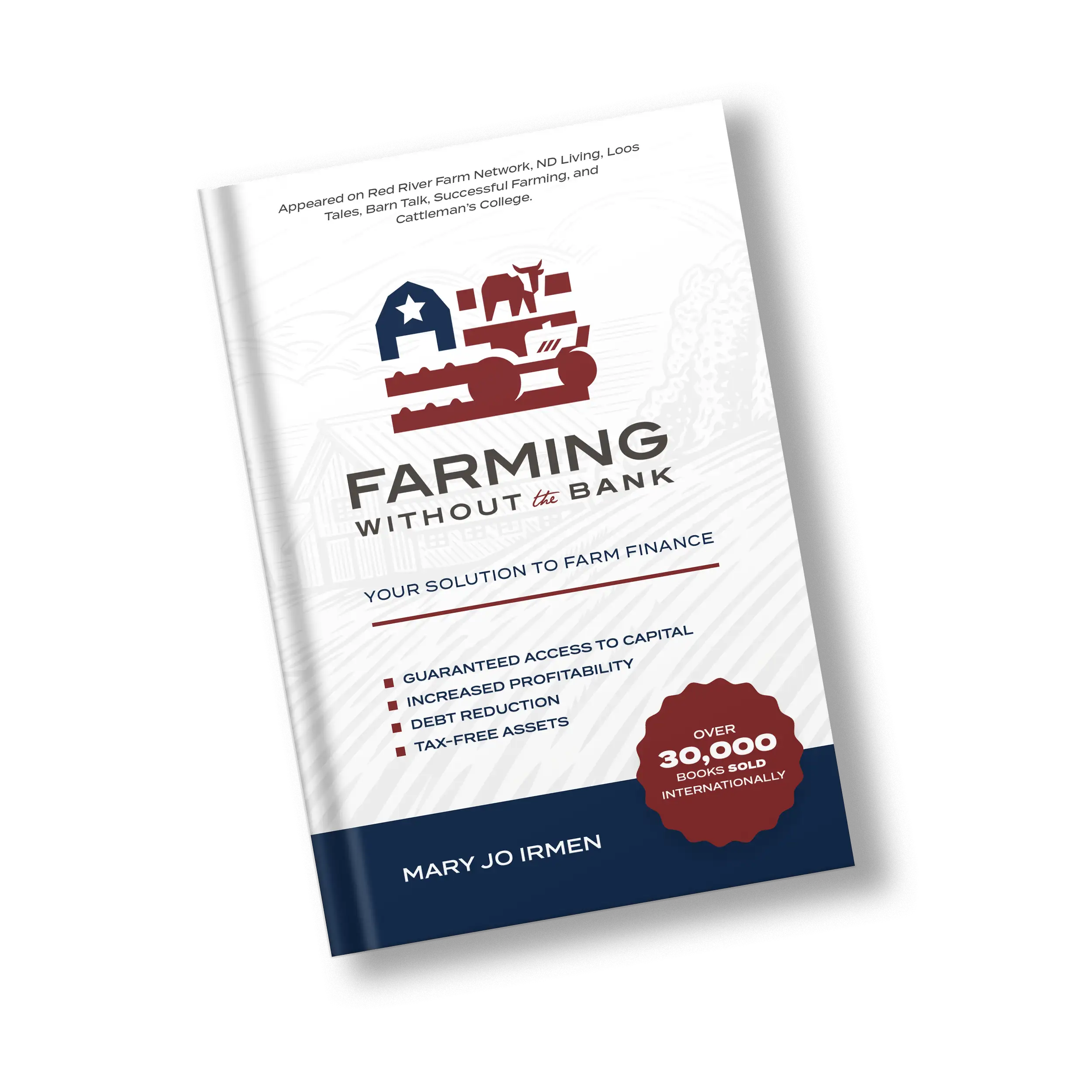
Your farm’s financial independence starts with one book.
30,000 farmers and ranchers have already made the shift. The only question is how long you’ll keep paying interest you could be keeping yourself.