 GET THE BOOK
 GET THE BOOK




Podcast
EP. 312
Ep. 312 – Seed or Harvest?
Jul 25, 2025 ·
21 min
0:00 / 20:43
EPISODE OVERVIEW
ABOUT THIS EPISODE
Most farmers and business owners are unknowingly planning for a tax-heavy retirement, and it’s costing them big time.
In this episode, Mary Jo Irmen uses a simple corn jar visual to unpack the powerful financial truth behind “seed vs. harvest” taxation. She explains why paying taxes today (on the seed) is often smarter than paying them later (on the harvest), and how whole life insurance and the Infinite Banking Concept (IBC) let you grow wealth without giving Uncle Sam a bigger cut later.
If you’re putting money into IRAs, 401(k)s, or even Roths without understanding the harvest tax implications, this episode is a must-listen.
🔑 Key Takeaways
- Why “tax deferral” often leads to bigger tax bills in retirement
- The danger of maxing out your 401(k) or IRA without a tax exit strategy
- What the government doesn’t want you to know about Roth IRAs
- How whole life insurance gives you tax control both now and later
- Why borrowing from your policy is income tax-free, and how to do it right
- What wealthy people do differently when planning for retirement
- How Infinite Banking changes your mindset about taxes, income, and control
📚 Resources & Links
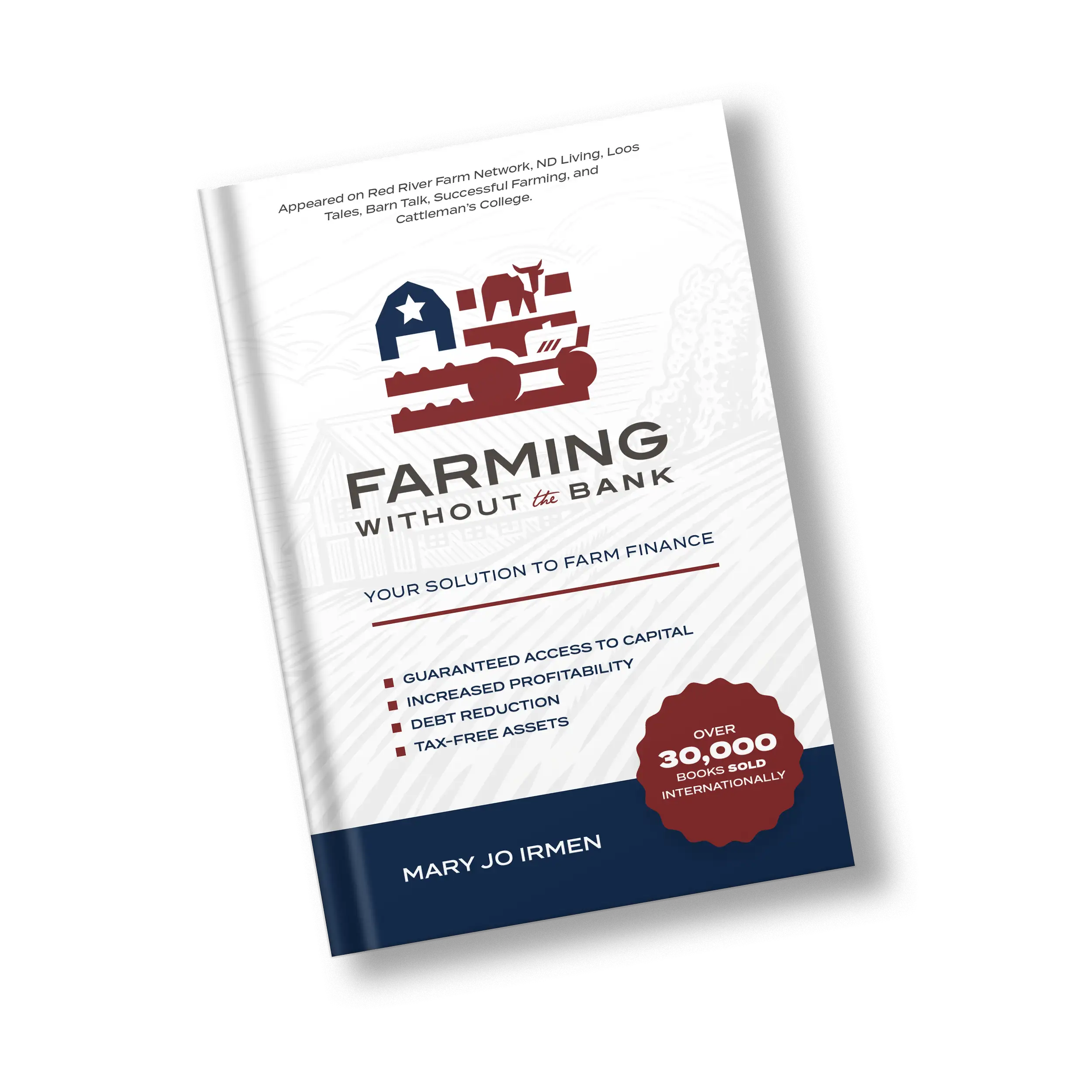
- 📘 Grab your copy of Farming Without the Bank
- 📅 Already read the book? Book a meeting with Mary Jo
- 📧 Questions? Reach out: maryjo@withoutthebank.com
- 👍 Follow on Facebook
- 🎧 More episodes: the Farming Without the Bank podcast is available on all podcast platforms.
🔥 Want to Keep Learning?
Binge past episodes to hear how real people are using IBC to take back control of their finances. Start with the case studies, and never look at retirement planning the same way again.
CHAPTER TIMESTAMPS
- 00:00Are You Paying Tax on the Seed or the Harvest?
- 01:15Why Life Insurance Premiums Shouldn't Be Deducted
- 02:30Capital Gains and the Step-Up in Basis Strategy
- 03:35IRAs, 401(k)s, and Tax-Deferred Regrets
- 04:30Roth IRAs: The Government's Least Favorite Tool
- 06:00The Farm Analogy for Retirement Accounts
- 06:48Why Whole Life Insurance Creates Tax-Free Retirement Cash Flow
- 08:00Taxes in Retirement: The Hidden Trap
- 09:50Required Minimum Distributions (RMDs) and Government Control
- 11:03Using Whole Life Insurance for Smarter Cash Flow
- 12:00How Wealthy People Avoid Taxes (Legally)
- 13:06Why Infinite Banking Is All About Tax Positioning
- 14:00Accountants vs. Financial Advisors: Who's Planning Long Term?
- 15:07Retirement Income vs. Forced Distributions
- 16:00FAQs: Premium Deductions, Access to Cash Value, and More
- 18:00Why the Case Studies in the Book Actually Matter
- 19:45Company Differences in Access to Policy Cash
- 20:00Wrap-Up and Where to Get Started
YOUTUBE EPISODE
TRANSCRIPTION
“Now, a lot of people think, well, I’m in a really high tax bracket. Are you going to be in a lower tax bracket at some point? Ideally in life, do we want to make more money or do we want to make less money? I know people that don’t want to make money so they don’t have to pay taxes. They literally do anything they can to not make money so they don’t have to pay taxes. If you are truly trying to not get ahead in life, this might not be the podcast for you.”
Hello, hello, hello, and welcome back to the podcast. Thank you very much for being here. Okay, today let’s talk about seed versus harvest and I have some visuals. So if you guys want to go to Spotify and listen to me on Spotify, you’re going to see a video. You want to go to YouTube, you can go to YouTube and you can watch me there. And then when you go to YouTube, why don’t you hit the little follow button? I would appreciate some follows on the YouTube.
Okay, so let’s talk about seed versus harvest. This is going to apply to a couple of different things. So I’m going to try my best here to explain this. So we’ve got seed, okay? We’ve got two kernels of corn that produced X amount of cobs. I don’t know how many cobs this was. This was years and years ago, but I took corn off the cob, put it in a jar, okay? Seed versus harvest. Which one do you want to pay tax on? Do you want to pay tax on this? Or do you want to pay tax on this? What are we doing? In a lot of aspects of our life, we’re paying tax on the harvest instead of the seed.
So here is one example. If we have a life insurance policy, a lot of people say, well, I want to deduct the premium as an expense. The premium can be deducted as an expense. It is not smart though, because when we die, our heirs are going to pay tax on the death benefit, which is equivalent to the harvest, right? We don’t want to pay tax on the death benefit. We want that to come to us income tax free or come to our heirs income tax free. And so if we can pay tax on the seed, fantastic.
Now, a lot of people think, well, I’m in a really high tax bracket. Are you going to be in a lower tax bracket at some point? Or ideally in life, do we want to make more money or do we want to make less money? Now, I know some people, believe me, like this, I know people that don’t want to make money so they don’t have to pay taxes. They literally do anything they can to not make money so they don’t have to pay taxes. Okay. So if you are truly trying to not get ahead in life, this might not be the podcast for you. But if we can pay taxes on what we make today, because ideally tomorrow, we’re always going to have more money, that would be fantastic. Right?
We are doing similar things when we talk about, like I can use the same visualization for capital gains. Right? Are we going to pay tax on the seed or are we going to pay tax on the harvest for capital gains? The reason that people pass things on when they pass away is so that they don’t have to pay tax on their harvest, their gains of everything that they’ve made. They want to give that to the next generation as a step up in basis and then they have a year or whatever it is to sell so that they don’t have to pay capital gains on those things. So we are constantly trying to not pay tax on the harvest and we have to be smart about it.
What are we doing with our IRAs, our 401(k)s? We’re paying tax on the harvest and we are putting money into this IRA and we’re sticking. Man, I’ve talked to people just recently who are sticking 10, 12, 15% away into IRAs and 401(k)s. Some of them are, you know, a lot of people do put the max in. People that are really good savers put the max in every year. Or if they have a 4% match, they’re putting in 8%. What are we doing? We are creating a bigger harvest that is taxed later. But if we’re farming, we have the write-offs to have the tax benefit on the seed, right? We’ve got tractors and we have cattle and we have feed and we have fencing and we have seed and chemical and fertilizer and fuel and all these expenses on the farm. And so we’re putting money away that we have to pay tax on later.
So a lot of people are like, well, a Roth, I don’t get a tax benefit from a Roth IRA. No, but you’re paying tax on the seed today. So when you take it out later, you’re not paying tax on all of this. That’s growing income tax-free. Do you ever consider why does a government only allow so much money into a Roth? And high income earners cannot contribute to a Roth. Does anybody ever think about why that is?
So I’m not a huge fan of anything in the market, right? You guys all know that. If you don’t know that, grab the book, Farming Without the Bank, and guess what? You’re going to learn that real quick. I have a whole chapter on why I don’t like the market. However, if we look at what’s happening inside of a Roth, it’s all growing income tax-free, right? We get to take that out income tax-free. That’s why a lot of people have Roth IRAs. That’s why most people, most people that are literate, financially literate, are going to put money into a Roth before they put money into a regular IRA.
High income earners like traditional IRAs because they can get the tax break today, and they think that that’s great. So they’re saying, hey, I’m going to take a tax break on this. This is what you’re doing with your IRA or your 401(k). I’m going to take a tax break on these two seeds, but I’m going to pay tax on this. That’s if you make this, right? Your IRA is very much like farming. Your 401(k) is very much like farming. We have to have rain to have that, right? We don’t just get this. We could plant this and get nothing, which is the risk that you take inside of a 401(k) as well.
And so what do we want to pay tax on? I don’t want to pay tax on this. So I’m going to put money into a whole life insurance policy, dividend-paying whole life insurance policy. So my policy is guaranteed to do this. Guaranteed that this is going to grow, right? And I’m going to pay tax before I pay my premium so that I can use it income tax free later when I borrow against the cash value. There’s no tax on that. So when we go to retire and we want to use that money for retirement, we can borrow against that. We can take out what we put in without an income tax penalty. We have to know how to do it correctly. Like you can’t just take whatever you want out. You can borrow against all of it income tax free, but you can’t just take any amount of it out. You have to be diligent about how you do that. So again, another reason why it’s helpful to have somebody that knows what they’re doing.
But I want my money so that I’m going to pay tax today. I’m in a high tax bracket. I’m going to pay tax today as much as I hate doing that because everything I have is growing. And so later, I’m going to be able to use it and I’m going to try to get myself into the 0% tax bracket. Is that 100% possible? I’m going to probably say no. At this point in my life, I have yet to see anybody that pays zero taxes. I don’t care what wealthy person you’re talking to out there. They are paying some level of taxes. And if they’re making a billion dollars and they pay a million dollars in taxes, they’re like, oh, that was a great deal. Okay? Because the more money we make, the more we adjust to what our taxes are. It’s sort of a necessary evil of life. Okay? Not necessary that I would love to have, but it’s there and you pay your taxes.
And so, we need to consider how we are doing that. How are we doing anything in life is are we looking at the seed or are we looking at the harvest? We’re so busy trying to avoid taxes right here that we pay them over here. We don’t want any expense on our seed as far as taxes go. So, we’re going to buy tractors. We’re going to buy cattle. We’re going to buy side-by-sides. We’re going to buy vehicles. We’re going to buy things that we don’t actually need in order to avoid the tax. But if we utilized our money differently and if we understood that we can pay some taxes today, have a guaranteed return, and not pay taxes later, isn’t that more beneficial?
And then we have to wonder why. And nobody asks this question. Why are Roth IRAs limited? Why doesn’t the government want you paying taxes later? When we have money in a 401(k) or an IRA or even an annuity, the rule of 72 applies. Well, now it’s 73. You need to start taking money at 73 years old. The government does not say, oh, hey, you can just pass that on to your heirs. It’s not a big deal. Nope. At 73, you need to take required minimum distributions. Why? If you don’t need the money, why are they making you take it? So that they can tax you on the harvest. They want their tax money out of here because they gave you a benefit early on. If you know how to invest that money and it grows, they’re going to tax you on the little bit of growth you have. They’re going to get their money.
And so when we start talking to people who are retired, they’re in a higher tax bracket today than they’ve ever been in their entire life. Because now we’re retired, we may not be farming, we may not be running our business, we don’t have any kids in school, we’re not buying things to avoid taxes because we’re 75 years old and we’re like, hey, you know what, I don’t need to buy land, I don’t need to buy equipment, I’m slowing down. So now we don’t have those write-offs and that’s what we’re paying tax on, is the harvest. And so if we’ve stuck money into a 401(k) or an IRA, that’s what we’re doing. If we have land that has increased in value, praise God, we have land that increased in value, but now we have to pay capital gains on it.
And so we’re always so worried about taxes that we don’t do certain things. How about we just do those things smarter so that if we’re going to be putting money into an IRA, why don’t we do a Roth IRA? Or if we’re going to put money into something that we want to remain liquid, there’s your whole life insurance policy, right? That’s the whole point of the infinite banking concept. If you guys read Becoming Your Own Banker, you would understand that Nelson does not like paying taxes. He absolutely believed that tax is theft, and I would have to agree with him. It is the easiest form of theft that we have in this country. And so if we’re going to avoid, how can we avoid those taxes? He’s going to pay on the seed so that when he retired, he was taking money out of his insurance policies or he was borrowing against them and he was using that money income tax free. Because when you take out just the basis of what you put in or you borrow against it, there are no taxes for that.
So if you listen to people like Robert Kiyosaki, he is saying, hey, I’m going to go buy real estate. And I saw that, oh my gosh, I forgot the name of the lady. She’s off the top of my head. She’s on the, it’s not The Apprentice. Is it The Apprentice? No, it’s not The Apprentice. That’s Donald Trump’s show. Oh my gosh, Barbara Corcoran. She was saying how she buys real estate and then she borrows money from the bank and takes all the equity out of that real estate and uses that income tax-free because loans are not income. They have to be paid back. And so even if you’re going to be borrowing from your whole life insurance policy or against your whole life insurance policy, that is income tax-free money for you. We have to figure out how to do this differently and that is what Nelson was talking about. That is the infinite banking piece of this. Utilizing money differently, thinking about money differently.
We have to consider the seed versus the harvest in many aspects of life. Not everything is depreciating. Like, your cattle may be depreciating, your equipment may be depreciating. It depends on the year. Right now, cattle are not depreciating. Equipment does not seem to be depreciating. It really depends on what’s happening. And so, if I can pay tax on the seed, I’m not happy to do that, but I’m happier to pay tax on the seed than I am to pay tax on the harvest. We need to be planning long-term, not just for today.
And the majority of our accountants are concerned about the seed. Oh my gosh, this is what you have today. They’re not talking about what that’s going to grow into and what that’s going to look like in the future. They don’t even consider that there’s going to be a harvest. I swear to goodness. That’s mind-boggling to me. Financial advisors will talk about the harvest, but are they going to talk about the taxes on the harvest? Oh, I’m going to get you from here to here, and I’m going to give you this 10 or 15 percent rate of return, but are we going to talk about the taxes on the harvest and what that looks like? Because they’re telling you, well, you’d only need X amount to live every year. Okay, but what are taxes going to be in the future? What does that look like for write-offs? I don’t have children. I don’t have a mortgage. I don’t have these things that I’m not supposed to do. I’ve done everything I’m supposed to do, right? I’ve listened to the gurus. I’ve followed all the instruction, and guess what? Guess what, my friends? Now I’m in tax trouble, and I am retired. So what do I do?
If we look at what wealthy people do, they are planning out into the future, and they’re planning for the harvest, and all aspects of the harvest. Now, as you guys know, I am a proponent of cash flow. How is that cash flow going to be coming in at retirement? I don’t want to have to be told, oh, I’ve got all this cash flow, but now I also am 73, and I have to take money out of my IRA. No, why? I did everything right. I have the rental properties, I have land, I have businesses that have money coming into me, and now you’re telling me that I need to pay taxes on something I don’t need? Yes, yes, that’s what they’re telling you.
And so we need to consider where we’re putting our money. Obviously, I am a proponent of dividend-paying whole life insurance, just because I’m going to pay tax on the seed, and then when I go to use the harvest, which is my cash value, I’m not going to pay tax on that, right? Because I’m going to do it correctly. Then, when my heirs get my death benefit, they’re not going to pay income tax on that either. And hopefully they don’t pay estate tax because we have that set up correctly. I hope that makes sense, and I hope that makes you guys think about your taxes just a little bit differently, and how you’re utilizing money, and what that looks like. No, you cannot deduct your premiums. But if you’re going to be using cash value, use that cash value for something that does create the deduction then.
Okay, let me know if you have questions. Hopefully, that visual helped you. If you need anything, maryjo@withoutthebank.com. Otherwise, go grab your book, Farming Without the Bank, schedule your appointment.
Here’s something that I’ve been running into lately, is a lot of people are not scheduling their appointments, and they’re not for a couple of reasons. One, you’re like, oh, I don’t know how this is going to work for me. That’s the whole point of the meeting, is so that John and I can go over exactly what you’re doing to figure out how this is going to work for you. No, we do not sell something. I had somebody tell me, yes, we sell life insurance, but we don’t push you, I should say. I had somebody tell me the other day, you are the least salesy person on the planet. He’s like, you’re actually trying to talk me out of this. And I’m like, yes, because you don’t have any money. And this would actually be an injustice if I sold you a policy right now. This would not benefit you financially at all. We need to get X, Y, and Z in order. And so, don’t be scared that we’re going to try to push you into something. John and I are not pushy people. I hate salespeople. That’s not going to happen.
And so, if you want to understand how the policy is structured, how quickly you have access to money. Doug Ferguson called me the other day from Sell/Buy Marketing. You guys know Doug Ferguson? Okay. So, Doug Ferguson called me the other day and said, hey, I got a lot of people coming to my schools and asking how soon can we have access to the cash value? Well, first of all, it’s in the book. How much you have access to is in the book in the Don and Anita case study, right? But you have access to money in 10 days. We go over all of that, how it’s structured, the inner workings of interest. All that stuff is covered in our meeting, which is why you should have the meeting. If I had to put all of that in the book, then we would have a 250, 300 page book and guess what? None of you would want to read it. So, there’s that.
So, schedule your appointment so that we can show you the inner workings of everything. We can look at to see what this is going to do for you, if it’s a fit for you financially, all that good stuff. So, read the book, make your appointment, and go over those case studies because all the numbers are there. How it works is there. If you are listening on audio, if you’ve bought the audio book and you’re like, well, I didn’t get the case studies. Well, I’m to point where I may just not even allow the audio book to be purchased without the actual hardcover. And the reason why is because you guys get all of the case studies in an email with the link to the audio book, but y’all are not looking at it. Okay? That, and then you come in and you’re like, well, I don’t understand how this works. Well, you don’t understand how it works because you haven’t actually followed the case studies.
So the case studies are there to show you how much money is accessible. Yes, it doesn’t say in 10 days. Every company is different. The company that I use, we have access to money in 10 days. That check clears, 10 days later, we can take a loan. That is not every company. Some companies are 30 days. Some companies are 90 days. Every company is just a little bit different. So anyway, the case studies are there. The numbers are there. Subtract some zeros off of it if we’re not understanding it. Reread it again or schedule your appointment so that we can answer those questions. Okay, let me know if you guys need anything. maryjo@withoutthebank.com. Grab your book and we’ll talk to you in the next podcast.
Thanks for listening to the Farming Without the Bank podcast. We hope today’s episode has inspired you to take control of your finances in new ways. Don’t forget to check out our website, farmingwithoutthebank.com, and engage with us on our Facebook page, Farming Without the Bank. Join us next week as we smash more financial myths and empower you to accomplish your financial goals.
View MoreHello, hello, hello, and welcome back to the podcast. Thank you very much for being here. Okay, today let’s talk about seed versus harvest and I have some visuals. So if you guys want to go to Spotify and listen to me on Spotify, you’re going to see a video. You want to go to YouTube, you can go to YouTube and you can watch me there. And then when you go to YouTube, why don’t you hit the little follow button? I would appreciate some follows on the YouTube.
Okay, so let’s talk about seed versus harvest. This is going to apply to a couple of different things. So I’m going to try my best here to explain this. So we’ve got seed, okay? We’ve got two kernels of corn that produced X amount of cobs. I don’t know how many cobs this was. This was years and years ago, but I took corn off the cob, put it in a jar, okay? Seed versus harvest. Which one do you want to pay tax on? Do you want to pay tax on this? Or do you want to pay tax on this? What are we doing? In a lot of aspects of our life, we’re paying tax on the harvest instead of the seed.
So here is one example. If we have a life insurance policy, a lot of people say, well, I want to deduct the premium as an expense. The premium can be deducted as an expense. It is not smart though, because when we die, our heirs are going to pay tax on the death benefit, which is equivalent to the harvest, right? We don’t want to pay tax on the death benefit. We want that to come to us income tax free or come to our heirs income tax free. And so if we can pay tax on the seed, fantastic.
Now, a lot of people think, well, I’m in a really high tax bracket. Are you going to be in a lower tax bracket at some point? Or ideally in life, do we want to make more money or do we want to make less money? Now, I know some people, believe me, like this, I know people that don’t want to make money so they don’t have to pay taxes. They literally do anything they can to not make money so they don’t have to pay taxes. Okay. So if you are truly trying to not get ahead in life, this might not be the podcast for you. But if we can pay taxes on what we make today, because ideally tomorrow, we’re always going to have more money, that would be fantastic. Right?
We are doing similar things when we talk about, like I can use the same visualization for capital gains. Right? Are we going to pay tax on the seed or are we going to pay tax on the harvest for capital gains? The reason that people pass things on when they pass away is so that they don’t have to pay tax on their harvest, their gains of everything that they’ve made. They want to give that to the next generation as a step up in basis and then they have a year or whatever it is to sell so that they don’t have to pay capital gains on those things. So we are constantly trying to not pay tax on the harvest and we have to be smart about it.
What are we doing with our IRAs, our 401(k)s? We’re paying tax on the harvest and we are putting money into this IRA and we’re sticking. Man, I’ve talked to people just recently who are sticking 10, 12, 15% away into IRAs and 401(k)s. Some of them are, you know, a lot of people do put the max in. People that are really good savers put the max in every year. Or if they have a 4% match, they’re putting in 8%. What are we doing? We are creating a bigger harvest that is taxed later. But if we’re farming, we have the write-offs to have the tax benefit on the seed, right? We’ve got tractors and we have cattle and we have feed and we have fencing and we have seed and chemical and fertilizer and fuel and all these expenses on the farm. And so we’re putting money away that we have to pay tax on later.
So a lot of people are like, well, a Roth, I don’t get a tax benefit from a Roth IRA. No, but you’re paying tax on the seed today. So when you take it out later, you’re not paying tax on all of this. That’s growing income tax-free. Do you ever consider why does a government only allow so much money into a Roth? And high income earners cannot contribute to a Roth. Does anybody ever think about why that is?
So I’m not a huge fan of anything in the market, right? You guys all know that. If you don’t know that, grab the book, Farming Without the Bank, and guess what? You’re going to learn that real quick. I have a whole chapter on why I don’t like the market. However, if we look at what’s happening inside of a Roth, it’s all growing income tax-free, right? We get to take that out income tax-free. That’s why a lot of people have Roth IRAs. That’s why most people, most people that are literate, financially literate, are going to put money into a Roth before they put money into a regular IRA.
High income earners like traditional IRAs because they can get the tax break today, and they think that that’s great. So they’re saying, hey, I’m going to take a tax break on this. This is what you’re doing with your IRA or your 401(k). I’m going to take a tax break on these two seeds, but I’m going to pay tax on this. That’s if you make this, right? Your IRA is very much like farming. Your 401(k) is very much like farming. We have to have rain to have that, right? We don’t just get this. We could plant this and get nothing, which is the risk that you take inside of a 401(k) as well.
And so what do we want to pay tax on? I don’t want to pay tax on this. So I’m going to put money into a whole life insurance policy, dividend-paying whole life insurance policy. So my policy is guaranteed to do this. Guaranteed that this is going to grow, right? And I’m going to pay tax before I pay my premium so that I can use it income tax free later when I borrow against the cash value. There’s no tax on that. So when we go to retire and we want to use that money for retirement, we can borrow against that. We can take out what we put in without an income tax penalty. We have to know how to do it correctly. Like you can’t just take whatever you want out. You can borrow against all of it income tax free, but you can’t just take any amount of it out. You have to be diligent about how you do that. So again, another reason why it’s helpful to have somebody that knows what they’re doing.
But I want my money so that I’m going to pay tax today. I’m in a high tax bracket. I’m going to pay tax today as much as I hate doing that because everything I have is growing. And so later, I’m going to be able to use it and I’m going to try to get myself into the 0% tax bracket. Is that 100% possible? I’m going to probably say no. At this point in my life, I have yet to see anybody that pays zero taxes. I don’t care what wealthy person you’re talking to out there. They are paying some level of taxes. And if they’re making a billion dollars and they pay a million dollars in taxes, they’re like, oh, that was a great deal. Okay? Because the more money we make, the more we adjust to what our taxes are. It’s sort of a necessary evil of life. Okay? Not necessary that I would love to have, but it’s there and you pay your taxes.
And so, we need to consider how we are doing that. How are we doing anything in life is are we looking at the seed or are we looking at the harvest? We’re so busy trying to avoid taxes right here that we pay them over here. We don’t want any expense on our seed as far as taxes go. So, we’re going to buy tractors. We’re going to buy cattle. We’re going to buy side-by-sides. We’re going to buy vehicles. We’re going to buy things that we don’t actually need in order to avoid the tax. But if we utilized our money differently and if we understood that we can pay some taxes today, have a guaranteed return, and not pay taxes later, isn’t that more beneficial?
And then we have to wonder why. And nobody asks this question. Why are Roth IRAs limited? Why doesn’t the government want you paying taxes later? When we have money in a 401(k) or an IRA or even an annuity, the rule of 72 applies. Well, now it’s 73. You need to start taking money at 73 years old. The government does not say, oh, hey, you can just pass that on to your heirs. It’s not a big deal. Nope. At 73, you need to take required minimum distributions. Why? If you don’t need the money, why are they making you take it? So that they can tax you on the harvest. They want their tax money out of here because they gave you a benefit early on. If you know how to invest that money and it grows, they’re going to tax you on the little bit of growth you have. They’re going to get their money.
And so when we start talking to people who are retired, they’re in a higher tax bracket today than they’ve ever been in their entire life. Because now we’re retired, we may not be farming, we may not be running our business, we don’t have any kids in school, we’re not buying things to avoid taxes because we’re 75 years old and we’re like, hey, you know what, I don’t need to buy land, I don’t need to buy equipment, I’m slowing down. So now we don’t have those write-offs and that’s what we’re paying tax on, is the harvest. And so if we’ve stuck money into a 401(k) or an IRA, that’s what we’re doing. If we have land that has increased in value, praise God, we have land that increased in value, but now we have to pay capital gains on it.
And so we’re always so worried about taxes that we don’t do certain things. How about we just do those things smarter so that if we’re going to be putting money into an IRA, why don’t we do a Roth IRA? Or if we’re going to put money into something that we want to remain liquid, there’s your whole life insurance policy, right? That’s the whole point of the infinite banking concept. If you guys read Becoming Your Own Banker, you would understand that Nelson does not like paying taxes. He absolutely believed that tax is theft, and I would have to agree with him. It is the easiest form of theft that we have in this country. And so if we’re going to avoid, how can we avoid those taxes? He’s going to pay on the seed so that when he retired, he was taking money out of his insurance policies or he was borrowing against them and he was using that money income tax free. Because when you take out just the basis of what you put in or you borrow against it, there are no taxes for that.
So if you listen to people like Robert Kiyosaki, he is saying, hey, I’m going to go buy real estate. And I saw that, oh my gosh, I forgot the name of the lady. She’s off the top of my head. She’s on the, it’s not The Apprentice. Is it The Apprentice? No, it’s not The Apprentice. That’s Donald Trump’s show. Oh my gosh, Barbara Corcoran. She was saying how she buys real estate and then she borrows money from the bank and takes all the equity out of that real estate and uses that income tax-free because loans are not income. They have to be paid back. And so even if you’re going to be borrowing from your whole life insurance policy or against your whole life insurance policy, that is income tax-free money for you. We have to figure out how to do this differently and that is what Nelson was talking about. That is the infinite banking piece of this. Utilizing money differently, thinking about money differently.
We have to consider the seed versus the harvest in many aspects of life. Not everything is depreciating. Like, your cattle may be depreciating, your equipment may be depreciating. It depends on the year. Right now, cattle are not depreciating. Equipment does not seem to be depreciating. It really depends on what’s happening. And so, if I can pay tax on the seed, I’m not happy to do that, but I’m happier to pay tax on the seed than I am to pay tax on the harvest. We need to be planning long-term, not just for today.
And the majority of our accountants are concerned about the seed. Oh my gosh, this is what you have today. They’re not talking about what that’s going to grow into and what that’s going to look like in the future. They don’t even consider that there’s going to be a harvest. I swear to goodness. That’s mind-boggling to me. Financial advisors will talk about the harvest, but are they going to talk about the taxes on the harvest? Oh, I’m going to get you from here to here, and I’m going to give you this 10 or 15 percent rate of return, but are we going to talk about the taxes on the harvest and what that looks like? Because they’re telling you, well, you’d only need X amount to live every year. Okay, but what are taxes going to be in the future? What does that look like for write-offs? I don’t have children. I don’t have a mortgage. I don’t have these things that I’m not supposed to do. I’ve done everything I’m supposed to do, right? I’ve listened to the gurus. I’ve followed all the instruction, and guess what? Guess what, my friends? Now I’m in tax trouble, and I am retired. So what do I do?
If we look at what wealthy people do, they are planning out into the future, and they’re planning for the harvest, and all aspects of the harvest. Now, as you guys know, I am a proponent of cash flow. How is that cash flow going to be coming in at retirement? I don’t want to have to be told, oh, I’ve got all this cash flow, but now I also am 73, and I have to take money out of my IRA. No, why? I did everything right. I have the rental properties, I have land, I have businesses that have money coming into me, and now you’re telling me that I need to pay taxes on something I don’t need? Yes, yes, that’s what they’re telling you.
And so we need to consider where we’re putting our money. Obviously, I am a proponent of dividend-paying whole life insurance, just because I’m going to pay tax on the seed, and then when I go to use the harvest, which is my cash value, I’m not going to pay tax on that, right? Because I’m going to do it correctly. Then, when my heirs get my death benefit, they’re not going to pay income tax on that either. And hopefully they don’t pay estate tax because we have that set up correctly. I hope that makes sense, and I hope that makes you guys think about your taxes just a little bit differently, and how you’re utilizing money, and what that looks like. No, you cannot deduct your premiums. But if you’re going to be using cash value, use that cash value for something that does create the deduction then.
Okay, let me know if you have questions. Hopefully, that visual helped you. If you need anything, maryjo@withoutthebank.com. Otherwise, go grab your book, Farming Without the Bank, schedule your appointment.
Here’s something that I’ve been running into lately, is a lot of people are not scheduling their appointments, and they’re not for a couple of reasons. One, you’re like, oh, I don’t know how this is going to work for me. That’s the whole point of the meeting, is so that John and I can go over exactly what you’re doing to figure out how this is going to work for you. No, we do not sell something. I had somebody tell me, yes, we sell life insurance, but we don’t push you, I should say. I had somebody tell me the other day, you are the least salesy person on the planet. He’s like, you’re actually trying to talk me out of this. And I’m like, yes, because you don’t have any money. And this would actually be an injustice if I sold you a policy right now. This would not benefit you financially at all. We need to get X, Y, and Z in order. And so, don’t be scared that we’re going to try to push you into something. John and I are not pushy people. I hate salespeople. That’s not going to happen.
And so, if you want to understand how the policy is structured, how quickly you have access to money. Doug Ferguson called me the other day from Sell/Buy Marketing. You guys know Doug Ferguson? Okay. So, Doug Ferguson called me the other day and said, hey, I got a lot of people coming to my schools and asking how soon can we have access to the cash value? Well, first of all, it’s in the book. How much you have access to is in the book in the Don and Anita case study, right? But you have access to money in 10 days. We go over all of that, how it’s structured, the inner workings of interest. All that stuff is covered in our meeting, which is why you should have the meeting. If I had to put all of that in the book, then we would have a 250, 300 page book and guess what? None of you would want to read it. So, there’s that.
So, schedule your appointment so that we can show you the inner workings of everything. We can look at to see what this is going to do for you, if it’s a fit for you financially, all that good stuff. So, read the book, make your appointment, and go over those case studies because all the numbers are there. How it works is there. If you are listening on audio, if you’ve bought the audio book and you’re like, well, I didn’t get the case studies. Well, I’m to point where I may just not even allow the audio book to be purchased without the actual hardcover. And the reason why is because you guys get all of the case studies in an email with the link to the audio book, but y’all are not looking at it. Okay? That, and then you come in and you’re like, well, I don’t understand how this works. Well, you don’t understand how it works because you haven’t actually followed the case studies.
So the case studies are there to show you how much money is accessible. Yes, it doesn’t say in 10 days. Every company is different. The company that I use, we have access to money in 10 days. That check clears, 10 days later, we can take a loan. That is not every company. Some companies are 30 days. Some companies are 90 days. Every company is just a little bit different. So anyway, the case studies are there. The numbers are there. Subtract some zeros off of it if we’re not understanding it. Reread it again or schedule your appointment so that we can answer those questions. Okay, let me know if you guys need anything. maryjo@withoutthebank.com. Grab your book and we’ll talk to you in the next podcast.
Thanks for listening to the Farming Without the Bank podcast. We hope today’s episode has inspired you to take control of your finances in new ways. Don’t forget to check out our website, farmingwithoutthebank.com, and engage with us on our Facebook page, Farming Without the Bank. Join us next week as we smash more financial myths and empower you to accomplish your financial goals.
ready to start?
Your farm’s financial independence starts with one book.
30,000 farmers and ranchers have already made the shift. The only question is how long you’ll keep paying interest you could be keeping yourself.