 GET THE BOOK
 GET THE BOOK




Podcast
EP. 316
Ep. 316 – Reimagining Agricultural Finance
Aug 22, 2025 ·
27 min
0:00 / 26:40
EPISODE OVERVIEW
ABOUT THIS EPISODE
Tired of banks controlling when and how you sell your crops or cattle? In this episode, Mary Jo Irmen breaks down how the Infinite Banking Concept (IBC) can transform the way farmers and ranchers finance their operations.
Instead of selling at wholesale prices just to make loan payments, you can take back control, build generational wealth, and stop letting bankers dictate your future.
🔑 What You’ll Learn in This Video
- Why banks force farmers to sell at the wrong time
- How Infinite Banking creates liquidity, control, and guaranteed growth
- The 10% tipping point that could change the entire ag market
- How to finance equipment, cattle, and land without the bank
- The role of Infinite Banking in reducing stress, farm foreclosures, and even suicide rates in agriculture
- How building your own banking system protects family farms and generational wealth
Mary Jo explores the significant impacts of bank control on farming operations and presents the Infinite Banking Concept as a solution. By controlling their own finances, farmers could make strategic decisions without bank-imposed selling deadlines, increasing profits and reducing stress.
The discussion also touches upon the broader implications of financial control, such as influencing market prices, promoting generational wealth, and even addressing serious issues like farmer suicide.
(Timestamps are from the video version. Audio-only edits are always shorter since they have had more fluff removed, so the timestamps are not accurate to this version.)
🌾 Ready to Stop Letting the Bank Control Your Farm?
- 📘 Grab Mary Jo’s book Farming Without the Bank
- 📘 Get Nelson Nash’s classic Becoming Your Own Banker
- 📅 Read the book? Schedule a consultation
🔔 Subscribe to Farming Without the Bank for more videos on:
- Infinite Banking for farmers & ranchers
- How to keep family farms in the family
- Generational wealth strategies without Wall Street
- Financial education for business owners
CHAPTER TIMESTAMPS
- 00:00The Problem: Banks Control Your Operation
- 02:30Why Farmers Sell at Wholesale Prices
- 05:45Neighbor A vs. Neighbor B: Who Really Controls the Deal?
- 08:10The Infinite Banking Solution for Farmers
- 12:20Could 10% of Farmers Change the Markets?
- 15:00Generational Wealth & Keeping Family Farms Alive
- 20:00Why Waiting for Others Keeps You Stuck
- 23:00Final Thoughts: Take Control, Build Your Own Banking System
YOUTUBE EPISODE
TRANSCRIPTION
“What if we didn’t have the bank to owe money to? What if the bank was not in control? Because as soon as we take a bank loan, the bank is in control and they determine what we’re going to sell for, when we’re going to sell based on when that note is due. What if we could hold it and say, you know what, I’m not selling until spring because the only person I have to answer to is me. So if I controlled that loan, I would have the ability to pay me when I want to pay me. And if that is cash, that’s fantastic. But if we use the infinite banking concept, we’re earning interest on all of that money. Now, when we harvest, we can pay it back whenever we want because nobody is going to be like, hey, you got to pay that back, it’s January. No, not happening. You get to pay that back when you want, which means you can control your sale price and you can sit on that corn for as long as you like.”
Hello, hello, hello, and welcome back to the podcast. Thank you very much for being here. All right, today, let’s talk about how much is bank control hurting your operation? And I want to look at really, what would it do if we shift all of that money control back to you? Would it affect the markets? Would it affect the big four packers? Would it affect all of those things?
And so the biggest thing that I see and the biggest thing that we hear in the industry is we buy at retail and we sell at wholesale. Or you guys don’t have control of the markets. And so you’re going to have to sell and you’re not going to get what you need. But everything comes down to money. When I try to solve the problem, instead of just complaining about the problem, which everybody wants to complain about, China’s buying our land. All the big good developers are buying our land. We don’t get what we need for our products. We’re barely out here surviving. Okay, can we just stop complaining about it and start figuring out the solution? Many of us in the world, it does not matter if you’re a farmer or who you are, a lot of people like to complain, but they don’t ever try to find the solution and move towards the solution. So let’s look at a possible solution today.
So when I hear those things and I hear, well, JBS isn’t paying me what I want for my cattle. Okay, so how do we get them to pay you what you want for your cattle? And why are you taking less? Are you taking less? And this is in most cases that I hear, I’m taking less because that’s all JBS is offering and they won’t negotiate any further and I need to pay my bank loan. Why are you selling corn and wheat for less than you want to? Because that’s what the markets are right now and my loan is due so I have to get it sold because the bank is wanting their money.
So if the problem is that the bank is holding a note for you and they’re pushing you to sell and you have to sell at today’s prices because they have to be fulfilled, then guess who has the upper hand? The market. Because the market knows that the majority of you are in bed with the banker and they know that your note is due and they know that the bank is not going to hold that over. So when people like JBS come in and you go to the elevator and that’s what wheat is and that’s what corn is per bushel, your hands are a little bit tied because you don’t have the ability to say, no, I’m putting that grain back in the bin and I’m going to sit on it until prices are better. Because my farmers that farm with cash, that’s what they do. They wait for the correct price or they contract their grain so they know, but they don’t contract all of it. So maybe they only contract 40% of it. The other 60% of it, they’re going to just hold it until prices are right. They contract what they need to fulfill the bank and then they can play with the rest.
I had a JBS buyer meet with me and I was quizzing him a little bit on prices and his comment was very interesting. He said, I can go to two neighbors and I will pay one neighbor more for their cattle than the other neighbor. Because let’s say neighbor A took less than neighbor B. Well, it is, why? Because neighbor B maybe didn’t have anybody that he was having to pay, right? So neighbor B is like, no, I’m not taking your offer at JBS. Go fly a kite because I don’t have to sell these cows right now. I mean, obviously they got to be sold at some point, but I don’t need to sell them right now. So no, go fly a kite. But neighbor A is saying, I have to sell them. That’s the best you’re going to give me. Okay, I have to sell them because I have to fulfill the bank.
The other thing he said is they don’t talk to one another. In this industry, we are so private and we think that we have the upper hand, that we are not helping out our neighbor. And so nobody talks to one another. So neighbor A is not going to talk to neighbor B. He’s going to take less and then he’s going to be mad because neighbor B got more money. Well, why did neighbor B get more money? Like, are we not asking why? Why is the market the price it is? Who is manipulating it? Why are they manipulating it? And how can we come in to have a scarcity of product? So now they’re like, hey, we need more wheat. We need more corn. What happens? What would happen if the majority of farmers said, I am not hauling corn to the ethanol plant until I get X amount of dollars? Guess what? We’re all hauling corn to the ethanol plant at whatever they’re giving us that day because we need money to make our bank payment.
So what if we didn’t have the bank to owe money to? What if the bank was not in control? Because as soon as we take a bank loan, the bank is in control and they determine what we’re going to sell for, when we’re going to sell based on when that note is due. Right? If we want to hold it over for another six months because commodity prices might be higher in July or it might be higher in spring when we’re planting because less is being hauled in. Now we can’t haul it in, but, or we can’t hold it until spring because our note is due in January. Right? So we have to sell for whatever the December price is.
So what if we could hold it and say, you know what? I’m not selling until spring because the only person I have to answer to is me. So if I controlled that loan, I would have the ability to pay me when I want to pay me. And if that is cash, that’s fantastic. But if we use the infinite banking concept, we’re earning interest on all of that money. Right? Compound interest, dividends, we’re earning it on all the money we use to plant that corn. Now when we harvest, we can pay it back whenever we want because nobody is going to be like, hey, you got to pay that back. It’s January. No, not happening. You get to pay that back when you want, which means you can control your sale price and you can sit on that corn for as long as you like. Is there, no, people are going to say there’s a cost of sitting on the corn. I’m paying the elevator. Yeah, I know. I get it. But let’s just look at the big picture of it and then break it down to see if it makes sense.
There is a book called The Tipping Point, something The Tipping Point. And they have determined that 10% is the tipping point. So what if, and it doesn’t matter what it is, so what if 10% of farmers said, I am not going to the bank to borrow money. I am going to use cash or I am going to use infinite banking and I am going to be my own banker and I am going to pay myself back. If 10% of farmers did that, would there be enough scarcity set that the demand would drive the price up? So now, 10% of farmers are not hauling corn to the ethanol plant because we are saying that price is not good enough. We’re not accepting that price. We need more. So now, who is setting the price? Farmers.
But farmers can’t do that if the banks are the ones that are controlling when things have to be paid because they’re not holding over a note. Because as soon as the price goes down, what happens at the bank? Oh my God, I’m not going to get my payment from farmer X, Y, and Z. And so they need to sell. I don’t care what the price is. I don’t care if they can put food on their table. But right now, I know if they sold their grain in the bins, they would have enough to pay my note. So they’re going to sell. I’m going to make them sell. I’m not going to extend this note so they can hold that grain and get a better price. Now, if I was in control, I wouldn’t have to worry about it.
It’s no different than me buying land. So I bought some farm ground and guess what? I have to pay the bank on X day. I have to have the bank paid on X day. So that means my renter needs to pay me so I have the money to make my bank payment. I have to plan for that. It is, they are in control of that payment. If I’m late, that’s not good. Right? I don’t want to lose my land. I don’t want to pay extra interest. I don’t want to pay penalties. And so, I don’t even want to have to work with them. I just need to get them paid. Now, let’s say that my tenant had a bad year and I owed myself that money and I didn’t go to the bank. I could say, you know what, you just pay me whenever works for you because it doesn’t matter when I make that payment because I’m in control of that payment. Therefore, my tenant would be less stressed as well because he had a bad year.
Think about it. We are all looking at the problem and we’re complaining about the problem that we’re selling at wholesale, buying at retail. We’re not happy with the prices we’re getting. Can we be in charge of that? Can we hold the grain? And we all have that person we know. That’s old. And they have, they’re using cash and they might have three years worth of grain in their bins. They’re like, well, haven’t sold it. A, maybe I don’t, I want to defer taxes so I’m not selling it because I don’t want to pay taxes on it. Maybe it’s because it was too low a price and we’re going to hold it. Doesn’t matter how long we hold it as long as it stays good and we get a good price for it, we’re fine. But they’re in control. Instead of using cash, they should be using IBC. But they’re ultimately in control.
What if we had a bad year, we couldn’t make a bank payment, would we need to commit suicide? If things, if we were, if we were using our life insurance policy and we had control of payback, if we had two bad years, would we reduce the suicide rate amongst farmers? I 100% believe we would. There is not a banker on this planet that wants anybody to commit suicide. Not one. I don’t care. You can’t, you could not convince me otherwise. Bankers are not bad people. They are in the business of making money. And when we borrow money from them, they want to be made whole. And in most cases, they don’t want your land, they don’t want your equipment, and they don’t want your cattle. They want the cash flow. And I’ve talked about this before. But they have to call notes because they have a board that they have to answer to. And the board is there to run the business.
And so, when the banker calls a note on somebody and that person commits suicide because he doesn’t see a way out, that is stress. What is causing that stress? His loan with the bank that he is not in control of. If we, every, every time that I look at one of these problems, not every time, the majority of times that I look at these problems and you trace the problem to the root and you’re like, where is the root of this coming from? It is a money issue. Divorce will cause a money issue. Bank control will cause a money issue. Borrowing too much money is a money issue. Mismanagement of the business. And so, if we can get the money control back into your hands, you start running it like a business, the stress level goes down.
So, now if I get hailed out or if I get droughted out and I lost money and crop insurance didn’t make up the difference, it’s okay because I owe that back to me and I can pay that back over my lifetime if I need. If that one piece we controlled wouldn’t make a difference in what you get paid and how you sell your product. Could you actually make more profit? And again, the internet’s heads are going to roll because you guys are going to say, Mary Jo, you’re such a moron, it’s not that easy. I’m not saying it’s easy. I’m not saying it’s going to happen overnight. But if 10% of farmers controlled their own finances, would it make a difference in the market?
And if you look at the book, it’s a 10%, they’ve studied it, it’s a 10% tipping point. We talk about it within the infinite banking world. If 10% of the population stopped using the bank, the Federal Reserve would actually be hurt. They would not be able to print the kind of money they’re printing because we wouldn’t be turning money 10 to 1. We wouldn’t be going to the bank to borrow money. So if we can get 10% of the population to make that move to infinite banking, we could actually see a difference in inflation. Now, that’s huge. Yet, it’s a huge task. Is it going to happen in my lifetime? Probably not. Does it mean I’m not trying to help be a part of the 10%? No. I’m not saying, hey, it’s not going to happen in my lifetime, so I’m not going to worry about it. I will plant the tree today so that it is there for the next generation or generations to come. I’m not selfish enough to be like, oh, I’m not starting. I’m not going to do anything about it. Because if somebody doesn’t start, how do we ever end up in a better position?
And this belief that everybody needs to struggle because we struggled is asinine. Do people need to be appreciative of what they got and understand where their ancestors came from and the struggle to build it? Yes. 100%. But that is on us to relay that and make sure that our heirs have gratitude and understanding towards that. If they don’t, then we have either done something wrong or our children are not decent human beings and we need to maybe consider that in our estate plan. But to say I’m not doing it because it’s not going to help me is ridiculous.
So if we can get started today and we can slowly move the finances over to us where we control them and we can do infinite banking because we have the generational wealth piece that will even escalate this faster to get rid of the banks, if we can do that, could we stop selling at wholesale? Could we start selling at retail? Could we then tell JBS to go pound sand? Because we’re not taking that offer. And if 10% of their cattle producers said no, we are not accepting that offer, would they have to pay more and maybe take less for their executives? We can complain about a problem or we can find the solution to the problem. All of us have to be on board though. It’s not a one man can change this.
I am out here hoping that by the time I die, there is a generation after me, whatever, that we have enough farmers that say, I want to control this and I want to change the way farming is financed. I want to give the bank, I want to give the farmers more control. That’s all I’m trying to do out here is say, hey, you, Mr. Farmer, let’s give you more control. Let’s make sure that the next generation has some generational wealth that we don’t lead them back to the farm. Because what are we seeing? There are generations, there are people out there in this generation that are farming with cash, but they’re going to leave it to everybody and then they’re going to have to go back to the bank to buy out siblings. So mom and dad, whoever own it, grandpa and grandma, they’re farming with cash, but the next generation is going to get put right back into the banking system.
So if we all did infinite banking, if 10% of our farmers did infinite banking, could that seriously change the markets? Could that seriously help generational wealth and keep family farms, family farms? I 100% believe that. And you can think I am smoking something, I frankly don’t care. Because the people that don’t believe it aren’t the people that are going to make the change. And that as soon as we make the change and quit waiting for somebody else to do it, we might actually see change.
I’m always a little bit amazed when I get an email from somebody that’s like 30 or 40 years old and they’re like, yeah, mom and dad won’t listen to me to do this. Who cares? Who cares? Do it yourself then. Figure out how to do infinite banking yourself and start your own system. I am not waiting for mom and dad. Why are we waiting for mom and dad to do it? Would it work better if they did? 100%. 100% it would. But if they’re not going to, why put your energy there? Figure out how you can be building your own system to get started. Right? We’re always passing the buck. Quit passing it. Accept it. Do something about it. Take some action and move on.
And so I hear this non-stop chatter of how it’s so hard in agriculture and we’re not getting what we rightly deserve for our commodities. And I agree with you 100% you’re not. It is legitimate chatter. But what I don’t hear is the solution to that chatter. Instead, we all get together and we go chat, we go to the coffee shop or we meet up in somebody’s shop and drink some beers and bitch about all the same problems we’ve complained about for the last two decades or two generations, sorry, but yet nobody’s solving the problem. And here I am with what I believe is a solution to the problem and y’all are telling me I’ve lost my ever-loving mind and that this isn’t going to work. Yeah, well, yes, it will. We just have to get it started. And who better to start with than you?
And don’t say, Mary Jo, it doesn’t matter, I need $3 million, I need a million dollars. You didn’t start farming 5,000 acres overnight. You didn’t have 500 head of cattle overnight. You worked your way up to that. And so you’re going to have to work your way into the system. Getting a little bit out of the banking system is better than being 100% in the banking system. What if 10% of your finances you controlled and the other 90% were the bank? What if all of your equipment loans and your cattle notes were in your banking system but you were only borrowing operating? What if you were only borrowing money for cattle and land and equipment but all your operating was in the insurance policy and under your control? Doesn’t matter. Does not matter. I still have bank loans. But the majority of what I do is outside of the banking system. The bank is plan B, not plan A.
And so it’s not an all or nothing approach. That mindset is what keeps you where you’re at, to completely go back to the complaining and moaning and groaning that somebody else is controlling you, yet you signed up for that. So can we look at an option for a solution, to look at our business like a business, to run it like a business and to control the money supply coming through, because it’s truly the biggest thing coming through your system and yet we’re letting somebody else control that.
I didn’t plan to get so passionate about this, but here we are. This is extremely passionate for me, I… because I look at the solution. I am very much a what’s causing this, what’s… where’s the root cause of what we’re doing? And it comes down to money. So if we can control our own money, will that make us more money? Will it cut down suicides? Will it save family farms? Will it keep family farms going? Will the next generation want to come back? Will it reduce our stress and help our family dynamics, because now we’re not screaming at one another for money, because we have enough money to pay people? Would it create a better relationship with our banker, because we’re in control of some and they’re in control of some?
But bank should ultimately love me, because if all of this happened, you would be… I’m a great bank client. Bankers love me because the majority of my debt is in a policy, right? And so on paper, it looks like the only thing I owe them is what I owe them, which is very minimal, because I can pay my policy back whenever. If I die, it gets paid. All is good in the world. It makes that relationship so much easier.
All right, I’m sure I’ll hear some… I’m sure some heads will roll and I will get put in my place. But if you haven’t gotten the book, if you haven’t started, why? What are you waiting for? Okay. And here’s the thing that I’m also seeing is last week alone, I got three emails in one week of people that different agents, or have gone to different agents. They have their policies and then they’re saying, Mary Jo, I don’t think that that’s right. I read your book, I went to my local agent, I don’t think that’s right. Can you take a look at it? I’m happy to take a look at it. 100% happy to take a look at it. But here’s the thing. Why are you going to your local agent… and none of these were correct, by the way. So why are you going to your local agent and having it done incorrectly and then coming to me afterwards anyway? Why not just come to myself or John right away, and so that you know that it’s right? You know that there’s somebody here to help you with infinite banking. We know farming and ranching, and so we can help. Why not just trust me enough to come to us right away? So something to think about. I kind of understand why you’re doing it, but I don’t understand why you’re trusting me later.
So if it’s a wait time, John’s not booked out for two months. I’m only booked out for two months at this point, month and a half, and so it’s getting better because I’ve not traveled as much and so I’m not booked as much. But John can see people usually within a day or two. And so make sure to get on one of our schedules. Make sure to get on my wait list, because you don’t want something that’s incorrect. Again, this is your money and if we’re going to get you to the point where you can get out of the system of banking, we do… farmingwithoutthebank.com. Grab your books, read them, schedule your appointment. Okay, you guys, you have a fantastic rest of your day.
Thanks for listening to the Farming Without the Bank podcast. We hope today’s episode has inspired you to take control of your finances in new ways. Don’t forget to check out our website, farmingwithoutthebank.com, and engage with us on our Facebook page, Farming Without the Bank. Join us next week as we smash more financial myths and empower you to accomplish your financial goals.
View MoreHello, hello, hello, and welcome back to the podcast. Thank you very much for being here. All right, today, let’s talk about how much is bank control hurting your operation? And I want to look at really, what would it do if we shift all of that money control back to you? Would it affect the markets? Would it affect the big four packers? Would it affect all of those things?
And so the biggest thing that I see and the biggest thing that we hear in the industry is we buy at retail and we sell at wholesale. Or you guys don’t have control of the markets. And so you’re going to have to sell and you’re not going to get what you need. But everything comes down to money. When I try to solve the problem, instead of just complaining about the problem, which everybody wants to complain about, China’s buying our land. All the big good developers are buying our land. We don’t get what we need for our products. We’re barely out here surviving. Okay, can we just stop complaining about it and start figuring out the solution? Many of us in the world, it does not matter if you’re a farmer or who you are, a lot of people like to complain, but they don’t ever try to find the solution and move towards the solution. So let’s look at a possible solution today.
So when I hear those things and I hear, well, JBS isn’t paying me what I want for my cattle. Okay, so how do we get them to pay you what you want for your cattle? And why are you taking less? Are you taking less? And this is in most cases that I hear, I’m taking less because that’s all JBS is offering and they won’t negotiate any further and I need to pay my bank loan. Why are you selling corn and wheat for less than you want to? Because that’s what the markets are right now and my loan is due so I have to get it sold because the bank is wanting their money.
So if the problem is that the bank is holding a note for you and they’re pushing you to sell and you have to sell at today’s prices because they have to be fulfilled, then guess who has the upper hand? The market. Because the market knows that the majority of you are in bed with the banker and they know that your note is due and they know that the bank is not going to hold that over. So when people like JBS come in and you go to the elevator and that’s what wheat is and that’s what corn is per bushel, your hands are a little bit tied because you don’t have the ability to say, no, I’m putting that grain back in the bin and I’m going to sit on it until prices are better. Because my farmers that farm with cash, that’s what they do. They wait for the correct price or they contract their grain so they know, but they don’t contract all of it. So maybe they only contract 40% of it. The other 60% of it, they’re going to just hold it until prices are right. They contract what they need to fulfill the bank and then they can play with the rest.
I had a JBS buyer meet with me and I was quizzing him a little bit on prices and his comment was very interesting. He said, I can go to two neighbors and I will pay one neighbor more for their cattle than the other neighbor. Because let’s say neighbor A took less than neighbor B. Well, it is, why? Because neighbor B maybe didn’t have anybody that he was having to pay, right? So neighbor B is like, no, I’m not taking your offer at JBS. Go fly a kite because I don’t have to sell these cows right now. I mean, obviously they got to be sold at some point, but I don’t need to sell them right now. So no, go fly a kite. But neighbor A is saying, I have to sell them. That’s the best you’re going to give me. Okay, I have to sell them because I have to fulfill the bank.
The other thing he said is they don’t talk to one another. In this industry, we are so private and we think that we have the upper hand, that we are not helping out our neighbor. And so nobody talks to one another. So neighbor A is not going to talk to neighbor B. He’s going to take less and then he’s going to be mad because neighbor B got more money. Well, why did neighbor B get more money? Like, are we not asking why? Why is the market the price it is? Who is manipulating it? Why are they manipulating it? And how can we come in to have a scarcity of product? So now they’re like, hey, we need more wheat. We need more corn. What happens? What would happen if the majority of farmers said, I am not hauling corn to the ethanol plant until I get X amount of dollars? Guess what? We’re all hauling corn to the ethanol plant at whatever they’re giving us that day because we need money to make our bank payment.
So what if we didn’t have the bank to owe money to? What if the bank was not in control? Because as soon as we take a bank loan, the bank is in control and they determine what we’re going to sell for, when we’re going to sell based on when that note is due. Right? If we want to hold it over for another six months because commodity prices might be higher in July or it might be higher in spring when we’re planting because less is being hauled in. Now we can’t haul it in, but, or we can’t hold it until spring because our note is due in January. Right? So we have to sell for whatever the December price is.
So what if we could hold it and say, you know what? I’m not selling until spring because the only person I have to answer to is me. So if I controlled that loan, I would have the ability to pay me when I want to pay me. And if that is cash, that’s fantastic. But if we use the infinite banking concept, we’re earning interest on all of that money. Right? Compound interest, dividends, we’re earning it on all the money we use to plant that corn. Now when we harvest, we can pay it back whenever we want because nobody is going to be like, hey, you got to pay that back. It’s January. No, not happening. You get to pay that back when you want, which means you can control your sale price and you can sit on that corn for as long as you like. Is there, no, people are going to say there’s a cost of sitting on the corn. I’m paying the elevator. Yeah, I know. I get it. But let’s just look at the big picture of it and then break it down to see if it makes sense.
There is a book called The Tipping Point, something The Tipping Point. And they have determined that 10% is the tipping point. So what if, and it doesn’t matter what it is, so what if 10% of farmers said, I am not going to the bank to borrow money. I am going to use cash or I am going to use infinite banking and I am going to be my own banker and I am going to pay myself back. If 10% of farmers did that, would there be enough scarcity set that the demand would drive the price up? So now, 10% of farmers are not hauling corn to the ethanol plant because we are saying that price is not good enough. We’re not accepting that price. We need more. So now, who is setting the price? Farmers.
But farmers can’t do that if the banks are the ones that are controlling when things have to be paid because they’re not holding over a note. Because as soon as the price goes down, what happens at the bank? Oh my God, I’m not going to get my payment from farmer X, Y, and Z. And so they need to sell. I don’t care what the price is. I don’t care if they can put food on their table. But right now, I know if they sold their grain in the bins, they would have enough to pay my note. So they’re going to sell. I’m going to make them sell. I’m not going to extend this note so they can hold that grain and get a better price. Now, if I was in control, I wouldn’t have to worry about it.
It’s no different than me buying land. So I bought some farm ground and guess what? I have to pay the bank on X day. I have to have the bank paid on X day. So that means my renter needs to pay me so I have the money to make my bank payment. I have to plan for that. It is, they are in control of that payment. If I’m late, that’s not good. Right? I don’t want to lose my land. I don’t want to pay extra interest. I don’t want to pay penalties. And so, I don’t even want to have to work with them. I just need to get them paid. Now, let’s say that my tenant had a bad year and I owed myself that money and I didn’t go to the bank. I could say, you know what, you just pay me whenever works for you because it doesn’t matter when I make that payment because I’m in control of that payment. Therefore, my tenant would be less stressed as well because he had a bad year.
Think about it. We are all looking at the problem and we’re complaining about the problem that we’re selling at wholesale, buying at retail. We’re not happy with the prices we’re getting. Can we be in charge of that? Can we hold the grain? And we all have that person we know. That’s old. And they have, they’re using cash and they might have three years worth of grain in their bins. They’re like, well, haven’t sold it. A, maybe I don’t, I want to defer taxes so I’m not selling it because I don’t want to pay taxes on it. Maybe it’s because it was too low a price and we’re going to hold it. Doesn’t matter how long we hold it as long as it stays good and we get a good price for it, we’re fine. But they’re in control. Instead of using cash, they should be using IBC. But they’re ultimately in control.
What if we had a bad year, we couldn’t make a bank payment, would we need to commit suicide? If things, if we were, if we were using our life insurance policy and we had control of payback, if we had two bad years, would we reduce the suicide rate amongst farmers? I 100% believe we would. There is not a banker on this planet that wants anybody to commit suicide. Not one. I don’t care. You can’t, you could not convince me otherwise. Bankers are not bad people. They are in the business of making money. And when we borrow money from them, they want to be made whole. And in most cases, they don’t want your land, they don’t want your equipment, and they don’t want your cattle. They want the cash flow. And I’ve talked about this before. But they have to call notes because they have a board that they have to answer to. And the board is there to run the business.
And so, when the banker calls a note on somebody and that person commits suicide because he doesn’t see a way out, that is stress. What is causing that stress? His loan with the bank that he is not in control of. If we, every, every time that I look at one of these problems, not every time, the majority of times that I look at these problems and you trace the problem to the root and you’re like, where is the root of this coming from? It is a money issue. Divorce will cause a money issue. Bank control will cause a money issue. Borrowing too much money is a money issue. Mismanagement of the business. And so, if we can get the money control back into your hands, you start running it like a business, the stress level goes down.
So, now if I get hailed out or if I get droughted out and I lost money and crop insurance didn’t make up the difference, it’s okay because I owe that back to me and I can pay that back over my lifetime if I need. If that one piece we controlled wouldn’t make a difference in what you get paid and how you sell your product. Could you actually make more profit? And again, the internet’s heads are going to roll because you guys are going to say, Mary Jo, you’re such a moron, it’s not that easy. I’m not saying it’s easy. I’m not saying it’s going to happen overnight. But if 10% of farmers controlled their own finances, would it make a difference in the market?
And if you look at the book, it’s a 10%, they’ve studied it, it’s a 10% tipping point. We talk about it within the infinite banking world. If 10% of the population stopped using the bank, the Federal Reserve would actually be hurt. They would not be able to print the kind of money they’re printing because we wouldn’t be turning money 10 to 1. We wouldn’t be going to the bank to borrow money. So if we can get 10% of the population to make that move to infinite banking, we could actually see a difference in inflation. Now, that’s huge. Yet, it’s a huge task. Is it going to happen in my lifetime? Probably not. Does it mean I’m not trying to help be a part of the 10%? No. I’m not saying, hey, it’s not going to happen in my lifetime, so I’m not going to worry about it. I will plant the tree today so that it is there for the next generation or generations to come. I’m not selfish enough to be like, oh, I’m not starting. I’m not going to do anything about it. Because if somebody doesn’t start, how do we ever end up in a better position?
And this belief that everybody needs to struggle because we struggled is asinine. Do people need to be appreciative of what they got and understand where their ancestors came from and the struggle to build it? Yes. 100%. But that is on us to relay that and make sure that our heirs have gratitude and understanding towards that. If they don’t, then we have either done something wrong or our children are not decent human beings and we need to maybe consider that in our estate plan. But to say I’m not doing it because it’s not going to help me is ridiculous.
So if we can get started today and we can slowly move the finances over to us where we control them and we can do infinite banking because we have the generational wealth piece that will even escalate this faster to get rid of the banks, if we can do that, could we stop selling at wholesale? Could we start selling at retail? Could we then tell JBS to go pound sand? Because we’re not taking that offer. And if 10% of their cattle producers said no, we are not accepting that offer, would they have to pay more and maybe take less for their executives? We can complain about a problem or we can find the solution to the problem. All of us have to be on board though. It’s not a one man can change this.
I am out here hoping that by the time I die, there is a generation after me, whatever, that we have enough farmers that say, I want to control this and I want to change the way farming is financed. I want to give the bank, I want to give the farmers more control. That’s all I’m trying to do out here is say, hey, you, Mr. Farmer, let’s give you more control. Let’s make sure that the next generation has some generational wealth that we don’t lead them back to the farm. Because what are we seeing? There are generations, there are people out there in this generation that are farming with cash, but they’re going to leave it to everybody and then they’re going to have to go back to the bank to buy out siblings. So mom and dad, whoever own it, grandpa and grandma, they’re farming with cash, but the next generation is going to get put right back into the banking system.
So if we all did infinite banking, if 10% of our farmers did infinite banking, could that seriously change the markets? Could that seriously help generational wealth and keep family farms, family farms? I 100% believe that. And you can think I am smoking something, I frankly don’t care. Because the people that don’t believe it aren’t the people that are going to make the change. And that as soon as we make the change and quit waiting for somebody else to do it, we might actually see change.
I’m always a little bit amazed when I get an email from somebody that’s like 30 or 40 years old and they’re like, yeah, mom and dad won’t listen to me to do this. Who cares? Who cares? Do it yourself then. Figure out how to do infinite banking yourself and start your own system. I am not waiting for mom and dad. Why are we waiting for mom and dad to do it? Would it work better if they did? 100%. 100% it would. But if they’re not going to, why put your energy there? Figure out how you can be building your own system to get started. Right? We’re always passing the buck. Quit passing it. Accept it. Do something about it. Take some action and move on.
And so I hear this non-stop chatter of how it’s so hard in agriculture and we’re not getting what we rightly deserve for our commodities. And I agree with you 100% you’re not. It is legitimate chatter. But what I don’t hear is the solution to that chatter. Instead, we all get together and we go chat, we go to the coffee shop or we meet up in somebody’s shop and drink some beers and bitch about all the same problems we’ve complained about for the last two decades or two generations, sorry, but yet nobody’s solving the problem. And here I am with what I believe is a solution to the problem and y’all are telling me I’ve lost my ever-loving mind and that this isn’t going to work. Yeah, well, yes, it will. We just have to get it started. And who better to start with than you?
And don’t say, Mary Jo, it doesn’t matter, I need $3 million, I need a million dollars. You didn’t start farming 5,000 acres overnight. You didn’t have 500 head of cattle overnight. You worked your way up to that. And so you’re going to have to work your way into the system. Getting a little bit out of the banking system is better than being 100% in the banking system. What if 10% of your finances you controlled and the other 90% were the bank? What if all of your equipment loans and your cattle notes were in your banking system but you were only borrowing operating? What if you were only borrowing money for cattle and land and equipment but all your operating was in the insurance policy and under your control? Doesn’t matter. Does not matter. I still have bank loans. But the majority of what I do is outside of the banking system. The bank is plan B, not plan A.
And so it’s not an all or nothing approach. That mindset is what keeps you where you’re at, to completely go back to the complaining and moaning and groaning that somebody else is controlling you, yet you signed up for that. So can we look at an option for a solution, to look at our business like a business, to run it like a business and to control the money supply coming through, because it’s truly the biggest thing coming through your system and yet we’re letting somebody else control that.
I didn’t plan to get so passionate about this, but here we are. This is extremely passionate for me, I… because I look at the solution. I am very much a what’s causing this, what’s… where’s the root cause of what we’re doing? And it comes down to money. So if we can control our own money, will that make us more money? Will it cut down suicides? Will it save family farms? Will it keep family farms going? Will the next generation want to come back? Will it reduce our stress and help our family dynamics, because now we’re not screaming at one another for money, because we have enough money to pay people? Would it create a better relationship with our banker, because we’re in control of some and they’re in control of some?
But bank should ultimately love me, because if all of this happened, you would be… I’m a great bank client. Bankers love me because the majority of my debt is in a policy, right? And so on paper, it looks like the only thing I owe them is what I owe them, which is very minimal, because I can pay my policy back whenever. If I die, it gets paid. All is good in the world. It makes that relationship so much easier.
All right, I’m sure I’ll hear some… I’m sure some heads will roll and I will get put in my place. But if you haven’t gotten the book, if you haven’t started, why? What are you waiting for? Okay. And here’s the thing that I’m also seeing is last week alone, I got three emails in one week of people that different agents, or have gone to different agents. They have their policies and then they’re saying, Mary Jo, I don’t think that that’s right. I read your book, I went to my local agent, I don’t think that’s right. Can you take a look at it? I’m happy to take a look at it. 100% happy to take a look at it. But here’s the thing. Why are you going to your local agent… and none of these were correct, by the way. So why are you going to your local agent and having it done incorrectly and then coming to me afterwards anyway? Why not just come to myself or John right away, and so that you know that it’s right? You know that there’s somebody here to help you with infinite banking. We know farming and ranching, and so we can help. Why not just trust me enough to come to us right away? So something to think about. I kind of understand why you’re doing it, but I don’t understand why you’re trusting me later.
So if it’s a wait time, John’s not booked out for two months. I’m only booked out for two months at this point, month and a half, and so it’s getting better because I’ve not traveled as much and so I’m not booked as much. But John can see people usually within a day or two. And so make sure to get on one of our schedules. Make sure to get on my wait list, because you don’t want something that’s incorrect. Again, this is your money and if we’re going to get you to the point where you can get out of the system of banking, we do… farmingwithoutthebank.com. Grab your books, read them, schedule your appointment. Okay, you guys, you have a fantastic rest of your day.
Thanks for listening to the Farming Without the Bank podcast. We hope today’s episode has inspired you to take control of your finances in new ways. Don’t forget to check out our website, farmingwithoutthebank.com, and engage with us on our Facebook page, Farming Without the Bank. Join us next week as we smash more financial myths and empower you to accomplish your financial goals.
ready to start?
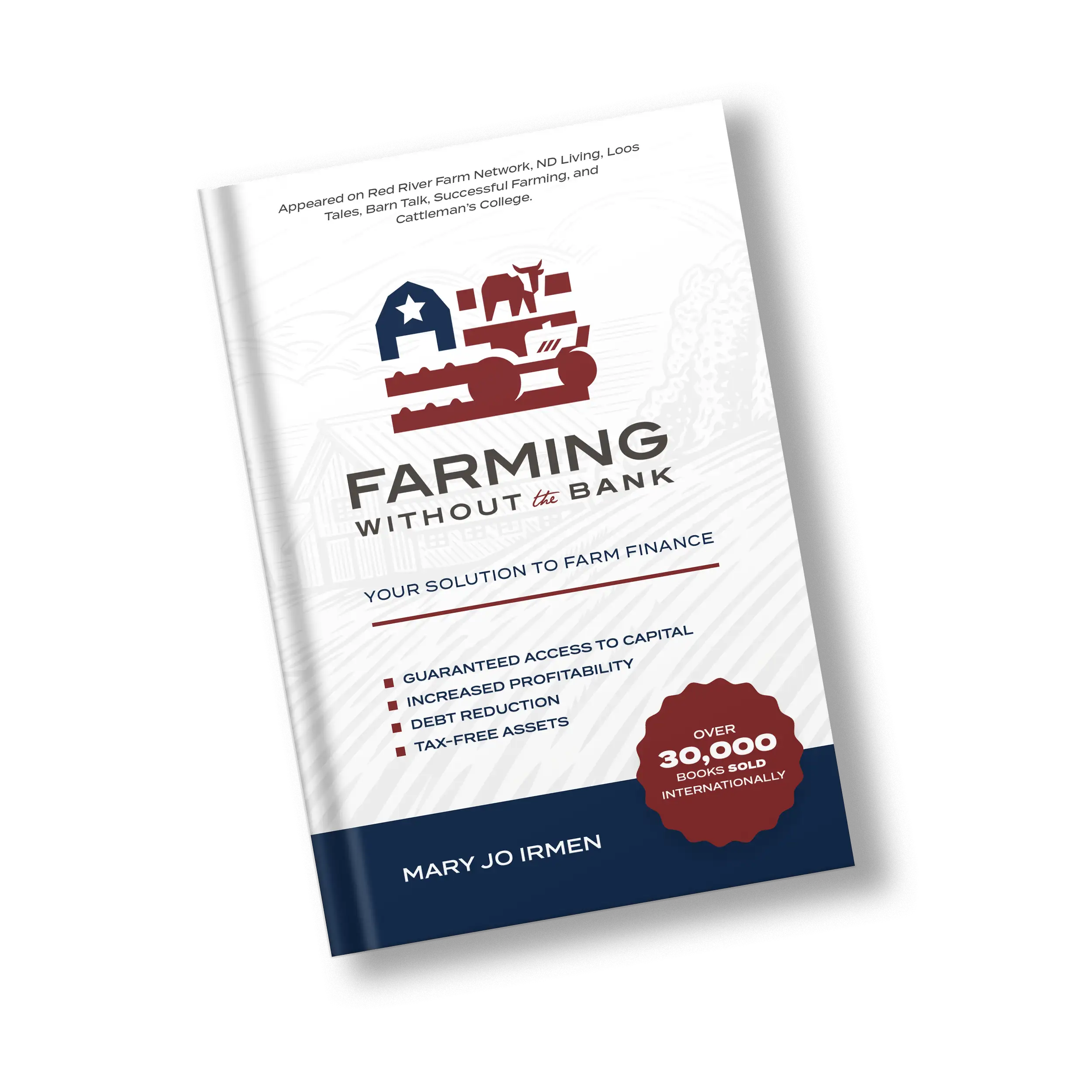
Your farm’s financial independence starts with one book.
30,000 farmers and ranchers have already made the shift. The only question is how long you’ll keep paying interest you could be keeping yourself.