 GET THE BOOK
 GET THE BOOK




Podcast
EP. 324
$100K in Cattle at 20: The Move Dave Ramsey Hated (Ep. 324)
Oct 17, 2025 ·
34 min
0:00 / 33:53
EPISODE OVERVIEW
ABOUT THIS EPISODE
When Dave Ramsey told a 20-year-old rancher he made a “huge mistake” buying $100,000 in cattle, we had some thoughts. Spoiler: Dave doesn’t understand agriculture, leverage, or infinite banking.
In this fiery episode #324 of Farming Without the Bank, Mary Jo Irmen and John dive deep into a recent Dave Ramsey clip that went viral: a 20-year-old caller buys $100K in cattle, and Dave loses it.
Mary Jo and John break down why the young man’s decision wasn’t reckless at all; it was smart business. They explain how proper use of leverage, cash flow, and infinite banking can make or break a farm or ranch operation.
If you’ve ever been told “debt is evil” or “cash only is the way,” this episode will challenge everything you thought you knew about farm finance.
💡 Key Takeaways
- Why Dave Ramsey’s blanket financial advice doesn’t work for farmers or ranchers
- The truth about using leverage in agriculture
- How infinite banking can replace CDs and traditional loans
- Why business owners must understand cash flow, not just “debt-free living”
- How to use banks strategically, not avoid them completely
(Timestamps are from the video version. Audio-only edits are always shorter since they have had more fluff removed, so the timestamps are not accurate to this version.)
💬 Have questions about infinite banking for your farm or ranch?
Email Mary Jo: maryjo@withoutthebank.com
Links Mentioned
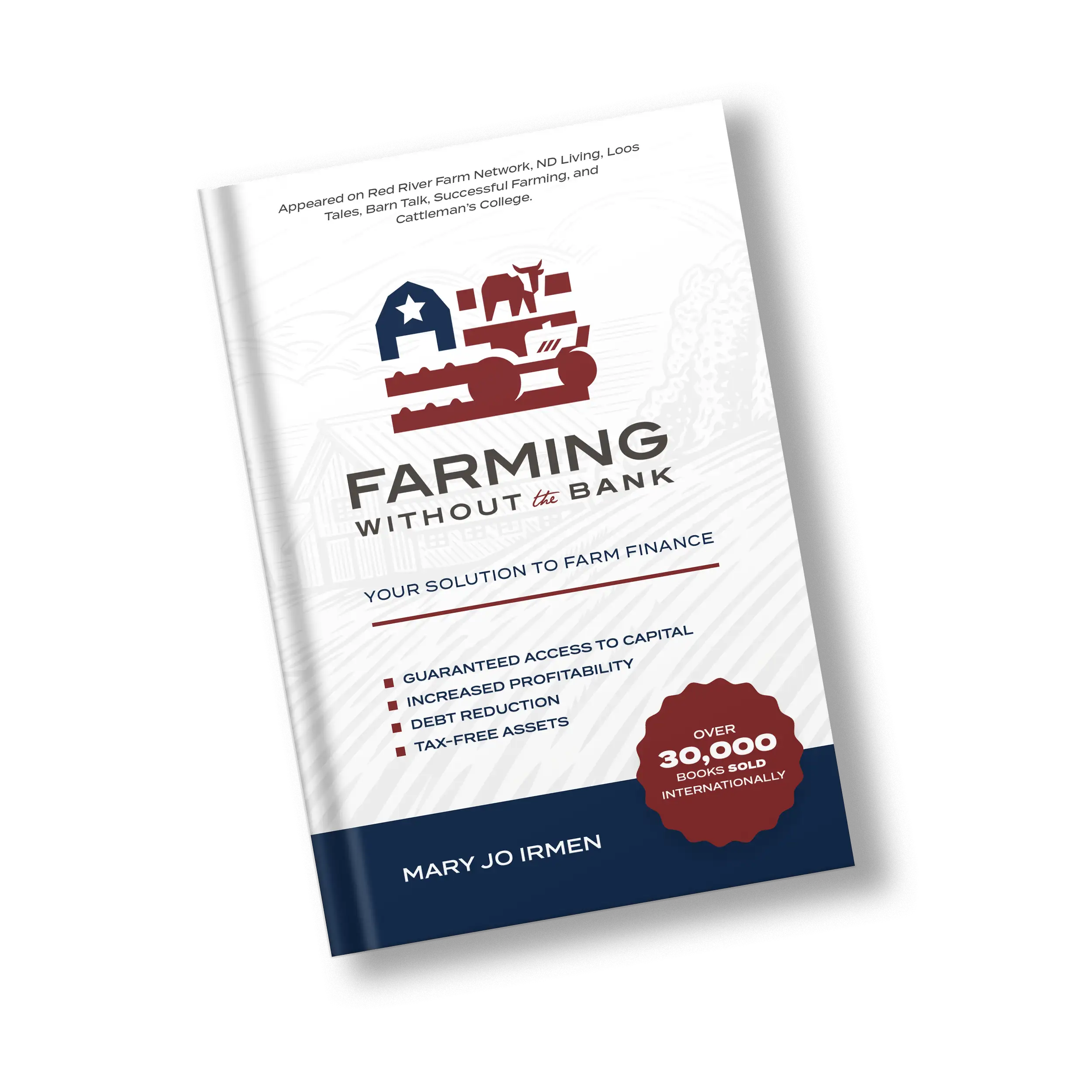
- 📘 Grab the Farming Without the Bank book and start building your own financial system today.
CHAPTER TIMESTAMPS
- 00:00- The Problem With Dave Ramsey's Cattle Advice
- 03:00- Why College Debt Isn't a Business Investment
- 06:00- The $100K Cattle Example Explained
- 10:00- Infinite Banking vs. CDs
- 14:00- Understanding Cash-Flowing Assets in Agriculture
- 20:00- The Myth of "No Debt Ever"
- 24:00- When to Use Bank Leverage Smartly
- 27:00- Real-Life Client Success Stories
- 32:00- Final Thoughts: What Farmers Should Really Do
YOUTUBE EPISODE
TRANSCRIPTION
“Well, here’s my advice, young man. If you’re listening, don’t second guess it. Know your numbers. That’s what we learned at Sell/Buy Marketing. Know your numbers, create your barn card, whatever the hell it is you need to do. Go do it because it’s a market you know, and quit going to school. Everything you need to know is gonna be in books and online, and go do stuff outside of the college education, unless you wanna drink and have a good time. Then you stay where you’re at. Don’t listen to what Dave had to say, because what you’re doing is infinite banking. However, you’re not using the right tool. The CD is a pretty decent tool, but life insurance is the correct tool. So call John or I, let us know you are from the show, and we’d be happy to help you, because you’re on the right track. You are getting horrible advice from somebody that does not understand the industry.”
Hello, hello, hello, and welcome back to the podcast. Thank you very much for being here. Okay. I invited John in to share in my misery today because we are going to talk about the Dave Ramsey clip with the 20-year-old who bought $100,000 worth of cattle. I shared it with John because I feel like if I get mad, then I should invite someone to be mad with me. Now, y’all…
I’m just here to be a hype man today.
Yeah. Look at John. He’s still smiling. He’s not even mad. I may have made a mistake, my friends. John may not be the guy I need to go to to have anger and rage. He probably thinks it’s funny because that’s how John looks at things.
I do. I just, like I was just telling you, it’s just somebody that’s talking about a subject they have no business talking about.
Yes. That’s exactly right. Pretty much summarizes it. But let’s talk about all the things that he said wrong. So let me set the stage, my friends. If, and I’m not going to post a link to his video because I’m not going to promote this. And I have pages. As you can see, if you’re not on Spotify, you should be on Spotify listening to this. Okay. Or the YouTubes. So there are pages. I have pages of notes. Now, I wrote big. So this could probably be condensed to two pages with a smaller handwriting, but I was in a hurry. And so I ripped him apart, like, by minute, maybe seconds, because I was play, pause, play, pause, play, pause, because I wanted to not miss one thing that he said wrong.
And let me just preface this with, I don’t hate the guy. I agree with a lot of what he says, but he is not in his lane when he is talking about agriculture. And it comes up over and over and over and over. And there are a lot of people that need Dave to get their finances in order and to do budgeting and to do debt snowball stuff. And I think that’s great, because I’m not your girl when you do those things. John’s probably not the guy to be telling you how to budget. But so he’s good with those things. But what he did with this particular caller was absolutely crazy to me. So first they start, like, I thought this was quite funny. Who’s the dude that was with him?
Well, so he is a part of his team overall. Like, he’s got all sorts of people that work with him, but his name is John Delony. He is a doctor, but, like, more like mental health type stuff. So he’s not, believe it or not, he’s not, like, an ag finance specialist.
Oh, that’s a surprise. I would have never known by his comments.
But yeah, he’s like a mental health doctor.
All right. Not what I was expecting either.
Yeah.
So Dave asks the caller, oh, the caller says, “I’m going to college.” And Dave says, “Oh, what are you going to college for?” And he says, “Business.” Oh, they were so happy. They were so happy that this kid was wasting his money on a business degree. So immediately I am, like, not on the same page, because I make a fair amount of money in a year. I feel like I’m a pretty decent business owner. None of that did I learn with my business degree. I have a four-year business degree. None of it. I paid tens of thousands of dollars to be coached by people that are million and billionaires. So I could have just saved my money from college and I could have just started my business and then gone to coaching from other people that make more money than I do. So it’s interesting that they’re so happy about that. But then the kid says he just paid off $100,000 of debt and he bought $100,000 of cattle. And their level of pride for him went down from a 10 to a zero very quickly.
He pretty much said right away, “Well, you just called the wrong show.”
Yeah.
He said at one point, he was really into that. He’s like, “You called the wrong place.” He was like, “You’re calling here? Why?”
And I kind of feel like I wish I could find the kid. Like, I would love to find this 20-year-old. Because I think that he knew. Like, I think that he was trying to get Dave, like…
Oh, yeah. They know what they’re doing.
He was not calling for any kind of advice except to prove Dave didn’t know what he was talking about in this situation.
And I think that it… Like, the more that you listen, you’re like, the guy didn’t really have any questions. Because he even asked, like, “What was your question?”
But, okay. So, so, Dave is upset because a bank gave a kid… So, the kid said about $100,000 worth of cattle. And Dave immediately hits him with, “Who gave a 20-year-old $100,000 loan?” And demands the name of the bank. Bullies the kid into saying the name of the bank. Now, what if this kid would have said, “Oh, I’m going to school to be a doctor and I have $100,000 in student loans?” He wouldn’t have cared. Would we have the same reaction?
No, I can’t even answer that because I’ve not listened to enough of Dave’s stuff to know if he thinks you should go to college with cash as well.
But what does it matter if it’s $100,000 worth of cattle or if it’s $100,000 student loan? Because if it’s $100,000 worth of cattle, I have an asset worth $100,000. And he chooses to not ask the kid any questions. And we should probably call him a young man because he’s 20. Doesn’t ask the young man any questions. He just continues to be pissed because he has this $100,000 loan. Then the young man says he has a CD with $100,000 that he used as collateral to the loan. Here’s where it starts to get good. Now, I’m going to refer to my notes, people, because I got notes. If you got them, use them.
Yeah.
So, Dave says, “Oh, so you’re borrowing your own money.” But he didn’t ask what rate the CD was at. He didn’t ask what rate the cattle note was at. Eventually, the kid comes out and says, there, well, John says, “What size cows?” The kid said, “What?” He said, “What size cows?” Then Dave stepped in and said, “How many, how many cows did you buy?” Right?
No. I think he said, “How many cows did you buy?” Or, “How many head did you buy?”
Yeah. So Dave’s using the right terminology. Mr. John, Dr. John, he not known, like, he may as well just zip it at this point, because he doesn’t know anything. So the kid doesn’t answer, the young man, does not answer how many head he bought, but he answers, or he tells them that they’re two, two- and three-year-old bred cows.
It was three- to six-year-old bred cows, but they’re…
I have two- and three-year-olds.
No, it was three- to six-year-old cows, but it was 25 to 30 head.
How did I miss that? I listened to this thing like three times and took notes.
Well, maybe I’m wrong too, but that’s what I, that’s what I heard.
Well, I doubt it.
You weren’t raising. So it’s not, I mean, it’s not a bad buy, really.
Yeah.
It’s $4,000 bred cows that are going to be around. He bought bred heifers. He bought six-year-olds. Right? So he probably bought smart.
And so Dave said, the money in the CD that you’ve borrowed against your own money. So the kid, the young man sold some cows that he had with a partner, and they made some money. So he must’ve paid off his vehicle note, his $100,000 vehicle note. And then he had another $100,000. So he put that into a CD and used that to buy these cattle. So I think that’s pretty smart. Right? At some point during this whole conversation, Dave said, “Well, you’re going to, this is going to fall apart on me. You are not going to be able to do this. And you are going, you’re, you’re going to lose your $100,000 CD.” Okay. So let’s just say that this kid loses, that cattle prices drop. He can’t make the cattle note. All the cows die. Whatever. He has, he has death loss on those calves that are astronomical. He can’t make a payment. If all, it would have to be really, really bad. So let’s say that he loses his $100,000 CD. Then what? He still has the cows. He still has the calves.
It turns out there’s more to it than he went into at his, uh, 30,000-foot view.
Well, the kid is doing infinite… The young man is doing infinite banking with a CD.
Yeah.
My advice would have been, put your $100,000 into a life insurance policy. So you have the death benefit and uninterrupted compound interest. And you have the cows and you have the CD. Or you have the policy and the cows.
Yeah. To be honest, this, this young man has a pretty good deal going here with his cow…
Absolutely.
Because is this not what Nelson talks about in the book with the twin sister example?
Yeah. It’s the same type of thing. He compares a whole life insurance policy to a CD. Dave is so mad. And I’m thinking, why are you mad? Because the CD is earning uninterrupted compound interest. He’s just not getting dividends. It’s earning interest. He went to the bank and borrowed money.
Yeah. I’m more upset that nobody’s told the young man about infinite banking and whole life insurance.
That’s definitely one part.
But just on its own, this deal that this kid has going on works. Like, he’s going to make money on these cattle. His main issue that he kept saying was, he clearly was going to put all the income right back in.
Yeah.
Like, pay down extra debt on the loan. Which, whatever. But he said he will have the loan paid off in two to three years.
But then, Dr. John, that guy pissed me off more than Dave. He says, “You know how to calve out babies?” That is not proper lingo. “Do you know how to calve babies?”
I don’t know if you caught this, but this is funny. Because Dave immediately stepped in and said, “Well, he grew up doing it. So, I’m assuming that he knows how to do that.”
Yeah. Right.
Every time Dr. John had something to say, Dave had to, like, come in and kind of brush it off because he didn’t know what he was talking about.
And then Dave yelled at him and said, “Have you ever heard me tell anyone to take a loan? How long have you listened to me?” Why are you yelling at people all the time? Like, you guys might think that I yell at people. I don’t yell at anybody. I just yell about things. Okay? Like, I’m yelling about this right now, but I don’t yell at clients.
To be honest, I see a fair amount of his clips, like clips from Dave’s show on TikTok and stuff. I get that vibe a lot. Like, he’s, like, talking down to the callers quite often.
Yes. He is mean. And then, Miss Dr. John. I’m saying Dr. John because I don’t want you to think I’m talking about my John.
Yeah. Well, these guys know I’m not a doctor, so.
Right. So, then, Dr. John says, “We know, we all know cattle prices are high because of the drought. When prices plummet, you will have lost it all,” Dave said, “and your CD is what you lost. The bank doesn’t have any risk.” Okay, you follow cattle prices more than I do. I actually was, I got this clip sent to me by Doug Ferguson. Thanks a lot, Doug. Like, he was, it’s made me mad several times already. But, it is, the cattle prices, so I verified with Doug, but you watch them more than I do. It is not because of a drought. There is more to it than just, “Oh, there’s a drought in the South,” or, “There’s a drought somewhere in the country. That’s why cattle prices are so high.”
Well, absolutely. That’s, basically, what’s going on with the math of this is that, like that young man says, he can pay this off in two years because prices are that high that, you know, if this is a five-year loan, if he stuffed every penny back in, you know, and assuming low death loss, he would be able to do that.
Yeah, but, you know, but you should go take some, you should go take some courses in commodities, John, because that’s what he tells the young man. “You go back to school and you take some classes in commodities,” because, you know, beef is a commodity and it is, there is not a guarantee. All it is, is speculation. This John guy, I got to go through my notes here because I got more stuff that I forgot. Dr. John says, “The only reason that we have a job is because of schemes like this that don’t work.” This is a scheme? This is commodity prices, and if the, Dave says it’s supply versus demand on what drives the prices. Oh, it’s not the Big Four? It’s not, I wonder if Dave knows who the Big Four is.
Well, I mean, that’s, that’s a little bit of why the price, I mean, that’s always part of a commodity market. It’s a combination. It’s not one thing.
But, John, it is risk. A hundred percent of the time, this is what Dave said, “A hundred percent of the time, it’s a guess about what commodities will do.” What do you think we’re doing with the stock market? Guessing. A hundred percent of the time, it’s a guess. But yet, he tells you to put your retirement in the stock market.
Yep. Well, he’s, he’s said at the end, “It’s a gamble. This is just a straight gamble.” It’s like, yeah, dude, what is the stock market? That’s like the ag industry in general is gambling. I mean, any commodity market is that way.
Yeah. He says, “From a business perspective, you are gambling.” Dave, from a business perspective, every business owner is a gambler. We don’t know if we’re going to have a client tomorrow. We don’t know if we’re going to have a customer tomorrow. We don’t know if the government’s going to shut us down because of COVID. But you are touting, you are talking about gambling. He is talking about oil being a commodity and what drives it. As if, and, but he so conveniently leaves out the fact that the stock market is also a gamble. But that is where he’s telling everybody to put for, to get a 14% rate of return. But he doesn’t talk about the gamble of that. That’s the same thing. What? Is this, this is more of a gamble because you don’t know it, but a less of a gamble for the kid who has grown up with it his entire life. And he understands cattle. He understands that market. So where would you rather have him put his money? Like, there was no solution.
Not at all.
He, he wanted him to do what with the hundred thousand dollars? What would have, because he said, “Well,” this is what he wanted him to do. He said, because at one point he said, “Well, even if you would, would have, you did this anyway.” And the kid said, “Yeah, I’d have did it with cash.”
Right.
Now, if he can’t pay the loan back, he lost his cattle. ’Cause he had to sell the cattle to get his money back. Right. ’Cause he, he didn’t, he, there would have been no loan at that point. I apologize. So if he would have used the cash, he would have just had the cattle. Now the cattle are making him cash flow and the CD’s making him cash flow.
Yeah. He can go buy more cattle. If the same exact opportunity came up again, he could go do it again.
Right.
Yep. ’Cause he could use the cattle as collateral.
So this is the same thing. We had, I had a client do this. He called me and said, you know, he had been using his policy as a savings account. And he was like, “You know, Mary Jo, I used my policy to buy some cows.” And I said, “Okay, that’s awesome.” He goes, “But I didn’t think I could leverage it. ’Cause then a store came available in town. We could buy a building in town, and I used the cows as collateral for the building in town, but I still have a loan on them in my policy.” Uh, yep. You can leverage it that way if you want. ’Cause the bank doesn’t know. They only know what you tell them on the whole life insurance side of things. Right. It’s not that we’re trying to screw the bank. It’s just that this is a contract between you and the company. The bank does not have to be involved in it. The bank cannot be involved in it because it’s contractual.
Yeah. It’s just mind-blowing to me.
And then he said that, oh, Dr. John said, “It will end in failure.”
Well, I laughed at his, “Oh, you’re going to make money this time, but it’s the $250,000 deal that will cost you.” It’s like, he, he’s just talking.
There’s a question on when you ship calves or when you sell calves, how much money are you going to make? Are you going to retain the heifers? Are you, when are you going to sell them? Are you going to feed them out? Like, no questions at all about how this works.
Just straight up.
It’s just, “You’re stupid. Thanks for calling.”
That, cash or loan. That’s the only option we have here.
We can’t look at how the cash flow system around it is going to work. And I get that this is agriculture, but my concern is, how often is he doing this to just business owners? Should I go, should I go buy that new welder that sits on the back of my pickup? Should I finance that thing? Because I can make some cash flow going to the, going to oil country and welding. I could make some cash flow, do X, Y, and Z welding, right? There’s a million opportunities out there. How motivated is the individual? If he’s going to sleep till noon, I might say, yeah, you might not want to buy it, right? If he thinks he’s going to work from noon to five, if he’s going to work from noon to 9 PM, does it matter? He’s working. What? There’s no talk about cash flow.
Well, that’s kind of like, I was going to, the vibe from his, again, I see these videos all the time, but the, he’s creating, like, a scarcity mindset in these people where it’s like, don’t go try to do this because that’s a stupid idea. Like, this kid’s going to make money off of this deal, right? He is, no matter what he does with it. Like, he’s not making this, this guy have, like, anxiety or apprehension about, “Oh, should I do these things in the future?” You know? And so these people that are business owners or farmers listening to them, it, it makes you question these things that you’re able to do. You know, these ideas you’re able to come up with that can expand your, your income. He, he gives you hesitancy.
But he’s basically saying, don’t farm. It feels like.
Yeah.
Unless you have all the cash you need to do it.
Which would be no farmer in the world.
Yeah. So we would all starve. Where are you going to get your food? Because everybody’s going to say, “Well, Dave said I can’t do it.” Like, I was just talking, I was just doing a podcast with Whitney and Lacy from Canada. So if y’all don’t know, I, we wrote the Canadian version of Farming Without the Bank. So you should go to Ranch Your Way and listen to that podcast, but it’s under Win A. Win E H like A. So, and we were just talking about this, that at some point, like, who’s going, if, if you are waiting to buy land with cash, the neighbor’s going to come in with a loan and he’s going to buy that land from you. No, I wasn’t talking to them about it. I was talking to a client about it. Whatever. Still go listen to the podcast.
The, we need to think about, we have to use the bank as leverage at some point. Even though the book is Farming Without the Bank, that does not mean you and I say, “Don’t ever go to the bank.” There are times where we are going to need to go to the bank to leverage what we need to do. If we want to do, if we want to buy cattle, if we want to do Sell/Buy Marketing, if we want to buy land, if we want to farm, I don’t care what you’re doing, at some point, if you need, you may need to go to the bank to leverage it, but you don’t want to get so deep in that you can’t get out. And what Dave is saying is, “I got in trouble a long, long, long, long time ago. So I am never getting another bank loan again.” So the way Dave is financing everything he does is he sells a bunch of books. He has a bunch of programs. He has his radio show. So he is essentially self-financing because he has a successful business. That is not for everybody. And so if, if you can go to the bank and you can be smart about it and not overextend yourself, you’ll be okay. It’s the people that overextend themselves that have the problem.
Yeah. I mean, especially in agriculture, you’re not going to, you know, start from scratch or start from a small place and scale without the bank at some point.
Right. But it’s doing it strategically so that you’re not married to them. You know, you’re just involved. Right. So if they call in, you don’t want to give them a reason to be calling a note. You don’t want to get into the, the issue of the ’80s. So you have to be smart, but you can’t do it in today’s world without the bank at some point in that process. Even I use the bank to leverage my own stuff. Like, I, when we went and bought land last year, I could have, I paid cash.
Yeah, I sure could have, but I’m like, why would I do that? Yeah, I’ll go get a 7% loan. No, not happy about it, but it leaves me liquidity, so I can use that money as a down payment on another piece of ground. But I know those two loans would not overextend me. Right. Like we just, there’s so much fear. It’s like saying, well, you know, I dated one chick and she was awful, so I’m never dating again the rest of my life. They’re not all bad. What?
Or here’s another analogy for y’all. I bought cows and they went down once, so I’m never buying cows again. I am now because I bought them, and I’m not doing that again.
Nope. Here we are. We just keep buying cows. So he’s saying, don’t go to the bank because it didn’t work one time. Now, any banker that listens to this should love both of us because we’re telling people to go to the bank.
Yep.
But you got to be smart about it. And if you don’t have it all in your policy, you need to start your policy to create your bank. But if you don’t have your policy in order, then get some policies, get them started, and then use the bank when you need to. But Geez Louise, Dave.
Well, yeah. Like I said, he’s just talking about stuff he has no…
Those cows are…
It’d be like if I tried to go tell people about the stock market. Like, that’s not my forte. I’m not going to blab to you, you know, about what stock you should buy. He should not give people advice on agriculture. Same deal.
But he neglects the whole fact that those cows are cash-flowing assets. They’re bred.
Well, he just talked about how they’re a commodity. That also means they’re worth something all the time. So, yeah, he was just ignoring that.
That’s a good point. That’s a good point. They’re an asset. They’re a cash-flowing asset. But it’s not an asset he understands. So, I’m going to just whip you silly.
Mm-hmm.
And the poor young man came out black and blue. And now he’s famous.
Well, I’m sure he got… Like you said, I’m sure he knew that he wasn’t going to love his plan there. I’m sure he got a little kick out of it. But the problem is, is now that I think that next time that opportunity comes up, he’s going to second guess it a little bit, at least. You know, like…
Well, here’s my advice, young man.
Yeah.
If you’re listening, don’t second guess it. Know your numbers. Right? That’s what we learned at Sell/Buy Marketing. Know your numbers. Create your barn card. Whatever the hell it is you need to do. Go do it because it’s a market you know. And go quit going to school. Everything you need to know is going to be in books and online, and go to do stuff outside of the college education. Unless you want to drink and have a good time. Then you stay where you’re at. But there is… Don’t listen to what Dave had to say. Because what you’re doing is infinite banking. However, you’re not using the right tool. Right? The CD is a pretty decent tool. But life insurance is the correct tool. So, call John or I. Let us know you are from the show. And we’d be happy to help you. Because you’re on the right track. You are 100% on the right track. You are getting horrible advice from somebody that does not understand the industry. And so…
Don’t go cancel your CD. You’re probably getting a good rate on it. Honestly, keep doing what you’re doing. Just…
Yeah. You know.
Exactly. Because you’re not doing anything wrong.
Except you did do one wrong thing.
He did one wrong… Yeah, he’s not using the right vehicle. But…
No.
Yeah. One wrong thing. He called Dave.
Well, yeah. Get a Spotify account or something, man.
It was the one wrong move. He dialed the wrong number.
Yeah. He should have been calling us.
Yep. That is a fact. I don’t know if anybody knows who it is. But, you know, the TikTok does its work. And it finds people all the time.
Yeah.
So, maybe, maybe the TikTok will find this young man and say, “You need to contact Farming Without the Bank.” Because you did everything right. Kudos. Just, you need that. You could do it better with the right tool. And don’t call Dave. Or don’t call Dr. John, for sure. Because that guy’s clueless.
Well, like I said, he’s just, he’s a mental health specialist. It’s not his forte at all.
Do you ever see him on the clips?
Yeah, quite a bit. And now that I looked, now that I looked him up, it’s all my TikTokers.
Yeah. Well, that’s why I, he does. I mean, I didn’t have time to look him up before we met, John. But I thought, if I look him up, then I’m going to see Dave. So, I’m going to have John look him up. And now John’s going to get swarmed.
I already was looking, like, five minutes before we started recording this. Every video is this guy now. And some of the stories are really sad. So, I’m going to have to not look at TikTok tonight, I guess.
So, maybe, maybe it is a good thing that he’s on there for the mental health piece of it. For people that are…
Well, it sounds like he does a great job with that part.
But again, he grew up in Houston.
Which he should, because that’s what he does as a living.
Yeah. But even Dave was, it was kind of funny. If you go back and watch, Dave was kind of shutting him down a little bit.
But, “Do you know how to calve babies?”
Yeah.
“Then for certain, this is not going to work for you.” Huh? So, I’m praying for this drought that he was talking about. Where is his… There’s one of those somewhere all the time.
Yeah.
Oh, gosh. Well, I can probably leave it alone now. But it, it was just too much. It was too, there’s too many things in that one little clip that are not right. And it’s the reason that farmers and ranchers that have been following Dave come and see us, because they can see it’s not working.
Oh, yeah. They always know that, that’s not the reason they sought him out. They’re usually past that point. You know, like, they’ve discovered that he’s not a lifelong, you know, person you should follow.
Yeah. Not if you want to grow. Not if you want to succeed. If you want to stay where you’re at and remain debt-free, then that’s a great place for you to stay. But even doing a debt snowball in the farming sector is not always the best option either. Like, if, if we’ve got rates that are 2 and 3%, why debt snowball those? Because if there comes an opportunity on the other side, you probably should just leave those where they’re at. If you’re not overextended.
Yeah.
Every situation is just a little bit different, but you have to be smart about it, and you should not… This is another reason. You shouldn’t be calling into a show for advice. But this is a reason why, when people email us and say, “Hey, can you give me a quote?” No, I’m not giving you a quote over email. And no, I’m not answering how you can do this over email. And no, I’m not answering anything. I don’t care if your email is 10 paragraphs long or two sentences long. I cannot give you advice. And nobody should be giving you advice based on a short amount of information. This call with Dave should have been an hour, hour and a half.
Yeah.
Because I have a lot of questions for this young man. I can’t wait till he calls, because I’m excited to talk to him.
I hope it does reach him. That’d be cool.
Wouldn’t that be fun?
It would be.
Such a, oh my gosh. Don’t schedule if, young man. Yes, bypass me. Go Rachel. Go to John, because I want to know.
I’m far more curious to talk to you than John is. So don’t even consider John. Come straight with me. He didn’t say his name, did he?
If he did, I didn’t catch it.
Yeah, he didn’t. I don’t think he said his name.
He was from West Texas. That’s all I remember.
Call me. Schedule, dude. I want to have a call. Listen, I want to see how the cattle market’s been for you. Because I feel like this was recorded a while ago.
I looked at it. The clip is from 10 days ago.
Oh.
But I don’t, I don’t know when the call was from.
Oh, right. Because it sounded like he had just bought them and it was spring.
Well, it had to be somewhat recent due to the price of the cattle. I mean, it’s somewhere in the last year or so. But yeah, I don’t know when.
A year or two.
But yeah, I don’t know when it was from. But the post was 10 days ago.
Well, but it sold high. Anywho. Okay. Well, any final thoughts on Dave, John?
No. I mean, he, like you said, if you got some debt you’re looking to pay off, maybe go listen to him. But beyond that, keep us rolling, I would say.
If you’re in financial strain because you don’t know how to budget, listen to Dave.
Yeah. He’s got his purpose.
If you want to grow and have a business and make more money, you came to the right place. You’re here. You’re listening to John and I.
Yeah. If you’re an internet troll listening to a clip, thanks for being here. Maybe we opened your eyes to something.
All right. That’s all I got. You guys know the routine. Schedule with John or I. Grab the book. Read it. And then we are happy to help where we can. But you have a fantastic rest of your day.
Thanks for listening to the Farming Without the Bank podcast. We hope today’s episode has inspired you to take control of your finances in new ways. Don’t forget to check out our website, farmingwithoutthebank.com, and engage with us on our Facebook page, Farming Without the Bank. Join us next week as we smash more financial myths and empower you to accomplish your financial goals.
View MoreHello, hello, hello, and welcome back to the podcast. Thank you very much for being here. Okay. I invited John in to share in my misery today because we are going to talk about the Dave Ramsey clip with the 20-year-old who bought $100,000 worth of cattle. I shared it with John because I feel like if I get mad, then I should invite someone to be mad with me. Now, y’all…
I’m just here to be a hype man today.
Yeah. Look at John. He’s still smiling. He’s not even mad. I may have made a mistake, my friends. John may not be the guy I need to go to to have anger and rage. He probably thinks it’s funny because that’s how John looks at things.
I do. I just, like I was just telling you, it’s just somebody that’s talking about a subject they have no business talking about.
Yes. That’s exactly right. Pretty much summarizes it. But let’s talk about all the things that he said wrong. So let me set the stage, my friends. If, and I’m not going to post a link to his video because I’m not going to promote this. And I have pages. As you can see, if you’re not on Spotify, you should be on Spotify listening to this. Okay. Or the YouTubes. So there are pages. I have pages of notes. Now, I wrote big. So this could probably be condensed to two pages with a smaller handwriting, but I was in a hurry. And so I ripped him apart, like, by minute, maybe seconds, because I was play, pause, play, pause, play, pause, because I wanted to not miss one thing that he said wrong.
And let me just preface this with, I don’t hate the guy. I agree with a lot of what he says, but he is not in his lane when he is talking about agriculture. And it comes up over and over and over and over. And there are a lot of people that need Dave to get their finances in order and to do budgeting and to do debt snowball stuff. And I think that’s great, because I’m not your girl when you do those things. John’s probably not the guy to be telling you how to budget. But so he’s good with those things. But what he did with this particular caller was absolutely crazy to me. So first they start, like, I thought this was quite funny. Who’s the dude that was with him?
Well, so he is a part of his team overall. Like, he’s got all sorts of people that work with him, but his name is John Delony. He is a doctor, but, like, more like mental health type stuff. So he’s not, believe it or not, he’s not, like, an ag finance specialist.
Oh, that’s a surprise. I would have never known by his comments.
But yeah, he’s like a mental health doctor.
All right. Not what I was expecting either.
Yeah.
So Dave asks the caller, oh, the caller says, “I’m going to college.” And Dave says, “Oh, what are you going to college for?” And he says, “Business.” Oh, they were so happy. They were so happy that this kid was wasting his money on a business degree. So immediately I am, like, not on the same page, because I make a fair amount of money in a year. I feel like I’m a pretty decent business owner. None of that did I learn with my business degree. I have a four-year business degree. None of it. I paid tens of thousands of dollars to be coached by people that are million and billionaires. So I could have just saved my money from college and I could have just started my business and then gone to coaching from other people that make more money than I do. So it’s interesting that they’re so happy about that. But then the kid says he just paid off $100,000 of debt and he bought $100,000 of cattle. And their level of pride for him went down from a 10 to a zero very quickly.
He pretty much said right away, “Well, you just called the wrong show.”
Yeah.
He said at one point, he was really into that. He’s like, “You called the wrong place.” He was like, “You’re calling here? Why?”
And I kind of feel like I wish I could find the kid. Like, I would love to find this 20-year-old. Because I think that he knew. Like, I think that he was trying to get Dave, like…
Oh, yeah. They know what they’re doing.
He was not calling for any kind of advice except to prove Dave didn’t know what he was talking about in this situation.
And I think that it… Like, the more that you listen, you’re like, the guy didn’t really have any questions. Because he even asked, like, “What was your question?”
But, okay. So, so, Dave is upset because a bank gave a kid… So, the kid said about $100,000 worth of cattle. And Dave immediately hits him with, “Who gave a 20-year-old $100,000 loan?” And demands the name of the bank. Bullies the kid into saying the name of the bank. Now, what if this kid would have said, “Oh, I’m going to school to be a doctor and I have $100,000 in student loans?” He wouldn’t have cared. Would we have the same reaction?
No, I can’t even answer that because I’ve not listened to enough of Dave’s stuff to know if he thinks you should go to college with cash as well.
But what does it matter if it’s $100,000 worth of cattle or if it’s $100,000 student loan? Because if it’s $100,000 worth of cattle, I have an asset worth $100,000. And he chooses to not ask the kid any questions. And we should probably call him a young man because he’s 20. Doesn’t ask the young man any questions. He just continues to be pissed because he has this $100,000 loan. Then the young man says he has a CD with $100,000 that he used as collateral to the loan. Here’s where it starts to get good. Now, I’m going to refer to my notes, people, because I got notes. If you got them, use them.
Yeah.
So, Dave says, “Oh, so you’re borrowing your own money.” But he didn’t ask what rate the CD was at. He didn’t ask what rate the cattle note was at. Eventually, the kid comes out and says, there, well, John says, “What size cows?” The kid said, “What?” He said, “What size cows?” Then Dave stepped in and said, “How many, how many cows did you buy?” Right?
No. I think he said, “How many cows did you buy?” Or, “How many head did you buy?”
Yeah. So Dave’s using the right terminology. Mr. John, Dr. John, he not known, like, he may as well just zip it at this point, because he doesn’t know anything. So the kid doesn’t answer, the young man, does not answer how many head he bought, but he answers, or he tells them that they’re two, two- and three-year-old bred cows.
It was three- to six-year-old bred cows, but they’re…
I have two- and three-year-olds.
No, it was three- to six-year-old cows, but it was 25 to 30 head.
How did I miss that? I listened to this thing like three times and took notes.
Well, maybe I’m wrong too, but that’s what I, that’s what I heard.
Well, I doubt it.
You weren’t raising. So it’s not, I mean, it’s not a bad buy, really.
Yeah.
It’s $4,000 bred cows that are going to be around. He bought bred heifers. He bought six-year-olds. Right? So he probably bought smart.
And so Dave said, the money in the CD that you’ve borrowed against your own money. So the kid, the young man sold some cows that he had with a partner, and they made some money. So he must’ve paid off his vehicle note, his $100,000 vehicle note. And then he had another $100,000. So he put that into a CD and used that to buy these cattle. So I think that’s pretty smart. Right? At some point during this whole conversation, Dave said, “Well, you’re going to, this is going to fall apart on me. You are not going to be able to do this. And you are going, you’re, you’re going to lose your $100,000 CD.” Okay. So let’s just say that this kid loses, that cattle prices drop. He can’t make the cattle note. All the cows die. Whatever. He has, he has death loss on those calves that are astronomical. He can’t make a payment. If all, it would have to be really, really bad. So let’s say that he loses his $100,000 CD. Then what? He still has the cows. He still has the calves.
It turns out there’s more to it than he went into at his, uh, 30,000-foot view.
Well, the kid is doing infinite… The young man is doing infinite banking with a CD.
Yeah.
My advice would have been, put your $100,000 into a life insurance policy. So you have the death benefit and uninterrupted compound interest. And you have the cows and you have the CD. Or you have the policy and the cows.
Yeah. To be honest, this, this young man has a pretty good deal going here with his cow…
Absolutely.
Because is this not what Nelson talks about in the book with the twin sister example?
Yeah. It’s the same type of thing. He compares a whole life insurance policy to a CD. Dave is so mad. And I’m thinking, why are you mad? Because the CD is earning uninterrupted compound interest. He’s just not getting dividends. It’s earning interest. He went to the bank and borrowed money.
Yeah. I’m more upset that nobody’s told the young man about infinite banking and whole life insurance.
That’s definitely one part.
But just on its own, this deal that this kid has going on works. Like, he’s going to make money on these cattle. His main issue that he kept saying was, he clearly was going to put all the income right back in.
Yeah.
Like, pay down extra debt on the loan. Which, whatever. But he said he will have the loan paid off in two to three years.
But then, Dr. John, that guy pissed me off more than Dave. He says, “You know how to calve out babies?” That is not proper lingo. “Do you know how to calve babies?”
I don’t know if you caught this, but this is funny. Because Dave immediately stepped in and said, “Well, he grew up doing it. So, I’m assuming that he knows how to do that.”
Yeah. Right.
Every time Dr. John had something to say, Dave had to, like, come in and kind of brush it off because he didn’t know what he was talking about.
And then Dave yelled at him and said, “Have you ever heard me tell anyone to take a loan? How long have you listened to me?” Why are you yelling at people all the time? Like, you guys might think that I yell at people. I don’t yell at anybody. I just yell about things. Okay? Like, I’m yelling about this right now, but I don’t yell at clients.
To be honest, I see a fair amount of his clips, like clips from Dave’s show on TikTok and stuff. I get that vibe a lot. Like, he’s, like, talking down to the callers quite often.
Yes. He is mean. And then, Miss Dr. John. I’m saying Dr. John because I don’t want you to think I’m talking about my John.
Yeah. Well, these guys know I’m not a doctor, so.
Right. So, then, Dr. John says, “We know, we all know cattle prices are high because of the drought. When prices plummet, you will have lost it all,” Dave said, “and your CD is what you lost. The bank doesn’t have any risk.” Okay, you follow cattle prices more than I do. I actually was, I got this clip sent to me by Doug Ferguson. Thanks a lot, Doug. Like, he was, it’s made me mad several times already. But, it is, the cattle prices, so I verified with Doug, but you watch them more than I do. It is not because of a drought. There is more to it than just, “Oh, there’s a drought in the South,” or, “There’s a drought somewhere in the country. That’s why cattle prices are so high.”
Well, absolutely. That’s, basically, what’s going on with the math of this is that, like that young man says, he can pay this off in two years because prices are that high that, you know, if this is a five-year loan, if he stuffed every penny back in, you know, and assuming low death loss, he would be able to do that.
Yeah, but, you know, but you should go take some, you should go take some courses in commodities, John, because that’s what he tells the young man. “You go back to school and you take some classes in commodities,” because, you know, beef is a commodity and it is, there is not a guarantee. All it is, is speculation. This John guy, I got to go through my notes here because I got more stuff that I forgot. Dr. John says, “The only reason that we have a job is because of schemes like this that don’t work.” This is a scheme? This is commodity prices, and if the, Dave says it’s supply versus demand on what drives the prices. Oh, it’s not the Big Four? It’s not, I wonder if Dave knows who the Big Four is.
Well, I mean, that’s, that’s a little bit of why the price, I mean, that’s always part of a commodity market. It’s a combination. It’s not one thing.
But, John, it is risk. A hundred percent of the time, this is what Dave said, “A hundred percent of the time, it’s a guess about what commodities will do.” What do you think we’re doing with the stock market? Guessing. A hundred percent of the time, it’s a guess. But yet, he tells you to put your retirement in the stock market.
Yep. Well, he’s, he’s said at the end, “It’s a gamble. This is just a straight gamble.” It’s like, yeah, dude, what is the stock market? That’s like the ag industry in general is gambling. I mean, any commodity market is that way.
Yeah. He says, “From a business perspective, you are gambling.” Dave, from a business perspective, every business owner is a gambler. We don’t know if we’re going to have a client tomorrow. We don’t know if we’re going to have a customer tomorrow. We don’t know if the government’s going to shut us down because of COVID. But you are touting, you are talking about gambling. He is talking about oil being a commodity and what drives it. As if, and, but he so conveniently leaves out the fact that the stock market is also a gamble. But that is where he’s telling everybody to put for, to get a 14% rate of return. But he doesn’t talk about the gamble of that. That’s the same thing. What? Is this, this is more of a gamble because you don’t know it, but a less of a gamble for the kid who has grown up with it his entire life. And he understands cattle. He understands that market. So where would you rather have him put his money? Like, there was no solution.
Not at all.
He, he wanted him to do what with the hundred thousand dollars? What would have, because he said, “Well,” this is what he wanted him to do. He said, because at one point he said, “Well, even if you would, would have, you did this anyway.” And the kid said, “Yeah, I’d have did it with cash.”
Right.
Now, if he can’t pay the loan back, he lost his cattle. ’Cause he had to sell the cattle to get his money back. Right. ’Cause he, he didn’t, he, there would have been no loan at that point. I apologize. So if he would have used the cash, he would have just had the cattle. Now the cattle are making him cash flow and the CD’s making him cash flow.
Yeah. He can go buy more cattle. If the same exact opportunity came up again, he could go do it again.
Right.
Yep. ’Cause he could use the cattle as collateral.
So this is the same thing. We had, I had a client do this. He called me and said, you know, he had been using his policy as a savings account. And he was like, “You know, Mary Jo, I used my policy to buy some cows.” And I said, “Okay, that’s awesome.” He goes, “But I didn’t think I could leverage it. ’Cause then a store came available in town. We could buy a building in town, and I used the cows as collateral for the building in town, but I still have a loan on them in my policy.” Uh, yep. You can leverage it that way if you want. ’Cause the bank doesn’t know. They only know what you tell them on the whole life insurance side of things. Right. It’s not that we’re trying to screw the bank. It’s just that this is a contract between you and the company. The bank does not have to be involved in it. The bank cannot be involved in it because it’s contractual.
Yeah. It’s just mind-blowing to me.
And then he said that, oh, Dr. John said, “It will end in failure.”
Well, I laughed at his, “Oh, you’re going to make money this time, but it’s the $250,000 deal that will cost you.” It’s like, he, he’s just talking.
There’s a question on when you ship calves or when you sell calves, how much money are you going to make? Are you going to retain the heifers? Are you, when are you going to sell them? Are you going to feed them out? Like, no questions at all about how this works.
Just straight up.
It’s just, “You’re stupid. Thanks for calling.”
That, cash or loan. That’s the only option we have here.
We can’t look at how the cash flow system around it is going to work. And I get that this is agriculture, but my concern is, how often is he doing this to just business owners? Should I go, should I go buy that new welder that sits on the back of my pickup? Should I finance that thing? Because I can make some cash flow going to the, going to oil country and welding. I could make some cash flow, do X, Y, and Z welding, right? There’s a million opportunities out there. How motivated is the individual? If he’s going to sleep till noon, I might say, yeah, you might not want to buy it, right? If he thinks he’s going to work from noon to five, if he’s going to work from noon to 9 PM, does it matter? He’s working. What? There’s no talk about cash flow.
Well, that’s kind of like, I was going to, the vibe from his, again, I see these videos all the time, but the, he’s creating, like, a scarcity mindset in these people where it’s like, don’t go try to do this because that’s a stupid idea. Like, this kid’s going to make money off of this deal, right? He is, no matter what he does with it. Like, he’s not making this, this guy have, like, anxiety or apprehension about, “Oh, should I do these things in the future?” You know? And so these people that are business owners or farmers listening to them, it, it makes you question these things that you’re able to do. You know, these ideas you’re able to come up with that can expand your, your income. He, he gives you hesitancy.
But he’s basically saying, don’t farm. It feels like.
Yeah.
Unless you have all the cash you need to do it.
Which would be no farmer in the world.
Yeah. So we would all starve. Where are you going to get your food? Because everybody’s going to say, “Well, Dave said I can’t do it.” Like, I was just talking, I was just doing a podcast with Whitney and Lacy from Canada. So if y’all don’t know, I, we wrote the Canadian version of Farming Without the Bank. So you should go to Ranch Your Way and listen to that podcast, but it’s under Win A. Win E H like A. So, and we were just talking about this, that at some point, like, who’s going, if, if you are waiting to buy land with cash, the neighbor’s going to come in with a loan and he’s going to buy that land from you. No, I wasn’t talking to them about it. I was talking to a client about it. Whatever. Still go listen to the podcast.
The, we need to think about, we have to use the bank as leverage at some point. Even though the book is Farming Without the Bank, that does not mean you and I say, “Don’t ever go to the bank.” There are times where we are going to need to go to the bank to leverage what we need to do. If we want to do, if we want to buy cattle, if we want to do Sell/Buy Marketing, if we want to buy land, if we want to farm, I don’t care what you’re doing, at some point, if you need, you may need to go to the bank to leverage it, but you don’t want to get so deep in that you can’t get out. And what Dave is saying is, “I got in trouble a long, long, long, long time ago. So I am never getting another bank loan again.” So the way Dave is financing everything he does is he sells a bunch of books. He has a bunch of programs. He has his radio show. So he is essentially self-financing because he has a successful business. That is not for everybody. And so if, if you can go to the bank and you can be smart about it and not overextend yourself, you’ll be okay. It’s the people that overextend themselves that have the problem.
Yeah. I mean, especially in agriculture, you’re not going to, you know, start from scratch or start from a small place and scale without the bank at some point.
Right. But it’s doing it strategically so that you’re not married to them. You know, you’re just involved. Right. So if they call in, you don’t want to give them a reason to be calling a note. You don’t want to get into the, the issue of the ’80s. So you have to be smart, but you can’t do it in today’s world without the bank at some point in that process. Even I use the bank to leverage my own stuff. Like, I, when we went and bought land last year, I could have, I paid cash.
Yeah, I sure could have, but I’m like, why would I do that? Yeah, I’ll go get a 7% loan. No, not happy about it, but it leaves me liquidity, so I can use that money as a down payment on another piece of ground. But I know those two loans would not overextend me. Right. Like we just, there’s so much fear. It’s like saying, well, you know, I dated one chick and she was awful, so I’m never dating again the rest of my life. They’re not all bad. What?
Or here’s another analogy for y’all. I bought cows and they went down once, so I’m never buying cows again. I am now because I bought them, and I’m not doing that again.
Nope. Here we are. We just keep buying cows. So he’s saying, don’t go to the bank because it didn’t work one time. Now, any banker that listens to this should love both of us because we’re telling people to go to the bank.
Yep.
But you got to be smart about it. And if you don’t have it all in your policy, you need to start your policy to create your bank. But if you don’t have your policy in order, then get some policies, get them started, and then use the bank when you need to. But Geez Louise, Dave.
Well, yeah. Like I said, he’s just talking about stuff he has no…
Those cows are…
It’d be like if I tried to go tell people about the stock market. Like, that’s not my forte. I’m not going to blab to you, you know, about what stock you should buy. He should not give people advice on agriculture. Same deal.
But he neglects the whole fact that those cows are cash-flowing assets. They’re bred.
Well, he just talked about how they’re a commodity. That also means they’re worth something all the time. So, yeah, he was just ignoring that.
That’s a good point. That’s a good point. They’re an asset. They’re a cash-flowing asset. But it’s not an asset he understands. So, I’m going to just whip you silly.
Mm-hmm.
And the poor young man came out black and blue. And now he’s famous.
Well, I’m sure he got… Like you said, I’m sure he knew that he wasn’t going to love his plan there. I’m sure he got a little kick out of it. But the problem is, is now that I think that next time that opportunity comes up, he’s going to second guess it a little bit, at least. You know, like…
Well, here’s my advice, young man.
Yeah.
If you’re listening, don’t second guess it. Know your numbers. Right? That’s what we learned at Sell/Buy Marketing. Know your numbers. Create your barn card. Whatever the hell it is you need to do. Go do it because it’s a market you know. And go quit going to school. Everything you need to know is going to be in books and online, and go to do stuff outside of the college education. Unless you want to drink and have a good time. Then you stay where you’re at. But there is… Don’t listen to what Dave had to say. Because what you’re doing is infinite banking. However, you’re not using the right tool. Right? The CD is a pretty decent tool. But life insurance is the correct tool. So, call John or I. Let us know you are from the show. And we’d be happy to help you. Because you’re on the right track. You are 100% on the right track. You are getting horrible advice from somebody that does not understand the industry. And so…
Don’t go cancel your CD. You’re probably getting a good rate on it. Honestly, keep doing what you’re doing. Just…
Yeah. You know.
Exactly. Because you’re not doing anything wrong.
Except you did do one wrong thing.
He did one wrong… Yeah, he’s not using the right vehicle. But…
No.
Yeah. One wrong thing. He called Dave.
Well, yeah. Get a Spotify account or something, man.
It was the one wrong move. He dialed the wrong number.
Yeah. He should have been calling us.
Yep. That is a fact. I don’t know if anybody knows who it is. But, you know, the TikTok does its work. And it finds people all the time.
Yeah.
So, maybe, maybe the TikTok will find this young man and say, “You need to contact Farming Without the Bank.” Because you did everything right. Kudos. Just, you need that. You could do it better with the right tool. And don’t call Dave. Or don’t call Dr. John, for sure. Because that guy’s clueless.
Well, like I said, he’s just, he’s a mental health specialist. It’s not his forte at all.
Do you ever see him on the clips?
Yeah, quite a bit. And now that I looked, now that I looked him up, it’s all my TikTokers.
Yeah. Well, that’s why I, he does. I mean, I didn’t have time to look him up before we met, John. But I thought, if I look him up, then I’m going to see Dave. So, I’m going to have John look him up. And now John’s going to get swarmed.
I already was looking, like, five minutes before we started recording this. Every video is this guy now. And some of the stories are really sad. So, I’m going to have to not look at TikTok tonight, I guess.
So, maybe, maybe it is a good thing that he’s on there for the mental health piece of it. For people that are…
Well, it sounds like he does a great job with that part.
But again, he grew up in Houston.
Which he should, because that’s what he does as a living.
Yeah. But even Dave was, it was kind of funny. If you go back and watch, Dave was kind of shutting him down a little bit.
But, “Do you know how to calve babies?”
Yeah.
“Then for certain, this is not going to work for you.” Huh? So, I’m praying for this drought that he was talking about. Where is his… There’s one of those somewhere all the time.
Yeah.
Oh, gosh. Well, I can probably leave it alone now. But it, it was just too much. It was too, there’s too many things in that one little clip that are not right. And it’s the reason that farmers and ranchers that have been following Dave come and see us, because they can see it’s not working.
Oh, yeah. They always know that, that’s not the reason they sought him out. They’re usually past that point. You know, like, they’ve discovered that he’s not a lifelong, you know, person you should follow.
Yeah. Not if you want to grow. Not if you want to succeed. If you want to stay where you’re at and remain debt-free, then that’s a great place for you to stay. But even doing a debt snowball in the farming sector is not always the best option either. Like, if, if we’ve got rates that are 2 and 3%, why debt snowball those? Because if there comes an opportunity on the other side, you probably should just leave those where they’re at. If you’re not overextended.
Yeah.
Every situation is just a little bit different, but you have to be smart about it, and you should not… This is another reason. You shouldn’t be calling into a show for advice. But this is a reason why, when people email us and say, “Hey, can you give me a quote?” No, I’m not giving you a quote over email. And no, I’m not answering how you can do this over email. And no, I’m not answering anything. I don’t care if your email is 10 paragraphs long or two sentences long. I cannot give you advice. And nobody should be giving you advice based on a short amount of information. This call with Dave should have been an hour, hour and a half.
Yeah.
Because I have a lot of questions for this young man. I can’t wait till he calls, because I’m excited to talk to him.
I hope it does reach him. That’d be cool.
Wouldn’t that be fun?
It would be.
Such a, oh my gosh. Don’t schedule if, young man. Yes, bypass me. Go Rachel. Go to John, because I want to know.
I’m far more curious to talk to you than John is. So don’t even consider John. Come straight with me. He didn’t say his name, did he?
If he did, I didn’t catch it.
Yeah, he didn’t. I don’t think he said his name.
He was from West Texas. That’s all I remember.
Call me. Schedule, dude. I want to have a call. Listen, I want to see how the cattle market’s been for you. Because I feel like this was recorded a while ago.
I looked at it. The clip is from 10 days ago.
Oh.
But I don’t, I don’t know when the call was from.
Oh, right. Because it sounded like he had just bought them and it was spring.
Well, it had to be somewhat recent due to the price of the cattle. I mean, it’s somewhere in the last year or so. But yeah, I don’t know when.
A year or two.
But yeah, I don’t know when it was from. But the post was 10 days ago.
Well, but it sold high. Anywho. Okay. Well, any final thoughts on Dave, John?
No. I mean, he, like you said, if you got some debt you’re looking to pay off, maybe go listen to him. But beyond that, keep us rolling, I would say.
If you’re in financial strain because you don’t know how to budget, listen to Dave.
Yeah. He’s got his purpose.
If you want to grow and have a business and make more money, you came to the right place. You’re here. You’re listening to John and I.
Yeah. If you’re an internet troll listening to a clip, thanks for being here. Maybe we opened your eyes to something.
All right. That’s all I got. You guys know the routine. Schedule with John or I. Grab the book. Read it. And then we are happy to help where we can. But you have a fantastic rest of your day.
Thanks for listening to the Farming Without the Bank podcast. We hope today’s episode has inspired you to take control of your finances in new ways. Don’t forget to check out our website, farmingwithoutthebank.com, and engage with us on our Facebook page, Farming Without the Bank. Join us next week as we smash more financial myths and empower you to accomplish your financial goals.
ready to start?
Your farm’s financial independence starts with one book.
30,000 farmers and ranchers have already made the shift. The only question is how long you’ll keep paying interest you could be keeping yourself.