 GET THE BOOK
 GET THE BOOK




Podcast
EP. 325
The Truth About Infinite Banking: What Haters Get Wrong (Ep. 325)
Oct 24, 2025 ·
22 min
0:00 / 22:19
EPISODE OVERVIEW
ABOUT THIS EPISODE
Why do so many people say, “Whole life insurance never works”? Let’s unpack that.
In this episode, Mary Jo takes on online critics who claim infinite banking doesn’t work and reveals why most people making these comments haven’t even done their homework.
Mary Jo shares personal stories, lessons from Nelson Nash, and her own journey from being labeled “learning disabled” to becoming a teacher who helps thousands understand money in a different way.
If you’ve ever wondered whether the Infinite Banking Concept (IBC) really helps people make financial progress, this episode will open your eyes.
🎯 Key Takeaways
- Why people misunderstand Infinite Banking and Whole Life Insurance
- How assumptions and “keyboard warriors” cloud financial discussions
- The role of human nature and mindset in financial success
- Lessons from Nelson Nash about honesty, discipline, and being your own banker
- How critical thinking and open-minded learning lead to real wealth
(Timestamps are from the video version. Audio-only edits are always shorter since they have had more fluff removed, so the timestamps are not accurate to this version.)
- 📅 Read the book? Schedule your appointment with Mary Jo or John today at maryjo@withoutthebank.com
- 💬 Have a podcast topic idea? Drop it in the comments below!
- 👍 Like this episode if you learned something new, and subscribe for more no-nonsense financial education.
📘 Links Mentioned
- 💡 Get the book
- 🌾 Canada version: ranchyourway.com
- 🎓 Learn from Nelson Nash: infinitebanking.org
CHAPTER TIMESTAMPS
- 00:00Welcome & New Studio
- 02:10Reading & Responding to Online Comments
- 05:30"Whole Life Insurance Never Helps": Debunking the Myth
- 09:00The Learning Disabled Label & Becoming a Teacher
- 14:20Why People Don't Understand Infinite Banking
- 18:45Human Nature & Why Policies Fail
- 24:00Judging Others' Finances Without Knowing Their Numbers
- 30:10Regenerative Agriculture & Financial Parallels
- 35:50Keeping Your Eye on Your Own Bobber
- 41:00Keyboard Warriors & Online Hate
- 47:00Why We Don't Talk About Money (and Why We Should)
- 52:00Being Open-Minded About Finance (and Bitcoin)
- 57:30Final Thoughts & Call to Action
YOUTUBE EPISODE
TRANSCRIPTION
"The keyboard warriors come out at some point. Maybe I'll do a podcast of the people that hate MJ the most. Because sometimes it's pretty funny what people come up with. I've been called some pretty nasty things. And I like to comment and I like to let them know that, hey, I read that. I saw that. Where are you at now? Where are you at behind your no picture? Where are you at behind your private, super locked up Facebook page? Super locked up TikTok. Oh, you're the keyboard warrior in your mama's basement while somebody else is out here trying to share and spread a message. But you know everything. Where's your voice, my friend? They have all kinds of comments to say. They don't post. They don't do anything except go out and heckle. Maybe if we were spending less time heckling and more time learning, we would get somewhere. Just another thought for you guys to just rip apart into shreds."
Hello, hello, and welcome back to the podcast. Thank you very much for being here. All right. You know, I think I forgot last time to say, hey, welcome to the studio. I was preoccupied with the dog. I can't call her by her name or breed, I should say, when she's not here. Because it would sound weird. You know, anywho, we have a new studio in case you did not notice. Or a studio because it's new, but never had a studio before. So we've upgraded a little bit.
All right. So today I want to talk to you about some comments that I saw online. Because obviously if these people have these same comments, somebody else does as well. And two of them, it's always kind of funny because first off, I do read the comments. And it is me you're talking to. So if you want to be a keyboard warrior out there, just know I'm reading. I'm watching. And I'm going to most likely comment back. Unless you're a complete doofus. And then I'm going to delete and block you. Yes. And I'm sure people are out there in the world who don't like me. And they're like, oh my God, Mary Jo blocked me. I sure did. Because it's my page. And I do whatever I want with my page. Yeah. Yeah. Anywho.
Okay. So a couple of people made some comments. One of them was, I've never seen whole life insurance help people make progress financially. And then another guy commented, right? He replied to this guy and said, and I've never seen infinite banking explained. So it makes sense. Well, I did my due diligence. They probably didn't do their due diligence, but I did do my due diligence. And I looked and neither one of those two people have bought the book from me. So we're saying we've never seen it work. We're saying it's never been explained correctly. But yet, we haven't purchased the book, maybe. I don't know. Maybe they got the book off of Amazon. I don't know if that is, you know, I can't see those people that have gotten the book off of Amazon.
I can tell you the number of people that have come to me and said, Mary Jo, I have listened to a lot of people talk about infinite banking. And you are the only one that answers questions and explains it so that we can understand it. So if it is something that you are not understanding, and I'm not saying, oh, I'm the best teacher in the world. I'm just saying, if it's something that you're not understanding, are you trying to understand it?
I don't share this a lot, not that I care about it. But I do consider myself a fairly decent teacher because of the fact that I was labeled. When I went to school, I was labeled as a learning disabled child from like third grade on. Oh, she just doesn't get it. It's, you know, I had to leave the room. I had to go to a special room. And this is funny. This is going to be a little side note because this is funny. They would take me to a special room because I had like what I would call test anxiety today. I do. I am not an anxious person by any stretch of the imagination. However, when I would take a test, I would be like, oh, my gosh, I knew that. But now they've confused me with all the answers because it's multiple choice. But I knew the answer. So this was their way of teaching me is they would send me out of the classroom to another, you know, to a special ed teacher. And then that teacher would show me the test before I took the test. And I would. So what would I do? I would leave the room and go tell all of my fellow classmates what was on the test because I love to talk. Right. And so they think, oh, they're they're really helping Mary Jo. I would still barely, barely pass the test because it was crunch time and I had to actually get the answers right.
You know, so it's always kind of funny to me that people think that kids are learning disabled. When, you know, once I got into my 30s and really started educating myself on things I wanted to know, I was doing much better. Even in my 20s, when I went to college and I got to pick my subjects, I was getting great grades. It was in high school that I didn't because I frankly don't care about killing a mockingbird. I do not care about it. I don't care. And so you're trying to teach me something that I don't care about, which is the problem with our school system today is that we're not teaching to kids so they learn.
So a lot of people will say, well, I've never seen this explained so I can understand it. Who has been explaining it to you? Again, not that I'm the best teacher in the world, but is it somebody that can tell you the truth of what's truly going on within infinite banking? These are the questions you have. These are the answers. I was just talking to John yesterday as I record this. And John was like, yeah, somebody said to John, Mary Jo is the only one that answers the questions directly and doesn't beat around the bush. And so when we're trying to utilize the infinite banking concept and there's life insurance attached, we immediately think, oh, my God, being a slime ball because they're trying to sell me some life insurance because that's what you know. It's probably not what you've experienced, but it's what you know because it's what you've heard. And so instead of being open-minded about stuff, we're just closed-minded because it's life insurance and we don't want to know about it.
I used to tell Nelson all the time. I would thank him for sharing it and writing the book and whatever. And Nelson would say, you know, Mary Jo, I didn't do anything. You're the student. The teacher appears when the student is ready. He's like, you've done the work. I didn't do anything except share the message. And that's exactly right.
I have talked to people and I have spent, there's one gentleman in the, in the, um, ag sector that he does not understand it. He doesn't. And, and I, I talked to him for a couple of hours. We've exchanged emails back and forth and he doesn't want to understand it. All of the objections he gave me are covered in Nelson's book. And he said, yeah, I read Nelson's book and I read your book. Did you read it to learn? Or did you just read it to say you've read it? Because all of the answers are there. And so, and the same questions, it's funny because Nelson's book was written in like 2000. 25 years ago. And we still have the same objections we have today. No, nothing new. Nobody has ever come up with a new objection that I have already not heard in 16 years. Nobody. So if you are just repeating what somebody else has said, then we have a problem.
So now let's go to the guy that said, I've never seen anybody's financials have progress because of whole life insurance. How do you know that, sir? Do you know their numbers? Are you just watching from the outside? That is like saying, oh, no till doesn't work because the neighbor did it and it's not working. Is the neighbor doing it correctly? How many years has the neighbor been doing it? Right? If we buy a life insurance policy year one, do you think you're going to see them immediately buy a new house and new vehicles? Is that what is a status symbol to you? Is a new house and new vehicles, new equipment? What makes you think somebody is doing well financially? Because you can see somebody with a whole bunch of new equipment. But does that mean they have a loan on everything? If they bought land, did they buy it with cash? Did they get a loan? Here is the problem within society in general is we make a lot of assumptions and we don't know the true answer to that.
And I have had people tell me before. And I don't know anything about organic farming. I don't know anything. I don't know anything about it. I don't know anything about it. Like, I don't understand microbiomes. And I don't know anything about it. I don't know anything about it. I don't know anything about it. I don't know anything about it. That learning disabled child in school. I hated science. And I'm not... I didn't... I don't frankly care. Somebody else can figure that out because I like money. I like to understand finances. So I can see people's finances and I can see the people that know their numbers, the people that do regenerative agriculture, the people that are some of my clients that are doing organic farming. They're making money, right? And they're making money because they ultimately know their numbers.
So you can say, hey, regenerative farming doesn't work. How do you know it's not working? Because you're watching from the other side of the fence? Maybe you need to keep your eye on your own bobber. Right? So my husband tells me when I'm trying to tell him something to do that I should not be telling him what to do. Because, you know, that happens. He's like, hey, keep your eye on your own bobber. Yeah, maybe that's what we need to do is keep our eye on our side of the fence because we don't know what the other guy is doing.
I had somebody tell me just last week that, oh, regenerative agriculture doesn't work because Bob down the road, his crap looks like crap. Is Bob, does Bob have a consultant? How long has Bob been doing regenerative? How much money did Bob save? Is Bob still making a profit? Because you don't know. You're looking at it and saying, oh, maybe there's some weeds in there. Right? I know a gal that was working with Gabe Brown. Okay? And she was helping a farmer work with Gabe Brown. And this farmer was, Gabe was saying, hey, you need to put some chemical and fertilizer on because you're just starting. Like, you can't just drop it all at once. And the farmer said, no, I'm not putting any of that stuff on because I'm going to go full-blown regenerative. Right? Or organic or whatever he was trying to do. But he's paying a consultant and he's not listening to the consultant. So, in all reality, you're seeing Bob down the road. Is he actually listening?
You can say, oh, hey, that infinite banking whole life thing doesn't work. What does Nelson say in his book? For those of you that have read it, the number one reason that this is going to fail is human nature. Do you think he talks about human nature in the book and I talk about human nature in the book? Parkinson's law, Willie Sutton's law, those with the gold make the rules, right? Like, do we think that the human nature pieces of this, that that is not important? That's why Nelson put it in the book, just to fill pages. Why do I talk about being an honest banker? Why does Nelson talk about being an honest banker? Why does Nelson talk about not stealing the peas? All the things that Nelson talks about in his book over and over and over for human nature is, hey, stop. You're the one that's going to destroy your policy before the economy or the life insurance company falls apart to destroy your policy. That's going to be your fault because you're not going to pay it back. You're not going to borrow for the right reasons.
I have clients that have amazing policies. It has created more wealth, more flexibility, more liquidity, more control in their system. And then I have clients that aren't using it at all. And they have fallen back to the old, they're using it as a savings account and they still are struggling, right? At a client that called and said, this is just a bill. I need a washer and dryer and I need a new deck on the house. Okay, you have the money in the policy and you put money in a CD. You have the money to do those things. You're just choosing not to use the policy because you forgot to do it. Human nature. Nothing wrong or right about it, just human nature. And we fall back into what we were doing.
So to say, I've never seen anybody successful with it, what are you looking at? And how do you know? Are you asking them about their finances? Probably not. Are you seeing their finances? Yeah. No. Guarantee you, you're not seeing their finances. Right? So what is successful? Is it the guy that has a camper and a boat and a ton of land and a bunch of equipment? That guy, you look at that guy and say, he's successful? Probably not. I'll make an assumption and say, no, you probably say, geez, he's financed to the hilt. Right? Because we always have our eye on somebody else's bobber. And we're always talking about what that guy's doing instead of looking at what we're doing and moving forward.
I was listening. I did a podcast interview with Ranch Your Way out of Canada. So if you guys don't know, we have a Canadian version of Farming Without the Bank. And if you go to ranchyourway.com, Lacy and Winnie will help you in Canada. So Lacy and her husband ranch, and she was telling us that when they read my book first and they visited with Winnie, they went home and told nobody what they were doing. Nobody. Because they did not want to have the influence from the outside. And so how do you even know anybody's using it? Your neighbor could have whole life policies. They could be doing infinite banking. And how would you even know? You think they're just going to tell you that?
And why do you think the 401(k) and IRA people are doing so well? Do you know their finances? Have you asked them about their finances? Yeah, probably not. Nobody's talking about, oh, I have a million, two million dollars in my 401(k). They may say, hey, I just lost 50 grand today. But are you seeing the success of that? We as a nation do not talk about money. We think it is taboo and we should not talk about money just like we don't talk about politics. And yet that same person will talk about their sex life like it is not a big deal. Oh, we're going to make jokes about that. No, that is a big deal. That's the crap we shouldn't be talking about, in my opinion. We should be talking about finance. It should be normal to talk about finance. If everybody actually talked about money and how to correctly use money and were interested in it, don't you think we would all be better off because we would have a different mindset around it? But that's not what's happening. And so to sit there and say, well, this isn't going to work. The only ones that are going to agree with you are the ones that also have never seen it and have never thought past, how do I know it's not working for somebody else? How do you know? You don't know. You're making assumptions that it's not working.
I find it interesting. The keyboard warriors come out in the droves. At some point, maybe I'll do a podcast of the people that hate MJ the most. Because sometimes it's pretty funny what people come up with. I've been called some pretty, pretty nasty things. And I like to comment. A lot of times if they're not like super ridiculous, I like to comment. And I like to let them know that, hey, I read that. I saw that. Where are you at now? Where are you at behind your no picture? Where are you at behind your private, super locked up Facebook page? Super locked up TikTok. Oh, you're the keyboard warrior in your mama's basement while somebody else is out here trying to share and spread a message. But you know everything. But you're too scared to share your information. Where's your voice, my friend? I think it's funny. Because those people don't typically. Sometimes. Sometimes they do. But don't typically. I would say 90% of the time. 95% of the time. They're hiding. But they have all kinds of comments to say. They don't post. They don't do anything except go out and heckle. Maybe if we were spending less time heckling and more time learning, we would get somewhere. But, you know, just another thought for you guys to just rip apart into shreds.
And it's funny, too, how a lot of people don't look at the whole podcast. They base all of their education on a 30-second clip. And a 30-second clip is meant to get you to listen to the podcast. It's not meant for you to have the entire message. Nelson said, IBC is a 10-hour course in how to utilize whole life insurance. 10 hours. A guy that says, I've never heard anybody explain it to where it makes sense, have you done the 10-hour course? You can go to Nelson Nash's website, infinitebanking.org, and you can buy a 10-hour course of Nelson teaching it. Have we exhausted all avenues to say, I don't understand it?
I am not a proponent of Bitcoin. I don't see the value in Bitcoin. I've researched it. I've asked a lot of people about it. I still don't 100% see the value in Bitcoin. I see a tiny bit of value, but I'm not an all-in Kool-Aid drinker on it. And so, but does that mean that I'm going to go out to the interwebs and be like, Bitcoin is the worst? No. No. Because I'm still listening to everything that people send me or people say about Bitcoin. I had a client conversation this week with a client who likes Bitcoin. And he said, I know you don't like it, but here's why I like it. I am 100% open to having those conversations.
When I do these podcasts, I have clients that email me all the time that are like, hey, you said this in the podcast. I don't agree. And this is why. I love that. I love hearing the other side of that so that I can, I don't ever want to be in a room where I know everything and be, be the, have the arrival syndrome. I want to always be learning and hearing the other side of somebody's objection because maybe it was a piece I did not consider. And I've learned over my life that there's some stuff I don't consider. And so I want to be open to that. But not everybody is. And so the more open I am to that, the more I see people comment like this, that nobody's ever explained it. I've never seen anybody get rich off of a whole life policy. Not exactly what he said, but I've never seen anybody's financials progress because of whole life. Okay, so maybe you haven't seen it, but have you actually done your due diligence? Or do you think you're going to actually see it? And if you do physically see it, can you tell me what you're looking for? He's probably not thought that far. Because we don't want to critically think about things.
That's today's podcast. You let me know. If you guys have comments, questions, concerns, whatever, get your book, Farming Without the Bank, schedule your appointment with John or I, and we are happy to explain. We're happy to share. A lot of people think, oh, we're going to, you know, sell you something, and we're going to be pushy, and that is just absolutely not how we are, because I hate salespeople. So, if you don't set up your appointment, how do you know if it is going to work for you? It's really that simple.
Okay. Let me know if there's anything you need, and let me know if you guys have a podcast topic. I am 100%, you know, feel like that's all I do is repeat myself, and thank you for sticking around to listen to me repeat myself all the time. But if there's truly something you want to know that you've not had answered, or you've not had explained to you, I'm happy to do that. So, let me know. maryjo@withoutthebank.com. Otherwise, you guys have a fantastic rest of your day.
Thanks for listening to the Farming Without the Bank podcast. We hope today's episode has inspired you to take control of your finances in new ways. Don't forget to check out our website, farmingwithoutthebank.com, and engage with us on our Facebook page, Farming Without the Bank. Join us next week as we smash more financial myths and empower you to accomplish your financial goals.
View MoreHello, hello, and welcome back to the podcast. Thank you very much for being here. All right. You know, I think I forgot last time to say, hey, welcome to the studio. I was preoccupied with the dog. I can't call her by her name or breed, I should say, when she's not here. Because it would sound weird. You know, anywho, we have a new studio in case you did not notice. Or a studio because it's new, but never had a studio before. So we've upgraded a little bit.
All right. So today I want to talk to you about some comments that I saw online. Because obviously if these people have these same comments, somebody else does as well. And two of them, it's always kind of funny because first off, I do read the comments. And it is me you're talking to. So if you want to be a keyboard warrior out there, just know I'm reading. I'm watching. And I'm going to most likely comment back. Unless you're a complete doofus. And then I'm going to delete and block you. Yes. And I'm sure people are out there in the world who don't like me. And they're like, oh my God, Mary Jo blocked me. I sure did. Because it's my page. And I do whatever I want with my page. Yeah. Yeah. Anywho.
Okay. So a couple of people made some comments. One of them was, I've never seen whole life insurance help people make progress financially. And then another guy commented, right? He replied to this guy and said, and I've never seen infinite banking explained. So it makes sense. Well, I did my due diligence. They probably didn't do their due diligence, but I did do my due diligence. And I looked and neither one of those two people have bought the book from me. So we're saying we've never seen it work. We're saying it's never been explained correctly. But yet, we haven't purchased the book, maybe. I don't know. Maybe they got the book off of Amazon. I don't know if that is, you know, I can't see those people that have gotten the book off of Amazon.
I can tell you the number of people that have come to me and said, Mary Jo, I have listened to a lot of people talk about infinite banking. And you are the only one that answers questions and explains it so that we can understand it. So if it is something that you are not understanding, and I'm not saying, oh, I'm the best teacher in the world. I'm just saying, if it's something that you're not understanding, are you trying to understand it?
I don't share this a lot, not that I care about it. But I do consider myself a fairly decent teacher because of the fact that I was labeled. When I went to school, I was labeled as a learning disabled child from like third grade on. Oh, she just doesn't get it. It's, you know, I had to leave the room. I had to go to a special room. And this is funny. This is going to be a little side note because this is funny. They would take me to a special room because I had like what I would call test anxiety today. I do. I am not an anxious person by any stretch of the imagination. However, when I would take a test, I would be like, oh, my gosh, I knew that. But now they've confused me with all the answers because it's multiple choice. But I knew the answer. So this was their way of teaching me is they would send me out of the classroom to another, you know, to a special ed teacher. And then that teacher would show me the test before I took the test. And I would. So what would I do? I would leave the room and go tell all of my fellow classmates what was on the test because I love to talk. Right. And so they think, oh, they're they're really helping Mary Jo. I would still barely, barely pass the test because it was crunch time and I had to actually get the answers right.
You know, so it's always kind of funny to me that people think that kids are learning disabled. When, you know, once I got into my 30s and really started educating myself on things I wanted to know, I was doing much better. Even in my 20s, when I went to college and I got to pick my subjects, I was getting great grades. It was in high school that I didn't because I frankly don't care about killing a mockingbird. I do not care about it. I don't care. And so you're trying to teach me something that I don't care about, which is the problem with our school system today is that we're not teaching to kids so they learn.
So a lot of people will say, well, I've never seen this explained so I can understand it. Who has been explaining it to you? Again, not that I'm the best teacher in the world, but is it somebody that can tell you the truth of what's truly going on within infinite banking? These are the questions you have. These are the answers. I was just talking to John yesterday as I record this. And John was like, yeah, somebody said to John, Mary Jo is the only one that answers the questions directly and doesn't beat around the bush. And so when we're trying to utilize the infinite banking concept and there's life insurance attached, we immediately think, oh, my God, being a slime ball because they're trying to sell me some life insurance because that's what you know. It's probably not what you've experienced, but it's what you know because it's what you've heard. And so instead of being open-minded about stuff, we're just closed-minded because it's life insurance and we don't want to know about it.
I used to tell Nelson all the time. I would thank him for sharing it and writing the book and whatever. And Nelson would say, you know, Mary Jo, I didn't do anything. You're the student. The teacher appears when the student is ready. He's like, you've done the work. I didn't do anything except share the message. And that's exactly right.
I have talked to people and I have spent, there's one gentleman in the, in the, um, ag sector that he does not understand it. He doesn't. And, and I, I talked to him for a couple of hours. We've exchanged emails back and forth and he doesn't want to understand it. All of the objections he gave me are covered in Nelson's book. And he said, yeah, I read Nelson's book and I read your book. Did you read it to learn? Or did you just read it to say you've read it? Because all of the answers are there. And so, and the same questions, it's funny because Nelson's book was written in like 2000. 25 years ago. And we still have the same objections we have today. No, nothing new. Nobody has ever come up with a new objection that I have already not heard in 16 years. Nobody. So if you are just repeating what somebody else has said, then we have a problem.
So now let's go to the guy that said, I've never seen anybody's financials have progress because of whole life insurance. How do you know that, sir? Do you know their numbers? Are you just watching from the outside? That is like saying, oh, no till doesn't work because the neighbor did it and it's not working. Is the neighbor doing it correctly? How many years has the neighbor been doing it? Right? If we buy a life insurance policy year one, do you think you're going to see them immediately buy a new house and new vehicles? Is that what is a status symbol to you? Is a new house and new vehicles, new equipment? What makes you think somebody is doing well financially? Because you can see somebody with a whole bunch of new equipment. But does that mean they have a loan on everything? If they bought land, did they buy it with cash? Did they get a loan? Here is the problem within society in general is we make a lot of assumptions and we don't know the true answer to that.
And I have had people tell me before. And I don't know anything about organic farming. I don't know anything. I don't know anything about it. I don't know anything about it. Like, I don't understand microbiomes. And I don't know anything about it. I don't know anything about it. I don't know anything about it. I don't know anything about it. That learning disabled child in school. I hated science. And I'm not... I didn't... I don't frankly care. Somebody else can figure that out because I like money. I like to understand finances. So I can see people's finances and I can see the people that know their numbers, the people that do regenerative agriculture, the people that are some of my clients that are doing organic farming. They're making money, right? And they're making money because they ultimately know their numbers.
So you can say, hey, regenerative farming doesn't work. How do you know it's not working? Because you're watching from the other side of the fence? Maybe you need to keep your eye on your own bobber. Right? So my husband tells me when I'm trying to tell him something to do that I should not be telling him what to do. Because, you know, that happens. He's like, hey, keep your eye on your own bobber. Yeah, maybe that's what we need to do is keep our eye on our side of the fence because we don't know what the other guy is doing.
I had somebody tell me just last week that, oh, regenerative agriculture doesn't work because Bob down the road, his crap looks like crap. Is Bob, does Bob have a consultant? How long has Bob been doing regenerative? How much money did Bob save? Is Bob still making a profit? Because you don't know. You're looking at it and saying, oh, maybe there's some weeds in there. Right? I know a gal that was working with Gabe Brown. Okay? And she was helping a farmer work with Gabe Brown. And this farmer was, Gabe was saying, hey, you need to put some chemical and fertilizer on because you're just starting. Like, you can't just drop it all at once. And the farmer said, no, I'm not putting any of that stuff on because I'm going to go full-blown regenerative. Right? Or organic or whatever he was trying to do. But he's paying a consultant and he's not listening to the consultant. So, in all reality, you're seeing Bob down the road. Is he actually listening?
You can say, oh, hey, that infinite banking whole life thing doesn't work. What does Nelson say in his book? For those of you that have read it, the number one reason that this is going to fail is human nature. Do you think he talks about human nature in the book and I talk about human nature in the book? Parkinson's law, Willie Sutton's law, those with the gold make the rules, right? Like, do we think that the human nature pieces of this, that that is not important? That's why Nelson put it in the book, just to fill pages. Why do I talk about being an honest banker? Why does Nelson talk about being an honest banker? Why does Nelson talk about not stealing the peas? All the things that Nelson talks about in his book over and over and over for human nature is, hey, stop. You're the one that's going to destroy your policy before the economy or the life insurance company falls apart to destroy your policy. That's going to be your fault because you're not going to pay it back. You're not going to borrow for the right reasons.
I have clients that have amazing policies. It has created more wealth, more flexibility, more liquidity, more control in their system. And then I have clients that aren't using it at all. And they have fallen back to the old, they're using it as a savings account and they still are struggling, right? At a client that called and said, this is just a bill. I need a washer and dryer and I need a new deck on the house. Okay, you have the money in the policy and you put money in a CD. You have the money to do those things. You're just choosing not to use the policy because you forgot to do it. Human nature. Nothing wrong or right about it, just human nature. And we fall back into what we were doing.
So to say, I've never seen anybody successful with it, what are you looking at? And how do you know? Are you asking them about their finances? Probably not. Are you seeing their finances? Yeah. No. Guarantee you, you're not seeing their finances. Right? So what is successful? Is it the guy that has a camper and a boat and a ton of land and a bunch of equipment? That guy, you look at that guy and say, he's successful? Probably not. I'll make an assumption and say, no, you probably say, geez, he's financed to the hilt. Right? Because we always have our eye on somebody else's bobber. And we're always talking about what that guy's doing instead of looking at what we're doing and moving forward.
I was listening. I did a podcast interview with Ranch Your Way out of Canada. So if you guys don't know, we have a Canadian version of Farming Without the Bank. And if you go to ranchyourway.com, Lacy and Winnie will help you in Canada. So Lacy and her husband ranch, and she was telling us that when they read my book first and they visited with Winnie, they went home and told nobody what they were doing. Nobody. Because they did not want to have the influence from the outside. And so how do you even know anybody's using it? Your neighbor could have whole life policies. They could be doing infinite banking. And how would you even know? You think they're just going to tell you that?
And why do you think the 401(k) and IRA people are doing so well? Do you know their finances? Have you asked them about their finances? Yeah, probably not. Nobody's talking about, oh, I have a million, two million dollars in my 401(k). They may say, hey, I just lost 50 grand today. But are you seeing the success of that? We as a nation do not talk about money. We think it is taboo and we should not talk about money just like we don't talk about politics. And yet that same person will talk about their sex life like it is not a big deal. Oh, we're going to make jokes about that. No, that is a big deal. That's the crap we shouldn't be talking about, in my opinion. We should be talking about finance. It should be normal to talk about finance. If everybody actually talked about money and how to correctly use money and were interested in it, don't you think we would all be better off because we would have a different mindset around it? But that's not what's happening. And so to sit there and say, well, this isn't going to work. The only ones that are going to agree with you are the ones that also have never seen it and have never thought past, how do I know it's not working for somebody else? How do you know? You don't know. You're making assumptions that it's not working.
I find it interesting. The keyboard warriors come out in the droves. At some point, maybe I'll do a podcast of the people that hate MJ the most. Because sometimes it's pretty funny what people come up with. I've been called some pretty, pretty nasty things. And I like to comment. A lot of times if they're not like super ridiculous, I like to comment. And I like to let them know that, hey, I read that. I saw that. Where are you at now? Where are you at behind your no picture? Where are you at behind your private, super locked up Facebook page? Super locked up TikTok. Oh, you're the keyboard warrior in your mama's basement while somebody else is out here trying to share and spread a message. But you know everything. But you're too scared to share your information. Where's your voice, my friend? I think it's funny. Because those people don't typically. Sometimes. Sometimes they do. But don't typically. I would say 90% of the time. 95% of the time. They're hiding. But they have all kinds of comments to say. They don't post. They don't do anything except go out and heckle. Maybe if we were spending less time heckling and more time learning, we would get somewhere. But, you know, just another thought for you guys to just rip apart into shreds.
And it's funny, too, how a lot of people don't look at the whole podcast. They base all of their education on a 30-second clip. And a 30-second clip is meant to get you to listen to the podcast. It's not meant for you to have the entire message. Nelson said, IBC is a 10-hour course in how to utilize whole life insurance. 10 hours. A guy that says, I've never heard anybody explain it to where it makes sense, have you done the 10-hour course? You can go to Nelson Nash's website, infinitebanking.org, and you can buy a 10-hour course of Nelson teaching it. Have we exhausted all avenues to say, I don't understand it?
I am not a proponent of Bitcoin. I don't see the value in Bitcoin. I've researched it. I've asked a lot of people about it. I still don't 100% see the value in Bitcoin. I see a tiny bit of value, but I'm not an all-in Kool-Aid drinker on it. And so, but does that mean that I'm going to go out to the interwebs and be like, Bitcoin is the worst? No. No. Because I'm still listening to everything that people send me or people say about Bitcoin. I had a client conversation this week with a client who likes Bitcoin. And he said, I know you don't like it, but here's why I like it. I am 100% open to having those conversations.
When I do these podcasts, I have clients that email me all the time that are like, hey, you said this in the podcast. I don't agree. And this is why. I love that. I love hearing the other side of that so that I can, I don't ever want to be in a room where I know everything and be, be the, have the arrival syndrome. I want to always be learning and hearing the other side of somebody's objection because maybe it was a piece I did not consider. And I've learned over my life that there's some stuff I don't consider. And so I want to be open to that. But not everybody is. And so the more open I am to that, the more I see people comment like this, that nobody's ever explained it. I've never seen anybody get rich off of a whole life policy. Not exactly what he said, but I've never seen anybody's financials progress because of whole life. Okay, so maybe you haven't seen it, but have you actually done your due diligence? Or do you think you're going to actually see it? And if you do physically see it, can you tell me what you're looking for? He's probably not thought that far. Because we don't want to critically think about things.
That's today's podcast. You let me know. If you guys have comments, questions, concerns, whatever, get your book, Farming Without the Bank, schedule your appointment with John or I, and we are happy to explain. We're happy to share. A lot of people think, oh, we're going to, you know, sell you something, and we're going to be pushy, and that is just absolutely not how we are, because I hate salespeople. So, if you don't set up your appointment, how do you know if it is going to work for you? It's really that simple.
Okay. Let me know if there's anything you need, and let me know if you guys have a podcast topic. I am 100%, you know, feel like that's all I do is repeat myself, and thank you for sticking around to listen to me repeat myself all the time. But if there's truly something you want to know that you've not had answered, or you've not had explained to you, I'm happy to do that. So, let me know. maryjo@withoutthebank.com. Otherwise, you guys have a fantastic rest of your day.
Thanks for listening to the Farming Without the Bank podcast. We hope today's episode has inspired you to take control of your finances in new ways. Don't forget to check out our website, farmingwithoutthebank.com, and engage with us on our Facebook page, Farming Without the Bank. Join us next week as we smash more financial myths and empower you to accomplish your financial goals.
ready to start?
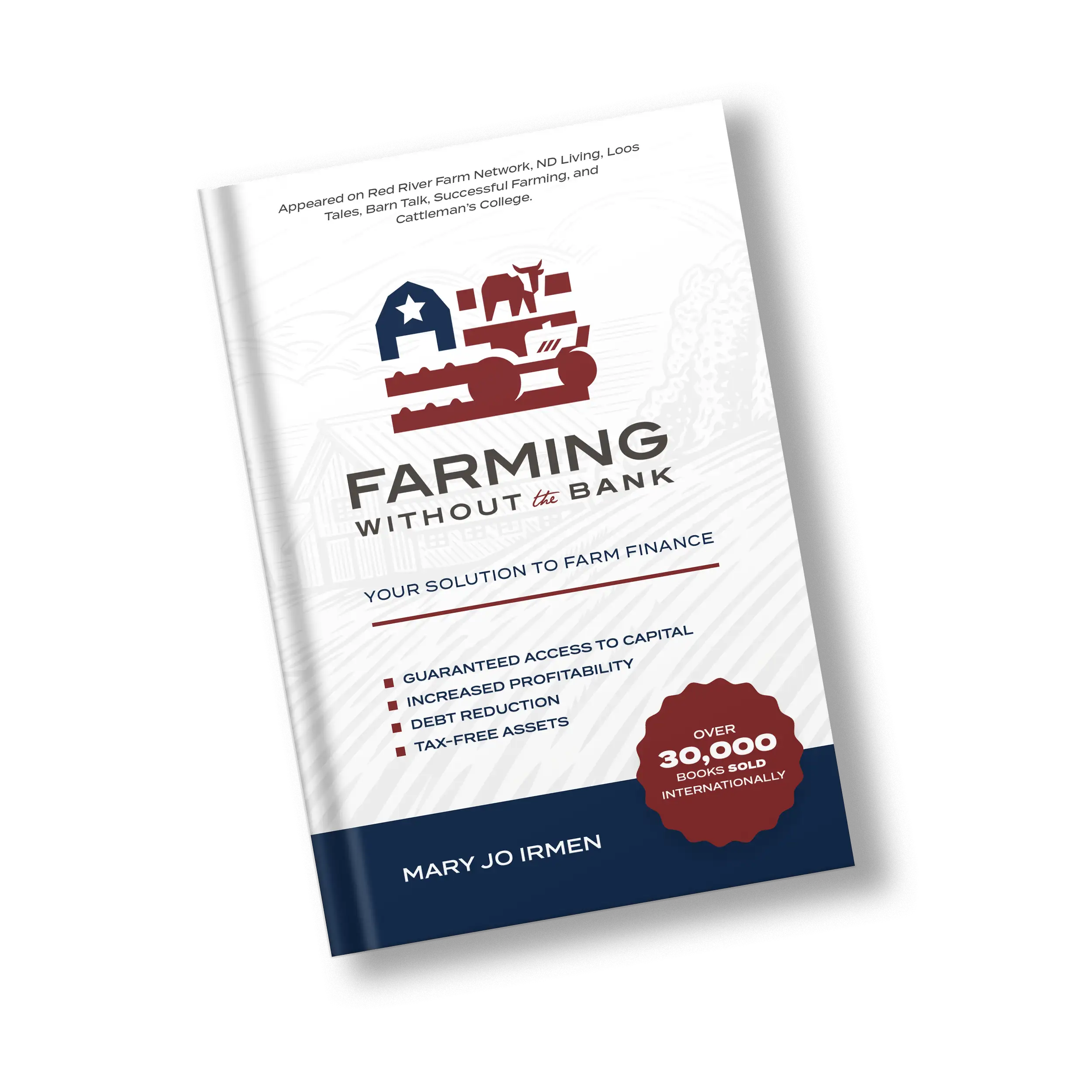
Your farm’s financial independence starts with one book.
30,000 farmers and ranchers have already made the shift. The only question is how long you’ll keep paying interest you could be keeping yourself.