 GET THE BOOK
 GET THE BOOK




Podcast
EP. 328
The Truth About Policy Loans, Dividends, & Inflation (Ep. 328)
Nov 14, 2025 ·
18 min
0:00 / 18:08
EPISODE OVERVIEW
ABOUT THIS EPISODE
Most people think policy loans mean “borrowing your own money.” That’s completely wrong, and it’s costing them big. In this episode, Mary Jo breaks down exactly how policy loans work inside Infinite Banking and why understanding the difference can change how you build wealth.
In this deep dive, Mary Jo explains why you’re borrowing the life insurance company’s money, not your own, when using policy loans, and how that lets your cash value keep earning uninterrupted compound interest and dividends.
She also addresses common misconceptions some accountants have, what’s actually deductible, and why using this strategy helps reduce inflation by keeping dollars out of the fractional-reserve banking system.
If you’ve ever wondered whether you “pay to borrow your own money,” this episode clears it up once and for all.
🧭 Key Takeaways
- You’re borrowing against your policy, not from it.
- The interest goes to the insurance company, not back into your policy.
- You still earn compound interest + dividends while using that money.
- Accountants often misunderstand how policy loans and deductions work.
- Using Infinite Banking helps you leverage dollars and avoid inflating the currency.
(Timestamps are from the video version. Audio-only edits are always shorter since they have had more fluff removed, so the timestamps are not accurate to this version.)
- 👍 Like this episode if it cleared up a myth about policy loans
- 💬 Comment your biggest “aha!” moment below
- 📲 Subscribe for more Infinite Banking education and strategies
📚 Mentioned Links
- 📘 Grab your book and check out the Harvest Sale
- 📧 Contact Mary Jo with your questions: maryjo@withoutthebank.com
CHAPTER TIMESTAMPS
- 00:00Welcome & Today's Topic
- 02:30The Big Infinite Banking Misconception
- 05:10Borrowing the Insurance Company's Money
- 08:30Accountants, Interest, and Tax Deductions
- 13:00How This Strategy Fights Inflation
- 16:30Uninterrupted Compound Interest in Action
- 19:00Why Understanding Leverage Matters
- 20:00Harvest Sale + Final Thoughts
YOUTUBE EPISODE
TRANSCRIPTION
"If you have to go get your Monopoly money, go get it. That's what I did right away. I was like, this is stupid. How does that work? I don't believe that. I went to my daughter's Monopoly game and I took her Monopoly money and I put the life insurance company's pile and I put my pile and I started borrowing and I started moving money around and it all worked exactly like it was supposed to. It is such a mind shift that we think, oh, there's no way that works. And it does, 100% it does. Sometimes we have to touch and feel that strategy in order to make it make sense. If that is how you learn. Some people just get it right away. I'm not one of those people. I need to touch it and feel it. I need to see it moving in order to make sure that it's making sense. So I did my due diligence for you. But if you don't want to believe my due diligence, then go out and do it yourself."
Hello, hello and welcome back to the podcast. Thank you very much for being here. I appreciate it. Okay, today let's talk about borrowing your money or borrowing the life insurance company's money. And this is actually a really good conversation to have. After we talked about, if you missed John and I's podcast about Dave Ramsey, talking to a young guy about taking a cattle note, this is going to be a good podcast. Because it's very much what we talked about there is the leverage of money. And we're going to talk about that here.
So a lot of people, one of the really, really big objections with infinite banking is that people will say, well, I'm not going to pay to borrow my money. Well, that is not what's happening in the policy. And so what happens, and this is such a big, huge misconception, and I'm actually running into this a lot right now with accountants, where you are not borrowing your money. The interest that you are paying to the insurance company is to borrow their money. They get the interest. That interest is not going back into your policy. What is increasing in your policy is the compound interest your money's earning while you borrow the insurance company's money, and it is the dividends.
And so this seems crazy that people can't quite understand this, but it makes sense in the fact that there isn't another tool that really allows us to do that. The only other tool is a CD that we could borrow against a CD, just like the kid did in the podcast that John and I were talking about, Dave Ramsey, and that was what, two, three weeks ago. And so if you go back to that, that kid is saying, hey, I'm going to put money in a CD. I'm going to let the bank pay me compound interest on that CD, and then I'm going to go to the bank and I'm going to borrow money. So if he's paying 7% at the bank, and his CD's earning 4%, he has a difference of 3%, right? And it's not just 3% interest. There is a spread. That's a 3% spread, right? But that's not the actual interest rate when you figure out a spread. That's a whole other podcast. Anywho, he is paying the difference, people will say, of 3%.
So inside your life insurance policy, the same thing is happening. We are going to borrow the insurance company's money while our money stays in there, earning us compound interest plus a dividend. This is where a lot of people get hung up, is that the difference between the CD and the policy is that the CD, the dividend, is going to the bank, right? The bank makes money. Who gets the money? The shareholders of the bank. What's happening inside the policy is that we're all owners of the life insurance company now. We are participating in the ownership of that. So when that company makes money, you and I are going to get a dividend. So not only are we getting the compound interest, but we're getting a dividend. And we're getting uninterrupted compound interest. And I use that phrase a lot, uninterrupted on purpose, because there is a difference between interrupted compound interest and uninterrupted compound interest.
So the power of the life insurance policy is that we have the ability to earn that uninterrupted compound interest because we're using the insurance company's money. So we can leverage our dollar. There would really not be a huge purpose to using life insurance outside of that. Yes, there's death benefit. And yes, that is 100% important. And it's useful. But we have to, when we're looking at why are we borrowing somebody else's money or why are we paying interest on our money? We're not borrowing our money. Our money stays in the account very much like the CD.
Now, when we go to the bank, a lot of people like this kid that we talked about in the podcast, he had $100,000 in a CD. The bank is earning interest on that, right? The bank is making money on that. Well, all they did was lend him back his own money. And that's exactly what Dave was saying in his podcast. He said, hey, all you're doing is borrowing your money. And that's exactly right. If we have money in savings, if we have money in a CD, if we have money anywhere within the banking system, and then we go to the bank to borrow money because we don't want to touch our savings, we did exactly that. We just borrowed back our own money. And we're not even getting the dividend from it, right?
So, accountants are having a really hard time with this lately. And I don't know why. Accountants are telling clients, you cannot deduct the interest from that policy as an expense. And I'm hoping to get an accountant on here so that we can straighten this all out for once. But if you borrowed money from the insurance company against your policy, if you've borrowed money against your policy and you used it to buy cattle, used it for fuel, fertilizer, feed, seed, chemical, I don't care what it was. If it was a farm expense, if you put up a barn, if you put up corrals, if that was a farm expense and you have the receipts, 99% of accountants are going to say, yes, you can deduct that. I have run into the 1% that are saying, no, that can't be deducted because that interest is going back to you, not the insurance company. No, no, no, no, Mr. Accountant. That is not what is happening. The interest is going to the insurance company. It is not going back into the policy.
If we are borrowing from our 401(k), that money that we've borrowed is, they're going to charge us 4, 6, 7, 8% interest, right? Everybody's kind of different. That is actually going back into our 401(k). So if I borrow money from my 401(k), the interest goes back in. That's actually, in my opinion, not a bad idea because if that money was in the market, I don't know what I'm going to make. But if the investment company or whoever I'm borrowing it from, if they're going to allow me to borrow it and then I can pay it back at 6%, I know I just made a 6% rate of return, right? Because I put 6% back in there. So I don't have it subject to the market because it wasn't in the market, but I'm the one paying the 6%. It's basically like what Nelson says. Hey, pay it back plus extra. That's what you're doing in a 401(k). Great, fantastic. That goes into the 401(k). If we're borrowing from the company, the interest goes to the company. It is a true, real expense.
And it is amazing. The stuff that I am hearing from clients that accountants are saying, no, you can't do that because it was your personal money. No, it was not your personal money. It was the insurance company's money. It is no different than getting a loan from anywhere else. I have a client that the accountant said, no, that's your personal money. You can't do that. But yet he allowed the interest to be deducted when the client took a loan from his father. And so now he took a loan from dad and that interest could be deducted for farm expenses, but not the stuff from the life insurance company. It just doesn't even make sense to me. Why are you saying that this money is coming to you differently than this money? It's a loan regardless. It is a loan on the life insurance company's paperwork.
If that person were to cancel the policy, let's say that they have a loan in their policy and they canceled the policy, guess what? They're going to get sent a 1099 and anything above what they paid in, so their basis, anything above their basis, they're going to have to pay tax on. If they had a loan and they canceled the policy, that loan turns into a payout. Now you have to pay tax on it. So if that's the case, why are we not deducting the interest, right? Because now they're paying tax on the growth, so why can't we deduct the interest? It's an actual loan, my friends.
The more clients we have, the more the people who try to use these policies to deduct interest, the more we're running into this problem. And it is because people think they're borrowing their own money. You are not borrowing your own money. You are borrowing the life insurance company's money. No different than if you had a CD and you went to the bank and you borrowed money from that CD and all of a sudden, you get to deduct that interest. It's the same thing. So we are leveraging our dollar. The reason we're using the life insurance policy is because we get to leverage our dollar. We have our money working for us while we've borrowed somebody else's money. Again, you could do this with a CD. I don't care what you do it with. You could do it with gold and silver if you wanted. The difference is that we own part of this company. It is paying us a dividend.
And let me add one more thing. We are not inflating the dollar. When you give a dollar to the bank, they can go get 10 times that. So in the case of the podcast John and I did, they had $100,000, right? They were able to go get 10 times that and lend it back out. If that kid would have put that $100,000 into a life insurance policy, he could only borrow $100,000. The bank would not be creating some fractional reserve banking with that money. They wouldn't be inflating our dollar. And so a lot of people don't talk about it because it's not sexy. It's not fun. It's boring as all get out. But that is the point of what Nelson really was trying to do. He was an Austrian economist. Besides his Bible, it is the one thing that he was adamant about. We have to get rid of the Fed. We have to look at how we can do that. And if we one-on-one start moving our money into life insurance policies, they cannot inflate the dollar. They can't turn it 10 times.
And so can we use this tool that still allows us liquidity, control, and guarantees and it doesn't create inflation? Because we're borrowing that money. Yes, it's going into our checking account, but ideally it's coming out of our checking account. Banks make a lot of money when we have loans there, right? Because a loan payment will come back in, which will create more money for them. They like your high-yield savings accounts because then they can go get 10 times the money. And so if we did this, would and if 10% of the population did it, that's kind of the tipping point that they've discovered. If 10% of the population did this, could we deflate that dollar a little bit? Now, we're probably nowhere near 10%, right? We don't even have 10% of life insurance agents understanding the infinite banking concept. But if we did, how amazing would that be?
So anyway, there's a couple of reasons, obviously, that we do this. Number one is we're leveraging our dollar. We're earning uninterrupted compound interest and dividends. And then we are stopping the inflation of the dollar. So if you are out there and you hear somebody that has just got all these rebuttals of why this is so bad, or you're working with your accountant, and he is saying, well, that interest can't be deducted, maybe ask another accountant. I am not an accountant. I am just telling you what most accountants are doing, and they are allowing people to deduct the interest. You need to have the receipt. My old accountant was an IRS auditor for 30 years. My new accountant was also an auditor, and they are not seeing problems with it. And so we definitely want to make sure that we are aligning ourselves with somebody that understands or wants to understand. If your accountant doesn't want to understand this, doesn't want to do the research, then maybe you don't have the right accountant. I just don't see that problem happening very often. And so I'm going to speak as if I'm an accountant, which I probably shouldn't do. But make sure you're doing your due diligence and not just accepting what people are saying on the other side that may truly not understand.
I think a lot of accountants and a lot of people think they're actually borrowing your money. And here's the thing. You could take your money out, but then you can't put it back in. So if you want to do something with your money that's in cash value, you can take it out, but you can't borrow your money free. They always give you their money and that's going to have an interest rate associated with it. It's all leverage. It's all leverage. It is no different than saying, I am going to use my land and I'm going to go to the bank and use my land as collateral. It's the exact same thing. Your cash value is collateral to your loan, right? And then your death benefit's collateral to that. So there is not any difference in doing that. It's the tool used to do it is different because we have the uninterrupted compound interest.
I don't know if I can say that in any additional ways that are going to get you to understand it without actually you having Monopoly money. If you have to go get your Monopoly money, go get it. That's what I did right away. I was like, this is stupid. How does that work? I don't believe that. I went to my daughter's Monopoly game and I took her Monopoly money and I put the life insurance company's pile and I put my pile and I started borrowing and I started moving money around and it all worked exactly like it was supposed to. It is such a mind shift that we think, oh, there's no way that works. And it does, 100% it does. Sometimes we have to touch and feel that strategy in order to make it make sense. If that is how you learn. Some people just get it right away. Yeah, I'm not one of those people. I need to touch it and feel it. I need to see it moving in order to make sure that it's making sense. So I did my due diligence for you. But if you don't want to believe my due diligence, then go out and do it yourself. But we are participating in infinite banking in many aspects of our life. We're just allowing somebody else to get the dividend and we're interrupting our money in the process. So there's that.
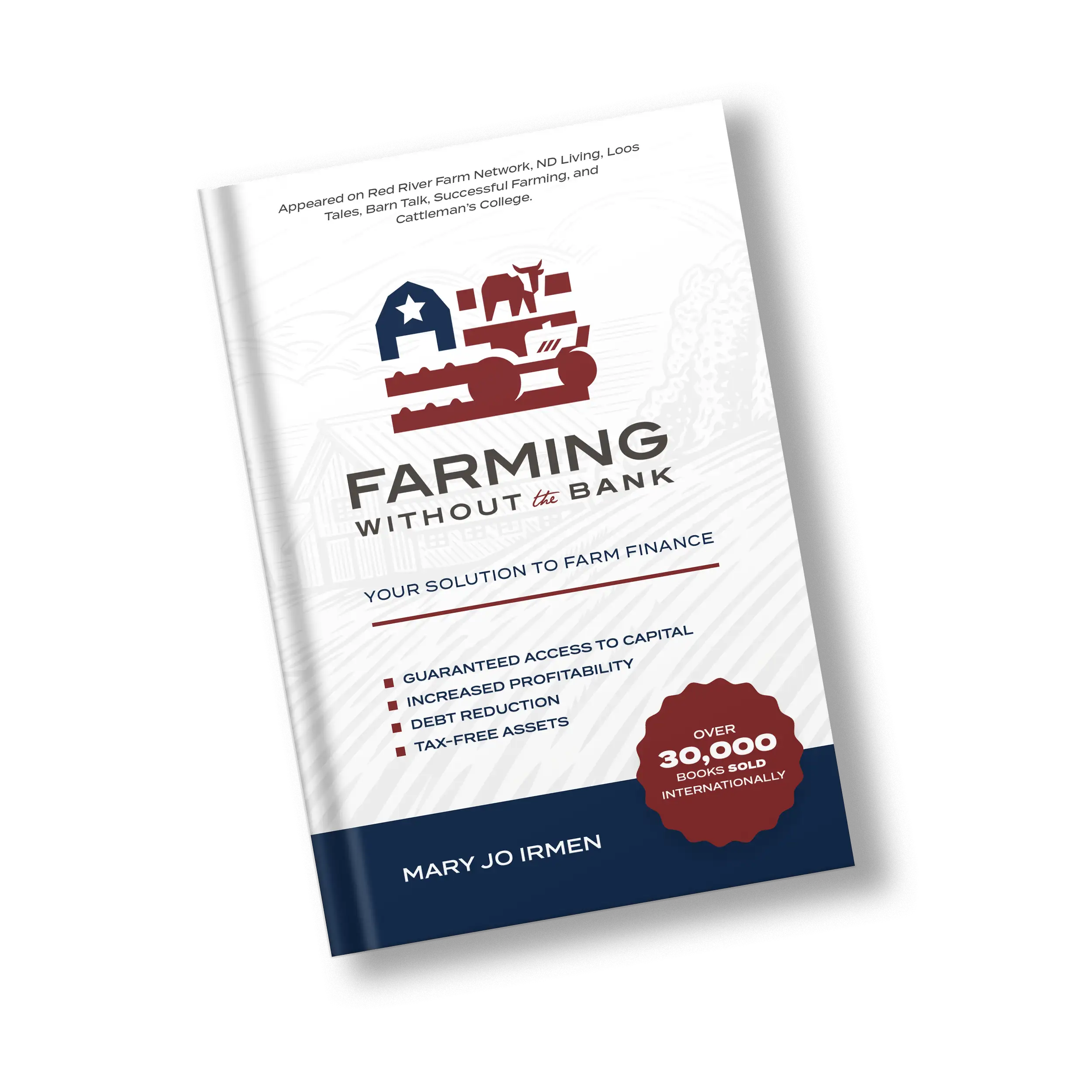
If you have questions, you know where I'm at. Let me know. maryjo@withoutthebank.com. Go ahead, grab your books if you have not gotten them. While this is airing, we do have a sale going on for harvest. And so go ahead, go to farmingwithoutthebank.com. If you've not gotten the book yet, go get the harvest sale because it's going to include a free audio so you guys can listen while you're in the tractor. Now, I don't want you just to listen. I also want you to go through the numbers in the book and to see all those numbers. Because those of you that just listen to the book and don't actually read the book, then you don't understand how the numbers work because you just listened and you didn't read. So it's on paper for a reason. And part of me is thinking that I'm going to eliminate audio only. That you will have to buy the paper book with the audio because I am seeing such a significant difference and understanding when you actually physically read the book. And don't be scared of a book, my friends. It's just a book. It's got a little spine. It's no different than a magazine. It's just called a book instead. So don't be scared. It won't bite you.
All right. Let me know if you need anything. maryjo@withoutthebank.com. Otherwise, you have a fantastic rest of your day.
Thanks for listening to the Farming Without the Bank podcast. We hope today's episode has inspired you to take control of your finances in new ways. Don't forget to check out our website, farmingwithoutthebank.com, and engage with us on our Facebook page, Farming Without the Bank. Join us next week as we smash more financial myths and empower you to accomplish your financial goals.
View MoreHello, hello and welcome back to the podcast. Thank you very much for being here. I appreciate it. Okay, today let's talk about borrowing your money or borrowing the life insurance company's money. And this is actually a really good conversation to have. After we talked about, if you missed John and I's podcast about Dave Ramsey, talking to a young guy about taking a cattle note, this is going to be a good podcast. Because it's very much what we talked about there is the leverage of money. And we're going to talk about that here.
So a lot of people, one of the really, really big objections with infinite banking is that people will say, well, I'm not going to pay to borrow my money. Well, that is not what's happening in the policy. And so what happens, and this is such a big, huge misconception, and I'm actually running into this a lot right now with accountants, where you are not borrowing your money. The interest that you are paying to the insurance company is to borrow their money. They get the interest. That interest is not going back into your policy. What is increasing in your policy is the compound interest your money's earning while you borrow the insurance company's money, and it is the dividends.
And so this seems crazy that people can't quite understand this, but it makes sense in the fact that there isn't another tool that really allows us to do that. The only other tool is a CD that we could borrow against a CD, just like the kid did in the podcast that John and I were talking about, Dave Ramsey, and that was what, two, three weeks ago. And so if you go back to that, that kid is saying, hey, I'm going to put money in a CD. I'm going to let the bank pay me compound interest on that CD, and then I'm going to go to the bank and I'm going to borrow money. So if he's paying 7% at the bank, and his CD's earning 4%, he has a difference of 3%, right? And it's not just 3% interest. There is a spread. That's a 3% spread, right? But that's not the actual interest rate when you figure out a spread. That's a whole other podcast. Anywho, he is paying the difference, people will say, of 3%.
So inside your life insurance policy, the same thing is happening. We are going to borrow the insurance company's money while our money stays in there, earning us compound interest plus a dividend. This is where a lot of people get hung up, is that the difference between the CD and the policy is that the CD, the dividend, is going to the bank, right? The bank makes money. Who gets the money? The shareholders of the bank. What's happening inside the policy is that we're all owners of the life insurance company now. We are participating in the ownership of that. So when that company makes money, you and I are going to get a dividend. So not only are we getting the compound interest, but we're getting a dividend. And we're getting uninterrupted compound interest. And I use that phrase a lot, uninterrupted on purpose, because there is a difference between interrupted compound interest and uninterrupted compound interest.
So the power of the life insurance policy is that we have the ability to earn that uninterrupted compound interest because we're using the insurance company's money. So we can leverage our dollar. There would really not be a huge purpose to using life insurance outside of that. Yes, there's death benefit. And yes, that is 100% important. And it's useful. But we have to, when we're looking at why are we borrowing somebody else's money or why are we paying interest on our money? We're not borrowing our money. Our money stays in the account very much like the CD.
Now, when we go to the bank, a lot of people like this kid that we talked about in the podcast, he had $100,000 in a CD. The bank is earning interest on that, right? The bank is making money on that. Well, all they did was lend him back his own money. And that's exactly what Dave was saying in his podcast. He said, hey, all you're doing is borrowing your money. And that's exactly right. If we have money in savings, if we have money in a CD, if we have money anywhere within the banking system, and then we go to the bank to borrow money because we don't want to touch our savings, we did exactly that. We just borrowed back our own money. And we're not even getting the dividend from it, right?
So, accountants are having a really hard time with this lately. And I don't know why. Accountants are telling clients, you cannot deduct the interest from that policy as an expense. And I'm hoping to get an accountant on here so that we can straighten this all out for once. But if you borrowed money from the insurance company against your policy, if you've borrowed money against your policy and you used it to buy cattle, used it for fuel, fertilizer, feed, seed, chemical, I don't care what it was. If it was a farm expense, if you put up a barn, if you put up corrals, if that was a farm expense and you have the receipts, 99% of accountants are going to say, yes, you can deduct that. I have run into the 1% that are saying, no, that can't be deducted because that interest is going back to you, not the insurance company. No, no, no, no, Mr. Accountant. That is not what is happening. The interest is going to the insurance company. It is not going back into the policy.
If we are borrowing from our 401(k), that money that we've borrowed is, they're going to charge us 4, 6, 7, 8% interest, right? Everybody's kind of different. That is actually going back into our 401(k). So if I borrow money from my 401(k), the interest goes back in. That's actually, in my opinion, not a bad idea because if that money was in the market, I don't know what I'm going to make. But if the investment company or whoever I'm borrowing it from, if they're going to allow me to borrow it and then I can pay it back at 6%, I know I just made a 6% rate of return, right? Because I put 6% back in there. So I don't have it subject to the market because it wasn't in the market, but I'm the one paying the 6%. It's basically like what Nelson says. Hey, pay it back plus extra. That's what you're doing in a 401(k). Great, fantastic. That goes into the 401(k). If we're borrowing from the company, the interest goes to the company. It is a true, real expense.
And it is amazing. The stuff that I am hearing from clients that accountants are saying, no, you can't do that because it was your personal money. No, it was not your personal money. It was the insurance company's money. It is no different than getting a loan from anywhere else. I have a client that the accountant said, no, that's your personal money. You can't do that. But yet he allowed the interest to be deducted when the client took a loan from his father. And so now he took a loan from dad and that interest could be deducted for farm expenses, but not the stuff from the life insurance company. It just doesn't even make sense to me. Why are you saying that this money is coming to you differently than this money? It's a loan regardless. It is a loan on the life insurance company's paperwork.
If that person were to cancel the policy, let's say that they have a loan in their policy and they canceled the policy, guess what? They're going to get sent a 1099 and anything above what they paid in, so their basis, anything above their basis, they're going to have to pay tax on. If they had a loan and they canceled the policy, that loan turns into a payout. Now you have to pay tax on it. So if that's the case, why are we not deducting the interest, right? Because now they're paying tax on the growth, so why can't we deduct the interest? It's an actual loan, my friends.
The more clients we have, the more the people who try to use these policies to deduct interest, the more we're running into this problem. And it is because people think they're borrowing their own money. You are not borrowing your own money. You are borrowing the life insurance company's money. No different than if you had a CD and you went to the bank and you borrowed money from that CD and all of a sudden, you get to deduct that interest. It's the same thing. So we are leveraging our dollar. The reason we're using the life insurance policy is because we get to leverage our dollar. We have our money working for us while we've borrowed somebody else's money. Again, you could do this with a CD. I don't care what you do it with. You could do it with gold and silver if you wanted. The difference is that we own part of this company. It is paying us a dividend.
And let me add one more thing. We are not inflating the dollar. When you give a dollar to the bank, they can go get 10 times that. So in the case of the podcast John and I did, they had $100,000, right? They were able to go get 10 times that and lend it back out. If that kid would have put that $100,000 into a life insurance policy, he could only borrow $100,000. The bank would not be creating some fractional reserve banking with that money. They wouldn't be inflating our dollar. And so a lot of people don't talk about it because it's not sexy. It's not fun. It's boring as all get out. But that is the point of what Nelson really was trying to do. He was an Austrian economist. Besides his Bible, it is the one thing that he was adamant about. We have to get rid of the Fed. We have to look at how we can do that. And if we one-on-one start moving our money into life insurance policies, they cannot inflate the dollar. They can't turn it 10 times.
And so can we use this tool that still allows us liquidity, control, and guarantees and it doesn't create inflation? Because we're borrowing that money. Yes, it's going into our checking account, but ideally it's coming out of our checking account. Banks make a lot of money when we have loans there, right? Because a loan payment will come back in, which will create more money for them. They like your high-yield savings accounts because then they can go get 10 times the money. And so if we did this, would and if 10% of the population did it, that's kind of the tipping point that they've discovered. If 10% of the population did this, could we deflate that dollar a little bit? Now, we're probably nowhere near 10%, right? We don't even have 10% of life insurance agents understanding the infinite banking concept. But if we did, how amazing would that be?
So anyway, there's a couple of reasons, obviously, that we do this. Number one is we're leveraging our dollar. We're earning uninterrupted compound interest and dividends. And then we are stopping the inflation of the dollar. So if you are out there and you hear somebody that has just got all these rebuttals of why this is so bad, or you're working with your accountant, and he is saying, well, that interest can't be deducted, maybe ask another accountant. I am not an accountant. I am just telling you what most accountants are doing, and they are allowing people to deduct the interest. You need to have the receipt. My old accountant was an IRS auditor for 30 years. My new accountant was also an auditor, and they are not seeing problems with it. And so we definitely want to make sure that we are aligning ourselves with somebody that understands or wants to understand. If your accountant doesn't want to understand this, doesn't want to do the research, then maybe you don't have the right accountant. I just don't see that problem happening very often. And so I'm going to speak as if I'm an accountant, which I probably shouldn't do. But make sure you're doing your due diligence and not just accepting what people are saying on the other side that may truly not understand.
I think a lot of accountants and a lot of people think they're actually borrowing your money. And here's the thing. You could take your money out, but then you can't put it back in. So if you want to do something with your money that's in cash value, you can take it out, but you can't borrow your money free. They always give you their money and that's going to have an interest rate associated with it. It's all leverage. It's all leverage. It is no different than saying, I am going to use my land and I'm going to go to the bank and use my land as collateral. It's the exact same thing. Your cash value is collateral to your loan, right? And then your death benefit's collateral to that. So there is not any difference in doing that. It's the tool used to do it is different because we have the uninterrupted compound interest.
I don't know if I can say that in any additional ways that are going to get you to understand it without actually you having Monopoly money. If you have to go get your Monopoly money, go get it. That's what I did right away. I was like, this is stupid. How does that work? I don't believe that. I went to my daughter's Monopoly game and I took her Monopoly money and I put the life insurance company's pile and I put my pile and I started borrowing and I started moving money around and it all worked exactly like it was supposed to. It is such a mind shift that we think, oh, there's no way that works. And it does, 100% it does. Sometimes we have to touch and feel that strategy in order to make it make sense. If that is how you learn. Some people just get it right away. Yeah, I'm not one of those people. I need to touch it and feel it. I need to see it moving in order to make sure that it's making sense. So I did my due diligence for you. But if you don't want to believe my due diligence, then go out and do it yourself. But we are participating in infinite banking in many aspects of our life. We're just allowing somebody else to get the dividend and we're interrupting our money in the process. So there's that.
If you have questions, you know where I'm at. Let me know. maryjo@withoutthebank.com. Go ahead, grab your books if you have not gotten them. While this is airing, we do have a sale going on for harvest. And so go ahead, go to farmingwithoutthebank.com. If you've not gotten the book yet, go get the harvest sale because it's going to include a free audio so you guys can listen while you're in the tractor. Now, I don't want you just to listen. I also want you to go through the numbers in the book and to see all those numbers. Because those of you that just listen to the book and don't actually read the book, then you don't understand how the numbers work because you just listened and you didn't read. So it's on paper for a reason. And part of me is thinking that I'm going to eliminate audio only. That you will have to buy the paper book with the audio because I am seeing such a significant difference and understanding when you actually physically read the book. And don't be scared of a book, my friends. It's just a book. It's got a little spine. It's no different than a magazine. It's just called a book instead. So don't be scared. It won't bite you.
All right. Let me know if you need anything. maryjo@withoutthebank.com. Otherwise, you have a fantastic rest of your day.
Thanks for listening to the Farming Without the Bank podcast. We hope today's episode has inspired you to take control of your finances in new ways. Don't forget to check out our website, farmingwithoutthebank.com, and engage with us on our Facebook page, Farming Without the Bank. Join us next week as we smash more financial myths and empower you to accomplish your financial goals.
ready to start?
Your farm’s financial independence starts with one book.
30,000 farmers and ranchers have already made the shift. The only question is how long you’ll keep paying interest you could be keeping yourself.