 GET THE BOOK
 GET THE BOOK




Podcast
EP. 330
Why Life Insurance Might Be Your Secret Asset! (Ep. 330)
Nov 28, 2025 ·
22 min
0:00 / 22:24
EPISODE OVERVIEW
ABOUT THIS EPISODE
Banks classify your life insurance as an asset, so why do so many people treat it like an expense?
In this episode, we break down how dividend-paying whole life can be your warehouse of wealth without feeding inflation like the banking system does.
Chapter 1 of Building Your Warehouse of Wealth (Nelson Nash) hits hard: government programs, fractional reserve banking, and how we’ve become “part of the problem” by chasing cheap loans and rates of return.
We contrast banks (who lend money that doesn’t exist) with mutual life insurance companies (who don’t inflate money and invest conservatively).
You’ll learn why policy loans aren’t withdrawals, why whole life beats UL/IUL/VUL for guarantees and control, and how to classify your policy correctly... as an asset with liquidity, control, and a tax-advantaged end-of-life benefit.
Key Takeaways
- Classify correctly: Whole life is an asset, not an expense.
- Banks vs Insurers: Banks inflate; mutual insurers don’t.
- Policy loans ≠ withdrawals: Your cash value keeps compounding while you borrow against it.
- Owner priority: You outrank every other borrower for your policy’s cash value.
- Avoid rate-chasing: UL/IUL/VUL = non-guaranteed costs and moving parts; IBC prioritizes liquidity, control, and guarantees.
- Don’t be part of the problem: Think twice about HELOCs/premium financing/velocity banking to fund policies.
Want to Build Your Own Warehouse of Wealth the Right Way?
👉 Grab the book/bundle and follow along with the study: 📘 farmingwithoutthebank.com/book
CHAPTER TIMESTAMPS
- 00:00Asset or Expense? Reframing Life Insurance
- 01:17Nelson's Roots & the IBC Basics
- 02:24Government, Banks & Fractional Reserve
- 05:56What Really Drives Inflation
- 08:26Are We Part of the Problem? (Loans & Leverage)
- 12:16How Insurers Invest + Why It Matters
- 15:37Policy Loans 101: Borrowing vs Withdrawing
YOUTUBE EPISODE
TRANSCRIPTION
"He goes on to say it is important to classify things on the basis of their major characteristics, not incidental ones. And he is talking about the life insurance policy. We're looking at it as an expense. Is it really an expense or is it an asset that we can put money into and we can pay premium? And now all of a sudden our money is earning compound interest and dividends. And we've included a life insurance death benefit that is income tax free. How are we classifying that? When we have a loan at the bank and the bank says, do you have life insurance as collateral to the loan? They want some sort of an asset that they can use as collateral to your loan. The banks are looking at it as an asset. The banks have bank owned life insurance. It's an asset. Big corporations have corporate owned life insurance. It's an asset. So if all of these other people are looking at it as an asset, why are we looking at it like it's a liability?"
Hello, hello, hello and welcome back to the podcast. Thank you very much for being here. Today we are back into Building Your Warehouse of Wealth and we are going to go over chapter one of this book. If you have not gotten it yet, go order it because it's a great book. And today we're going to be learning about a lot of stuff that Nelson did not like. We're going to really kind of get into Nelson's personality here, which is fantastic. Because, you know, the more stuff you read about Nelson, the more you understand that he wasn't a big lover of government programs. He wasn't a big lover of the banking system. And he's exposing all of that stuff, which is where the Austrian side of everything he does comes from.
And so I think that it's important that we understand the base of where infinite banking was built. Because a lot of people have lost that. And you guys hear me talk about that a lot. That we need to get back to the basics of IBC. We need to keep it wholesome. And a lot of people don't want to do that. A lot of people just want to say, hey, let's just try to get some big rate of return. And a lot of stuff is covered in this chapter. That's important. So, all right. Let me get into some of what he said.
He's talking about the government and that they're thieves. So, he says, they don't produce anything themselves, but just steal what others produce. And there are all kinds of sophisticated ways to steal. Jim Trotter said, give a man a gun and he can rob a bank. Give a man a bank and he will rob the world. Thomas Jefferson said, banking establishments are more dangerous than standing armies. And Nelson goes on to say, get informed on what is really happening to your money. You need to know.
And this is something that I've talked about just recently. I've talked about it a lot. And I talked about it in my crypto podcast. 97% of this population has no idea how to manage money. They don't know anything about money. A lot of our population doesn't even know how to do a budget, which is why Dave Ramsey is so popular. And the one thing he does well is gets people to understand how to add and subtract, basically. This much is coming in. This much is going out. To me, that is common sense. I don't understand why we don't know that. But a lot of people just don't care. They're rather going to say, hey, what's the next Netflix show I can binge? Not how can I make money? How can I manage my money? And maybe some of that is financial PTSD. Maybe we have this horrible feeling about it because we've never had it. And so we don't want to address it. I don't know. But once we know what the problem is, we know what's going on.
And he goes on to say, banks lend money that doesn't exist. That is fraud. If any other business did that, they would be thrown under the jail. But this has gone on so long that the practice has become normal. People accept it and think nothing of it. They let bankers do their thinking for them. And that is 100% true. This whole fractional reserve banking did not always exist. The Federal Reserve did not always exist. And Nelson goes on to talk about the book The Creature from Jekyll Island and how everybody should be reading that book. It exposes how the Federal Reserve got started, what their intent was, all the stuff.
And so if we don't understand what the problem is, we become part of the problem. Because we just go along doing our business thinking we all just need to go to the bank and borrow money. When in fact, we don't have to. But if we don't understand the problem, if we don't understand that we put a dollar in the bank and they go to the feds and get $10 and then they can lend nine of that 10 and create an interest rate income, they create income off of fake money. None of us would be able to do that. We would be thrown under the jail. And that's not what's happening, right? The banks are allowed to do it, but we're not allowed to do it. What?
What is causing the true inflation in this country? Is it the banking system? He says, the primary source of inflation in the U.S. is your local commercial bank. The Fed is there to bail out the banks in case they get into trouble with their lending practices. Hmm. That's interesting. I've never heard of the feds coming in and bailing out a life insurance company because it's not going to happen. They're going to bail out the banking institutions. Well, the banking institutions kind of know they have this safety net. So who cares if we over lend? Who cares if we screw people along the way? The feds will come in and bail us out.
This brings us to a problem today. Where are you going to warehouse your wealth? Your money. Banks make money by lending money that doesn't exist. It's pretty obvious that if no one made a loan at a bank, they would have no customers and would have to change their business. Therefore, if you have a loan at a regular commercial bank, then you are part of the problem. Think about it.
And that is true. That is 100% true. I am 100% part of the problem. Like everybody else, most likely listening to this podcast, we are going to go to the bank and I'm going to go to the bank and I'm going to borrow money to buy land. I am not, though, under any circumstance doing velocity banking, telling people to borrow money from the banks to pay premium. Hey, go borrow against your land and stick that money into a policy so you can get some huge rate of return and you can have this death benefit that'll save the farm. Heck no. Absolutely not. We become part of the problem.
So here is part of the problem within infinite banking and people that are saying they're doing infinite banking, but now we're pushing people to the banking system to use a HELOC to buy a premium or to pay premium, borrow against land to pay premium, premium financing. Oh, just go to the bank, borrow a bunch of money and buy a life insurance policy. Put the bank on the policy as collateral. Velocity banking. We are part of the problem. The whole premise of what Nelson was trying to do with infinite banking is to say, hey, let's end the Fed. Let's get rid of this fractional reserve banking. Let's control inflation so we can't print more money than necessary. Now, some people are going to believe that's possible. Some people are going to believe it's not possible.
What Nelson did, he beat Parkinson's law in the aspect of saying, you know what? I am getting away from the banking system. And if I ever need anything going forward and I cannot purchase that thing through my policy, I don't need it. So he would yell at me today and say, Mary Jo, did you need that farm ground that you purchased? Because you went to the bank and you became part of the problem. Or would you be just fine without the farm ground and have bought something else that you could have used your entire policy for? Get it through the life insurance company and borrow it from there instead of going to the bank and being part of the problem.
Do I plan to be part of the problem forever? No. We just paid off some of our farm ground. I was like, you know what? I've got the money in the policy. I don't want to be part of the problem to this extent anymore. Am I still part of the problem? Yes, I am. But what we're seeing and what I'm seeing online is all of these people chasing rates of return. They're saying, hey, what about if I did this and I can make a better rate in the policy because I could borrow from the bank and I could do all of this stuff. Even when interest rates were 2%, Nelson would have said, borrow from your policy because you are part of the problem by going to the banking system. If you want to stop inflation, then stop going to the banks or stop complaining about inflation. Right? We can't have both.
It's no different than Nelson saying, I don't want Social Security. He called the Social Security office and said, I don't want it because I don't want to be part of the problem. Well, they made him take it anyway. But we say, well, we don't want all this government funding. We don't want all these government handouts, as we call them. But we're taking child tax credits. We're taking mortgage interest credits. We're taking the standard deduction credit. Right? We're taking all of those credits. We're not saying, hey, hey, you keep them because we don't want to be part of the problem. Nelson used to say that to me, too. Are you getting your mortgage tax deduction? Because if you're taking that, you're part of the problem. If everybody would just not take it, then we could say, hey, Mr. Government, why don't you stop taking taxes from us? But what do we do? Instead, we believe that's not going to happen. They're going to take them anyway. And everybody else is taking them. So we may as well take them. Right?
It was no different during COVID that we could take all of this money as businesses. Oh, you can take all this PPP money. You can do all this stuff. I did not take any of it because I did not want to be part of the problem. I refused to take it. A, I didn't need it. And B, a lot of not colleagues, but other business owners that I know took it because they say, well, you know how much I paid in taxes? I pay so much in taxes. It's like me getting my money back. What? It's a new, it's just another way for the government to increase taxes because everybody took it. Right? If we don't stop taking it, we don't have the control that we need to put our foot down.
But Nelson goes on to say, fortunately, there is a place where wealth can be accumulated and stored that does not engage in lending money that does not exist. That is dividend paying whole life insurance. The insurance companies cannot go to the feds and borrow $10 and lend out nine of that. They cannot create inflation. Then he says life insurance companies have to invest their money in very conservative things like bonds, things that are guaranteed repayment schedules. So they know the insurance company is not going to put their money in the stock market. They're going to go buy bonds or real estate or something that's very secure that they know that they can cash in to pay a death claim later. They have to have a guaranteed product. There's no ands, ifs, or buts. They're not putting the majority of their money in the stock market. Dividend paying whole life with a mutual company. This is not every company. This is not a stock company. Okay? There is a difference.
He says they are not looking for a high rate of return. Like the universal life, variable life, and equity indexed universal life. That is, they are chasing a rate of return. Dividend paying whole life is not doing that. So I'm going to beat this horse until I die. I swear to God, I am not going to let up on this universal life, variable life, and IUL crap. Because they are chasing a rate of return. We are not chasing a rate of return. We are about liquidity, control, and guarantees. There are no guarantees in a universal life policy. Any type of universal life policy. The fees are not guaranteed to stay the same. They are guaranteed to go up. They're not guaranteed to stay the same. So you have to really understand what you're buying. And Nelson said it here, right here. Not universal. Not variable. Not indexed universal.
He also went on to say, The insurance company will lend money to the policyholder up to the amount of equity each person has in the policy. How much cash value do you have? That is how much you can borrow against. It is not less than that. It is not more than that. It is the equity of the policy. In a universal life, you're only borrowing whatever you can minus surrender value. That surrender charge is 10 to 20 years in those policies. So you can borrow up to the amount of equity you have in the policy.
The owner is using the cash value as collateral to obtain a loan from the insurance company, which now holds a lien against the death benefit. So you're going to borrow against your cash value. And the death benefit is collateral to that cash value loan. The loans to the policyholders, however, are totally secure. Thus, it is obvious that the owner outranks every other possible borrower in access to money. Meaning, you are the owner of the policy. You get first dibs to that cash value loan. I'm not going to say, Hey, sorry, you're second in line. No, you get first dibs. You fill out a form and you have access to it.
What's more, the insurance company cannot lend out money that doesn't exist the way a local commercial bank does. Saying it again. Hence, they cannot inflate the money supply. Notice that this means the value in your policy is always at work at any one time. This is the part that people get so confused about. They're like, hey, I'm taking my money out. No, you are not taking your money. You absolutely are not taking your money. You are borrowing against your money. So your cash value is earning interest while you're paying the life insurance company interest.
This is no different than if I were to say, do you have a loan at the bank for your land? Yep. Well, your land is increasing in value, right? You're building equity while you pay the bank an interest rate to use their money. So that you can be buying land today and be building value over time. It is not any different than that. So many people want to say, though, well, I don't want to pay the life insurance company to use my money. You aren't using your money. You are using the life insurance company's money and you borrowed against your money, allowing your money to earn compound interest and dividends.
Okay. Nelson addresses this very thing. What about this idea of making loans? Many people hear the word loan and immediately their brain goes into deep freeze. A loan equals something bad. It is a truism that you finance everything that you buy. You either borrow from someone else or you use your money and give up the ability to earn interest on your money. There is no exception. And again, he is 100% correct. You are going to either use your money and pay cash for whatever it is you want. And you now don't have the ability to earn uninterrupted compound interest on it. So you've lost money or you borrow against your money and you pay the insurance company money.
But I don't want a loan, Mary Jo. Okay. This is where we have a problem with the terminology. If I borrow money from the bank and I pay them back $10,000, I lost that $10,000, right? The bank took it. I cannot use it again. It is gone. It is equity in my ground. It is equity in a piece of equipment. It's equity in cattle, whatever. It is invisible. I can't access it without going back to the bank to ask them to borrow against that item again.
Now, if I borrow against my life insurance policy and I pay back $10,000 in the form of a loan repayment, that $10,000 is released from collateral. So now in 10 days, I have access to borrow against it again. Did that $10,000 act like a deposit? It did. It is not a deposit. Do not get me wrong. It was a loan repayment, but I now have access to borrow against it again. So we get in our heads that, oh my God, they're going to require me to make a loan repayment. But if you were willing to pay the bank a loan repayment and that $10,000 was gone, you may have been willing to pay $10,000 in cash and now that cash is gone and you don't have access to any of it. But if I borrow $10,000 against my policy and I pay $10,000 back and I now have access to $10,000 again, I'm just recycling the same money. And I get access to it first because I'm the owner of that policy. So whenever I want it, I can go in and I can access it.
He goes on to say, it is important to classify things on the basis of their major characteristics, not incidental ones. And he is talking about the life insurance policy. We are categorizing it as some sort of an expense and we're looking at it as an expense. When in fact, is it really an expense? Or is it an asset that we can put money into and we can pay premium and now all of a sudden our money is earning compound interest and dividends? And we've included life insurance death benefit that is income tax free. How are we classifying that? When we have a loan at the bank and the bank says, do you have life insurance as collateral to the loan? They want some sort of an asset that they can use as collateral to your loan, right? The banks are looking at it as an asset. The banks have bank owned life insurance. It's an asset. Companies, big corporations have corporate owned life insurance. It's an asset. So if all of these other people are looking at it as an asset, why are we looking at it like it's a liability? This is some expense that we have to pay.
It is not an expense. And it is not some fancy, sexy thing that says, oh, you're going to get rich quick. That is absolutely what this is not. It is not about a rate of return. Nelson said it. It's not about indexed universal variable life insurance, right? It is dividend paying whole life that acts in a certain manner that does not inflate a dollar.
If we all were not part of the problem, what would happen to inflation? It would go down. What is the likelihood that that is going to happen? Almost zilch. Because the majority of the population does not know what the problem is. They don't even know enough to pay attention to what's going on with their money to understand that the Federal Reserve is part of the problem. That the inflation of money is the unbelievable printing of money. Think about it. When interest rates are 2%, we're all flooding to the banks to borrow money at 2%. Because why wouldn't you? It's a cheap interest rate. We're all causing our own demise on the other side. We're all becoming part of the problem. And then we scream and yell about inflation. But yet, we went to the banks to borrow money at 2% for the boat, for the camper, for the tractor, for the cattle, whatever. Because we're going to leverage our dollar. I'm not saying that it's you. It is all of us, right?
It takes a very strong individual to do what Nelson did. To say, you know what? No, I'm not going to be part of the problem. I'm not going to leverage everything. I'm not going to expand and have all these businesses and all this land and all of these things. I'm going to live within my means. And I'm going to beat Parkinson's Law so we can get rid of the feds. Isn't that awesome? Even if, think about this. What happens if we lent money to one another through our policies? We can't inflate money 10 times. If policyholders would actually become lenders, now all of a sudden we're truly affecting that banking system. We're truly affecting inflation. But in order to get there, we need to understand infinite banking. We need to have life insurance policies. We need to pay attention to our money so we know what's happening. And the majority of us are not doing that.
Okay, that's chapter one. Let me know if you have comments, questions, concerns. If you haven't gotten the book yet, go to farmingwithoutthebank.com. Grab the book. Grab it as a bundle. Really start to understand what Nelson was talking about. I talked to a guy just this morning that he's like, I've listened to your book no less than 16 times. Okay, if you have only listened to the book once, if you've only read the book once, why? Why are you not listening to it 16 times? He was telling me stuff in my own book that I forgot was there. Like there, a lot of stuff is covered and we're not going to pick it up in just one time. That is why I do these book studies. It might sound repetitive, but that is what it's going to take in order for us to understand the problem, what's going on, and what is the solution.
So let me know if you need anything. maryjo@withoutthebank.com. Schedule your appointment. We're happy to meet with you. See if we can help you. Otherwise, you have a fantastic rest of your day.
Thanks for listening to the Farming Without the Bank podcast. We hope today's episode has inspired you to take control of your finances in new ways. Don't forget to check out our website, farmingwithoutthebank.com, and engage with us on our Facebook page, Farming Without the Bank. Join us next week as we smash more financial myths and empower you to accomplish your financial goals.
View MoreHello, hello, hello and welcome back to the podcast. Thank you very much for being here. Today we are back into Building Your Warehouse of Wealth and we are going to go over chapter one of this book. If you have not gotten it yet, go order it because it's a great book. And today we're going to be learning about a lot of stuff that Nelson did not like. We're going to really kind of get into Nelson's personality here, which is fantastic. Because, you know, the more stuff you read about Nelson, the more you understand that he wasn't a big lover of government programs. He wasn't a big lover of the banking system. And he's exposing all of that stuff, which is where the Austrian side of everything he does comes from.
And so I think that it's important that we understand the base of where infinite banking was built. Because a lot of people have lost that. And you guys hear me talk about that a lot. That we need to get back to the basics of IBC. We need to keep it wholesome. And a lot of people don't want to do that. A lot of people just want to say, hey, let's just try to get some big rate of return. And a lot of stuff is covered in this chapter. That's important. So, all right. Let me get into some of what he said.
He's talking about the government and that they're thieves. So, he says, they don't produce anything themselves, but just steal what others produce. And there are all kinds of sophisticated ways to steal. Jim Trotter said, give a man a gun and he can rob a bank. Give a man a bank and he will rob the world. Thomas Jefferson said, banking establishments are more dangerous than standing armies. And Nelson goes on to say, get informed on what is really happening to your money. You need to know.
And this is something that I've talked about just recently. I've talked about it a lot. And I talked about it in my crypto podcast. 97% of this population has no idea how to manage money. They don't know anything about money. A lot of our population doesn't even know how to do a budget, which is why Dave Ramsey is so popular. And the one thing he does well is gets people to understand how to add and subtract, basically. This much is coming in. This much is going out. To me, that is common sense. I don't understand why we don't know that. But a lot of people just don't care. They're rather going to say, hey, what's the next Netflix show I can binge? Not how can I make money? How can I manage my money? And maybe some of that is financial PTSD. Maybe we have this horrible feeling about it because we've never had it. And so we don't want to address it. I don't know. But once we know what the problem is, we know what's going on.
And he goes on to say, banks lend money that doesn't exist. That is fraud. If any other business did that, they would be thrown under the jail. But this has gone on so long that the practice has become normal. People accept it and think nothing of it. They let bankers do their thinking for them. And that is 100% true. This whole fractional reserve banking did not always exist. The Federal Reserve did not always exist. And Nelson goes on to talk about the book The Creature from Jekyll Island and how everybody should be reading that book. It exposes how the Federal Reserve got started, what their intent was, all the stuff.
And so if we don't understand what the problem is, we become part of the problem. Because we just go along doing our business thinking we all just need to go to the bank and borrow money. When in fact, we don't have to. But if we don't understand the problem, if we don't understand that we put a dollar in the bank and they go to the feds and get $10 and then they can lend nine of that 10 and create an interest rate income, they create income off of fake money. None of us would be able to do that. We would be thrown under the jail. And that's not what's happening, right? The banks are allowed to do it, but we're not allowed to do it. What?
What is causing the true inflation in this country? Is it the banking system? He says, the primary source of inflation in the U.S. is your local commercial bank. The Fed is there to bail out the banks in case they get into trouble with their lending practices. Hmm. That's interesting. I've never heard of the feds coming in and bailing out a life insurance company because it's not going to happen. They're going to bail out the banking institutions. Well, the banking institutions kind of know they have this safety net. So who cares if we over lend? Who cares if we screw people along the way? The feds will come in and bail us out.
This brings us to a problem today. Where are you going to warehouse your wealth? Your money. Banks make money by lending money that doesn't exist. It's pretty obvious that if no one made a loan at a bank, they would have no customers and would have to change their business. Therefore, if you have a loan at a regular commercial bank, then you are part of the problem. Think about it.
And that is true. That is 100% true. I am 100% part of the problem. Like everybody else, most likely listening to this podcast, we are going to go to the bank and I'm going to go to the bank and I'm going to borrow money to buy land. I am not, though, under any circumstance doing velocity banking, telling people to borrow money from the banks to pay premium. Hey, go borrow against your land and stick that money into a policy so you can get some huge rate of return and you can have this death benefit that'll save the farm. Heck no. Absolutely not. We become part of the problem.
So here is part of the problem within infinite banking and people that are saying they're doing infinite banking, but now we're pushing people to the banking system to use a HELOC to buy a premium or to pay premium, borrow against land to pay premium, premium financing. Oh, just go to the bank, borrow a bunch of money and buy a life insurance policy. Put the bank on the policy as collateral. Velocity banking. We are part of the problem. The whole premise of what Nelson was trying to do with infinite banking is to say, hey, let's end the Fed. Let's get rid of this fractional reserve banking. Let's control inflation so we can't print more money than necessary. Now, some people are going to believe that's possible. Some people are going to believe it's not possible.
What Nelson did, he beat Parkinson's law in the aspect of saying, you know what? I am getting away from the banking system. And if I ever need anything going forward and I cannot purchase that thing through my policy, I don't need it. So he would yell at me today and say, Mary Jo, did you need that farm ground that you purchased? Because you went to the bank and you became part of the problem. Or would you be just fine without the farm ground and have bought something else that you could have used your entire policy for? Get it through the life insurance company and borrow it from there instead of going to the bank and being part of the problem.
Do I plan to be part of the problem forever? No. We just paid off some of our farm ground. I was like, you know what? I've got the money in the policy. I don't want to be part of the problem to this extent anymore. Am I still part of the problem? Yes, I am. But what we're seeing and what I'm seeing online is all of these people chasing rates of return. They're saying, hey, what about if I did this and I can make a better rate in the policy because I could borrow from the bank and I could do all of this stuff. Even when interest rates were 2%, Nelson would have said, borrow from your policy because you are part of the problem by going to the banking system. If you want to stop inflation, then stop going to the banks or stop complaining about inflation. Right? We can't have both.
It's no different than Nelson saying, I don't want Social Security. He called the Social Security office and said, I don't want it because I don't want to be part of the problem. Well, they made him take it anyway. But we say, well, we don't want all this government funding. We don't want all these government handouts, as we call them. But we're taking child tax credits. We're taking mortgage interest credits. We're taking the standard deduction credit. Right? We're taking all of those credits. We're not saying, hey, hey, you keep them because we don't want to be part of the problem. Nelson used to say that to me, too. Are you getting your mortgage tax deduction? Because if you're taking that, you're part of the problem. If everybody would just not take it, then we could say, hey, Mr. Government, why don't you stop taking taxes from us? But what do we do? Instead, we believe that's not going to happen. They're going to take them anyway. And everybody else is taking them. So we may as well take them. Right?
It was no different during COVID that we could take all of this money as businesses. Oh, you can take all this PPP money. You can do all this stuff. I did not take any of it because I did not want to be part of the problem. I refused to take it. A, I didn't need it. And B, a lot of not colleagues, but other business owners that I know took it because they say, well, you know how much I paid in taxes? I pay so much in taxes. It's like me getting my money back. What? It's a new, it's just another way for the government to increase taxes because everybody took it. Right? If we don't stop taking it, we don't have the control that we need to put our foot down.
But Nelson goes on to say, fortunately, there is a place where wealth can be accumulated and stored that does not engage in lending money that does not exist. That is dividend paying whole life insurance. The insurance companies cannot go to the feds and borrow $10 and lend out nine of that. They cannot create inflation. Then he says life insurance companies have to invest their money in very conservative things like bonds, things that are guaranteed repayment schedules. So they know the insurance company is not going to put their money in the stock market. They're going to go buy bonds or real estate or something that's very secure that they know that they can cash in to pay a death claim later. They have to have a guaranteed product. There's no ands, ifs, or buts. They're not putting the majority of their money in the stock market. Dividend paying whole life with a mutual company. This is not every company. This is not a stock company. Okay? There is a difference.
He says they are not looking for a high rate of return. Like the universal life, variable life, and equity indexed universal life. That is, they are chasing a rate of return. Dividend paying whole life is not doing that. So I'm going to beat this horse until I die. I swear to God, I am not going to let up on this universal life, variable life, and IUL crap. Because they are chasing a rate of return. We are not chasing a rate of return. We are about liquidity, control, and guarantees. There are no guarantees in a universal life policy. Any type of universal life policy. The fees are not guaranteed to stay the same. They are guaranteed to go up. They're not guaranteed to stay the same. So you have to really understand what you're buying. And Nelson said it here, right here. Not universal. Not variable. Not indexed universal.
He also went on to say, The insurance company will lend money to the policyholder up to the amount of equity each person has in the policy. How much cash value do you have? That is how much you can borrow against. It is not less than that. It is not more than that. It is the equity of the policy. In a universal life, you're only borrowing whatever you can minus surrender value. That surrender charge is 10 to 20 years in those policies. So you can borrow up to the amount of equity you have in the policy.
The owner is using the cash value as collateral to obtain a loan from the insurance company, which now holds a lien against the death benefit. So you're going to borrow against your cash value. And the death benefit is collateral to that cash value loan. The loans to the policyholders, however, are totally secure. Thus, it is obvious that the owner outranks every other possible borrower in access to money. Meaning, you are the owner of the policy. You get first dibs to that cash value loan. I'm not going to say, Hey, sorry, you're second in line. No, you get first dibs. You fill out a form and you have access to it.
What's more, the insurance company cannot lend out money that doesn't exist the way a local commercial bank does. Saying it again. Hence, they cannot inflate the money supply. Notice that this means the value in your policy is always at work at any one time. This is the part that people get so confused about. They're like, hey, I'm taking my money out. No, you are not taking your money. You absolutely are not taking your money. You are borrowing against your money. So your cash value is earning interest while you're paying the life insurance company interest.
This is no different than if I were to say, do you have a loan at the bank for your land? Yep. Well, your land is increasing in value, right? You're building equity while you pay the bank an interest rate to use their money. So that you can be buying land today and be building value over time. It is not any different than that. So many people want to say, though, well, I don't want to pay the life insurance company to use my money. You aren't using your money. You are using the life insurance company's money and you borrowed against your money, allowing your money to earn compound interest and dividends.
Okay. Nelson addresses this very thing. What about this idea of making loans? Many people hear the word loan and immediately their brain goes into deep freeze. A loan equals something bad. It is a truism that you finance everything that you buy. You either borrow from someone else or you use your money and give up the ability to earn interest on your money. There is no exception. And again, he is 100% correct. You are going to either use your money and pay cash for whatever it is you want. And you now don't have the ability to earn uninterrupted compound interest on it. So you've lost money or you borrow against your money and you pay the insurance company money.
But I don't want a loan, Mary Jo. Okay. This is where we have a problem with the terminology. If I borrow money from the bank and I pay them back $10,000, I lost that $10,000, right? The bank took it. I cannot use it again. It is gone. It is equity in my ground. It is equity in a piece of equipment. It's equity in cattle, whatever. It is invisible. I can't access it without going back to the bank to ask them to borrow against that item again.
Now, if I borrow against my life insurance policy and I pay back $10,000 in the form of a loan repayment, that $10,000 is released from collateral. So now in 10 days, I have access to borrow against it again. Did that $10,000 act like a deposit? It did. It is not a deposit. Do not get me wrong. It was a loan repayment, but I now have access to borrow against it again. So we get in our heads that, oh my God, they're going to require me to make a loan repayment. But if you were willing to pay the bank a loan repayment and that $10,000 was gone, you may have been willing to pay $10,000 in cash and now that cash is gone and you don't have access to any of it. But if I borrow $10,000 against my policy and I pay $10,000 back and I now have access to $10,000 again, I'm just recycling the same money. And I get access to it first because I'm the owner of that policy. So whenever I want it, I can go in and I can access it.
He goes on to say, it is important to classify things on the basis of their major characteristics, not incidental ones. And he is talking about the life insurance policy. We are categorizing it as some sort of an expense and we're looking at it as an expense. When in fact, is it really an expense? Or is it an asset that we can put money into and we can pay premium and now all of a sudden our money is earning compound interest and dividends? And we've included life insurance death benefit that is income tax free. How are we classifying that? When we have a loan at the bank and the bank says, do you have life insurance as collateral to the loan? They want some sort of an asset that they can use as collateral to your loan, right? The banks are looking at it as an asset. The banks have bank owned life insurance. It's an asset. Companies, big corporations have corporate owned life insurance. It's an asset. So if all of these other people are looking at it as an asset, why are we looking at it like it's a liability? This is some expense that we have to pay.
It is not an expense. And it is not some fancy, sexy thing that says, oh, you're going to get rich quick. That is absolutely what this is not. It is not about a rate of return. Nelson said it. It's not about indexed universal variable life insurance, right? It is dividend paying whole life that acts in a certain manner that does not inflate a dollar.
If we all were not part of the problem, what would happen to inflation? It would go down. What is the likelihood that that is going to happen? Almost zilch. Because the majority of the population does not know what the problem is. They don't even know enough to pay attention to what's going on with their money to understand that the Federal Reserve is part of the problem. That the inflation of money is the unbelievable printing of money. Think about it. When interest rates are 2%, we're all flooding to the banks to borrow money at 2%. Because why wouldn't you? It's a cheap interest rate. We're all causing our own demise on the other side. We're all becoming part of the problem. And then we scream and yell about inflation. But yet, we went to the banks to borrow money at 2% for the boat, for the camper, for the tractor, for the cattle, whatever. Because we're going to leverage our dollar. I'm not saying that it's you. It is all of us, right?
It takes a very strong individual to do what Nelson did. To say, you know what? No, I'm not going to be part of the problem. I'm not going to leverage everything. I'm not going to expand and have all these businesses and all this land and all of these things. I'm going to live within my means. And I'm going to beat Parkinson's Law so we can get rid of the feds. Isn't that awesome? Even if, think about this. What happens if we lent money to one another through our policies? We can't inflate money 10 times. If policyholders would actually become lenders, now all of a sudden we're truly affecting that banking system. We're truly affecting inflation. But in order to get there, we need to understand infinite banking. We need to have life insurance policies. We need to pay attention to our money so we know what's happening. And the majority of us are not doing that.
Okay, that's chapter one. Let me know if you have comments, questions, concerns. If you haven't gotten the book yet, go to farmingwithoutthebank.com. Grab the book. Grab it as a bundle. Really start to understand what Nelson was talking about. I talked to a guy just this morning that he's like, I've listened to your book no less than 16 times. Okay, if you have only listened to the book once, if you've only read the book once, why? Why are you not listening to it 16 times? He was telling me stuff in my own book that I forgot was there. Like there, a lot of stuff is covered and we're not going to pick it up in just one time. That is why I do these book studies. It might sound repetitive, but that is what it's going to take in order for us to understand the problem, what's going on, and what is the solution.
So let me know if you need anything. maryjo@withoutthebank.com. Schedule your appointment. We're happy to meet with you. See if we can help you. Otherwise, you have a fantastic rest of your day.
Thanks for listening to the Farming Without the Bank podcast. We hope today's episode has inspired you to take control of your finances in new ways. Don't forget to check out our website, farmingwithoutthebank.com, and engage with us on our Facebook page, Farming Without the Bank. Join us next week as we smash more financial myths and empower you to accomplish your financial goals.
ready to start?
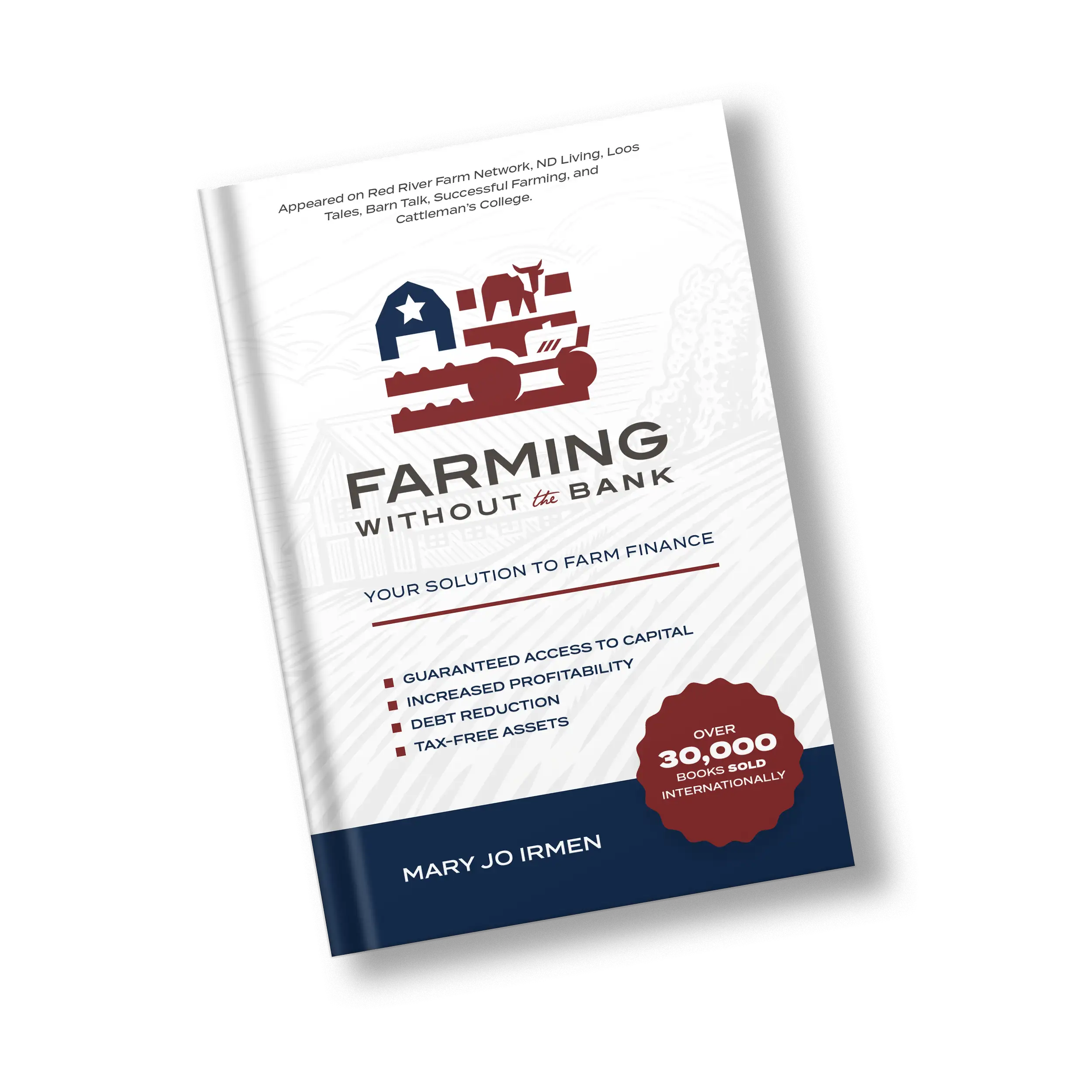
Your farm’s financial independence starts with one book.
30,000 farmers and ranchers have already made the shift. The only question is how long you’ll keep paying interest you could be keeping yourself.