 GET THE BOOK
 GET THE BOOK



Podcast
EP. 336
Your Biggest Problem Isn’t What You Think It Is (Ep. 336)
Jan 9, 2026 ·
15 min
0:00 / 14:57
EPISODE OVERVIEW
ABOUT THIS EPISODE
Everyone says farming and ranching are hard—but what if the real problem
isn't expenses… it's how money is being used?
In this episode, Mary Jo tackles the backlash around "excess money," breaks
down why being debt-free isn't the same as being financially secure, and
explains why cash flow—not comfort—is the real solution.
👉 Follow Mary Jo Here:
Mary Jo Irmen
👉 Get the book:
farmingwithoutthebank.com/book
In this candid rant-meets-masterclass, Mary Jo responds to critics who claim
there's no such thing as excess money in agriculture. She explains why higher
cattle prices create opportunities, and how most producers miss them by
paying everything off instead of building systems that generate cash flow.
In This Episode
- Why paying off low-interest debt can actually hurt you.
- How cash flow determines freedom, not net worth.
- Why "passive income" is mostly a myth.
- How money should move through your system differently.
This episode is a mindset shift for anyone stuck in the cycle of "it's hard"
and ready to start asking better questions.
✅ Key Takeaways
- Cash flow is more important than being debt-free.
- Two people with the same income can have vastly different outcomes.
- Excess money isn't the problem—misuse of it is.
- Paying off everything can kill future opportunity.
- Money must keep moving to create income.
If This Episode Challenged Your Thinking
🔔 Subscribe for more farm and ranch financial strategy.
Need Help With Your Cash Flow Strategy?
📧 Email:
maryjo@withoutthebank.com
🔗 Link Mentioned
Becoming Your Own Banker by Nelson Nash:
farmingwithoutthebank.com/product/becoming-your-own-banker
CHAPTER TIMESTAMPS
- 00:00The "It's Hard" Victim Mentality
- 01:13What "Excess Money" Really Means
- 03:03Why Money Utilization Matters More Than Income
- 04:30Paying Off Debt vs Creating Cash Flow
- 07:57Why Being Debt-Free Isn't the Answer
- 09:15How Money Should Move Through Your System
- 13:00Opportunity Thinking vs Staying Stuck
YOUTUBE EPISODE
TRANSCRIPTION
"We in the ag industry need to be the victims. We always need to be rescued. We can't do anything for ourselves. That's the mentality these people have. It's hard. It's hard. Don't you know how hard it is for us? Yeah, everybody has hard. Everybody knows how hard it is. The question is, how can we make it easier? And if we're not asking that question, we're not going to get the answer. If there is something in front of me, I'm like, ooh, how can I make that an opportunity? And I just naturally do that. And it's just so interesting to me how people don't. How people just sit in this narrative of it's hard. We just want to stay where we're at."
Hello, hello, hello, and welcome back to the podcast. Thank you very much for being here. All right. Today, we're going to talk about cash flow, some negative Nellies. It's all around that topic of cash flow.
And I have a post on the Book of Faces, and none of those people that commented are going to listen to this because based on their comments, they're not looking to learn anything. Let's just say that.
So we have a post that is a short little clip of me talking about the excess money in the cattle industry right now because of cattle prices, obviously. And the amount of people. I did some screenshots. This is the third time I'm recording this, so I'm not going to read them again. But I did screenshots and I probably have, I don't know, six or seven screenshots of people saying excess money. What are you talking about, lady? Has anybody told her that there are still expenses? One guy called me some names because, you know, he's far more intelligent than I am.
And so it's just so interesting to see 20, 30 comments saying, where do you think this excess money is? We don't have excess money. The cost of feed went up. The cost of fertilizer went up. The cost of cattle went up to even buy them back. So where is this excess money?
Honey, you got excess money because you sold cattle and you sold cattle for more than what you've sold them for in the past. That is called excess money. Here is the challenge that most people are not thinking about. And that is how to use that excess money. And that's what I was talking about in the video. But most of them didn't even get to the end of that video to understand that.
This truly is what is going to set successful people apart from unsuccessful people. If you have a good explanation as of to why I am wrong there, please, by all means, let me know. How people utilize money is what sets them apart. You can take two people that make the exact same amount of money and one person is going to have a better outcome than the other person.
Nelson talked about that in Becoming Your Own Banker. He's talking about if you took two cars and you gave the exact same car to two different people, one is going to go further than the other because of how they take care of it. It's the exact same thing here. And I don't understand why people can't think about that.
And here's a good example. I was talking to a couple within the last couple of weeks and they were talking about how they were going to sell some land and they wanted to take the proceeds from this land and they wanted to pay off their land note on the rest of the land that they have. They want to pay off their land note, and then they had a couple of vehicles and a trailer and some other stuff they wanted to pay off.
Now, some of those debts were at 7.5% to 8%. The land note, however, is at 4%. And so I said, you don't hardly have any debt. Why do you want to pay all of these things off? And I said, just so you feel warm and cozy, like it gives you less anxiety because he's a business owner and their cash flow isn't steady. Is that why? Yep, that was why.
I said, okay, I can totally understand that. I said, but right now our problem is cash flow because his business isn't super busy due to where they live. So if your business isn't busy, we have a cash flow problem. Our normal response is if we pay everything off and then we don't have any cash flow, we're okay because we don't owe anybody any money.
And I said, if you don't have cash flow, but then you need to purchase something, you can't do that because all of your money is wrapped up in these things. So your vehicle's paid off, your land's paid off, everything's paid off and that's great. But now we don't have any cash flow. We still need cash flow to go buy things. If we can't buy the things, we have to go back to the bank and we have to ask them for money, right? In order for them to give us money, we need cash flow to pay them. So they're not going to easily give us money if we don't have the cash flow.
So my alternative question is when we sell the land, do we want to pay off a couple of the high interest notes, free up some of those payments, but not pay off the land? Because the land is paying for itself essentially because it's being rented out. So can we utilize money differently?
So now we have a chunk of money that is not equity and ground because we didn't pay that off. Now we have this chunk of money. Can we buy something with that chunk of money? Can we buy a rental property with it? Could we be a private lender to where we're lending money at 15, 20%? I know people that are doing that, especially because this individual has family farms. Like they're paying eight and a half. They could be paying anywhere between seven and a half to probably nine for operating money. So if they're good farmers and if you know they can pay you back, would you be willing to lend it to them at 9%?
They had talked about wanting an Airbnb. Fantastic. Can we use that money to create more cash flow?
Out of all of the comments on my Facebook post, only I know one for sure, maybe two people had some comments about how they're buying more cattle to create more cash flow and they get the game, right? The majority of people are not thinking that way. And the couple that met with me, they weren't thinking that way, but they're educating themselves and they're trying to do better.
What most people are doing is not thinking at all, except the fact that they're thinking about how stupid I am. Because, you know, what the hell would I know? So they're thinking about how dumb I am, but they're not thinking about why is she saying this? What makes her talk about that? And what is she even talking about that maybe I should go read the book, right?
The utilization of money is so important. If we do not understand how to create cash flow, then we are going to be stuck in this cycle constantly. You guys have heard me say it a million times, being debt free is not the answer. Cash flow is the answer.
If you do not have cash flow, you cannot buy groceries. You cannot put gas in your vehicle. You can't do those things. Yes, you could do those with a credit card and you could pay a lot of interest to get that done. But we want to have a system that is constantly providing us income.
And do we always need to be physically working for that income? I don't know. Maybe. I mean, nothing is passive in my books. I've got several rental properties. Those suckers are not passive. That is the biggest lie ever. That is not passive. I don't know that you can be a business owner of any kind and be like, oh yeah, that's just passive income. Yeah. Because why? Yeah, you ain't doing anything and you hired somebody to do it. And are they even doing it up to the standards that you want? So there's all those things that need to be figured out around it.
But these conversations that I'm having are not any different on a day-to-day basis. And I think that we need to understand when we have this excess money, how are we going to use it? Are we going to run it through a life insurance policy that we can create our banking system? Are we going to run it through that policy? And then we're going to borrow against it to buy more cattle. We're going to borrow against it to use that cash for operating. We're going to use it to buy a baler. We're going to use it to buy feed. Whatever that is.
Most of us are saying, we don't have any money, Mary Jo. You are an idiot. Because it's gone. Yes, I know it's gone. How did we utilize it? Through that process of getting it. Because we have the excess money. And how are we using it?
It's no different in farming. I know I've kind of been talking about ranching. It's no different in farming. If we have cash, and we're not borrowing every dollar to operate, and we have some cash, how did that cash move through our system? And it's not something that we really think about. We're just like, oh, we've got cash in the account, so we don't have to go to our line of credit. We've got this cash in the account, so we're going to just write a check for fertilizer, or we're going to write a check for anhydrous, or we're going to write a check for chemicals, or whatever that might be, right? We're going to write our check for seed.
In an earlier podcast, I talked about the fact that farmers don't always know when I ask them, what are your operating costs? And they give me what their line of credit is. Those are not always the same. And it's amazing to me also, that video is also running on Facebook. And it's amazing to see the responses on that as well. Because if we know our numbers, even if we know our numbers, we still don't truly always understand how that money is being utilized and running through the system.
Your life insurance policy is really the before asset. Can we put the money there before and then we can still borrow against it? It's still earning uninterrupted compound interest. It's created a death benefit. It's done all of these wonderful things. Can we utilize it better so that we're creating more cash flow?
And when we create more cash flow, that creates more income. When we create more income, that creates more taxes. And so it's just this absolute vicious cycle. But so many people think, I am an idiot, that that is not going to happen. I don't know what she's talking about, but they don't want to look any further into it. Or we have this mentality that everything needs to be paid off so that we can feel warm and cozy.
So if we go back to this couple even and say, okay, let them pay everything off. That's great. But then where is the cash flow? Did we create any extra cash flow? No. We kept the cash flow of their household exactly the same. Instead, if we use that money and we buy an Airbnb, which is what they wanted to do, we use some of that money to buy an Airbnb. If they make a good decision on the Airbnb, then that can produce cash flow for them. And now we've increased the amount of money coming into their household.
And so we have to ask the right questions. We have to think about it correctly. So many people are not. And it is evident that people don't want to learn, or their feelers get all up in a bunch because somebody said something that maybe just poked them a little bit, maybe just said something a little bit where they're playing victim and they don't want to get out of that.
I'm seeing a lot of that in that post, that it's just attracting a lot of people for whatever reason that are playing victim. We in the ag industry need to be the victims. We always need to be rescued. We can't do anything for ourselves. That's the mentality that these people have. It's hard. It's hard. Don't you know how hard it is for us? Yeah. Everybody has hard. Everybody knows how hard it is. The question is, how can we make it easier? And if we're not asking that question, we're not going to get the answer.
I also talked to a lady yesterday. Super fun conversation. She was a little bit of a mini me. And she had all kinds of businesses, was doing all kinds of things. And she's like, I just see opportunity everywhere I go. And that is exactly how I am. If there is something in front of me, I'm like, ooh, how can I make that an opportunity? And I just naturally do that. And it's just so interesting to me how people don't. How people just sit in this narrative of it's hard.
And you do not know what you're talking about because we don't have excess money. The cost of everything has gone up. Yes, I know the cost of everything has gone up. I'm not new here. You're new to me, but I'm not new here. But we don't stop to think about what is she saying that could actually make some sense. We just want to stay where we're at.
So anyway, a little bit of a rant today. This is probably coming out, I'm guessing, the day after Christmas. I don't know. Hope you had a fantastic Christmas. Our office is closed during the holidays. So we will not be in the office. So I hope that you guys had a great time and you have a fantastic rest of your day.
You guys know the routine. If you need something, email me, maryjo@withoutthebank.com. Have a good one.
Thanks for listening to the Farming Without the Bank podcast. We hope today's episode has inspired you to take control of your finances in new ways. Don't forget to check out our website, farmingwithoutthebank.com, and engage with us on our Facebook page, Farming Without the Bank. Join us next week as we smash more financial myths and empower you to accomplish your financial goals.
View MoreHello, hello, hello, and welcome back to the podcast. Thank you very much for being here. All right. Today, we're going to talk about cash flow, some negative Nellies. It's all around that topic of cash flow.
And I have a post on the Book of Faces, and none of those people that commented are going to listen to this because based on their comments, they're not looking to learn anything. Let's just say that.
So we have a post that is a short little clip of me talking about the excess money in the cattle industry right now because of cattle prices, obviously. And the amount of people. I did some screenshots. This is the third time I'm recording this, so I'm not going to read them again. But I did screenshots and I probably have, I don't know, six or seven screenshots of people saying excess money. What are you talking about, lady? Has anybody told her that there are still expenses? One guy called me some names because, you know, he's far more intelligent than I am.
And so it's just so interesting to see 20, 30 comments saying, where do you think this excess money is? We don't have excess money. The cost of feed went up. The cost of fertilizer went up. The cost of cattle went up to even buy them back. So where is this excess money?
Honey, you got excess money because you sold cattle and you sold cattle for more than what you've sold them for in the past. That is called excess money. Here is the challenge that most people are not thinking about. And that is how to use that excess money. And that's what I was talking about in the video. But most of them didn't even get to the end of that video to understand that.
This truly is what is going to set successful people apart from unsuccessful people. If you have a good explanation as of to why I am wrong there, please, by all means, let me know. How people utilize money is what sets them apart. You can take two people that make the exact same amount of money and one person is going to have a better outcome than the other person.
Nelson talked about that in Becoming Your Own Banker. He's talking about if you took two cars and you gave the exact same car to two different people, one is going to go further than the other because of how they take care of it. It's the exact same thing here. And I don't understand why people can't think about that.
And here's a good example. I was talking to a couple within the last couple of weeks and they were talking about how they were going to sell some land and they wanted to take the proceeds from this land and they wanted to pay off their land note on the rest of the land that they have. They want to pay off their land note, and then they had a couple of vehicles and a trailer and some other stuff they wanted to pay off.
Now, some of those debts were at 7.5% to 8%. The land note, however, is at 4%. And so I said, you don't hardly have any debt. Why do you want to pay all of these things off? And I said, just so you feel warm and cozy, like it gives you less anxiety because he's a business owner and their cash flow isn't steady. Is that why? Yep, that was why.
I said, okay, I can totally understand that. I said, but right now our problem is cash flow because his business isn't super busy due to where they live. So if your business isn't busy, we have a cash flow problem. Our normal response is if we pay everything off and then we don't have any cash flow, we're okay because we don't owe anybody any money.
And I said, if you don't have cash flow, but then you need to purchase something, you can't do that because all of your money is wrapped up in these things. So your vehicle's paid off, your land's paid off, everything's paid off and that's great. But now we don't have any cash flow. We still need cash flow to go buy things. If we can't buy the things, we have to go back to the bank and we have to ask them for money, right? In order for them to give us money, we need cash flow to pay them. So they're not going to easily give us money if we don't have the cash flow.
So my alternative question is when we sell the land, do we want to pay off a couple of the high interest notes, free up some of those payments, but not pay off the land? Because the land is paying for itself essentially because it's being rented out. So can we utilize money differently?
So now we have a chunk of money that is not equity and ground because we didn't pay that off. Now we have this chunk of money. Can we buy something with that chunk of money? Can we buy a rental property with it? Could we be a private lender to where we're lending money at 15, 20%? I know people that are doing that, especially because this individual has family farms. Like they're paying eight and a half. They could be paying anywhere between seven and a half to probably nine for operating money. So if they're good farmers and if you know they can pay you back, would you be willing to lend it to them at 9%?
They had talked about wanting an Airbnb. Fantastic. Can we use that money to create more cash flow?
Out of all of the comments on my Facebook post, only I know one for sure, maybe two people had some comments about how they're buying more cattle to create more cash flow and they get the game, right? The majority of people are not thinking that way. And the couple that met with me, they weren't thinking that way, but they're educating themselves and they're trying to do better.
What most people are doing is not thinking at all, except the fact that they're thinking about how stupid I am. Because, you know, what the hell would I know? So they're thinking about how dumb I am, but they're not thinking about why is she saying this? What makes her talk about that? And what is she even talking about that maybe I should go read the book, right?
The utilization of money is so important. If we do not understand how to create cash flow, then we are going to be stuck in this cycle constantly. You guys have heard me say it a million times, being debt free is not the answer. Cash flow is the answer.
If you do not have cash flow, you cannot buy groceries. You cannot put gas in your vehicle. You can't do those things. Yes, you could do those with a credit card and you could pay a lot of interest to get that done. But we want to have a system that is constantly providing us income.
And do we always need to be physically working for that income? I don't know. Maybe. I mean, nothing is passive in my books. I've got several rental properties. Those suckers are not passive. That is the biggest lie ever. That is not passive. I don't know that you can be a business owner of any kind and be like, oh yeah, that's just passive income. Yeah. Because why? Yeah, you ain't doing anything and you hired somebody to do it. And are they even doing it up to the standards that you want? So there's all those things that need to be figured out around it.
But these conversations that I'm having are not any different on a day-to-day basis. And I think that we need to understand when we have this excess money, how are we going to use it? Are we going to run it through a life insurance policy that we can create our banking system? Are we going to run it through that policy? And then we're going to borrow against it to buy more cattle. We're going to borrow against it to use that cash for operating. We're going to use it to buy a baler. We're going to use it to buy feed. Whatever that is.
Most of us are saying, we don't have any money, Mary Jo. You are an idiot. Because it's gone. Yes, I know it's gone. How did we utilize it? Through that process of getting it. Because we have the excess money. And how are we using it?
It's no different in farming. I know I've kind of been talking about ranching. It's no different in farming. If we have cash, and we're not borrowing every dollar to operate, and we have some cash, how did that cash move through our system? And it's not something that we really think about. We're just like, oh, we've got cash in the account, so we don't have to go to our line of credit. We've got this cash in the account, so we're going to just write a check for fertilizer, or we're going to write a check for anhydrous, or we're going to write a check for chemicals, or whatever that might be, right? We're going to write our check for seed.
In an earlier podcast, I talked about the fact that farmers don't always know when I ask them, what are your operating costs? And they give me what their line of credit is. Those are not always the same. And it's amazing to me also, that video is also running on Facebook. And it's amazing to see the responses on that as well. Because if we know our numbers, even if we know our numbers, we still don't truly always understand how that money is being utilized and running through the system.
Your life insurance policy is really the before asset. Can we put the money there before and then we can still borrow against it? It's still earning uninterrupted compound interest. It's created a death benefit. It's done all of these wonderful things. Can we utilize it better so that we're creating more cash flow?
And when we create more cash flow, that creates more income. When we create more income, that creates more taxes. And so it's just this absolute vicious cycle. But so many people think, I am an idiot, that that is not going to happen. I don't know what she's talking about, but they don't want to look any further into it. Or we have this mentality that everything needs to be paid off so that we can feel warm and cozy.
So if we go back to this couple even and say, okay, let them pay everything off. That's great. But then where is the cash flow? Did we create any extra cash flow? No. We kept the cash flow of their household exactly the same. Instead, if we use that money and we buy an Airbnb, which is what they wanted to do, we use some of that money to buy an Airbnb. If they make a good decision on the Airbnb, then that can produce cash flow for them. And now we've increased the amount of money coming into their household.
And so we have to ask the right questions. We have to think about it correctly. So many people are not. And it is evident that people don't want to learn, or their feelers get all up in a bunch because somebody said something that maybe just poked them a little bit, maybe just said something a little bit where they're playing victim and they don't want to get out of that.
I'm seeing a lot of that in that post, that it's just attracting a lot of people for whatever reason that are playing victim. We in the ag industry need to be the victims. We always need to be rescued. We can't do anything for ourselves. That's the mentality that these people have. It's hard. It's hard. Don't you know how hard it is for us? Yeah. Everybody has hard. Everybody knows how hard it is. The question is, how can we make it easier? And if we're not asking that question, we're not going to get the answer.
I also talked to a lady yesterday. Super fun conversation. She was a little bit of a mini me. And she had all kinds of businesses, was doing all kinds of things. And she's like, I just see opportunity everywhere I go. And that is exactly how I am. If there is something in front of me, I'm like, ooh, how can I make that an opportunity? And I just naturally do that. And it's just so interesting to me how people don't. How people just sit in this narrative of it's hard.
And you do not know what you're talking about because we don't have excess money. The cost of everything has gone up. Yes, I know the cost of everything has gone up. I'm not new here. You're new to me, but I'm not new here. But we don't stop to think about what is she saying that could actually make some sense. We just want to stay where we're at.
So anyway, a little bit of a rant today. This is probably coming out, I'm guessing, the day after Christmas. I don't know. Hope you had a fantastic Christmas. Our office is closed during the holidays. So we will not be in the office. So I hope that you guys had a great time and you have a fantastic rest of your day.
You guys know the routine. If you need something, email me, maryjo@withoutthebank.com. Have a good one.
Thanks for listening to the Farming Without the Bank podcast. We hope today's episode has inspired you to take control of your finances in new ways. Don't forget to check out our website, farmingwithoutthebank.com, and engage with us on our Facebook page, Farming Without the Bank. Join us next week as we smash more financial myths and empower you to accomplish your financial goals.
ready to start?
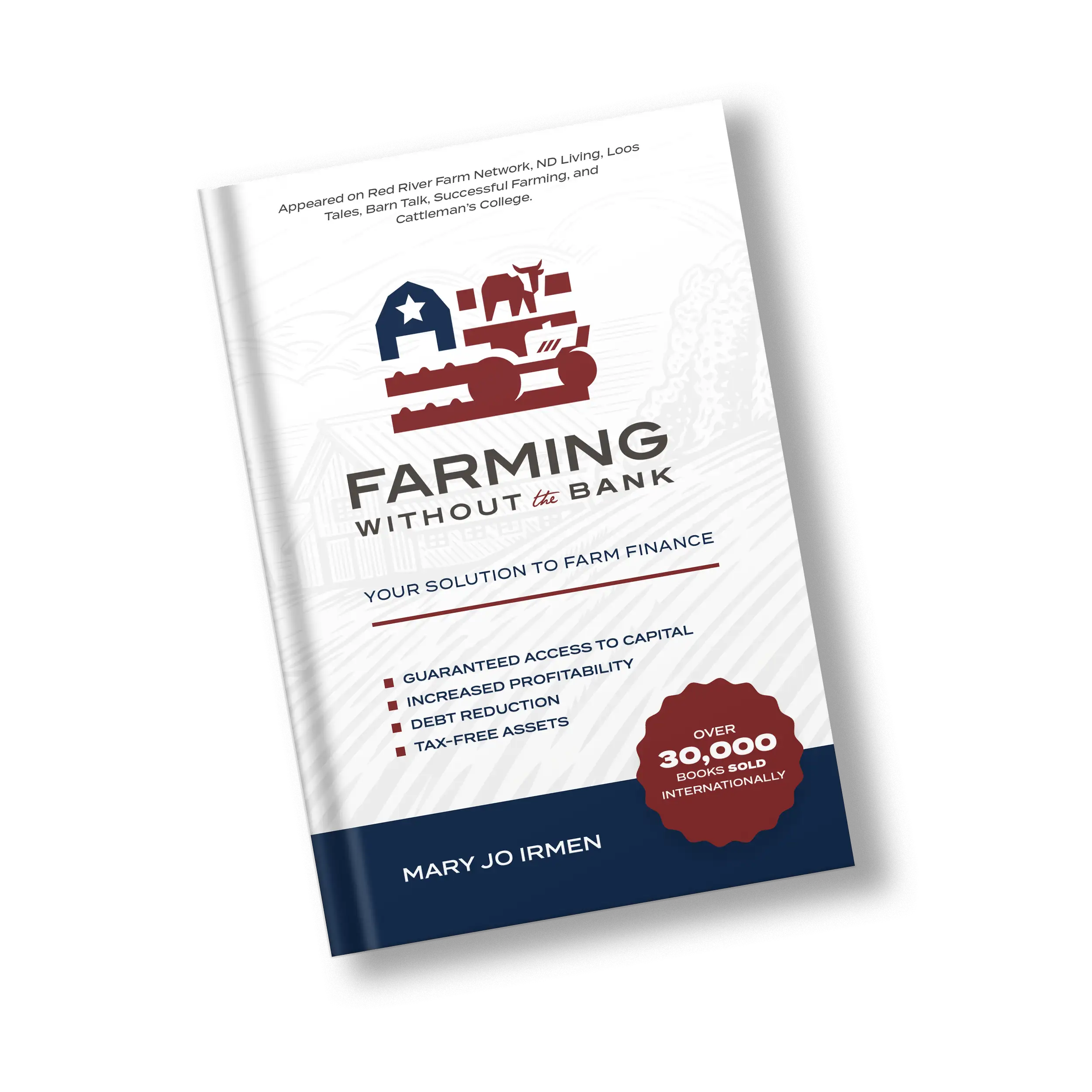
Your farm’s financial independence starts with one book.
30,000 farmers and ranchers have already made the shift. The only question is how long you’ll keep paying interest you could be keeping yourself.