 GET THE BOOK
 GET THE BOOK




Podcast
EP. 374
What Real Client Meetings Can Teach Us About Farm Estate Planning (Ep. 374)
Oct 2, 2026 ·
26 min
0:00 / 26:04
EPISODE OVERVIEW
ABOUT THIS EPISODE
Real meetings, real numbers, real lessons. Mary Jo recaps recent client meetings — from a 64 and 65-year-old couple buying land for their boys, to a 22-year-old starting with a $4,000 policy, to $100,000+ policies.
You'll hear why leaving land without a plan leaves debt + operating expenses to the kids, why helping one child and not the other creates future fights, why divided interest beats undivided interest, how two guys who quit drinking turned their financial lives around, how a 50s entrepreneur beat Parkinson's Law with '08-'09 rentals, storage units and businesses, and why a timber farm shrank from 10,000+ acres by selling land to solve problems.
It doesn't matter where you start — $4,000 or $100,000 — just get started.
Learn infinite banking, estate planning, and financial freedom for farming and agriculture families with Farming Without the Bank.
- Buy the book
- Email Mary Jo: MaryJo@WithoutTheBank.com
Audio Production by Podsworth Media
CHAPTER TIMESTAMPS
- 00:00$4K to $100K policies — just get started
- 00:31Welcome back — why I'm recapping real meetings
- 01:4364 & 65 buying land — kids inherit debt + operating costs
- 04:23Fairness trap — helping the struggling kid only
- 05:49Divided vs undivided interest — will they farm together?
- 07:34Quit drinking, turned life around — love these clients
- 08:10Trucker income jump — trailer rentals for cash flow
- 09:10Farm hand buyout opportunity — navigating transition
- 12:0322-year-old county + farm + side jobs — $4K starter + skid steer
- 12:4550s multi-millionaire — handicapped daughter + market risk
- 14:02Beat Parkinson's Law — '08-'09 rentals to storage to business
- 15:363D printers in front of you — stop being paralyzed, move
- 16:57Excavation + multi-state ranches run like a business
- 18:48Surgeon buys farm — chasing rate of return vs control
- 20:03Only ag-focused IBC practitioner — farmers think generations ahead
- 22:25Timber farm 10,000 to small thousands acres — insurance as operating expense
- 24:39Wrap — not all will start, some super ready
- 25:11Schedule with Mary Jo or John
YOUTUBE EPISODE
TRANSCRIPTION
"Fun meetings. Not all of them are gonna start policies, not all of them are ready to start policies, and then some of them are super ready to go, and we have really big policies, right? We have a $4,000 policy that I talked about, and then some of them we might be starting 100,000 or more. So this gives you guys an idea of who I'm talking to, what I'm going over, and it doesn't matter where you start, just get started. If you continually wait to get started, you're never going to accomplish anything. Nothing's ever going to change."
Hello, hello, hello, and welcome back to the podcast. Thank you very much for being here. Today, we are going to talk about some meetings that I've had, and I'm gonna recap those. I used to do this on Facebook, and people loved it, and I did it on a previous podcast, and I got a couple of people emailing in that said, "Hey, do more of those." So here we are. If you don't like 'em, you can tell me too. If there's something that you guys want to hear about, let me know. We're like, what? 500 podcasts in. I don't always have a guest, and so I run out of stuff to say. Many of you may not think so, but I do. And then I find myself repeating myself, which to me is not added value to you. I mean, some of you might not care, but I wanna make sure that I'm always adding value on here, and I'm not just coming on here to blab for 20 minutes. So anywho. All right, let's get into it.
These are just some of the meetings I've had. Of course, I'm not sharing, like, every single meeting 'cause some of them I may not feel like it's relevant or, whatever that might be. So I just kinda cherry-picked a handful of them.
So I met with, a couple, and this is just the last couple of weeks. So I met with a couple that, are 64 and 65 years old. They are farming. What was interesting about this situation is they are buying a lot of land at 64 and 65 years old. Their two boys farm with them, and I can't remember, I think it's only they only have the two boys, if I remember correctly. There are no other children that we have to worry about for estate planning. And so the two boys are farming with them, and they're buying a bunch of land, because they want to make sure that they can, have more farm ground for the kids.
The crazy thing is, they have life insurance that is expiring. So they don't have good whole life policies, but now when they die, because this land is just being bought, obviously it's going to go to the kids, and the kids are gonna inherit all this debt. So not only are the kids gonna inherit the debt, but they're also going to have the operating expenses. And so my suggestion or question to them was, "Have you ever thought of letting the boys buy some of this ground? Or even buying it and then just reselling it to the boys so they can get some of— use some of their FSA benefits." And then they've got a Schedule F and they've got, they've got something going.
Now, one of the kids, they have a ni— another business with, and so that's good. All is great in the land there, but these kids need to have a Schedule F. And they're in their 30s, so they're not like their 40-year-old kids, they're in their mid to early 30s. So a lot of times parents are saying, "Hey," and I see this a lot, "let me help the kid out. And so I'm gonna buy this land, and I'm gonna leave him all this land." But if they don't have a relationship with the lender, if they don't have, any idea of how the money is flowing and what the business side of this is. Because dad is obviously— They didn't have a lot of debt outside of land, and so dad is obviously a good operator financially. But has he actually looked and said, "Hey, the kids need to be involved in the finances of this"? Is he keeping that very secretive? I didn't get the feeling like it was a big family meeting, we're gonna share this information.
They also, obviously, as any family does, every family has one that excels financially and one that does not. So they're helping the kid that's not financially excelling, but the other one they're not so much looking out for. And so I said, "That's not fair to the other one. That's going to actually cause problems in the future. So if you're gonna help one financially, you better be giving the other one the same thing, especially if you expect them to farm together to some extent," that is something that parents aren't looking at. Because one kid cannot financially keep themselves together, we tend to want to help that kid, and I've talked about this before on the podcast. We had this epiphany as parents. We're helping the kids that need help, but the kid that doesn't need help, we're not helping them. And so I very quickly realized that and said, "No, no, that's not how this is gonna work. If we're gonna help the kids that are struggling, we're also gonna help the kids that are not struggling," because there's going to be a lot of anger there at some point for the kids that aren't, working hard and doing whatever they need to do and the other one is.
And so we talked about that. They kind of need to figure out an estate plan here. You know, I said, "Are the kids gonna get along? When you guys die, are they gonna farm together?" "Oh, yeah." I said, "Do they get along now?" "Well, we think so." I said, "Or are you being Switzerland and you're keeping everything neutral? What happens if you weren't keeping everything neutral? Make sure that you're dividing that land and you have a divided, they, it's divided interest. You're not giving it to them with undivided interest." And so I think that we talked about some things that maybe they hadn't wanted to talk about or Dad maybe hadn't wanted to talk about.
It was kind of funny. Dad started off the screen. He was not on the Zoom meeting and, I quickly realized he was in the room, so I was like, "Come on over. I got questions for you." And that hap— that actually happened to me twice in the last couple of weeks, that the dad did not want to have any kind of conversation, any kind of estate planning conversation, and then, obviously hopped on and we were able to talk about those conversations. And that is important. I'm not here to judge anybody. When I'm in my meetings, I am not judging how somebody wants to leave their estate, because it's your estate. You can do whatever you want with it. I frankly don't care. But I will be the voice of reason to some extent, or to say, "Hey, have you thought about this or have you thought about this?" So that you can kind of get that ball rolling and go see an attorney, go see an estate planner. That's gonna help you figure out and navigate those things.
But to think that our children are going to get along and farm together when we die is crazy to me. Because most partnerships do not work. And here's the thing. They might get along now, but what happens if they get married or have kids down the road? We have to think long term, and we have to think about those things. This couple has already, one of the kids is divorced, so they've already kind of experienced some of that. So, that was forefront to them as well.
I had two guys in the last couple of weeks that have quit drinking, so I'm assuming that they were alcoholics. I don't ask that question. I just hear they quit drinking. So they quit drinking, and in that process of not drinking, now we have, turned our life around, and now we're concerned about financials, and we're looking at what can we do to get better at life. And it's so fun. I love those clients because it's, like, all new, and they have this huge appreciation for learning and wanting to get better.
I talked to one gentleman that has just increased his income by a whole bunch. He got a better job, and now it's, "Hey, what can we do to create cash flow?" He has nothing to do with farming, but what can we do to create cash flow? Is it rental properties? How do we get you into rental properties? Is it starting a business with one of his kids? Because he has a good relationship with the kids. So great, let's start a business. Is it trailer rentals? What is it that you can do on the side so you're not actually working? And because this guy was a trucker, he can't do things for pay because that clocks against his drive time. So he's gonna have to be super creative on what he can do, and trailer rentals was one of the things that he had looked at to say, "Oh yeah, that's gonna work," because it's kind of a... It's not a on-the-job... Like, he's take— He's obviously getting rental income from trailers, but he's not physically there, 'cause you can do that business without physically being there.
I had another guy that quit drinking, and so he is just engulfed in learning anything and everything about business, which is super fun. He does farm, and the guy he farms for, he's going to have an opportunity to buy that land. The kids know that. He gets along with the kids. He knows which kids he needs to be concerned about and which kids he doesn't need to be concerned about. He has a really, really good relationship with that family 'cause he's worked there for, almost 10 years. And so even as a non-farm kid, he's having to navigate, how does that buyout look? And I'm having to navigate, okay, where do we get the money from to do that? Do we maybe just buy pieces of it at a time? We don't buy all of it, when he passes. And the owner has pulled back a little bit. Like, he was all gung ho, ready to go and, do some transition stuff, and now he's pulled back a little bit. Which is fine. That's to be expected because that's his livelihood, and there comes a little bit of fear when we have to give that up. So definitely, helping navigate that sort of thing.
But who do we insure? If we can insure them, then do we make sure we put as much money away for him? We talked a lot about Ranching for Profit. We talked a lot about just different business things that he can do. It was a really, really fun conversation, and we also had a lot of conversation in there about, what's happening with his friend group. Because now that he's not drinking, his friends are still drinking. He wants to learn about business, and he wants to make money, and his friends are now saying, "Hey, all you do is talk about making money. That's all you're obsessed with is making money." No, he's obsessed with learning, and that, the business side of things is a game, and those of you that have that bug, you understand that game. It's a challenge. It's fun. I love building businesses, and it's not for the money, it's for the love of building the business. It's for the love of being able to do something. The money comes if you do it correctly. If you don't do it correctly, the money's not gonna come. And so we talk about that a lot.
And the other gentleman that I talked to that, had quit drinking, he's kind of in that same scenario. He is also, trying to get around people that are learning all the time, and not drinking, and not just watching football and doing silly stuff that are not making them money. And so there is a navigation of that kind of thing, too, and I talk a lot about that in my meetings. These meetings are not just cramming you full of infinite banking and all these other... We talk about a lot of stuff, 'cause I really, really want to be here to provide as much value to you as I possibly can and give you ideas. If you don't want ideas, you probably don't schedule your appointment.
I had a young kid that was 22. He was making money working for the county, and then he makes some money, farming with some people, but he also has a bunch of l— little side jobs that he does. And in those side jobs, he needs to buy a skid steer. And so he has a lot going on right now, so we could start a really small policy, like $4,000 a year, but I wouldn't push it beyond that just because he's got so many irons in the fire, and he's got a lot of things to buy yet. I just don't wanna put too much through the policy to where it feels like he can't buy a skid steer and the tools he needs.
Had another guy with a ton of money, and he was in his 50s and just a pile of money in investments, like multi-millions. He didn't really need the life insurance side of it. He does have a daughter that is handicapped, and so we did talk about who's gonna care for her when you guys are gone, because he's only got this one child. And do we need to leave them money? Is it gonna be a cousin or a niece or a nephew, or like what, what does that... Not really a cousin, I guess, in that scenario, but what does that look like? And he hadn't really thought about that. But he is just very entrepreneurial, and he is going to start other businesses and he's looking at expanding the business he has, but he doesn't wanna work too hard because he's, wants to be semi-retired, but he gets too bored sitting around. And so, he totally was on board and ready to go because he has all this money sitting in the market, and it's a little... He's a little bit uncomfortable with the risk of that right now because he knows as well as anybody else why that the market is going to turn. And so he's kind of wanting to get some of that out of there so that he doesn't have such a loss and put some of it where it's more secure.
The other thing that was fun talking to him is I was like, "How did you make all this money?" I get that you're 50 and you have multi-millions, but that's very odd to see that. And he said, "Well, I beat Parkinson's Law. I didn't buy a bunch of stuff I didn't need when I was young." Well, he did beat Parkinson's Law. He got married later in life, but he also took advantage of '08 and '09. So when the housing crash came along, he had beat Parkinson's Law prior to the housing crash. So now all of a sudden he has a ton of money, and then he started buying properties. And so he ended up with like 30 rental properties, and he has since sold those. He made like a million or so on that deal. Then he went and bought storage units. Didn't like that, sold that, made a million dollars. And then he started this business, made a million dollars on that business, sold it, and now he is starting another business. So, the guy knows how to, just take advantage of whatever the situation is, and he just sells out when he kinda gets... when he realizes he doesn't like it.
But there's a lesson in that for all of you. And so many people think they need to just have it figured out right now. What do I have to do for the rest of my life? You're probably going to have to pivot, is what you're gonna have to do for the rest of your life, and then figure it out from there. He took some chances in '08 and '09 when houses were going for little or nothing. He bought them, he rented them, and the market's never gonna stay down forever. It will come back up. It doesn't matter if it's the housing market, if it's the stock market, if it's the commodity market. It all goes up and down.
Oh, I talked to a young gal that is not ready to start, but she has 3D printers, and so I was like, "You got 3D printers. You have the opportunity to make money. Go try to find some podcasts on what people are doing with 3D printers to make money. You've got what you need in front of you. Go use it instead of being stressed out about not having money and doing nothing." There's, like, basically two people in life, those that are stressed and paralyzed, and those that are stressed, and they just work through it and keep moving, and we have to work through things and keep moving. We can't just be paralyzed by the fact that we don't have money. Do you think being paralyzed and not doing anything is gonna make you more money? No. So get moving and do things. Figure out what it is that you can do.
I'm hoping to have, the guy from The Koerner Office on my podcast because, the more I listen to that podcast, the less reason there is for anybody in this country to not have money. Unless you are like, mentally handicapped or something, there is no reason that you cannot figure out how to do something. The amount of ideas on that podcast are insane. Just do something, but you can't, like, buy the printer and then not use the printer. You're not gonna have any money.
I had another meeting with a couple. This was a very interesting meeting because they have an excavation company, but they also have multiple ranches in multiple states, and the interesting piece about this was he is the business guy. His brother is a rancher. His dad is the rancher, but he is the business guy, one of his kids was in the meeting listening because he shares that financial business knowledge with his children, and they're all getting wrapped up into it, so it's very much a family business, and it is not something I see a lot in agriculture, right? A lot of times we're not running it like a business. They have very, very minute debt, very minute debt, and some of it was land that they just bought. They don't have a bunch of cattle debt, and they have massive size ranches with a lot of head of cattle. They have a very successful excavating company, that they niche out. What they do, they aren't just doing excavating of any kind. They have a specific clientele that they excavate for. They do more of a rural type excavation service. And so it really is eye-opening to see when people tell me, "You can't make money in farming and ranching. You can't make money in XYZ." Yes, you can. You have to run it like a business, and these guys prove that can be done. The downside to what they had going is they had a lot of term insurance, they have a lot of VULs, and because they have listened to the podcast, they've read the book, they know that that is not the best thing for them long term. So getting them out of that, explaining to them what they had so that the whole business can make sense long term for them.
And then I had another guy that's a surgeon. Not often do I talk to physicians. He obviously made a nice amount of money, just bought a farm, has a lot of infrastructure. I highly doubt that he will ever become a client, and that is because it is very hard for people that make a lot of money like him. They have a lot of money in the stock market. They're chasing a rate of return. That is the mindset they're in, and they have a really hard time understanding why I would put money into a life insurance policy because they don't quite need the liquidity of that money to do what they need to do because they have a ton of money coming in all the time. And because he didn't grow up in the farming world, his kids may want to farm, so there is some generational wealth there that we had to talk about that he maybe hadn't thought of. It's gonna take a little bit to kinda get his brain on the wavelength of where we're at over here for control, access to money, guaranteed rate of return, generational wealth. If you grow up in farming and ranching, that is just evident that is what we need to do.
I was at a training last week for the calculators that I use, and in that training, there was not another person that helps in the agriculture sector. I am probably the only IBC practitioner that just does agriculture for the most part, and I understand it, and I understand it well. And so it's really interesting to always listen to other agents who are trying to deal with the general public, as I would call them and they don't care about generational wealth. They don't care about leaving an inheritance. None of that matters, and so they were talking about, in this training, other agents were talking about how at 20, people don't care about leaving death benefit. They don't care about the death benefit until they have the children. Where I'm talking to 20-year-olds, and they do care about the death benefit. They're already thinking generations ahead of them because they're getting something that was passed down for generations. My conversations, it was very evident, three days of training, my conversations are nothing, like any of these other agents in the room. Not even for a business owner side of it, because most business owners are not passing down the business to the kids. Maybe private equity is coming in to buy it or whatever that might look like, but farming is its own animal in that regard. And so we have young people in this industry that are out-thinking their peers by ten to one, I'm gonna say. They just are not looking long term. I don't have to convince them of that.
If you guys have heard Michelle Prather talk, she says the exact same thing. When she is looking at long-term care insurance for a agriculture family, they understand why they should have it. Yet she talks to the general public, and they don't understand why they should have it. They think that the government should be paying for their long-term care. That is not how agriculture thinks. We want to make sure that we are saving what we have built. So it is just a super interesting conversation. This guy, probably not on the same wavelength because he didn't grow up in, agriculture.
And then I talked to another young guy that is a timber farmer. He's taking over a timber farm, possibly from family, and it's a bit of a nightmare. They don't have the long-term care. They don't understand how to replant. He is really on a fight uphill. And they really, in this situation, need to make life insurance part of their operating expenses so that he has— him and his wife have the death benefit to make sure that they can save. Because what's been happening is we've been selling off this farm a little bit constantly through inheritance. Like, two generations ago, it was a s— 10,000-plus acre farm, and now we're down to thousands of acres, and small thousands of acres. And it has really been just sold off because of mismanagement of business, mismanagement of timber.
Very eye-opening, for me to see that... Not, I shouldn't say eye-opening. It solidified what I've already said a million times, right? By the third generation, we're typically losing things because we don't pass the business knowledge down. Here, we maybe didn't pass business knowledge down, and we didn't pass agriculture knowledge down of what needs to be done correctly to make sure that land is producing and we are constantly harvesting timber. Now, it's interesting that I even know anything about timber coming from a place where we don't ever cut a tree because there's not enough planted. Timber is always very fascinating to me because it's something that I'm not super familiar with, so I'm always wanting to learn more about it. But in this case, life insurance and long-term care is going to be extremely necessary because if our solution is just to sell land, the next generation that's in line, there's not gonna be any land for them. So now they have to make a decision. Do I stay or, put my heart and soul into this, and then in 15 years it's all sold, or do I leave now and go make more money? Because obviously, we're not getting paid if there's not a lot of money there.
So fun meetings. Not all of them are gonna start policies, not all of them are ready to start policies, and then some of them are super ready to go, and we have really big policies, right? We have a $4,000 policy that I talked about, and then some of them we might be starting 100,000 or more. So this gives you guys an idea of who I'm talking to, what I'm going over, and it doesn't matter where you start, just get started. If you continually wait to get started, you're never going to accomplish anything. Nothing's ever going to change.
So schedule your meeting with John or I. If you meet with John, he knows what he's doing, okay? So if you don't think that John's going to know what he's doing, then don't schedule with John and just wait to meet with me. But we have had a couple situations recently where, John's not on the podcast all the time, and so people don't think that he knows. John knows what I know. We talk a lot. He is giving strategies out just like I'm giving strategies out, so he is 100% capable. If he wasn't, I wouldn't be sharing you with him. Believe me, I'm picky. Anyway, let us know if you need us, maryjo@withoutthebank.com, john@withoutthebank.com. If you have any questions, whatever, get your book, read it, schedule your appointment, and then we'll go from there and see if you can start, if you should wait, at what level you should start, and all the things. You guys have a fantastic rest of your day.
View MoreHello, hello, hello, and welcome back to the podcast. Thank you very much for being here. Today, we are going to talk about some meetings that I've had, and I'm gonna recap those. I used to do this on Facebook, and people loved it, and I did it on a previous podcast, and I got a couple of people emailing in that said, "Hey, do more of those." So here we are. If you don't like 'em, you can tell me too. If there's something that you guys want to hear about, let me know. We're like, what? 500 podcasts in. I don't always have a guest, and so I run out of stuff to say. Many of you may not think so, but I do. And then I find myself repeating myself, which to me is not added value to you. I mean, some of you might not care, but I wanna make sure that I'm always adding value on here, and I'm not just coming on here to blab for 20 minutes. So anywho. All right, let's get into it.
These are just some of the meetings I've had. Of course, I'm not sharing, like, every single meeting 'cause some of them I may not feel like it's relevant or, whatever that might be. So I just kinda cherry-picked a handful of them.
So I met with, a couple, and this is just the last couple of weeks. So I met with a couple that, are 64 and 65 years old. They are farming. What was interesting about this situation is they are buying a lot of land at 64 and 65 years old. Their two boys farm with them, and I can't remember, I think it's only they only have the two boys, if I remember correctly. There are no other children that we have to worry about for estate planning. And so the two boys are farming with them, and they're buying a bunch of land, because they want to make sure that they can, have more farm ground for the kids.
The crazy thing is, they have life insurance that is expiring. So they don't have good whole life policies, but now when they die, because this land is just being bought, obviously it's going to go to the kids, and the kids are gonna inherit all this debt. So not only are the kids gonna inherit the debt, but they're also going to have the operating expenses. And so my suggestion or question to them was, "Have you ever thought of letting the boys buy some of this ground? Or even buying it and then just reselling it to the boys so they can get some of— use some of their FSA benefits." And then they've got a Schedule F and they've got, they've got something going.
Now, one of the kids, they have a ni— another business with, and so that's good. All is great in the land there, but these kids need to have a Schedule F. And they're in their 30s, so they're not like their 40-year-old kids, they're in their mid to early 30s. So a lot of times parents are saying, "Hey," and I see this a lot, "let me help the kid out. And so I'm gonna buy this land, and I'm gonna leave him all this land." But if they don't have a relationship with the lender, if they don't have, any idea of how the money is flowing and what the business side of this is. Because dad is obviously— They didn't have a lot of debt outside of land, and so dad is obviously a good operator financially. But has he actually looked and said, "Hey, the kids need to be involved in the finances of this"? Is he keeping that very secretive? I didn't get the feeling like it was a big family meeting, we're gonna share this information.
They also, obviously, as any family does, every family has one that excels financially and one that does not. So they're helping the kid that's not financially excelling, but the other one they're not so much looking out for. And so I said, "That's not fair to the other one. That's going to actually cause problems in the future. So if you're gonna help one financially, you better be giving the other one the same thing, especially if you expect them to farm together to some extent," that is something that parents aren't looking at. Because one kid cannot financially keep themselves together, we tend to want to help that kid, and I've talked about this before on the podcast. We had this epiphany as parents. We're helping the kids that need help, but the kid that doesn't need help, we're not helping them. And so I very quickly realized that and said, "No, no, that's not how this is gonna work. If we're gonna help the kids that are struggling, we're also gonna help the kids that are not struggling," because there's going to be a lot of anger there at some point for the kids that aren't, working hard and doing whatever they need to do and the other one is.
And so we talked about that. They kind of need to figure out an estate plan here. You know, I said, "Are the kids gonna get along? When you guys die, are they gonna farm together?" "Oh, yeah." I said, "Do they get along now?" "Well, we think so." I said, "Or are you being Switzerland and you're keeping everything neutral? What happens if you weren't keeping everything neutral? Make sure that you're dividing that land and you have a divided, they, it's divided interest. You're not giving it to them with undivided interest." And so I think that we talked about some things that maybe they hadn't wanted to talk about or Dad maybe hadn't wanted to talk about.
It was kind of funny. Dad started off the screen. He was not on the Zoom meeting and, I quickly realized he was in the room, so I was like, "Come on over. I got questions for you." And that hap— that actually happened to me twice in the last couple of weeks, that the dad did not want to have any kind of conversation, any kind of estate planning conversation, and then, obviously hopped on and we were able to talk about those conversations. And that is important. I'm not here to judge anybody. When I'm in my meetings, I am not judging how somebody wants to leave their estate, because it's your estate. You can do whatever you want with it. I frankly don't care. But I will be the voice of reason to some extent, or to say, "Hey, have you thought about this or have you thought about this?" So that you can kind of get that ball rolling and go see an attorney, go see an estate planner. That's gonna help you figure out and navigate those things.
But to think that our children are going to get along and farm together when we die is crazy to me. Because most partnerships do not work. And here's the thing. They might get along now, but what happens if they get married or have kids down the road? We have to think long term, and we have to think about those things. This couple has already, one of the kids is divorced, so they've already kind of experienced some of that. So, that was forefront to them as well.
I had two guys in the last couple of weeks that have quit drinking, so I'm assuming that they were alcoholics. I don't ask that question. I just hear they quit drinking. So they quit drinking, and in that process of not drinking, now we have, turned our life around, and now we're concerned about financials, and we're looking at what can we do to get better at life. And it's so fun. I love those clients because it's, like, all new, and they have this huge appreciation for learning and wanting to get better.
I talked to one gentleman that has just increased his income by a whole bunch. He got a better job, and now it's, "Hey, what can we do to create cash flow?" He has nothing to do with farming, but what can we do to create cash flow? Is it rental properties? How do we get you into rental properties? Is it starting a business with one of his kids? Because he has a good relationship with the kids. So great, let's start a business. Is it trailer rentals? What is it that you can do on the side so you're not actually working? And because this guy was a trucker, he can't do things for pay because that clocks against his drive time. So he's gonna have to be super creative on what he can do, and trailer rentals was one of the things that he had looked at to say, "Oh yeah, that's gonna work," because it's kind of a... It's not a on-the-job... Like, he's take— He's obviously getting rental income from trailers, but he's not physically there, 'cause you can do that business without physically being there.
I had another guy that quit drinking, and so he is just engulfed in learning anything and everything about business, which is super fun. He does farm, and the guy he farms for, he's going to have an opportunity to buy that land. The kids know that. He gets along with the kids. He knows which kids he needs to be concerned about and which kids he doesn't need to be concerned about. He has a really, really good relationship with that family 'cause he's worked there for, almost 10 years. And so even as a non-farm kid, he's having to navigate, how does that buyout look? And I'm having to navigate, okay, where do we get the money from to do that? Do we maybe just buy pieces of it at a time? We don't buy all of it, when he passes. And the owner has pulled back a little bit. Like, he was all gung ho, ready to go and, do some transition stuff, and now he's pulled back a little bit. Which is fine. That's to be expected because that's his livelihood, and there comes a little bit of fear when we have to give that up. So definitely, helping navigate that sort of thing.
But who do we insure? If we can insure them, then do we make sure we put as much money away for him? We talked a lot about Ranching for Profit. We talked a lot about just different business things that he can do. It was a really, really fun conversation, and we also had a lot of conversation in there about, what's happening with his friend group. Because now that he's not drinking, his friends are still drinking. He wants to learn about business, and he wants to make money, and his friends are now saying, "Hey, all you do is talk about making money. That's all you're obsessed with is making money." No, he's obsessed with learning, and that, the business side of things is a game, and those of you that have that bug, you understand that game. It's a challenge. It's fun. I love building businesses, and it's not for the money, it's for the love of building the business. It's for the love of being able to do something. The money comes if you do it correctly. If you don't do it correctly, the money's not gonna come. And so we talk about that a lot.
And the other gentleman that I talked to that, had quit drinking, he's kind of in that same scenario. He is also, trying to get around people that are learning all the time, and not drinking, and not just watching football and doing silly stuff that are not making them money. And so there is a navigation of that kind of thing, too, and I talk a lot about that in my meetings. These meetings are not just cramming you full of infinite banking and all these other... We talk about a lot of stuff, 'cause I really, really want to be here to provide as much value to you as I possibly can and give you ideas. If you don't want ideas, you probably don't schedule your appointment.
I had a young kid that was 22. He was making money working for the county, and then he makes some money, farming with some people, but he also has a bunch of l— little side jobs that he does. And in those side jobs, he needs to buy a skid steer. And so he has a lot going on right now, so we could start a really small policy, like $4,000 a year, but I wouldn't push it beyond that just because he's got so many irons in the fire, and he's got a lot of things to buy yet. I just don't wanna put too much through the policy to where it feels like he can't buy a skid steer and the tools he needs.
Had another guy with a ton of money, and he was in his 50s and just a pile of money in investments, like multi-millions. He didn't really need the life insurance side of it. He does have a daughter that is handicapped, and so we did talk about who's gonna care for her when you guys are gone, because he's only got this one child. And do we need to leave them money? Is it gonna be a cousin or a niece or a nephew, or like what, what does that... Not really a cousin, I guess, in that scenario, but what does that look like? And he hadn't really thought about that. But he is just very entrepreneurial, and he is going to start other businesses and he's looking at expanding the business he has, but he doesn't wanna work too hard because he's, wants to be semi-retired, but he gets too bored sitting around. And so, he totally was on board and ready to go because he has all this money sitting in the market, and it's a little... He's a little bit uncomfortable with the risk of that right now because he knows as well as anybody else why that the market is going to turn. And so he's kind of wanting to get some of that out of there so that he doesn't have such a loss and put some of it where it's more secure.
The other thing that was fun talking to him is I was like, "How did you make all this money?" I get that you're 50 and you have multi-millions, but that's very odd to see that. And he said, "Well, I beat Parkinson's Law. I didn't buy a bunch of stuff I didn't need when I was young." Well, he did beat Parkinson's Law. He got married later in life, but he also took advantage of '08 and '09. So when the housing crash came along, he had beat Parkinson's Law prior to the housing crash. So now all of a sudden he has a ton of money, and then he started buying properties. And so he ended up with like 30 rental properties, and he has since sold those. He made like a million or so on that deal. Then he went and bought storage units. Didn't like that, sold that, made a million dollars. And then he started this business, made a million dollars on that business, sold it, and now he is starting another business. So, the guy knows how to, just take advantage of whatever the situation is, and he just sells out when he kinda gets... when he realizes he doesn't like it.
But there's a lesson in that for all of you. And so many people think they need to just have it figured out right now. What do I have to do for the rest of my life? You're probably going to have to pivot, is what you're gonna have to do for the rest of your life, and then figure it out from there. He took some chances in '08 and '09 when houses were going for little or nothing. He bought them, he rented them, and the market's never gonna stay down forever. It will come back up. It doesn't matter if it's the housing market, if it's the stock market, if it's the commodity market. It all goes up and down.
Oh, I talked to a young gal that is not ready to start, but she has 3D printers, and so I was like, "You got 3D printers. You have the opportunity to make money. Go try to find some podcasts on what people are doing with 3D printers to make money. You've got what you need in front of you. Go use it instead of being stressed out about not having money and doing nothing." There's, like, basically two people in life, those that are stressed and paralyzed, and those that are stressed, and they just work through it and keep moving, and we have to work through things and keep moving. We can't just be paralyzed by the fact that we don't have money. Do you think being paralyzed and not doing anything is gonna make you more money? No. So get moving and do things. Figure out what it is that you can do.
I'm hoping to have, the guy from The Koerner Office on my podcast because, the more I listen to that podcast, the less reason there is for anybody in this country to not have money. Unless you are like, mentally handicapped or something, there is no reason that you cannot figure out how to do something. The amount of ideas on that podcast are insane. Just do something, but you can't, like, buy the printer and then not use the printer. You're not gonna have any money.
I had another meeting with a couple. This was a very interesting meeting because they have an excavation company, but they also have multiple ranches in multiple states, and the interesting piece about this was he is the business guy. His brother is a rancher. His dad is the rancher, but he is the business guy, one of his kids was in the meeting listening because he shares that financial business knowledge with his children, and they're all getting wrapped up into it, so it's very much a family business, and it is not something I see a lot in agriculture, right? A lot of times we're not running it like a business. They have very, very minute debt, very minute debt, and some of it was land that they just bought. They don't have a bunch of cattle debt, and they have massive size ranches with a lot of head of cattle. They have a very successful excavating company, that they niche out. What they do, they aren't just doing excavating of any kind. They have a specific clientele that they excavate for. They do more of a rural type excavation service. And so it really is eye-opening to see when people tell me, "You can't make money in farming and ranching. You can't make money in XYZ." Yes, you can. You have to run it like a business, and these guys prove that can be done. The downside to what they had going is they had a lot of term insurance, they have a lot of VULs, and because they have listened to the podcast, they've read the book, they know that that is not the best thing for them long term. So getting them out of that, explaining to them what they had so that the whole business can make sense long term for them.
And then I had another guy that's a surgeon. Not often do I talk to physicians. He obviously made a nice amount of money, just bought a farm, has a lot of infrastructure. I highly doubt that he will ever become a client, and that is because it is very hard for people that make a lot of money like him. They have a lot of money in the stock market. They're chasing a rate of return. That is the mindset they're in, and they have a really hard time understanding why I would put money into a life insurance policy because they don't quite need the liquidity of that money to do what they need to do because they have a ton of money coming in all the time. And because he didn't grow up in the farming world, his kids may want to farm, so there is some generational wealth there that we had to talk about that he maybe hadn't thought of. It's gonna take a little bit to kinda get his brain on the wavelength of where we're at over here for control, access to money, guaranteed rate of return, generational wealth. If you grow up in farming and ranching, that is just evident that is what we need to do.
I was at a training last week for the calculators that I use, and in that training, there was not another person that helps in the agriculture sector. I am probably the only IBC practitioner that just does agriculture for the most part, and I understand it, and I understand it well. And so it's really interesting to always listen to other agents who are trying to deal with the general public, as I would call them and they don't care about generational wealth. They don't care about leaving an inheritance. None of that matters, and so they were talking about, in this training, other agents were talking about how at 20, people don't care about leaving death benefit. They don't care about the death benefit until they have the children. Where I'm talking to 20-year-olds, and they do care about the death benefit. They're already thinking generations ahead of them because they're getting something that was passed down for generations. My conversations, it was very evident, three days of training, my conversations are nothing, like any of these other agents in the room. Not even for a business owner side of it, because most business owners are not passing down the business to the kids. Maybe private equity is coming in to buy it or whatever that might look like, but farming is its own animal in that regard. And so we have young people in this industry that are out-thinking their peers by ten to one, I'm gonna say. They just are not looking long term. I don't have to convince them of that.
If you guys have heard Michelle Prather talk, she says the exact same thing. When she is looking at long-term care insurance for a agriculture family, they understand why they should have it. Yet she talks to the general public, and they don't understand why they should have it. They think that the government should be paying for their long-term care. That is not how agriculture thinks. We want to make sure that we are saving what we have built. So it is just a super interesting conversation. This guy, probably not on the same wavelength because he didn't grow up in, agriculture.
And then I talked to another young guy that is a timber farmer. He's taking over a timber farm, possibly from family, and it's a bit of a nightmare. They don't have the long-term care. They don't understand how to replant. He is really on a fight uphill. And they really, in this situation, need to make life insurance part of their operating expenses so that he has— him and his wife have the death benefit to make sure that they can save. Because what's been happening is we've been selling off this farm a little bit constantly through inheritance. Like, two generations ago, it was a s— 10,000-plus acre farm, and now we're down to thousands of acres, and small thousands of acres. And it has really been just sold off because of mismanagement of business, mismanagement of timber.
Very eye-opening, for me to see that... Not, I shouldn't say eye-opening. It solidified what I've already said a million times, right? By the third generation, we're typically losing things because we don't pass the business knowledge down. Here, we maybe didn't pass business knowledge down, and we didn't pass agriculture knowledge down of what needs to be done correctly to make sure that land is producing and we are constantly harvesting timber. Now, it's interesting that I even know anything about timber coming from a place where we don't ever cut a tree because there's not enough planted. Timber is always very fascinating to me because it's something that I'm not super familiar with, so I'm always wanting to learn more about it. But in this case, life insurance and long-term care is going to be extremely necessary because if our solution is just to sell land, the next generation that's in line, there's not gonna be any land for them. So now they have to make a decision. Do I stay or, put my heart and soul into this, and then in 15 years it's all sold, or do I leave now and go make more money? Because obviously, we're not getting paid if there's not a lot of money there.
So fun meetings. Not all of them are gonna start policies, not all of them are ready to start policies, and then some of them are super ready to go, and we have really big policies, right? We have a $4,000 policy that I talked about, and then some of them we might be starting 100,000 or more. So this gives you guys an idea of who I'm talking to, what I'm going over, and it doesn't matter where you start, just get started. If you continually wait to get started, you're never going to accomplish anything. Nothing's ever going to change.
So schedule your meeting with John or I. If you meet with John, he knows what he's doing, okay? So if you don't think that John's going to know what he's doing, then don't schedule with John and just wait to meet with me. But we have had a couple situations recently where, John's not on the podcast all the time, and so people don't think that he knows. John knows what I know. We talk a lot. He is giving strategies out just like I'm giving strategies out, so he is 100% capable. If he wasn't, I wouldn't be sharing you with him. Believe me, I'm picky. Anyway, let us know if you need us, maryjo@withoutthebank.com, john@withoutthebank.com. If you have any questions, whatever, get your book, read it, schedule your appointment, and then we'll go from there and see if you can start, if you should wait, at what level you should start, and all the things. You guys have a fantastic rest of your day.
ready to start?
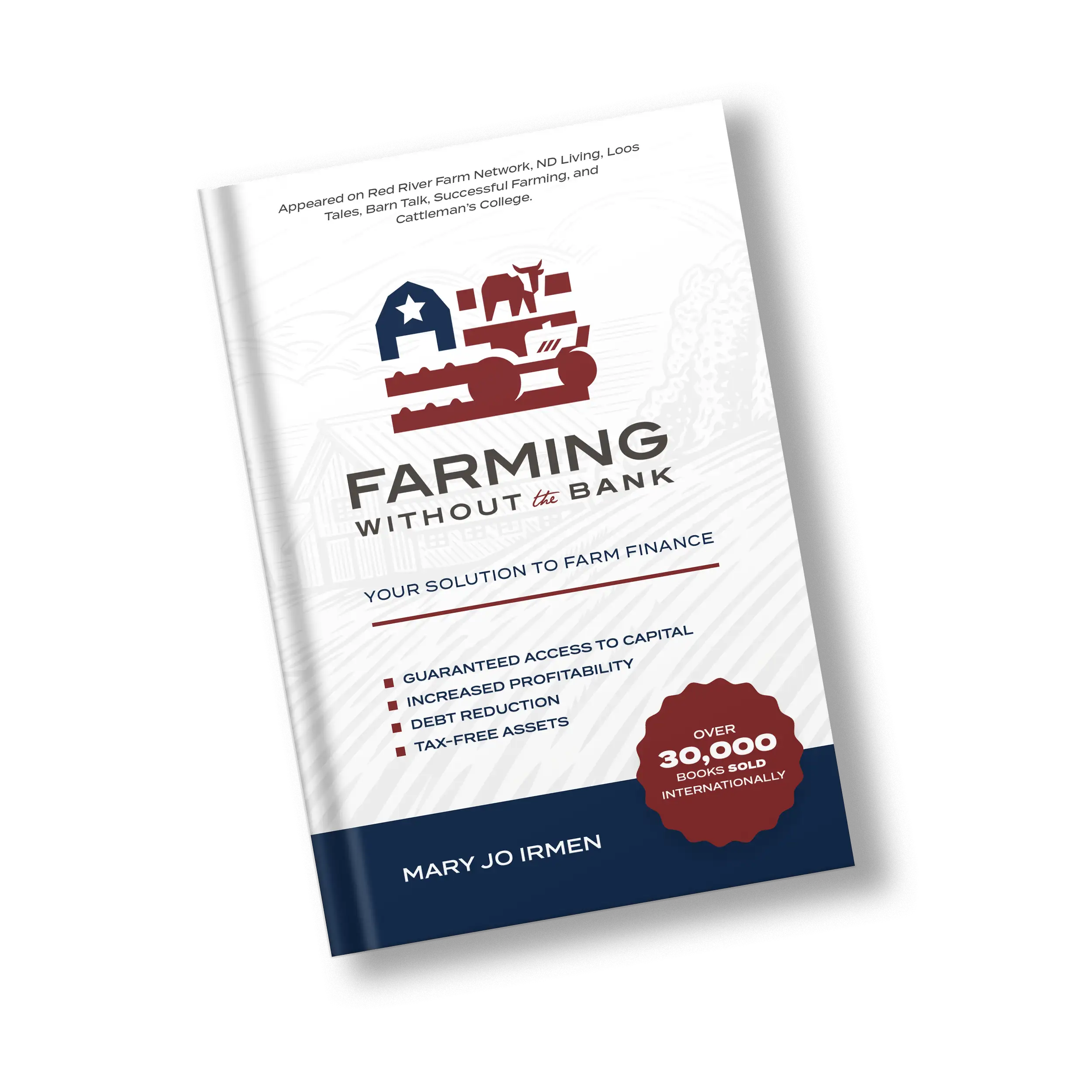
Your farm’s financial independence starts with one book.
30,000 farmers and ranchers have already made the shift. The only question is how long you’ll keep paying interest you could be keeping yourself.