 GET THE BOOK
 GET THE BOOK



Podcast
EP. 341
Universal Life Policies Are Collapsing | Here’s Why (Ep. 341)
Feb 13, 2026 ·
23 min
0:00 / 22:37
EPISODE OVERVIEW
ABOUT THIS EPISODE
🚨 Universal Life Insurance EXPOSED 🚨
Is Universal Life, Indexed Universal Life, or Variable Universal Life really the powerful wealth tool it's marketed to be? In this episode of the Farming Without the Bank podcast, Mary Jo dives deep into why universal life policies often fail, drawing directly from Nelson Nash's Warehouse of Wealth and decades of real-world experience.
If you've ever been pitched an IUL with "great returns" and "no downside," this episode is a must-watch before you sign anything.
Universal Life was designed as a "better mousetrap," but history shows a very different outcome. From rising costs of insurance to disappearing guarantees, Mary Jo breaks down why most UL, VUL, and IUL policies eventually collapse — often right when people need them most.
Using Nelson Nash's insights and Todd Langford's Truth Concepts analysis, this episode explains how risk is shifted from the insurance company to you, the policyholder.
🔑 Key Takeaways
- Why Universal Life policies often lapse between ages 60–80
- How non-guaranteed costs and mortality charges destroy cash value
- The "double pain" effect during market downturns
- Why caps, participation rates, and missing dividends matter
- How UL shifts risk from the insurer to the insured
- Why Whole Life offers liquidity, control, and guarantees
📚 Resources Mentioned
- Warehouse of Wealth — Nelson Nash
- Truth Concepts Calculators — truthconcepts.com
- The Battle for the Soul of Capitalism — John Bogle
- Pirates of Manhattan I & II — Barry James Dyke
- Farming Without the Bank — farmingwithoutthebank.com
📩 Ready to Learn More?
- 📧 Email questions to: maryjo@withoutthebank.com
- 📖 Read the book before scheduling an appointment
- 📅 Let's see if Infinite Banking is right for you
- 👉 Subscribe and share this episode with anyone considering an IUL or Universal Life policy.
CHAPTER TIMESTAMPS
- 00:00Why Universal Life Looks Good (At First)
- 02:12The History of Universal Life Insurance
- 05:35The Side Fund & Why It Falls Apart
- 08:20Double Pain: Market Losses Explained
- 11:11Caps, Participation Rates & Missing Dividends
- 14:29Guarantees Can Change (And Disappear)
- 18:36Why Whole Life Wins Long-Term
YOUTUBE EPISODE
TRANSCRIPTION
"I will always tell you, if you have a traditional, structured whole life policy where all the money is going to the base policy, it is all buying whole life death benefit — that is better to have that sold to you than anything universal life. Because chances are the universal life policy is going to change along the way. And it's going to lapse at some point. In 16 years, I've seen five — five decent, not bad, decent policies. Otherwise, they're all crap. All of them."
Hello, hello, hello, and welcome back to the podcast. Thank you very much for being here.
Okay, we are back into building your warehouse of wealth. And we are in chapter nine, talking about my favorite subject, universal life. And Nelson just confirms why it's a crappy product in most cases — in all cases, actually. But, you know, I'll say most, because some people think, oh, Mary Jo, if it's sold correctly, it's good. I don't even agree with that, because of the fact that they all have fees. They all have charges. They all have the stuff we're going to go over.
Now, this chapter has a lot of information in it. I'm not going over all of this. If you know somebody, if you are somebody that is tempted with universal life, variable universal life, indexed universal life, then you probably should go get Nelson's book. You can get it on farmingwithoutthebank.com. You can get it wherever the book is sold. It's not my book. I don't know where it's sold. Maybe Amazon. But this chapter is going to go over why it is not a good product and the things that you need to know about it.
We talk about it a lot. Somebody actually just asked us to talk about it again. And I'm like, I don't know how many times I should be talking about IULs and how bad they are. But it's in Nelson's chapter. So we're going to talk about it.
He starts out by saying — and I think that the history of some of this is important — that universal life was invented in the early 1980s by E.F. Hutton. In my opinion, he knew nothing about life insurance. Remember the show, or the commercials? When E.F. Hutton speaks, everyone listens. It was like a little music thing, wasn't it? Or was it just, when E.F. Hutton speaks, everybody listens. Well, whatever. As Nelson says, have you heard anything from him lately? Nope. Because he's completely gone.
He said, "UL is nothing more than one-year term insurance with a side fund of an interest-bearing account. It was an attempt to unbundle the savings element of the life insurance element of a whole life policy. Something that can't be done if one understands the concept of whole life insurance." So the moral is, they tried to unbundle the savings portion of whole life insurance.
He said, "When I first saw the policy, I ran some illustrations and they kept falling apart when the insured attained age 65 to 70." So let's keep in mind, in 1980, Nelson was still selling whole life insurance. Actively selling. So he was running these things, right? Because it was new and shiny. It was the new object. But it kept falling apart at 65 and 70.
"The cost of one-year term became prohibitive at the advanced age and ate up the cash fund. Therefore, I never sold one of them when I was in business, and I surely wouldn't buy one."
So you guys hear me talk about that all the time. And I see it usually from 70 to 80. Sometimes we'll get to 85 before these have crashed. Sometimes I'm seeing them crash in the 60s. And so why? Because there are fees associated with them. And when the fees get higher than premium, they start taking cash value to supplement the difference. Nobody tells you that's happening. They don't send you a letter to warn you. They just do it.
He said, next came variable life, invented by Equitable Life. It was nothing more than one-year term insurance with a side fund of mutual fund. And he goes on here to talk about mutual funds and how bad they are. And if you want to truly learn about what a mutual fund is, to read the truth about mutual funds, then read The Battle for the Soul of Capitalism by John Bogle. And then you should read Pirates of Manhattan and Pirates of Manhattan II by Barry James Dyke. Barry is amazing. Absolutely love him.
Nelson says, "I was with Equitable when variable life came onto the scene. I never sold one and I would never buy one. I don't recommend it for infinite banking." So once again, Nelson was there. The newest, shiniest object.
Then we come into this IUL. So IUL, another attempt at building a better mousetrap. "I can think of no better exposé of its fallacies than that presented by Todd Langford of Truth Concepts."
So some of you that have met with me, you've probably seen me use my calculators. Those are Truth Concepts calculators. Todd Langford is a genius. And he is based out of Texas and he created calculators to actually prove Nelson wrong. His story is pretty interesting. Somebody told him about infinite banking and he's like, there's no way you can do that and I'm going to prove it wrong. And he was trying to prove it and found out that it was right. And he has created an entire system of calculators for us so that we can use them with you guys. You have to purchase the calculators, but they are there for anybody to purchase. So you can do that on truthconcepts.com. I use the calculators. Tarisa uses the calculators. They're fantastic. I love them.
But Todd wrote an article, "The Top 10 Reasons Not to Buy Equity Indexed Universal Life." And I do believe that this is on his website.
Number 10 is internal costs are not guaranteed. And he goes on to say, run under current expense levels, but they can change at the discretion of the company. So the illustrations that you're running, you're looking at on any universal life is run under the current expense levels. But those can be changed. They can increase them to a max amount.
So when you're looking at expenses, you're looking at the cost of that insurance at the age you are today. You're not looking at what it's going to be when you're 65, 75. That's when it gets bad, because the expenses go up. And they can change those. They have the right to do that. And we've seen lawsuits that they will increase the expense because a rate of return isn't what it's supposed to be. So they increase the expense to kind of make it look better inside the illustration.
Number nine, mortality charges are not guaranteed. So mortality charges — the cost of this one year term insurance can be changed as well. So you have your administration fees and then you have your cost of insurance. I was talking about both earlier. So they can be changed.
Number eight, market drops cause double pain. This one is interesting. So I'm going to read it slow because that's how my brain works.
"Market affects the side fund negatively no matter what the side fund is invested in. Any market drop causes double pain. When the side fund is reduced by a drop in the market or current interest rates, it now has less value. So more term insurance must be bought to make up the difference, which further reduces the side fund. Consequently, you have double pain: less cash value and higher costs."
This might be the best explanation of this side fund that I have heard, because your investment is in a side fund. Well, when the market drops, you have less money, right? So now you need more money to buy the same amount of term insurance that your policy is for. So now they're going to take more. So now it even reduces by more because we have to do two things with it.
Number seven, late premiums kill any guarantees. You really have to look at your contract here. But that's the way that they can get out of guaranteeing you something. So some universal life has a guaranteed return, right? Some universal life has guarantees. Some IUL might have a guarantee. And that guarantee, if your premiums are late, they can remove the guarantee from your policy. So it's a way for them protecting themselves.
I don't know a lot of people that pay their premium on time every single year, especially with the company that I use, which is OneAmerica. They only send a notice two weeks ahead of time. Well, I never pay my premium on time ever. Like I don't open my mail the day I get it and then start writing checks the next day. I am not that organized, you guys.
Number six is dividends from the index don't get credited. So I'll also read this slow because this is important.
"Indexed universal life policies provide the policyholder no credit for any dividend from the stocks making up the index. The side fund of the IUL isn't actually invested in the index. Instead, the index is used to determine the gross crediting rate for the side fund. If money were actually invested in the index, the investor would get both the change in cash value and the dividend income. However, in the case of IUL, only the change in value of the index is the determining factor, and the dividend is left out of the calculation entirely."
So you're not getting the dividend and the indexing rate. That's also important, right? Are they telling you that? Probably not.
Number five, participation ratios are often less than 100%. Participation — so when you look at your IUL policy, it'll tell you what fund it's in and then it'll tell you beside it what participation you are in that. So is it 80%, 20%? And then it makes up whatever those numbers are, it'll make up 100.
"Participation ratios are often less than 100%. As mentioned directly above, the side fund is not invested directly in the index, and many insurance companies only credit a certain percentage of the increase in the market, known as the participation ratio. This is often reported at 80% or less, meaning you are getting only 80% of the increase in the market."
So if you think that you're going to get 100%, but you're only in it for 80%, you need to know that, right? Have they told you that? Did they explain all this to you? Because this is a lot for me already. And I would assume that this would be a lot for you if you don't understand anything about the market.
Number four, returns are usually capped at various interest rates. "Capping returns in order to keep high returns in the market from crediting too much to the side fund is a strategy many insurance companies use. The maximum return they'll give credit for may be a certain percentage rate, even though the index may be generating a higher percentage rate."
So they're going to cap how much money you can get. They might make this much, you're going to be capped at this much. And so what I've heard other people say in this industry — and I'm no IUL expert because I don't sell them, and they are a complicated beast. Chris Kirkpatrick also has really good stuff on IULs. They are going to move the cap rate to make it look better. I'm going to move that cap rate so your illustration looks better. I've heard of stuff like that.
Then, of course, number three is guarantees are not calculated annually. "Guaranteed minimum returns are not always calculated annually. Some policies, this guarantee is not applied annually, but instead over an indexing period, which could be five to ten years. So you could have negative returns in the index, which would be applied to the side fund. This would cause a further reduction of value in excess of the guaranteed minimum rate in one particular year, as long as the overall average rate for the entire indexing period is not less than the guaranteed minimum rate."
Good. Events. Okay. So the guaranteed minimum is not always figured annually.
Number two, all the above can be changed by the company. And so at the discretion of the company, any of the above factors can be changed at any time for the benefit of the company, even after the policy has started. And you see that if companies are getting into trouble, they are going to change things because they can. There's nothing that says that they can't, right? In whole life, they can't. That contract is solid. They're not changing anything.
And then number one, the risk is shifted back to the insured. And so all types of ULs shift the risk backwards, or from the insurance company to the insured. It's very much like a 401(k) or an IRA. The 401(k), the employer is not responsible. The broker is not responsible. The risk is shifted back to you. You are the one that is supposed to know all of this stuff and take all of the risk, and they will just collect the money and do nothing. Sounds like the government.
The carrot being sold with IUL is that it might exceed the return of the whole life policy. This is good. I love this line. "How could the insurance company pay out more than the profits of the company and still be in business?"
If the return is going to be better than a whole life policy, how is that company going to survive? Right? Whole life, that's going to be a lower return. It's going to be steady. They know they have to be there forever. They know that this is the return that they have to get. But with an IUL, it's going to be better. "If this was a sound investment strategy, why wouldn't the insurance company use this strategy on their overall portfolio?" Because they're not.
And then he goes on to talk about IULs and whole life. And he said, universal life was heavily promoted in the '80s. The unfortunate outcome is that any negative media affects the entire industry, because the media doesn't differentiate between the new faulty products and the old tried and true whole life products that have been around for close to 200 years.
And he's right in the aspect here that the media doesn't differentiate between the two. And they don't. Because frankly, the media doesn't know the difference between whole life and IULs and ULs and VULs. Because reporters don't do their jobs. They just want to write an article.
It's no different than the Nebraska Farmers article that they wrote about whole life and borrowing against it and infinite banking. They didn't do any research. They didn't reach out to me. Right? They just wrote an article. And then I was told by other people that are in that industry of writing articles that they just need to meet criteria. Right? You just need to spit something out. I don't care if it's BS. I don't care if it's accurate. I don't care about anything. Media is the biggest joke ever.
And so why are podcasts important? Why is social media important? Because people like myself can come out here and say, that's wrong. Everything that you're being taught about universal, variable universal, and IUL is wrong. Because they're not telling you this, this, and this. They're not telling you that the company has 100% control. That they can change fees and cost of insurance on things. They're not telling you that your guarantees are gone if you pay premium late. Right?
They're just selling you some shiny object. And we're all running towards that object. And we're like, oh my gosh, this is the greatest, latest thing. And this rate of return is amazing. Yeah. Okay. So that's what we think. And we're chasing that. But at the end of the day, is it really amazing?
Who won the race? The turtle? Yeah. The turtle did. And the turtle maybe just kept a straight line. And what's a rabbit doing? All over. Because as soon as somebody says that something is better, we're going to sway to that thing.
It's crazy to me when I hear — and had heard from Nelson directly when he was still alive — that he ran these illustrations. When this stuff came out, he looked at it. And he saw that it was falling apart. Nelson saw that when he ran the illustrations. How come nobody else has seen that when they're running illustrations for their clients? One must wonder.
It's even more amazing when an agent knows that those policies are falling apart, but they still sell the same policy. Because they don't know how to explain whole life. And they're like, oh, I wouldn't sell as much. Well, good. Then you're not going to screw as many people along the way. Right? They're going to have a solid product.
Like, I will always tell you, if you have a traditional, structured whole life policy where all the money is going to the base policy, it is all buying whole life death benefit — that is better to have that sold to you than anything universal life. Because chances are the universal life policy is going to change along the way. And it's going to lapse at some point. In 16 years, I've seen five — five decent, not bad, decent policies. Otherwise, they're all crap. All of them.
And so we have to heed the warning. There can be bad press. And that is a lot of why people don't understand whole life insurance. It's because we've kind of gotten some bad press. And there's not a lot of people that can explain what it is. So we now, because media is horrible and there is a lot of false information, we just have to continue to do more of our due diligence.
I have so many podcasts on this topic. And it's because it is somewhat prevalent out there. People are talking about it. And you have famous people. And I'll just use Tony Robbins as an example. I was super excited when he has a book. I don't know what the name of it is. But he was talking about investing. And in there, he started talking about IULs. And I'm like, here we go again. A big talking head that was talked into IULs. And now he's going to share this with the world. People are going to trust him. And guess what? He doesn't have a clue about whole life, about universal, about variable universal. He's not done the education. He believed somebody.
We now have people — I don't know the guy, I just keep hearing about him. Pace Morby is in the real estate world. And I am seeing over and over and over people going to IULs. I've seen videos that he has done. I've had them sent to me. And I don't do a lot in the real estate world. But man, oh man, whoever he is buying IUL from is an absolute, absolute liar and told him that whole life is bad. He had whole life stuff.
So this is the kind of stuff that — I maybe don't know these people. But by God, don't be swindled into buying something that you don't truly understand. Read the contract. Be that annoying client. Do your due diligence. Ask as many questions as you can.
And if you're making it about a rate of return, then is that policy supposed to be there for generational wealth? Is it supposed to be there for rate of return? Or is it supposed to be there for liquidity, control and guarantees? Right? That is what infinite banking is. Liquidity, control and guarantees.
And Nelson said, you need to use your imagination, reason and logic. And I think some of us have forgotten about reason and logic. Right? We need to pay attention to those things.
So sadly, the media can sway it. But the media can sway us on just about anything nowadays. And always has, because that's their agenda. We just have to be smarter than the media. Right? Talk to people. Do things.
All right, you guys. If you haven't gotten Warehouse of Wealth, grab it. I don't care where you grab it from. But it is a really good book. Obviously, that you've heard, goes deeper into some of Nelson's chapters of BYOB.
So anyway, let me know. That's all I got for rambling today. Let me know if you have comments, questions, concerns. maryjo@withoutthebank.com. Happy to answer any of your questions there.
Grab my books. Grab Nelson's book. One or both. Whatever. You need to read it before we can meet. So get the book. Read it. Schedule your appointment. And then we will see if we can help you. I mean, we're going to help you either way. But we'll see if it's time for you to start a policy. And what that looks like, and run some strategies for you with your actual numbers.
Okay, you guys. You have a fantastic rest of your day.
Thanks for listening to the Farming Without the Bank podcast. We hope today's episode has inspired you to take control of your finances in new ways. Don't forget to check out our website, farmingwithoutthebank.com, and engage with us on our Facebook page, Farming Without the Bank. Join us next week as we smash more financial myths and empower you to accomplish your financial goals.
View MoreHello, hello, hello, and welcome back to the podcast. Thank you very much for being here.
Okay, we are back into building your warehouse of wealth. And we are in chapter nine, talking about my favorite subject, universal life. And Nelson just confirms why it's a crappy product in most cases — in all cases, actually. But, you know, I'll say most, because some people think, oh, Mary Jo, if it's sold correctly, it's good. I don't even agree with that, because of the fact that they all have fees. They all have charges. They all have the stuff we're going to go over.
Now, this chapter has a lot of information in it. I'm not going over all of this. If you know somebody, if you are somebody that is tempted with universal life, variable universal life, indexed universal life, then you probably should go get Nelson's book. You can get it on farmingwithoutthebank.com. You can get it wherever the book is sold. It's not my book. I don't know where it's sold. Maybe Amazon. But this chapter is going to go over why it is not a good product and the things that you need to know about it.
We talk about it a lot. Somebody actually just asked us to talk about it again. And I'm like, I don't know how many times I should be talking about IULs and how bad they are. But it's in Nelson's chapter. So we're going to talk about it.
He starts out by saying — and I think that the history of some of this is important — that universal life was invented in the early 1980s by E.F. Hutton. In my opinion, he knew nothing about life insurance. Remember the show, or the commercials? When E.F. Hutton speaks, everyone listens. It was like a little music thing, wasn't it? Or was it just, when E.F. Hutton speaks, everybody listens. Well, whatever. As Nelson says, have you heard anything from him lately? Nope. Because he's completely gone.
He said, "UL is nothing more than one-year term insurance with a side fund of an interest-bearing account. It was an attempt to unbundle the savings element of the life insurance element of a whole life policy. Something that can't be done if one understands the concept of whole life insurance." So the moral is, they tried to unbundle the savings portion of whole life insurance.
He said, "When I first saw the policy, I ran some illustrations and they kept falling apart when the insured attained age 65 to 70." So let's keep in mind, in 1980, Nelson was still selling whole life insurance. Actively selling. So he was running these things, right? Because it was new and shiny. It was the new object. But it kept falling apart at 65 and 70.
"The cost of one-year term became prohibitive at the advanced age and ate up the cash fund. Therefore, I never sold one of them when I was in business, and I surely wouldn't buy one."
So you guys hear me talk about that all the time. And I see it usually from 70 to 80. Sometimes we'll get to 85 before these have crashed. Sometimes I'm seeing them crash in the 60s. And so why? Because there are fees associated with them. And when the fees get higher than premium, they start taking cash value to supplement the difference. Nobody tells you that's happening. They don't send you a letter to warn you. They just do it.
He said, next came variable life, invented by Equitable Life. It was nothing more than one-year term insurance with a side fund of mutual fund. And he goes on here to talk about mutual funds and how bad they are. And if you want to truly learn about what a mutual fund is, to read the truth about mutual funds, then read The Battle for the Soul of Capitalism by John Bogle. And then you should read Pirates of Manhattan and Pirates of Manhattan II by Barry James Dyke. Barry is amazing. Absolutely love him.
Nelson says, "I was with Equitable when variable life came onto the scene. I never sold one and I would never buy one. I don't recommend it for infinite banking." So once again, Nelson was there. The newest, shiniest object.
Then we come into this IUL. So IUL, another attempt at building a better mousetrap. "I can think of no better exposé of its fallacies than that presented by Todd Langford of Truth Concepts."
So some of you that have met with me, you've probably seen me use my calculators. Those are Truth Concepts calculators. Todd Langford is a genius. And he is based out of Texas and he created calculators to actually prove Nelson wrong. His story is pretty interesting. Somebody told him about infinite banking and he's like, there's no way you can do that and I'm going to prove it wrong. And he was trying to prove it and found out that it was right. And he has created an entire system of calculators for us so that we can use them with you guys. You have to purchase the calculators, but they are there for anybody to purchase. So you can do that on truthconcepts.com. I use the calculators. Tarisa uses the calculators. They're fantastic. I love them.
But Todd wrote an article, "The Top 10 Reasons Not to Buy Equity Indexed Universal Life." And I do believe that this is on his website.
Number 10 is internal costs are not guaranteed. And he goes on to say, run under current expense levels, but they can change at the discretion of the company. So the illustrations that you're running, you're looking at on any universal life is run under the current expense levels. But those can be changed. They can increase them to a max amount.
So when you're looking at expenses, you're looking at the cost of that insurance at the age you are today. You're not looking at what it's going to be when you're 65, 75. That's when it gets bad, because the expenses go up. And they can change those. They have the right to do that. And we've seen lawsuits that they will increase the expense because a rate of return isn't what it's supposed to be. So they increase the expense to kind of make it look better inside the illustration.
Number nine, mortality charges are not guaranteed. So mortality charges — the cost of this one year term insurance can be changed as well. So you have your administration fees and then you have your cost of insurance. I was talking about both earlier. So they can be changed.
Number eight, market drops cause double pain. This one is interesting. So I'm going to read it slow because that's how my brain works.
"Market affects the side fund negatively no matter what the side fund is invested in. Any market drop causes double pain. When the side fund is reduced by a drop in the market or current interest rates, it now has less value. So more term insurance must be bought to make up the difference, which further reduces the side fund. Consequently, you have double pain: less cash value and higher costs."
This might be the best explanation of this side fund that I have heard, because your investment is in a side fund. Well, when the market drops, you have less money, right? So now you need more money to buy the same amount of term insurance that your policy is for. So now they're going to take more. So now it even reduces by more because we have to do two things with it.
Number seven, late premiums kill any guarantees. You really have to look at your contract here. But that's the way that they can get out of guaranteeing you something. So some universal life has a guaranteed return, right? Some universal life has guarantees. Some IUL might have a guarantee. And that guarantee, if your premiums are late, they can remove the guarantee from your policy. So it's a way for them protecting themselves.
I don't know a lot of people that pay their premium on time every single year, especially with the company that I use, which is OneAmerica. They only send a notice two weeks ahead of time. Well, I never pay my premium on time ever. Like I don't open my mail the day I get it and then start writing checks the next day. I am not that organized, you guys.
Number six is dividends from the index don't get credited. So I'll also read this slow because this is important.
"Indexed universal life policies provide the policyholder no credit for any dividend from the stocks making up the index. The side fund of the IUL isn't actually invested in the index. Instead, the index is used to determine the gross crediting rate for the side fund. If money were actually invested in the index, the investor would get both the change in cash value and the dividend income. However, in the case of IUL, only the change in value of the index is the determining factor, and the dividend is left out of the calculation entirely."
So you're not getting the dividend and the indexing rate. That's also important, right? Are they telling you that? Probably not.
Number five, participation ratios are often less than 100%. Participation — so when you look at your IUL policy, it'll tell you what fund it's in and then it'll tell you beside it what participation you are in that. So is it 80%, 20%? And then it makes up whatever those numbers are, it'll make up 100.
"Participation ratios are often less than 100%. As mentioned directly above, the side fund is not invested directly in the index, and many insurance companies only credit a certain percentage of the increase in the market, known as the participation ratio. This is often reported at 80% or less, meaning you are getting only 80% of the increase in the market."
So if you think that you're going to get 100%, but you're only in it for 80%, you need to know that, right? Have they told you that? Did they explain all this to you? Because this is a lot for me already. And I would assume that this would be a lot for you if you don't understand anything about the market.
Number four, returns are usually capped at various interest rates. "Capping returns in order to keep high returns in the market from crediting too much to the side fund is a strategy many insurance companies use. The maximum return they'll give credit for may be a certain percentage rate, even though the index may be generating a higher percentage rate."
So they're going to cap how much money you can get. They might make this much, you're going to be capped at this much. And so what I've heard other people say in this industry — and I'm no IUL expert because I don't sell them, and they are a complicated beast. Chris Kirkpatrick also has really good stuff on IULs. They are going to move the cap rate to make it look better. I'm going to move that cap rate so your illustration looks better. I've heard of stuff like that.
Then, of course, number three is guarantees are not calculated annually. "Guaranteed minimum returns are not always calculated annually. Some policies, this guarantee is not applied annually, but instead over an indexing period, which could be five to ten years. So you could have negative returns in the index, which would be applied to the side fund. This would cause a further reduction of value in excess of the guaranteed minimum rate in one particular year, as long as the overall average rate for the entire indexing period is not less than the guaranteed minimum rate."
Good. Events. Okay. So the guaranteed minimum is not always figured annually.
Number two, all the above can be changed by the company. And so at the discretion of the company, any of the above factors can be changed at any time for the benefit of the company, even after the policy has started. And you see that if companies are getting into trouble, they are going to change things because they can. There's nothing that says that they can't, right? In whole life, they can't. That contract is solid. They're not changing anything.
And then number one, the risk is shifted back to the insured. And so all types of ULs shift the risk backwards, or from the insurance company to the insured. It's very much like a 401(k) or an IRA. The 401(k), the employer is not responsible. The broker is not responsible. The risk is shifted back to you. You are the one that is supposed to know all of this stuff and take all of the risk, and they will just collect the money and do nothing. Sounds like the government.
The carrot being sold with IUL is that it might exceed the return of the whole life policy. This is good. I love this line. "How could the insurance company pay out more than the profits of the company and still be in business?"
If the return is going to be better than a whole life policy, how is that company going to survive? Right? Whole life, that's going to be a lower return. It's going to be steady. They know they have to be there forever. They know that this is the return that they have to get. But with an IUL, it's going to be better. "If this was a sound investment strategy, why wouldn't the insurance company use this strategy on their overall portfolio?" Because they're not.
And then he goes on to talk about IULs and whole life. And he said, universal life was heavily promoted in the '80s. The unfortunate outcome is that any negative media affects the entire industry, because the media doesn't differentiate between the new faulty products and the old tried and true whole life products that have been around for close to 200 years.
And he's right in the aspect here that the media doesn't differentiate between the two. And they don't. Because frankly, the media doesn't know the difference between whole life and IULs and ULs and VULs. Because reporters don't do their jobs. They just want to write an article.
It's no different than the Nebraska Farmers article that they wrote about whole life and borrowing against it and infinite banking. They didn't do any research. They didn't reach out to me. Right? They just wrote an article. And then I was told by other people that are in that industry of writing articles that they just need to meet criteria. Right? You just need to spit something out. I don't care if it's BS. I don't care if it's accurate. I don't care about anything. Media is the biggest joke ever.
And so why are podcasts important? Why is social media important? Because people like myself can come out here and say, that's wrong. Everything that you're being taught about universal, variable universal, and IUL is wrong. Because they're not telling you this, this, and this. They're not telling you that the company has 100% control. That they can change fees and cost of insurance on things. They're not telling you that your guarantees are gone if you pay premium late. Right?
They're just selling you some shiny object. And we're all running towards that object. And we're like, oh my gosh, this is the greatest, latest thing. And this rate of return is amazing. Yeah. Okay. So that's what we think. And we're chasing that. But at the end of the day, is it really amazing?
Who won the race? The turtle? Yeah. The turtle did. And the turtle maybe just kept a straight line. And what's a rabbit doing? All over. Because as soon as somebody says that something is better, we're going to sway to that thing.
It's crazy to me when I hear — and had heard from Nelson directly when he was still alive — that he ran these illustrations. When this stuff came out, he looked at it. And he saw that it was falling apart. Nelson saw that when he ran the illustrations. How come nobody else has seen that when they're running illustrations for their clients? One must wonder.
It's even more amazing when an agent knows that those policies are falling apart, but they still sell the same policy. Because they don't know how to explain whole life. And they're like, oh, I wouldn't sell as much. Well, good. Then you're not going to screw as many people along the way. Right? They're going to have a solid product.
Like, I will always tell you, if you have a traditional, structured whole life policy where all the money is going to the base policy, it is all buying whole life death benefit — that is better to have that sold to you than anything universal life. Because chances are the universal life policy is going to change along the way. And it's going to lapse at some point. In 16 years, I've seen five — five decent, not bad, decent policies. Otherwise, they're all crap. All of them.
And so we have to heed the warning. There can be bad press. And that is a lot of why people don't understand whole life insurance. It's because we've kind of gotten some bad press. And there's not a lot of people that can explain what it is. So we now, because media is horrible and there is a lot of false information, we just have to continue to do more of our due diligence.
I have so many podcasts on this topic. And it's because it is somewhat prevalent out there. People are talking about it. And you have famous people. And I'll just use Tony Robbins as an example. I was super excited when he has a book. I don't know what the name of it is. But he was talking about investing. And in there, he started talking about IULs. And I'm like, here we go again. A big talking head that was talked into IULs. And now he's going to share this with the world. People are going to trust him. And guess what? He doesn't have a clue about whole life, about universal, about variable universal. He's not done the education. He believed somebody.
We now have people — I don't know the guy, I just keep hearing about him. Pace Morby is in the real estate world. And I am seeing over and over and over people going to IULs. I've seen videos that he has done. I've had them sent to me. And I don't do a lot in the real estate world. But man, oh man, whoever he is buying IUL from is an absolute, absolute liar and told him that whole life is bad. He had whole life stuff.
So this is the kind of stuff that — I maybe don't know these people. But by God, don't be swindled into buying something that you don't truly understand. Read the contract. Be that annoying client. Do your due diligence. Ask as many questions as you can.
And if you're making it about a rate of return, then is that policy supposed to be there for generational wealth? Is it supposed to be there for rate of return? Or is it supposed to be there for liquidity, control and guarantees? Right? That is what infinite banking is. Liquidity, control and guarantees.
And Nelson said, you need to use your imagination, reason and logic. And I think some of us have forgotten about reason and logic. Right? We need to pay attention to those things.
So sadly, the media can sway it. But the media can sway us on just about anything nowadays. And always has, because that's their agenda. We just have to be smarter than the media. Right? Talk to people. Do things.
All right, you guys. If you haven't gotten Warehouse of Wealth, grab it. I don't care where you grab it from. But it is a really good book. Obviously, that you've heard, goes deeper into some of Nelson's chapters of BYOB.
So anyway, let me know. That's all I got for rambling today. Let me know if you have comments, questions, concerns. maryjo@withoutthebank.com. Happy to answer any of your questions there.
Grab my books. Grab Nelson's book. One or both. Whatever. You need to read it before we can meet. So get the book. Read it. Schedule your appointment. And then we will see if we can help you. I mean, we're going to help you either way. But we'll see if it's time for you to start a policy. And what that looks like, and run some strategies for you with your actual numbers.
Okay, you guys. You have a fantastic rest of your day.
Thanks for listening to the Farming Without the Bank podcast. We hope today's episode has inspired you to take control of your finances in new ways. Don't forget to check out our website, farmingwithoutthebank.com, and engage with us on our Facebook page, Farming Without the Bank. Join us next week as we smash more financial myths and empower you to accomplish your financial goals.
ready to start?
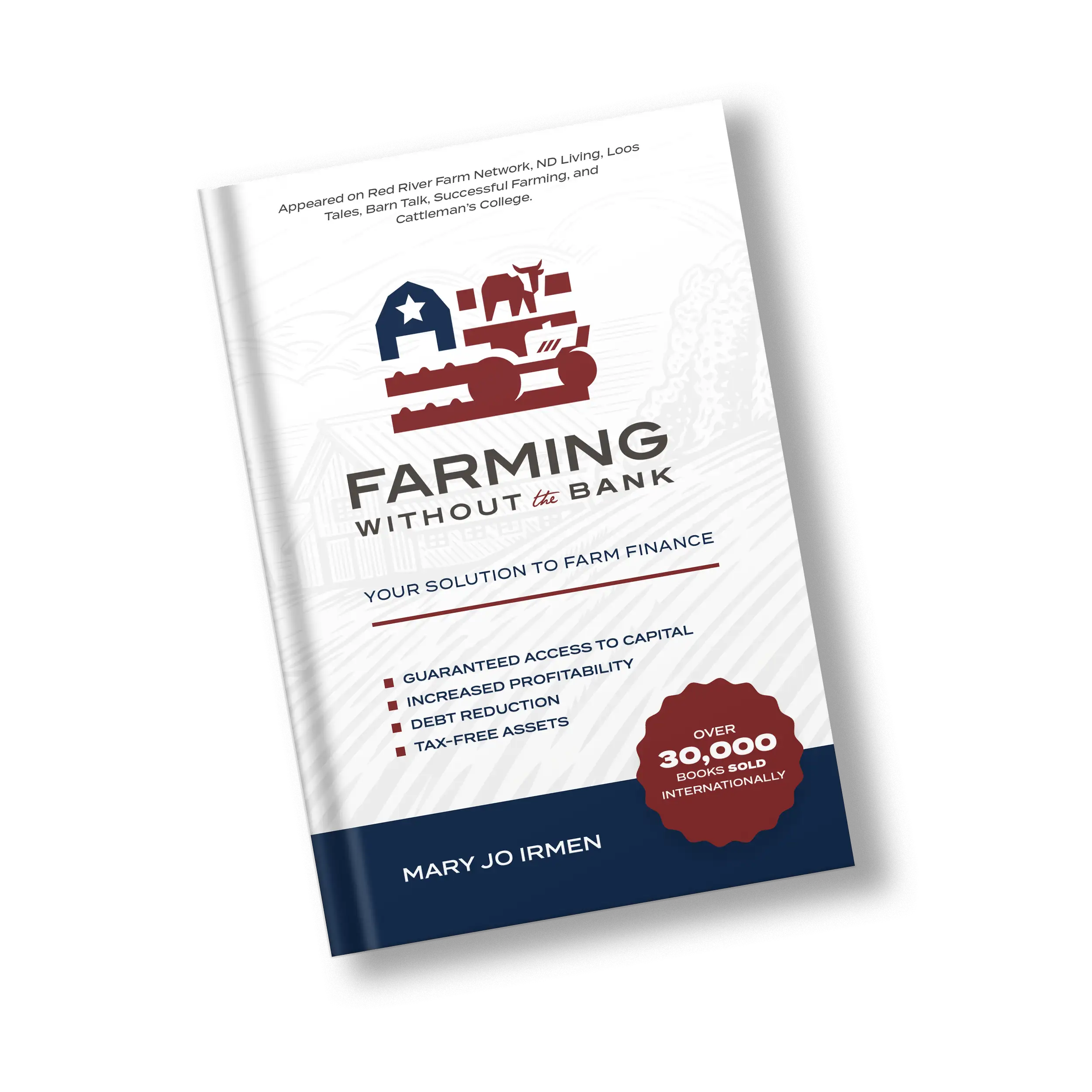
Your farm’s financial independence starts with one book.
30,000 farmers and ranchers have already made the shift. The only question is how long you’ll keep paying interest you could be keeping yourself.