 GET THE BOOK
 GET THE BOOK



Podcast
EP. 342
The Liquidity Problem with Annuities Nobody Warns You About (Ep. 342)
Feb 20, 2026 ·
13 min
0:00 / 13:14
EPISODE OVERVIEW
ABOUT THIS EPISODE
Are annuities a smart retirement strategy… or a costly mistake?
There are people who swear by annuities. Others avoid them completely. In this episode of Farming Without the Bank, we break down the real pros and cons of annuities — especially compared to dividend-paying whole life insurance and the Infinite Banking Concept.
If you've ever wondered whether annuities provide true security, tax advantages, or financial flexibility, this episode will help you think through the decision more clearly.
🔎 What You'll Learn in This Episode
- The key differences between annuities and whole life insurance
- Why annuity income is typically taxable
- The liquidity problem most people overlook
- When an immediate annuity actually makes sense
- How annuities can impact long-term care planning
- Why flexibility and control often matter more than guarantees
💡 Key Takeaways
- Annuities can provide guaranteed lifetime income — but usually at the cost of liquidity.
- You cannot borrow against an annuity like you can with whole life cash value.
- Annuity withdrawals are generally taxed as ordinary income.
- In certain situations (like large inheritances or land sales), an immediate annuity may be a strong fit.
Every financial tool has a place — but the situation must fit the strategy.
If you're building your own "warehouse of wealth," understanding how annuities compare to whole life insurance is critical.
- 📘 Grab the book
- 📅 Schedule an appointment with Mary Jo & John
- 📩 Questions? Email: maryjo@withoutthebank.com
If this episode helped you, be sure to subscribe, share it with someone who's planning for retirement, and leave a review!
CHAPTER TIMESTAMPS
- 00:00Why Annuities Are So Popular
- 01:05What Annuities Actually Are
- 03:04The Tax Problem Most People Miss
- 04:48When Immediate Annuities Make Sense
- 06:44Real-Life Example: 80-Year-Old Landowner
- 09:30Annuities & Long-Term Care Planning
- 11:31Liquidity vs Guarantees: What Matters Most?
YOUTUBE EPISODE
TRANSCRIPTION
"There are people that love annuities. There are people out there that say you need to have an annuity. You need to have a whole life insurance policy. And you need to have… There was one other thing. I forget what the other one was. But so many of us are trying to avoid taxes. They were like, oh no, taxes are bad. Taxes are bad. And taxes are theft, right? Taxes are bad. Taxes are theft. But if we can get our money through an annuity where we are making a rate of return while we're waiting to pay for life insurance, great. If there is the perfect situation, great."
Hello, hello, hello, and welcome back to the podcast. Thank you very much for being here. I appreciate it. Hey, if you guys have not subscribed, apparently I need to tell you to subscribe. And then if you haven't shared, please share.
Okay, we are back into building your warehouse of wealth. I have actually gotten quite a few emails about how you guys are enjoying this. So that's exciting. At least I know I'm not doing this for nothing.
Today we are getting into chapter 10 and we are going to talk about annuities.
Now, I don't sell a lot of annuities. I've never sold one. Early on when I was starting, an individual that I worked with sold annuities, but I have never sold one. I've just never seen the fit. I know people that have annuities, and there's some good and there's some bad with annuities.
And so Nelson had feelings on annuities as well. And so one of the things that he talked about is that it is the reverse of life insurance. It is taking a sum of money that has been accumulated and dissipating it over a certain period of time.
So with a life insurance policy, we cannot take a large inheritance and just put it into the policy one time and be done. Well, we can, but if we do that, it's going to MEC the policy. And so we have to do it over a period of time so that that's going to grow income tax-free.
With an annuity, you can take a lump sum, you can put it into the annuity. Some annuities are variable, so your rate of return is variable because essentially your money is still invested in the stock market. Some of your annuities have a floor — so, oh, they're never going to go below zero, right? I think those are like indexed annuities. You know, you guys, I'm no annuity expert over here.
And then you have immediate annuities. So you can put the money in and then you can immediately start taking it out. Some annuities, if you put the money in, they are going to give you like a doubling or they're going to give you a percentage more, but you have to leave it in for a certain amount of time. So every annuity kind of has its own thing.
The thing that people don't understand with annuities is the tax consequence. And that's what Nelson gets into further in this chapter.
What Nelson gets into is that supposed and unexpected need for cash arises. "Try borrowing from an annuity balance and see what happens." Well, you can't borrow from an annuity balance.
He said, "Every one of them — go back to the illustrations in Becoming Your Own Banker. Every one of them shows annual income from the policies and the ultimate death benefit doesn't disappear. The income received recaptures everything that was paid into the policy in four to six years. And all this income can be tax-free. The same income can be obtained by making policy loans, also tax-free. This is not so with an annuity."
So what he's saying is when we take income out of an annuity, it is a taxable event. And so if you were to take the same amount of money, put it into a life insurance policy, later on we can borrow the cash value income tax-free, and it still grew. You still got everything back that you put in. And that's how he's comparing the annuity.
So most people don't understand that, that that annuity is coming to you as taxable income. It's ordinary income.
He said, however, there can be a place where an immediate annuity could be a good strategy. "Suppose one had accumulated a significant sum of money elsewhere and would like to put it into life insurance." Basically, you can't do it because of the MEC, but one could put a lump sum into an immediate annuity and use the income to buy life insurance — the perfect warehouse of wealth.
So I just want to talk about that for a minute because I do have a lot of colleagues that do that. Somebody gets an inheritance, they will go ahead, have them put money into an immediate annuity, and then they will take a little bit out of that annuity every year to pay for their life insurance premium.
Now, that is an okay fit in certain circumstances, but there are other circumstances where that is not a good fit. And I personally have not found that fit, because if you put money into an immediate annuity, you can only take out X amount per year. Well, what happens if we get into a situation where we want more money? If we are investing that money into real estate or some sort of income producing properties, or maybe we're in some sort of income producing business — now the money is inside this annuity and I can't use it for those other opportunities.
And so because I'm so focused on opportunity, the majority of my clients are also focused on opportunity. And so putting it into an annuity and having some lifetime income out of that is great if that is exactly the position that you're in.
So I talked to a gentleman, I would say three weeks ago now, maybe four, and he was in his 80s. I think he was 82 or 84 or something around that area. And he was just looking for avenues of where to put his money. What could he do with his money? He had not ever heard of infinite banking, dividend paying whole life — which is crazy because he was in his 80s.
This gentleman's from Iowa and he sold some land. He made a bunch of money on the land, took all of that money and put it into an annuity. The annuity is paying him a fixed rate of interest. He is living off the interest only. He hasn't even touched the principal of what he's put in. And that is absolutely fantastic. And it is a great strategy for him.
Now, 15 years ago when he sold the land, could the strategy have been different? Yeah, absolutely. But this is a strategy that's actually working really well for him.
So there are times where an annuity is going to be the perfect answer. Now, all of his income is taxable. So he's having some tax trouble. He is having to figure out how he is going to have to lower his taxes. But if that's the least of your concerns and you have money, that's great.
Some of these annuities are written so that they will pay you X amount per year until the day you die. So even if you outlive the amount of money that you have in there, they're going to continue to pay you. So an annuity is really something nice because you cannot ever outlive it, essentially. With life insurance, you can run out of cash value. And you could live longer than we have cash value. With an annuity, you can't do that.
It's not as liquid. You can't borrow against it. It's not income tax free. So there's pros and there's cons.
Is it a good strategy if we come into money and we need a place to put it, like the old guy, or if we do need it to have an immediate annuity so that we can go ahead and we can use it to pay for life insurance? Yeah, absolutely. But the situation has to fit.
So I'm not like a hater of annuities. I don't have any pluses or minus feelings on them. But I just don't sell them, because people want liquidity of their money today. They don't want to wait for later.
No, I actually did look at an annuity two weeks ago for a client whose dad passed away. Mom came into a fair share of money through death benefit. Do we do an annuity with that so that we have some kind of guaranteed growth? It's got to be a fixed annuity. And what does that look like? Are we going to need that money? Can we get it? Can we protect it from the nursing home? Just a lot of questions on that front to make sure that that even makes sense.
Now, there are also annuities that you can use for long-term care. We are going to have Michelle Prather on in about a month. And she is going to talk about long-term care. I'm super excited for her to come and to record that podcast because she is very knowledgeable and been working in the long-term care industry for a long time. Did she say 27 or 30 years or something? It's been a long time. And she used to work for the home office. Now she's out on her own. I'm super excited about that podcast interview.
Because at the end of the day, you guys, the best way to protect everything is long-term care. You can do irrevocable trusts. You can do all that stuff. I have long-term care because I want that peace of mind.
I'll be honest. When I met with this gentleman three weeks ago or a month ago that had this annuity, I thought, hmm, that's a pretty good deal. Like, he's got to pay tax, but he's not going to ever really outlive that money. He has zero concerns about his expenses. And he's actually using that money to pay for his wife to be in the nursing home. He has so much money coming from this annuity that he's using it for the nursing home. So it's really worked out to be a great thing. His advisor just did him a solid. And you don't see that every day. And so it was exciting to see.
There are people that love annuities. There are people out there that say you need to have an annuity. You need to have a whole life insurance policy. And you need to have… There was one other thing. It's like a three-tiered thing. I forget what the other one was.
But so many of us are trying to avoid taxes. They were like, oh, no, taxes are bad. Taxes are bad. And taxes are theft, right? Taxes are bad. Taxes are theft. But if we can get our money through an annuity where we are making a rate of return while we're waiting to pay for life insurance, great. If there is the perfect situation, great.
It's just not something that I sell a lot of because we got to step into it. It's kind of like long-term care. I love long-term care. I have long-term care. You're going to hear about long-term care. But I don't sell a lot of it because we've got to get you to where you have access to money today, right?
We're building the farm. We're trying to get out of debt. We're trying to maybe farm without the bank. And we have to toggle which is more important — access to cash or long-term. And that's where a lot of people are on a lot of things. And that's why life insurance fits the bill, because it has liquidity. It has control. It has guarantees. It has all those amazing things that we're looking for today, not just what we're looking for tomorrow. If we need to borrow against it, we can borrow against it. Nelson shows that in his book. I show that in my book.
Okay, you guys, let me know if you have comments, questions, concerns. I am happy to answer those. Just email me, maryjo@withoutthebank.com. I will get all of your questions answered.
Sometimes — most of the time — I'm going to email back and say, we need to set up an appointment. It's very, very hard for me to answer a question based on an email. So just know that I'm not trying to be salesy. I'm just trying to be honest and saying, I can't answer that without more detail.
But go to farmingwithoutthebank.com, grab your book, schedule your appointment. Let John and I meet with you and get all the stuff answered. And we'll go from there. If it's a fit, it's a fit. If not, it's okay. It's okay.
All right, you guys, you have a fantastic rest of your day.
Thanks for listening to the Farming Without the Bank podcast. We hope today's episode has inspired you to take control of your finances in new ways. Don't forget to check out our website, farmingwithoutthebank.com, and engage with us on our Facebook page, Farming Without the Bank. Join us next week as we smash more financial myths and empower you to accomplish your financial goals.
View MoreHello, hello, hello, and welcome back to the podcast. Thank you very much for being here. I appreciate it. Hey, if you guys have not subscribed, apparently I need to tell you to subscribe. And then if you haven't shared, please share.
Okay, we are back into building your warehouse of wealth. I have actually gotten quite a few emails about how you guys are enjoying this. So that's exciting. At least I know I'm not doing this for nothing.
Today we are getting into chapter 10 and we are going to talk about annuities.
Now, I don't sell a lot of annuities. I've never sold one. Early on when I was starting, an individual that I worked with sold annuities, but I have never sold one. I've just never seen the fit. I know people that have annuities, and there's some good and there's some bad with annuities.
And so Nelson had feelings on annuities as well. And so one of the things that he talked about is that it is the reverse of life insurance. It is taking a sum of money that has been accumulated and dissipating it over a certain period of time.
So with a life insurance policy, we cannot take a large inheritance and just put it into the policy one time and be done. Well, we can, but if we do that, it's going to MEC the policy. And so we have to do it over a period of time so that that's going to grow income tax-free.
With an annuity, you can take a lump sum, you can put it into the annuity. Some annuities are variable, so your rate of return is variable because essentially your money is still invested in the stock market. Some of your annuities have a floor — so, oh, they're never going to go below zero, right? I think those are like indexed annuities. You know, you guys, I'm no annuity expert over here.
And then you have immediate annuities. So you can put the money in and then you can immediately start taking it out. Some annuities, if you put the money in, they are going to give you like a doubling or they're going to give you a percentage more, but you have to leave it in for a certain amount of time. So every annuity kind of has its own thing.
The thing that people don't understand with annuities is the tax consequence. And that's what Nelson gets into further in this chapter.
What Nelson gets into is that supposed and unexpected need for cash arises. "Try borrowing from an annuity balance and see what happens." Well, you can't borrow from an annuity balance.
He said, "Every one of them — go back to the illustrations in Becoming Your Own Banker. Every one of them shows annual income from the policies and the ultimate death benefit doesn't disappear. The income received recaptures everything that was paid into the policy in four to six years. And all this income can be tax-free. The same income can be obtained by making policy loans, also tax-free. This is not so with an annuity."
So what he's saying is when we take income out of an annuity, it is a taxable event. And so if you were to take the same amount of money, put it into a life insurance policy, later on we can borrow the cash value income tax-free, and it still grew. You still got everything back that you put in. And that's how he's comparing the annuity.
So most people don't understand that, that that annuity is coming to you as taxable income. It's ordinary income.
He said, however, there can be a place where an immediate annuity could be a good strategy. "Suppose one had accumulated a significant sum of money elsewhere and would like to put it into life insurance." Basically, you can't do it because of the MEC, but one could put a lump sum into an immediate annuity and use the income to buy life insurance — the perfect warehouse of wealth.
So I just want to talk about that for a minute because I do have a lot of colleagues that do that. Somebody gets an inheritance, they will go ahead, have them put money into an immediate annuity, and then they will take a little bit out of that annuity every year to pay for their life insurance premium.
Now, that is an okay fit in certain circumstances, but there are other circumstances where that is not a good fit. And I personally have not found that fit, because if you put money into an immediate annuity, you can only take out X amount per year. Well, what happens if we get into a situation where we want more money? If we are investing that money into real estate or some sort of income producing properties, or maybe we're in some sort of income producing business — now the money is inside this annuity and I can't use it for those other opportunities.
And so because I'm so focused on opportunity, the majority of my clients are also focused on opportunity. And so putting it into an annuity and having some lifetime income out of that is great if that is exactly the position that you're in.
So I talked to a gentleman, I would say three weeks ago now, maybe four, and he was in his 80s. I think he was 82 or 84 or something around that area. And he was just looking for avenues of where to put his money. What could he do with his money? He had not ever heard of infinite banking, dividend paying whole life — which is crazy because he was in his 80s.
This gentleman's from Iowa and he sold some land. He made a bunch of money on the land, took all of that money and put it into an annuity. The annuity is paying him a fixed rate of interest. He is living off the interest only. He hasn't even touched the principal of what he's put in. And that is absolutely fantastic. And it is a great strategy for him.
Now, 15 years ago when he sold the land, could the strategy have been different? Yeah, absolutely. But this is a strategy that's actually working really well for him.
So there are times where an annuity is going to be the perfect answer. Now, all of his income is taxable. So he's having some tax trouble. He is having to figure out how he is going to have to lower his taxes. But if that's the least of your concerns and you have money, that's great.
Some of these annuities are written so that they will pay you X amount per year until the day you die. So even if you outlive the amount of money that you have in there, they're going to continue to pay you. So an annuity is really something nice because you cannot ever outlive it, essentially. With life insurance, you can run out of cash value. And you could live longer than we have cash value. With an annuity, you can't do that.
It's not as liquid. You can't borrow against it. It's not income tax free. So there's pros and there's cons.
Is it a good strategy if we come into money and we need a place to put it, like the old guy, or if we do need it to have an immediate annuity so that we can go ahead and we can use it to pay for life insurance? Yeah, absolutely. But the situation has to fit.
So I'm not like a hater of annuities. I don't have any pluses or minus feelings on them. But I just don't sell them, because people want liquidity of their money today. They don't want to wait for later.
No, I actually did look at an annuity two weeks ago for a client whose dad passed away. Mom came into a fair share of money through death benefit. Do we do an annuity with that so that we have some kind of guaranteed growth? It's got to be a fixed annuity. And what does that look like? Are we going to need that money? Can we get it? Can we protect it from the nursing home? Just a lot of questions on that front to make sure that that even makes sense.
Now, there are also annuities that you can use for long-term care. We are going to have Michelle Prather on in about a month. And she is going to talk about long-term care. I'm super excited for her to come and to record that podcast because she is very knowledgeable and been working in the long-term care industry for a long time. Did she say 27 or 30 years or something? It's been a long time. And she used to work for the home office. Now she's out on her own. I'm super excited about that podcast interview.
Because at the end of the day, you guys, the best way to protect everything is long-term care. You can do irrevocable trusts. You can do all that stuff. I have long-term care because I want that peace of mind.
I'll be honest. When I met with this gentleman three weeks ago or a month ago that had this annuity, I thought, hmm, that's a pretty good deal. Like, he's got to pay tax, but he's not going to ever really outlive that money. He has zero concerns about his expenses. And he's actually using that money to pay for his wife to be in the nursing home. He has so much money coming from this annuity that he's using it for the nursing home. So it's really worked out to be a great thing. His advisor just did him a solid. And you don't see that every day. And so it was exciting to see.
There are people that love annuities. There are people out there that say you need to have an annuity. You need to have a whole life insurance policy. And you need to have… There was one other thing. It's like a three-tiered thing. I forget what the other one was.
But so many of us are trying to avoid taxes. They were like, oh, no, taxes are bad. Taxes are bad. And taxes are theft, right? Taxes are bad. Taxes are theft. But if we can get our money through an annuity where we are making a rate of return while we're waiting to pay for life insurance, great. If there is the perfect situation, great.
It's just not something that I sell a lot of because we got to step into it. It's kind of like long-term care. I love long-term care. I have long-term care. You're going to hear about long-term care. But I don't sell a lot of it because we've got to get you to where you have access to money today, right?
We're building the farm. We're trying to get out of debt. We're trying to maybe farm without the bank. And we have to toggle which is more important — access to cash or long-term. And that's where a lot of people are on a lot of things. And that's why life insurance fits the bill, because it has liquidity. It has control. It has guarantees. It has all those amazing things that we're looking for today, not just what we're looking for tomorrow. If we need to borrow against it, we can borrow against it. Nelson shows that in his book. I show that in my book.
Okay, you guys, let me know if you have comments, questions, concerns. I am happy to answer those. Just email me, maryjo@withoutthebank.com. I will get all of your questions answered.
Sometimes — most of the time — I'm going to email back and say, we need to set up an appointment. It's very, very hard for me to answer a question based on an email. So just know that I'm not trying to be salesy. I'm just trying to be honest and saying, I can't answer that without more detail.
But go to farmingwithoutthebank.com, grab your book, schedule your appointment. Let John and I meet with you and get all the stuff answered. And we'll go from there. If it's a fit, it's a fit. If not, it's okay. It's okay.
All right, you guys, you have a fantastic rest of your day.
Thanks for listening to the Farming Without the Bank podcast. We hope today's episode has inspired you to take control of your finances in new ways. Don't forget to check out our website, farmingwithoutthebank.com, and engage with us on our Facebook page, Farming Without the Bank. Join us next week as we smash more financial myths and empower you to accomplish your financial goals.
ready to start?
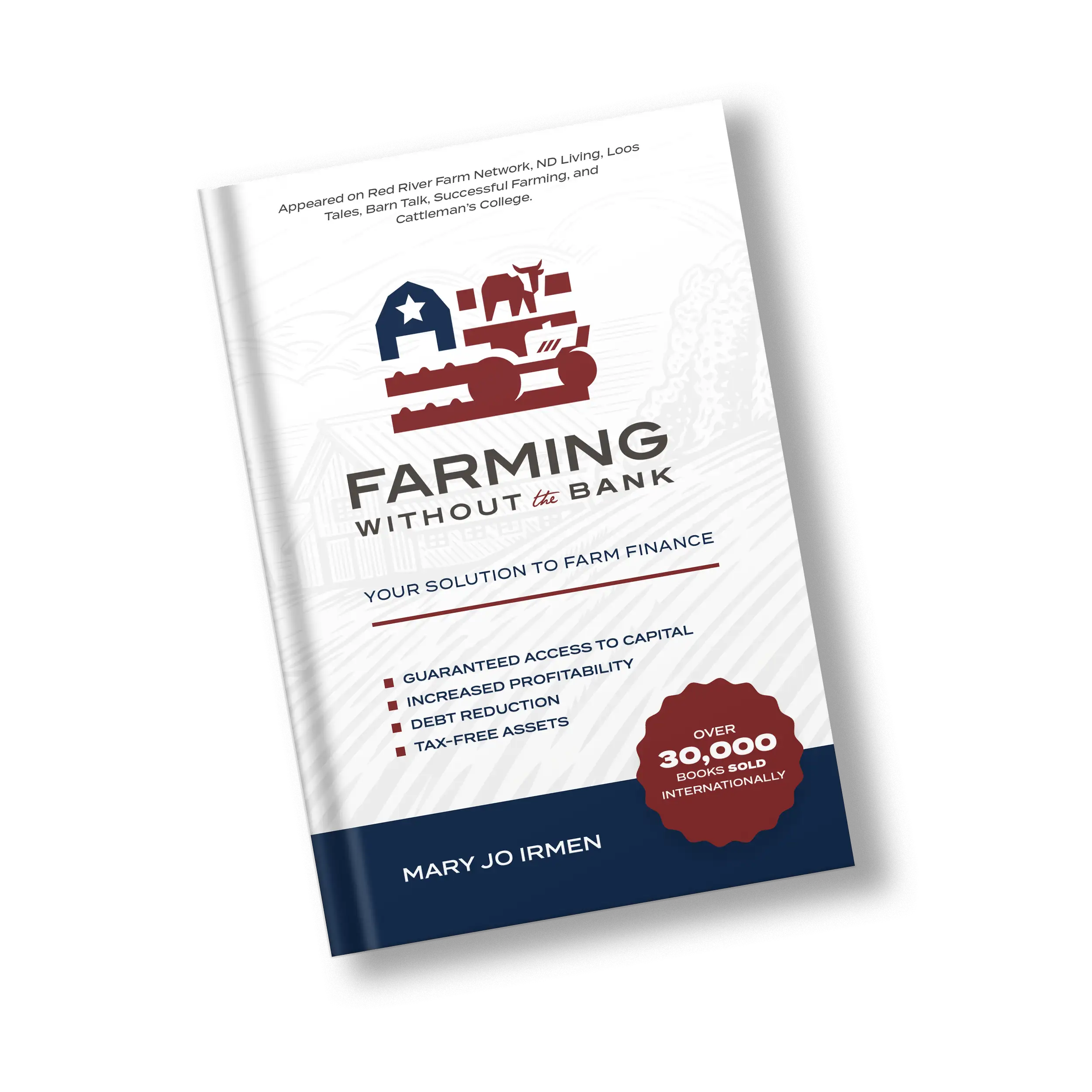
Your farm’s financial independence starts with one book.
30,000 farmers and ranchers have already made the shift. The only question is how long you’ll keep paying interest you could be keeping yourself.