 GET THE BOOK
 GET THE BOOK


Podcast
EP. 351
Farming Without the Bank in Canada: What’s Different (And What Could Cost You) (Ep. 351)
Apr 24, 2026 ·
59 min
0:00 / 59:10
EPISODE OVERVIEW
ABOUT THIS EPISODE
Canadian IBC warning! Policy loans can trigger taxes—know ACB before it costs you.
In Canada, borrowing from your whole life policy could become taxable income if you're not careful. Most farmers and ranchers north of the border don't know about the Adjusted Cost Basis (ACB) — and it could cost them. In this episode, MJ sits down with Lacy Rowan of Ranch Your Way to break down exactly how the Infinite Banking Concept works differently in Canada, what traps to avoid, and why understanding agriculture is non-negotiable for any financial advisor serving farm and ranch families.
Lacy brings a rare combination of boots-on-the-ground ranching experience and deep financial expertise. A Texas-born horsewoman who married a Canadian rodeo cowboy and now runs cattle on a family ranch established in 1910, Lacy understands the agricultural world from both sides of the fence — literally. Together, MJ and Lacy explore the critical differences between US and Canadian infinite banking policies, the realities Canadian farmers are facing with new government regulations, and why protecting your family legacy requires more than just working hard — it requires a plan.
Whether you're a Canadian farmer looking to implement the Farming Without the Bank strategy, a financial advisor serving agricultural clients, or simply curious about the cross-border differences in whole life insurance policy structures, this episode is packed with real-world insight you won't find anywhere else.
Key Takeaways
- ✅ The Adjusted Cost Basis (ACB) is Canada's biggest difference — when your ACB hits zero and you have an outstanding loan at year-end, that loan can become taxable income
- ✅ The Insured Retirement Plan (IRP) is a powerful Canadian-specific retirement strategy using your policy as bank collateral for tax-free annual income
- ✅ Financial advisors must understand the agricultural lifestyle to effectively serve farming and ranching families — underwriters often lack basic knowledge of rural life
- ✅ Proposed CFIA cattle tracking regulations could create major challenges for Canadian ranchers who use rotational grazing and large community pastures
- ✅ Without proper estate planning and life insurance, family farms are often lost — not from failure, but from lack of preparation
- ✅ Having a succession plan inside your own business ensures clients are protected no matter what happens to you personally
- 📘 Grab the Farming Without the Bank — Canadian Version
- 🎥 Enroll in the free 4-part video series
- 🇨🇦 Canadian farmers — email Wecare@ranchyourway.com for an appointment with Lacy's team
🇺🇸 US farmers — reach out to MJ or John to get started implementing Farming Without the Bank on your operation
CHAPTER TIMESTAMPS
- 00:00Introduction: Lacey & the Canadian Version of Farming Without the Bank
- 01:23Lacey's Agricultural Background: From Texas to a Canadian Ranch
- 05:00The 1910 Family Ranch & Children's Involvement in Ranching
- 07:30The #1 Difference in Canada: Loan Taxation & the Adjusted Cost Basis (ACB)
- 12:00MEC Rules, Uninterrupted Compound Interest & Canadian Insurance Companies
- 15:29Why Advisors Must Understand the Agricultural Lifestyle
- 22:00Underwriter Misconceptions & the Realities of Rural Life
- 32:00Protecting Family Farms from Corporate Buyouts & Legacy Loss
- 36:00Life Insurance as an Estate Planning Tool
- 37:40Canadian Government Cattle Tracking Regulations & the Impact on Ranchers
- 42:00The Economic Climate in Canada: Tariffs, Canola & the Weak Dollar
- 47:00Rural vs. City Life: Why the Farm is the Best Classroom
- 52:00The Importance of Succession Planning in Your Own Advisory Business
- 56:00Calls to Action & Where to Find the Canadian Book
YOUTUBE EPISODE
TRANSCRIPTION
Hello, hello, hello, and welcome back to the podcast. Thank you very much for being here today. We have Lacey from Canada, so I am excited about this. Lacey came down to visit with the sell-buy marketing class that Doug has going on, and so I've had a busy week of guests — that's why you're seeing so many guest podcasts.
But if you guys are not aware, I have coauthored a book with Winnie Lau in Canada, the Farming Without the Bank Canadian version. It's a little bit different than the US version, 'cause things work a little differently in Canada. Winnie is not here because she's got some family stuff going on and was not able to make it. But we are graced with Lacey.
Yeah. I'm so happy to be here. Thank you for having me. It's all surreal — like, finally getting to see your new podcast studio, and be here to record and meet with Doug and Amber and the sell-buy attendees. So yeah, I'm super excited.
I know, it's been fun to have you, 'cause we get to see each other at Think Tank, but we don't ever get alone time. So it's been fun.
Yeah.
So Lacey, tell us a little bit — 'cause I think this is important, that people want to know. Do you know anything about farming and ranching? So can you just share a little bit about your background in agriculture?
Yeah. So I was born and raised in Texas, and I grew up on —
Go USA.
Yeah. So I am a dual citizen and I'm very proud of that. I grew up on about a hundred acres. My dad was a calf roper. My mom was into horses. My dad actually used to hunt off of his horses — like hunt deer and shoot. So I grew up on the back of a horse, just not farming or ranching. There was a period of time where my dad had cattle. I was probably like 10 to 12 years old maybe. And every time my dad was at his real job — he was a first responder, so he was a firefighter for the city of Houston for 28 years. So when he was doing his 24-hour shift, I think that's when the cows always got out. So I was always his right hand man, per se, like feeding the cows and helping with everything, branding. I remember getting left behind at two different brandings because I just was so independent and, you know, just easily adaptable to whatever.
So I moved to Canada in 2004, actually, when I married my husband, who was a rodeo cowboy. Reed was a bareback rider for a lot of years. And we lived on an acreage too. I brought my horses, brought my dogs, continued to barrel race and do things. I did a little bit of roping. But it wasn't until 2015 where we needed a change for our family. We had two young boys. Reed was a welder in the oil field. His rodeo career had come to an end. He chose to retire. And we were like, okay, we need a next step.
So Reed comes from — his mom's side of the family, the ranch has been in the family since 1910.
Oh, wow.
Yeah. So we always dreamed, and we had a vision board with a log house and a pasture of black cows. So I know you love white cows, but we love black cows. So we always had this dream, and what we ended up doing was we sold everything. We sold our acreage. We took a job as a hired family on a ranch, and we bought some of our own cows. So that was our first step to really doing this ourselves. And so that was 2015.
And then 2018 we partnered with one of the uncles on the original family ranch. So we purchased more land, brought our cattle, and really the rest is kind of history, per se — because he wanted help, and he knew we wanted to be in that industry, and so we purchased land with him. We mostly run yearlings. We still have a few bred cows, but we mostly run a yearling operation with Uncle Brad. And his wife also happens to be from Texas, so we just have always had such a cool connection with them.
So we live right beside them, where Grandma Lizzie originally homesteaded in 1910. She was from Michigan actually, and she immigrated to Canada with her family. She was a widow and had a two-year-old daughter. So she homesteaded the original 10 acres, right where we live. And then she ended up, of course, marrying the neighbor, Jack Pearson — and that's the story, and the ranch is still in the family.
So that's my background. Getting into ranching is more with Reed's family. And I always knew, like, when I would go to Brad and Charlotte's, that just always felt like home. And so it only makes sense that we ended up being there and working with them.
And so my role in the ranch — I like to do the fun jobs. So if the cows need moved and I get to ride my horse, I'm all for it. Reed and Brad are mostly the brains behind the business and the hard physical labor, and I come in and fill in where it's needed. Or I do feed cows when Reed is away. So that's kind of my history, and just being a steward of the land and loving the lifestyle.
So, and you got three kids?
Three kids, yes.
So two boys and a girl. I got to overhear your conversation last night with your daughter, right? Who was nine, going on 50. She's kind of like you. She's the "let's just take her along," and she'll help fix fence and she'll ride.
Yeah, like Reed's right hand gal, I say. She's always up for trucking if they're going to get something. She has been fencing and working right alongside Reed and Uncle Brad since we moved down there, driving the side by side for them, doing different things. Even last year — I was away for some reason, she was home with Reed, and we have this amazing little horse for her. And she went out and checked yearlings for Reed and Brad and came back and said, there's a fuzzy-eared calf who lost his tag, but he has a swollen leg and he's limping. And sure enough — like, he's red, this is what he looks like. And so she says she's taking over. I mean, we'll see — like, she's nine, right?
Yeah. But she's kind of taking great grandma's spot.
Yeah. Grandma Lizzie. She's got an eye for it and she truly loves it. And that is what — like, sometimes our times are tough, living that lifestyle. Market volatility, what's gonna happen. A few years ago in calving, after we moved them to the far pasture, calves started getting sick. And then I started to go in like, oh my gosh, what if every single one gets sick?
Which is not super helpful.
No, it's not. And so, you know, living that life and being in that business isn't always easy. But it's worth it.
It's 'cause the kids are — even the boys are involved, but your daughter loves it.
Yeah. Our boys are involved with some physical labor stuff. Our oldest son Zane has a passion for hunting, and he has, since he was big enough to shoot a gopher. And he has spent four summers working as a wrangler for a hunting guide outfit in northern BC. And so his passion is really that. And will he come back? Probably not. The middle boy, I don't really know what direction he's gonna go in, because he's worked as a wrangler as well and he likes it. He really loves his hockey. So we'll see.
Maybe you'll have a professional hockey player out of the deal.
I don't think so, but I mean, I would be okay with that. I would go watch.
So it is nice to know, though, that there is — Winnie obviously is amazing, but doesn't have any kind of farm background, and so you get the best of both worlds really. You get the Winnie who understands it, doesn't live it, but understands it, and the infinite banking and all that kind of stuff. And so you guys work really good together as a pair.
Yeah. I always say I have the best of both worlds, because I'm living on the ranch. That's what Reed is doing. I'm active. But Winnie has almost 16 years of experience practicing and being an infinite banking advisor, and you can't replace those years of experience. So she does try really hard to understand. She'll be like, okay, Lacey, what does this mean? This person said this — what does that mean? And she really does try hard.
Hence why I coauthored the book with her.
Yes. And even though she's a city girl — she's raised in the city — her calling is to be a country girl. Like, she really does love the outdoors.
Winnie will live outdoors longer than I will.
Yes. Oh, absolutely.
She loves that life. And she loves the calm and all that kind of stuff. So it is nice that you guys are both working with the farmers up there.
What are the differences? A lot of people ask — I mean, I get a lot of questions, a lot of questions about, can we do this in Canada? And a lot of people don't know that you guys have a book. And so what are the differences between the US and Canada? Like, the modified endowment contract piece in Canada works a little differently. So when you take a loan in the States, you can take that loan and it does not qualify as income. Nothing is reported. It's super, super easy.
Correct.
What happens in Canada when you take a loan?
So when you take a loan — every policy has, and I'm not super familiar with the US yet as well, but your policy has what's called an adjusted cost basis. And when your policy is brand new, that adjusted cost basis is, let's just say, really high. And then as your policy ages, it grinds down. Eventually it will grind down to zero, and it takes years to do that. If your ACB, as we call it, is zero and you take a loan, then that amount of your loan becomes taxable income.
Okay.
So it's something that we as advisors in our team keep an eye on for clients. I've been with Winnie for almost six years, and I've only seen one time where a client received a T5 slip, they called it, and it was for like 200 bucks. So they had $230 of taxable income or something from their loan.
But then when they pay the loan back, that gets reimbursed, I understand.
Yes. It reverses it. So I can call up the insurance company and say, okay, my client has a policy loan balance of X, Y, Z. How much do they need to pay back by December 31st in order to prevent —
Any taxation.
Any taxation on it. And it's very easy. It takes focus and dedication from our team. And we try to coach our clients with that too. Like, hey, stay in tune, 'cause we can't care about your money more than you do. So stay in tune with, what is your loan balance? Let's set a calendar reminder for October 1st that says, hey, let's make a loan repayment. If you're not already making loan repayments regularly, let's set a reminder and say, okay, check in with Lacey and Winnie's team.
But the loan payment flexibility — is the loan as flexible as the US? They don't care if you make a loan payment. They don't care if you make interest. They're not tracking any of that.
That's correct. They're not tracking it.
So it's truly up — it's the same as here. It's you being the banker. If you're gonna start a policy, you need to make sure that you are the banker.
Yes.
And you're paying attention. But you're actually holding their hand more than we do. I'm not checking to make sure you have loan repayments, because you're an adult. And so who should be adult? But we also don't have that taxation issue to worry about.
It's my understanding, like, you make sure the policy is designed that it won't MEC.
Well, when we take a loan, the IRS code is — it's an actual loan. It's treated like a loan from a bank. So there is no income associated with that. But the policy — now, in the US, if you pay too much premium, let's say your premium is $20,000 a year and you pay the insurance company $21,000, they will send you a letter that says, hey, you're gonna MEC. And so we're not taking this thousand dollars unless you don't reply back to us. But taking a loan does not change that. Paying premium could cause a MEC. Taking a loan and repaying a loan does not create any kind of a tax expense.
Yeah. So that's where it's different. And then we also have something that we're exploring recently, something called an IRP — so it's an insured retirement plan. It goes against what Nelson taught about doing business with the banks, but we are exploring it as an option for when we have clients that are entering retirement. Basically in a nutshell, I won't get too much into it —
To help avoid some of the tax.
To avoid taxation, because the bank can take your policy as collateral and they give you a loan every year for your annual income, and they use the cash value to give you that loan. And then once you pass away, your loan's paid off and the remainder's paid out as a death benefit, just as it should. But we haven't done one yet, because our client base is quite young.
So when you take a loan in Canada, is your money still earning uninterrupted compound interest?
Yes.
Okay. So that acts the exact same. So that part of the book is still very, very accurate. You're earning uninterrupted compound interest. You're earning dividends, because it's a mutual company. And then there's only like one or two companies in Canada to work with, versus a bazillion. Well, we don't have quite a bazillion, but we probably have a dozen.
I'm actually not sure how many mutual companies there are in Canada, but we do most of our business with Equitable Life of Canada.
Well, and not every mutual company has a paid-up additions rider.
Yeah.
But Equitable does have a paid-up additions rider.
Yeah. We love Equitable. They're advisor friendly, they're client friendly —
And they're IBC friendly.
And they're IBC friendly. They really are. And their policies just perform so well. We've compared, and we come back to Equitable almost every time.
I think it's important that you understand IBC, you understand farming, you understand how to structure policies. And I think just for everybody listening, it's important to know that as well. Lacey does a lot of training with me. She sits in a lot of my meetings — and not because she needs to know how the US does it, but just to understand the farming side of it, and how I am presenting to farmers, how we're solving problems, strategies, that sort of thing.
Just so — I think knowing that what I'm doing down here is being replicated up there is also important, especially if you guys like me. Then you know that I have also picked somebody that I trust to take care of you. It's not that I just randomly went and picked anybody in Canada. It was very important to me that my farmers are taken care of. And when I say my farmers, every farmer in the world is mine. As silly as it sounds — not mine, that I have to do business with them, but it's my community. And I just wanna make sure that they're not being screwed. Because it's very easy for people to take advantage.
Yeah. And I'll say, when I started working with Winnie — we were actually Winnie's clients first. So we heard your podcast on the Working Cows podcast. We bought your book. Reed thought, why is this Chinese lady reaching out to me? Like, who is this lady? And I'm like, I think you're getting scammed. So he actually picked up the phone and called your office and talked to you, and you said, no, that's Winnie, she works with me. I pass all my Canadians off to her. So then it was like, oh, okay, perfect.
And we became her clients. And we were at a transition point where we were working as the hired family, but we knew we were gonna be moving back to the home place soon. And so it was a time where I had an opportunity — like I said, oh hey, I could actually maybe pursue a career, because I'd been a stay at home mom. Our oldest son was 13 at the time.
And I just kept asking Winnie in our meetings, I said, hey, is there an opportunity to work with you? I kind of like what you're doing. And she was like, what? And I just kept asking her, and I was persistent. I'm like, I really think — because in Texas I was in the insurance world. I was in home and auto.
Oh, okay.
I said, I really like this. And Reed — because so much money runs through the operation, purchasing cattle every year — he's like, this makes complete sense for ranchers and farmers. But we are ranchers. He's like, the money that we're purchasing cattle with, cash, could be run through a policy. And so it was the first time in our married life where we felt like a financial philosophy resonated with us. And that's kind of where the journey started.
I was persistent enough. Winnie grew to know me, because we sat in so many client meetings with her, and she finally said, okay, get your license.
Yeah. And that speaks volumes for Winnie, that she's not just like, sure, any old Tom, Dick and Harry can work with me.
No. I was the first person. So her and Amanda — Winnie's assistant Amanda had been with her for like six or seven years. Winnie never wanted to work with another advisor. I was the first one, and she said, I trusted you. She said, I didn't know what it was, but I just trusted you. And I went with my gut and I said, okay, go get your license. And she didn't think I would.
Because most people don't.
And I'm like, challenge accepted. So I got my license. I passed my test on the first time, which is kind of unheard of, I guess. And she's like, you really are serious. And I'm like, I really am serious.
So she actually made me start off in a role with her doing administration stuff. So I learned the backside of how the policies work. I sat in every single client meeting with her, taking notes — she made me take the notes. Looking back, I'm like, she made me do a lot of stuff, but it was for my own good and for the client's own good. So I stayed in that role, actually part-time, until January of this year. But the stuff that I learned in that role —
There's a lot of the backside that needs to be known. Agents that don't do the backside of it — a lot of my newer agents don't, because I have Jess. But I had to do it. And it makes you understand how the underwriting process works. Who's insurable, who's not insurable, what that looks like. Like, insurance companies don't like everybody.
No.
And so there's certain things that we know, or we have to explain. Like, you and I were talking about an issue that you're having right now that is the most ridiculous thing ever. And you are going to have to explain to the insurance company how ridiculous it is, because they're too ignorant to understand. Because it's not a health risk.
And the amount of things that I have to relay — or even on the farming side. Like, I had a guy that they asked what he farmed. And that's a pretty odd question, we don't get that a lot. And so we wrote down hemp, because he was a hemp farmer. Immediately came back denied. Because they're like, no, he's growing marijuana. Hemp is not marijuana. Like, can you at least make a phone call to me and be like, Mary Jo, this guy's growing hemp? He's growing marijuana. No, it's not. And they just don't always — the underwriters don't always understand.
So it is important to understand agriculture and to understand what your client's doing, so you can explain to these city folks why there's an issue. We even had a client that wanted insurance on her husband because he was going elk hunting, and she wanted to make sure that if he was killed, she had insurance. He was killed by a bear. And so for whatever reason that came out in the underwriting process, and our customer service manager person said, what? Killed by a bear? Like, that's a real thing? We're like, yeah, what do you mean, you don't know that's a real thing?
And so their lifestyle is so very, very different, because they're in a big city. They don't have rural people doing that job. It's more of an in-person job, it's not necessarily remote. And so it is important that we know how to relay that information, 'cause they're gonna ask, what are your clients doing? Like, even rodeo.
Even rodeo, yeah.
We had somebody that professionally rodeoed and they were like, are they a steer wrestler? A steer wrestler. You're concerned about a steer wrestler?
Yeah.
Should be concerned about the bull rider?
Probably. Yeah.
I've known a lot of steer wrestlers in my day, and I don't know any of 'em that have been killed. They're not jumping on the horn. I mean, I suppose they could miss the horns, but —
I suppose it could happen, but I mean —
Yeah. So they just don't understand that world.
No, they don't. And we try really hard to — we have an underwriter who does most of our underwriting.
We do too.
It's really good to have his phone number. And just in January, or maybe at the end of December, we spent an hour on the phone with him, because we had a ranching family that we're trying to get more policies for. And just us spending that hour on the phone with him gave him all the information that he needed to understand why we were applying. Like, we set up every application for success. We do everything in our power to set it up for success. If we run into a roadblock, then we deal with that. But our hope is that we provide enough information and clarity in the application that they don't need to come back to us for tons.
Right. Well, and a lot of times — I don't know what happens with you guys, but I do it so often that OneAmerica doesn't even really question it anymore. And we don't have one set underwriter per se, but I have enough business going through that they kind of just get to know you.
But I was working with a new company to me. And they would not allow me to have the child own a policy on mom. And if mom died, he was going to have to buy off the sister. So we just do that all the time. It's a key man policy, right? Or it's a buy-sell type policy, and it's so normal for us. And they just had a fit about it. They're like, no, mom can own it. And I had a full-on half an hour meeting with them, and they just could not understand.
They're like, why don't they just create an estate plan? Well, why don't they? That's such a good idea. Why don't you go to every farmer and say create an estate plan? 'Cause nobody else is doing it. I mean, if they created an estate plan, then we wouldn't have to do this, and that would be great. But there's not an estate plan. You need to understand that clientele. You need to understand their lifestyle.
It was so funny — as we were talking, there was one person on that call that's like, yeah, farmers are, you're just not gonna get 'em to do that. And these city folks just could not understand it. And I was so mad. I said, thanks, we'll never do business again. This person is not going to get rich off of $300,000 of death benefit. If we were talking 15 million, that'd be a different story. I could understand your concern. But $300,000, that's not even a down payment for what he needed.
No.
Like, that's not even a piece of equipment. That's not even taxes. The fact that you're not even trying to understand — because a lot of these insurance companies watch too much Dateline and they think everybody is killing everybody, you know, or murder mystery podcasts or whatever they're listening to. Their mindset is very different than ours.
Yes.
But I always say, if you took me to the city, I would be lost as well. You were recently in New York. It is a different lifestyle, that I don't wanna criticize them, but I would want to learn if I were in either one of those situations.
Yeah, for sure. When we were in New York City, I think it gave me a different perspective of — if you were born and raised in that setting, that's why you are a product of your environment. Just as we are a product of the ranch environment. Like we were talking last night, death comes on the farm. Death becomes something that we have to deal with more so than someone in the city.
We always ate our — because we'd have a bottle calf, and it would either get sold or end up on the table. You know, I mean, it was just a part of life. Like, things die. Back in our day you didn't euthanize a dog. You watched dad take it up to the pit with some dog food and not come back with it. Like, you knew what was happening. It just was not an emotional experience, and you don't get as attached to things.
Yeah. When you know, and you have to experience that. I remember when Reed's grandpa died in 2008, his cousin Kendall — Reed comes from a big family, but a rodeo family too. So his youngest cousin happens to be Kendall Pearson, breakaway roper. And when grandpa died, she said, so dad, are we just gonna take him out back with Minnie? And Minnie was his poodle, who had passed away a few months before. And he's like, no, it's a little different when people die, we don't just take them out back.
Oh, she was little at that time.
She was little at that time. Yeah, she was probably five or six.
So I feel like you do become a product of your environment. And that's where, like, with me having the ranching background — I know there have been some clients that were Winnie's before I came along, and one, a dairy farmer from BC actually said, he's like, I love Winnie and I love her knowledge. He's like, but I also like talking to you, because when I say, hey, I kept 15 replacement heifers, you know what I'm talking about. Or, I'm not gonna be able to keep this many. And so it does, I think, make them feel more at home or feel more understood. Because sometimes I feel like farmers and ranchers, from the outside world, can be seen as, well, that's not really a business — when it absolutely is a business.
And the world of farming and ranching is so misunderstood. The big wide world wants to tell you how to do your job, and they don't even know how to do it themselves. They don't truly know how things are raised.
Here's a good example. Scott chews Copenhagen. And so he's trying to decide if he should go to something else that would be better for him than Copenhagen, but it's just a nicotine replacement, right? And so we start reading the cans of these nicotine replacements, and I'm like, well, look at all these additives. You can't tell me that's better for you than straight up nicotine — the tobacco leaf.
Well, I've never grown tobacco. I don't know how tobacco's grown. I've never been on a tobacco farm. And so I go to TikTok, and I'm looking up all these tobacco growers, because I want to genuinely learn how the tobacco is grown. I don't care what AI has to say. I don't care what anybody outside of the tobacco industry has to say. I want to know how tobacco is grown from a tobacco grower. And I haven't found out how much spray is on it, chemicals, that sort of thing. But I'm not going to sit here and be like, that's the worst thing ever, and you need to change how you grow tobacco. Because everybody's growing it differently.
Like, everybody's saying, oh, all these farmers are desiccating their wheat. I didn't even know that was a thing until probably 10 years ago. I had no idea. Nobody that I knew growing up desiccated their wheat. And so to lump everybody in the same — the farming industry has to have somebody in it that understands what they're going through, how they grow their food, how they live. The fact that family lives on the same farm. You're very close to one another. You're very intertwined to one another. You may or may not like one another, depends on the day.
Like, there are so many variables to understand. And that there is heritage there. From 1910 to today, that means something to us, even though we weren't alive then. It means something to me that my dad is fixing my great grandparents' home, and it was a rock house. It's what they homesteaded with. That's still on our place. There's still sentimental value that got passed down. We know who died in that house. We know when they built the new house. That doesn't happen when you don't live in agriculture, because you're just moving houses.
It took me a long time to understand how people can move every couple years and not be in the same house that they were brought home from the hospital in. Like, I will never know another house. I will never know another home location that will always be home.
Yeah. And I think for me too — I didn't grow up on the place, and Reed didn't grow up there either. There's three sisters, three brothers, and the girls all left and the boys have the ranch, and all split, and everybody's separate, but it's all right there together. We're within five miles of everybody, family. But for me, living there, it is home to me and it's worth protecting. What Grandma Lizzie started in 1910 —
It means something.
She was a widow. She had a little baby and she homesteaded 10 acres. You went to the office of wherever they were handing out the homestead. Uncle Brad has her certificate of her land. And she went and found her 10 acres, and the next year —
Do you know what they had to do to homestead that?
I don't know the exact process. We have a family book and it's all in there.
So my dad has been studying that. He talks about it. If you guys want to listen to that interview — Heidi Olson with Pathfinder Legacy. Oh my God, I'm such a good friend. Heidi interviewed my dad on there and he talks about the homesteading, of what they had to do. 'Cause we have my great-grandparents as well, and similar story. My great-grandfather was killed in a tornado, and so my great-grandmother had to keep the farm going. And she was buying land in the thirties when everybody else was selling, and she was selling seed. And they were using tractors — little scuffle with the tractor situation — and she ended up going back to horses and plows.
But my dad has read a lot of books. In order to homestead our area, they had to remain on the land like a year or two before they could get their homesteading certificate. And dad had talked to one of the neighbors, I believe, and when they had homesteaded, they basically turned their wagon upside down, dug a hole, and lived in that for two years.
Oh, wow.
With their children. I cannot even imagine North Dakota winters. And dad did say in Heidi's podcast that a lot of these people wanted to just go back to Germany, but they didn't have the money to get back. And so they were stuck here, because it was so brutal. And Canada's not gonna be any better. I think where you're at, you're in Ontario?
Alberta.
Alberta. Okay. So it's not any better in Alberta. It's equally as cold.
Oh yeah. Brutal winters. And I'll look into what that process was, but I know she started with 10 acres. The next year she had another 10 acres. And there was a bachelor neighbor who was similar age to her, and he stopped in one day — like, oh, there's a new neighbor, whatever. And they started to see each other and they built the family. And that's where the Pearson family started.
I think there's a lot of women in agriculture. Like, people say, oh, there's not as many women in agriculture, and that's getting to be more and more. And I think there probably was a fair amount of women throughout the years in agriculture, you just didn't hear about them. You didn't see them. They just put their head down, they went to work. But people died and they had to keep it going, or not keep it going. And they had kids old enough to help.
Yeah, for sure. And so I always say, a legacy like ours is worth protecting. What she started, what has been expanded and built on — it's worth protecting. And we're closely tied to Uncle Brad and Auntie Charlotte and their two girls. They have two girls, but they're not on the farm. One is a pilot, and one works in Calgary. And so now we're working with them, like, how can we protect and preserve what everybody has built?
I think you have to live it to understand it.
You have to live it. Because if we are not doing something to protect it and preserve it and make it sustainable for the next generations to keep it — guess what? Corporations are gonna buy it. It's gonna be sold, because one day it's gonna come down to, well, nobody can afford to buy it except the big corporation. And so I always say, how many times are we gonna pay the bank for the same piece of land? Let's look at something different. Like the book. Let's look and see, is this gonna work for you?
I'm a firm believer the reason we're losing farms is due to the lack of estate planning.
Absolutely.
And in that estate plan, there's never life insurance, and we're not passing on those discounted dollars. And so we're actually making it harder for ourselves to sustain that. It's not all just market issues, because the market will fluctuate. It's gone up and down forever. It's always gonna go up and down.
There's one thing that we can have control of. And it was interesting when I was visiting with Doug — I said, what is sell-buy marketing? Like, why sell-buy marketing? And it took us a long time in our interview, again, if you know Doug. But he said, it's the one thing that I can control. I can control what I pay for an animal. I can't control what I sell an animal for. But I can control what I pay for that animal.
So if we have very little control anyway — almost everything is out of our control — we can control what we're going to leave to the next generation in a life insurance policy. That premium is guaranteed. The cash value is guaranteed. The death benefit is guaranteed in whole life. Not in universal life. In whole life. If we can take one or two things that we can control that would make a huge difference to save a livelihood, why wouldn't you wanna do that?
Preach it. I know.
It's so crazy that we are kind of our own worst enemy to some extent.
Yeah. And like my dad — my parents come up to visit quite often, and like I said, he was a first responder for 28 years. That's what he built his career on. He was also a farrier, and we had horses and did the whole rodeo thing. But when he comes to visit us, he often says, there is no better life than the way you're raising these kids on this ranch and with this family all surrounded. And people at home will say, man, don't you wish they'd move back here? And he said, nope. And they're shocked. Like, who wouldn't want their kids and their grandkids close?
Yeah. Right. And he tells the people at home — because we're near Houston, so very populated — he says, if you could see the lifestyle they live, you would understand why I don't want them down here. And it's because of the ranch.
You're seeing that, though. People are starting to go out into the wide opens. And that's why we're seeing the 40 acres, the hundred acres, the homesteaders. Because they're coming from town. And COVID was a huge push — we're gonna get outta town 'cause it's where we don't have to wear a mask. And they experienced the solitude.
We've had many guests over the years, and funny that they'll come and they're like, oh my God, I had such a good night's sleep. Yeah, I'm like, there was no light outside. There was no noise, there were no sirens. You can sit out here and hear the crickets. I don't want 40 acres. That's not enough for me. That's not enough space. I don't wanna hear barking dogs. I don't want to hear people talking. I want to be alone.
That's why people think they like camping. But we used to camp when we lived in town. We would go camping and we're like, oh, this is so great. And I heard somebody say, so people that live in houses basically put themselves in a trailer park every weekend. And I was like, oh my gosh, that is so accurate. But I got to the point where I was like, I am tired of hearing the neighbors camping. I'm tired of all these barking dogs. I'm tired of people partying all night. Forget it. We have complete solitude.
And so as much as we want to be upset that those people want to move out in the country, we also need to understand why they wanna move out. They just want a piece of what we have. And if somebody is selling it, there's nothing we can do about it. Because it's also a privilege to be able to own that land — or, I shouldn't say a privilege, I hate that word actually. It is an opportunity, a blessing, to be able to own the land and do what we want with it and not have government regulation.
And I'll say, like, Sid, our daughter — she has an amazing little black horse. It was supposed to be mine, but I call her the granny horse, and so we eventually passed her on through the kids. But Sid will get on her horse and — we call Auntie Charlotte, she's headed your way, and she rides over and visits her great auntie, who is also a horse lover.
But like I always say to people, what is it that you wanna protect? Because I wanna protect that she can get on her horse, ride over, hang out with her great auntie. Where else can you get that? We live in an area because of what Grandma Lizzie started, and Uncle Brad, Bruce, Randy — all that they've carried on. We get to live that life as well. And so I always say to clients, what is it that you wanna protect? What is it that you wanna see your grandkids, or your kids, or your great grandkids doing? Let's help protect that.
And what are the stories they're gonna tell?
Right. What's your story? This is my story. What's your story? Because every farm or ranch has a story, and it's worth preserving.
Let's talk about Canadian agriculture for a minute. What are you guys seeing? What's going on with these cattle regulations?
Oh yeah. That is a big —
Is that Alberta?
Yeah, well, it's all of Canada.
Oh, okay. I thought your provinces kind of had different rules.
Yeah, so the CFIA — the Canadian Food Inspection Agency. So they want to implement regulations where we have to document and track the movement of our cattle every time we move them.
It's ridiculous. So what happens if I'm doing regenerative agriculture up there and rotational grazing, and it's moving my cows every day?
Who are they sending to record this movement? And where we live, we have —
Who's gonna record it?
Well, so I believe they're wanting a veterinarian to record it.
Well, we have a shortage of veterinarians.
And then, so when we ship our cattle at the 1st of June, they go from our home place to the summer pasture, which is a community pasture. Well, who's gonna be there to record the import of them to that pasture? Because I mean, we're talking like hundreds of thousands of acres where these cattle go. Who's gonna do that? And there's no — first of all, there's no place to stay. So if you're sending somebody who's hired, they're gonna have to pitch a tent, because there's no place to stay. It's literally middle of nowhere. And everybody's staggered entrance, so they're gonna have to be there for two weeks.
And then you're gonna have to count 'em coming off the trailer. And if you miscount, we can't put 'em back on the trailer.
No. And it all comes down to control. And that is what we need to fight.
I've heard there's enough control up there. We're getting to the point where there's so much control that we're going to lose farms due to that sort of a thing.
Yeah. It's getting harder and harder. And I don't know a whole lot about that, that's kind of in a nutshell what I know about it. But I know that they implemented something like this in Europe, and it was detrimental.
We don't always learn from other people's mistakes.
No, we don't learn from other people's mistakes. It's just gonna be impossible to regulate. It's a disaster. It gives too much control to the government and not enough control to the producers.
And does it matter — do you know if it matters if we have a bank loan on those cattle or if they're paid off?
I don't know that.
I would think if I had a bank loan, I'd probably have to report for the loan. Or they're gonna somehow tie that together, where if we can finance them outside of a banking system, then we don't have to report.
Yeah, it very well could be. And it just gets ridiculous. Like, we have our cows on our home place there, and then we split the pairs off. So you're telling me every time I go split a pair off across the road, you want me to report it? That's not happening. People aren't gonna comply. It's ridiculous.
Is the tracking so they know where all the cattle are and how many there are? What do you think the control is? Why do you think they're trying to control it?
I don't know that answer. I don't know why they want that control. I always try to look at things and say, okay, is there a middle of the road here? Is there some sort of justification to what they're doing and why they're doing it? Or are they telling us not the whole story, and then it gets worse as it goes on? So I don't really know. I don't agree with being controlled, every move that you have being controlled. I don't like that.
Well, there's just so many things that happen in agriculture that you just don't have time to control things. You don't have time. Those cattle can't sit on a trailer all day.
No.
And so we just don't have time to be able to be implementing some of these things. Like, we looked at collars the other day, the GPS collars, because I have a new client that has 'em on her goats. She's using these goats to clean up areas, tree areas. And I was like, oh, that's such a good idea. And the collars are, like, if you buy them in bulk, I think they were $235 a collar.
That's crazy.
And then I think it's $35 a month to track that collar. Think if you had a thousand of those on cows and now you're supposed to track it. So I'm just barely familiar with it in the States, but it's like, oh, I'll give you some money if you do this and you put these collars on these cows, and then we can check the methane and we can check their grazing and we can check all this stuff. Well, now you also know how many cows I have.
Yep.
And so, no thank you. I am going to have however many cows I want to have, and you don't need to know that.
I'll saddle up my horse and go count my cows. And where our cows summer pasture — you know what, the guy who wants to implement the tracking, he can saddle up and we'll give him a real good horse. Not really. We'll give him the worst one and he can go count the cows. Seriously, you can go find them on 200,000 acres. It's ridiculous.
So what you're saying is the government employee that comes out to count your cows may or may not get the broke horse.
That's right. That's what I'm saying.
Let's hope the good one's available.
Hopefully. But I'll tell you which one's the good one.
So right now, cattle prices in the US are great. Commodity prices, not so good. I've kind of heard the same thing is happening.
Yeah. Cattle prices are at an all time high, where Reed's go-to is like, everything's for sale because of prices. And the commodities, yeah, they're softer. But our dollar is very weak right now. I think yesterday it's like 74 cents.
Oh wow.
But also our commodities are priced in US dollars, which helps us. But if we're having to buy inputs in US dollars, or from the US, then that can make our operating costs go up. So when our dollar is weaker, it really does impact us. Because even every time I cross the line, it's like something better be 40% off for me to justify purchasing it here versus at home, because I'm paying 40% more for it.
Have you guys noticed that the tariffs in agriculture have really affected up there, or are they affecting other things?
They're definitely affecting other things for sure. Our Prime Minister — that's why he's doing some dealings with China, because China took the tariffs off of canola. It's canola oil, canola seed. Anyways, he reduced some tariffs, but in turn he agreed that we would import X number of electric vehicles from China too.
Well, you're importing a lot of electric vehicles. How's your grid?
Right. There's a lot of shady business deals going on. Well, we quit buying the electric vehicles.
So you can have 'em.
No, we don't want 'em. And I always say, 'cause we live right near the river, they can bring their electric vehicle and see if they can make it to town from our place, 'cause the river hill will really probably drain it.
The thing with electric vehicles is they don't do well in the cold and they don't last long. And so we know people that have them, or we know dealerships — I know owners of dealerships that have had them. And just to get 90 miles from here to their home, they've had to plug in twice. They couldn't use heat, and it's winter, because the heat is draining the battery.
And so are they good in some places? Absolutely. You go ahead and you do you. I don't care either way. I have clients with electric vehicles and they love 'em, because the gas mileage is so great. And that's fantastic, they're saving a ton of money on gas. So if you're in an area where you can do that, whatever. But to mandate 'em is crazy. When you're living rural, it's another prime example of perhaps you should leave the city.
And even to come here, you flew in. I'm like, don't bother with a rental car, 'cause there probably aren't any. We just don't have the need for them. And so I'll just give you ours to borrow, 'cause you're not gonna need one. The last person I had that tried to get one, they were all out. I couldn't even get — the private one, what is that?
Oh, Turo.
Yeah. I couldn't even get a Turo car till Thursday, and it was Monday. I'm like, yeah, just take ours.
Yeah. So I always say, I feel super blessed to be able to call two countries home, and two of what I think are the best countries in the world. Canada has changed since I moved there, but I still call it home. That's where our home base is.
And yeah, I do truly think, just the fact that we're able to practice infinite banking and have the properly structured policies in the US and Canada, that's huge. 'Cause we have people from Australia contact — it's like, sorry. South Africa could do that, but you unfortunately can't. And so I feel so excited and so fortunate to be able to represent Canada in the Farming Without the Bank and infinite banking.
And hopefully soon in both countries.
Hopefully soon. Yeah. In the US I do technically have my license, but I have to jump through a couple more legalities, and then I will be able to serve people in the US as well. So that's super exciting, to be able to zip home and do some work and help people there.
And it's a benefit for all of us, 'cause I have a lot of people call me about, can I do this in Canada? Who do I talk to in Canada? And so it's nice if I have a Canadian question, to just be like, hey, Lacey is able to answer that question, or Winnie is able to answer that question.
It's super great, too. I think that Winnie and I work together because — she was supposed to be here with us this week. Something came up and she was needed to be with her family. But she knows, she's like, yep, you fully have the torch. So she knows I am gonna go and represent and do it well.
It's kind of like John and I. Like, if I get hit by a bus tomorrow, John's gonna be able to serve everybody, and he's gonna take care of 'em, and he's honest, and he's gonna do what's right. And you have to have that in this industry, because we always tell everybody else, well, you better be prepared for when you die — but we also need to be prepared for when we die, because we have a lot of clients to take care of.
And I take that very seriously. Like, I just lost my marketing guy, he passed away, and it has been a big eye-opener on the business side. We talk about the family side all the time, but the business side has been a huge eye-opener for me. That oh my gosh, we have to get this and we have to get that and we have to do this, and we didn't know what was going on there. We kind of thought we had everything in order, 'cause he had been sick and we knew something was gonna happen eventually, but it was more sudden, and we're like, oh my gosh, we were not as ready as we thought we were gonna be.
I've been talking more just to my team about what happens if I'm dead. Like, where do you go? What does that look like? Who takes over? What happens with the book? There are so many things we also have to be concerned of. So it's nice to be able to — nice for Lacey, or for Winnie to have you. It's nice to have John. And hopefully everybody else's world is not disrupted by that loss.
This is my new thing since I lost him. I was like, you know, we didn't have a period of mourning and just be able to tell stories. It took us about two weeks before we could start telling stories about him and reflect back on what he did for us and all this stuff. And I'm like, when I die, I don't care how many people are at my funeral, but I hope that they're not so busy scrambling that they can at least tell some stories about me. Even if they're like, finally she's gone. I mean, I don't care what it is. But it was like, oh my gosh, what's gonna happen? What are we gonna do? And it really was like, you don't get that impact for a week or for two weeks. It made me think about stuff.
Yeah. It does make you think. Recently Winnie and I had a death claim that we had to process, and it was a client who was an orphan client. So meaning — and he was very elderly, his advisor probably retired, is what happened.
Orphaned, meaning — what an orphan policy is, is somebody else wrote the policy, they got out of the business or they retired, and so now the insurance company looks for a place to put him. So you grabbed him?
Yeah. So we ended up being his advisor, and he passed away. And so we were processing his death claim with his wife. And she happened to actually live only minutes from Winnie. So Winnie went and sat with her, visited with her, helped her with paperwork, and then went back and delivered the death claim. And even though I'm the one that had the most relationship with him — and he was quite funny — it's like we were able to show up for her in a time where she was grieving, and we were able to bring her some relief.
And I'm sure Winnie gave her the biggest hug.
Multiple hugs. Yes.
Like, Winnie hugs. If the Canadians listening to this, if you are working with them and you've not gotten a Winnie hug — it isn't like any other hug you will ever receive in your life.
Yeah. If you meet her in person, you'll get a Winnie hug. I'll probably give you a firm handshake until I really get to know you.
But just being able to show up for people. I have two clients. One lost her husband when they were in their thirties. They had life insurance. She was able to pay off some land, carry on, and she's still farming. And now it's to the point where their kids are old enough and ready to come in and take over. So because of that death benefit, she was able to carry on financially.
She would've been selling.
Without it, she would've been selling. Another client who also lost her husband, not very long after they were married — they were still in their mid twenties, and they didn't have life insurance. Because, you know, she said, we were invincible, and what do we need that for? And we had just bought a house and we were starting our careers. And she said, I'll never be caught in a position of not being prepared again.
And so we can talk about preserving the farm and doing all these things and taking back control and having liquid access to our money and things like that. What's also important is that estate planning or succession planning, because accidents happen. People pass away unexpectedly or get sick. In 2023, I was diagnosed with colon cancer out of the blue. I was 40 years old. Winnie was able to carry on, meet with our clients. I was still able to earn an income and work whenever I could, and she picked up a lot of pieces on the days when I couldn't show up.
And cancer is such a common thing now that you just can't rule that out. Like saying, I'm gonna die of a heart attack or what have you. Like even heart attacks — it's amazing how many people I'm seeing between 40 and 50 that are having heart attacks. Oh, I'm lucky I didn't, you know. The widow maker was blocked and I just so happened to go in and catch that. And so you just don't know when that is going to be important. Very life changing.
All right. Well, we've been here an hour. There's so much to talk about.
I feel like I could sit for another hour.
Yeah. The biggest thing I think I would like people to understand is just kind of getting to know you. Understanding that if you are Canadian, there is a Canadian version of the book. You can go to ranchyourway.com and you can get the Farming Without the Bank book, the Canadian version, that comes directly shipped from your office.
Yeah, it does. And it now comes with the audio version too.
Oh, okay. So you'll get the audio book and the regular book. It's not hard cover.
Yeah. Paperback.
The paperback. There you go. And so, ranchyourway.com. If they have questions, can they call, or do you prefer them to get the book first?
We do prefer purchasing the book first. On our website there's a video series that they can enroll in and get that four-part series.
Oh, nice.
And then we also have a line — you can reach out and leave us a voicemail and then we'll call you right back, or text us. There's always somebody in the office there to respond to you, even if it's not Winnie or I. There's always somebody there to acknowledge your phone call or your message, and then we'll get back to you.
And so once they read the book, they can set up an appointment. The link is in the book. Or they can set the appointment up — or will you talk to them if they've got my book and not your book?
Yes.
Okay. So even if you have the US copy, they can just email you. Who should they email to get the calendar link?
So if you have Mary Jo's book and you've read that, you can email wecare — so W-E-C-A-R-E at ranchyourway.com. And our assistant Amanda will help you with getting set up to meet with us.
Okay. Yeah. So if you've got — 'cause I know a lot of you have got my book. The only thing in Farming Without the Bank in Canada that's changed is the back portion of the book. The numbers changed, because it's done a little differently in Canada. So set up your appointment with Winnie or Lacey and get started. I can't help you, 'cause I am not licensed in Canada, and I don't ever plan to get licensed in Canada at this point, because I don't wanna take any more tests.
So, you guys know the drill. Thank you for being here.
Yes, thank you for having me. I appreciate it.
Okay, you guys. You have comments, questions, concerns, email me. Set up your appointment with us. If you're in the US, John or I, we're happy to help, and let us know if there's anything we can do for you. You have a fantastic rest of your day.
Bye.
View MoreBut if you guys are not aware, I have coauthored a book with Winnie Lau in Canada, the Farming Without the Bank Canadian version. It's a little bit different than the US version, 'cause things work a little differently in Canada. Winnie is not here because she's got some family stuff going on and was not able to make it. But we are graced with Lacey.
Yeah. I'm so happy to be here. Thank you for having me. It's all surreal — like, finally getting to see your new podcast studio, and be here to record and meet with Doug and Amber and the sell-buy attendees. So yeah, I'm super excited.
I know, it's been fun to have you, 'cause we get to see each other at Think Tank, but we don't ever get alone time. So it's been fun.
Yeah.
So Lacey, tell us a little bit — 'cause I think this is important, that people want to know. Do you know anything about farming and ranching? So can you just share a little bit about your background in agriculture?
Yeah. So I was born and raised in Texas, and I grew up on —
Go USA.
Yeah. So I am a dual citizen and I'm very proud of that. I grew up on about a hundred acres. My dad was a calf roper. My mom was into horses. My dad actually used to hunt off of his horses — like hunt deer and shoot. So I grew up on the back of a horse, just not farming or ranching. There was a period of time where my dad had cattle. I was probably like 10 to 12 years old maybe. And every time my dad was at his real job — he was a first responder, so he was a firefighter for the city of Houston for 28 years. So when he was doing his 24-hour shift, I think that's when the cows always got out. So I was always his right hand man, per se, like feeding the cows and helping with everything, branding. I remember getting left behind at two different brandings because I just was so independent and, you know, just easily adaptable to whatever.
So I moved to Canada in 2004, actually, when I married my husband, who was a rodeo cowboy. Reed was a bareback rider for a lot of years. And we lived on an acreage too. I brought my horses, brought my dogs, continued to barrel race and do things. I did a little bit of roping. But it wasn't until 2015 where we needed a change for our family. We had two young boys. Reed was a welder in the oil field. His rodeo career had come to an end. He chose to retire. And we were like, okay, we need a next step.
So Reed comes from — his mom's side of the family, the ranch has been in the family since 1910.
Oh, wow.
Yeah. So we always dreamed, and we had a vision board with a log house and a pasture of black cows. So I know you love white cows, but we love black cows. So we always had this dream, and what we ended up doing was we sold everything. We sold our acreage. We took a job as a hired family on a ranch, and we bought some of our own cows. So that was our first step to really doing this ourselves. And so that was 2015.
And then 2018 we partnered with one of the uncles on the original family ranch. So we purchased more land, brought our cattle, and really the rest is kind of history, per se — because he wanted help, and he knew we wanted to be in that industry, and so we purchased land with him. We mostly run yearlings. We still have a few bred cows, but we mostly run a yearling operation with Uncle Brad. And his wife also happens to be from Texas, so we just have always had such a cool connection with them.
So we live right beside them, where Grandma Lizzie originally homesteaded in 1910. She was from Michigan actually, and she immigrated to Canada with her family. She was a widow and had a two-year-old daughter. So she homesteaded the original 10 acres, right where we live. And then she ended up, of course, marrying the neighbor, Jack Pearson — and that's the story, and the ranch is still in the family.
So that's my background. Getting into ranching is more with Reed's family. And I always knew, like, when I would go to Brad and Charlotte's, that just always felt like home. And so it only makes sense that we ended up being there and working with them.
And so my role in the ranch — I like to do the fun jobs. So if the cows need moved and I get to ride my horse, I'm all for it. Reed and Brad are mostly the brains behind the business and the hard physical labor, and I come in and fill in where it's needed. Or I do feed cows when Reed is away. So that's kind of my history, and just being a steward of the land and loving the lifestyle.
So, and you got three kids?
Three kids, yes.
So two boys and a girl. I got to overhear your conversation last night with your daughter, right? Who was nine, going on 50. She's kind of like you. She's the "let's just take her along," and she'll help fix fence and she'll ride.
Yeah, like Reed's right hand gal, I say. She's always up for trucking if they're going to get something. She has been fencing and working right alongside Reed and Uncle Brad since we moved down there, driving the side by side for them, doing different things. Even last year — I was away for some reason, she was home with Reed, and we have this amazing little horse for her. And she went out and checked yearlings for Reed and Brad and came back and said, there's a fuzzy-eared calf who lost his tag, but he has a swollen leg and he's limping. And sure enough — like, he's red, this is what he looks like. And so she says she's taking over. I mean, we'll see — like, she's nine, right?
Yeah. But she's kind of taking great grandma's spot.
Yeah. Grandma Lizzie. She's got an eye for it and she truly loves it. And that is what — like, sometimes our times are tough, living that lifestyle. Market volatility, what's gonna happen. A few years ago in calving, after we moved them to the far pasture, calves started getting sick. And then I started to go in like, oh my gosh, what if every single one gets sick?
Which is not super helpful.
No, it's not. And so, you know, living that life and being in that business isn't always easy. But it's worth it.
It's 'cause the kids are — even the boys are involved, but your daughter loves it.
Yeah. Our boys are involved with some physical labor stuff. Our oldest son Zane has a passion for hunting, and he has, since he was big enough to shoot a gopher. And he has spent four summers working as a wrangler for a hunting guide outfit in northern BC. And so his passion is really that. And will he come back? Probably not. The middle boy, I don't really know what direction he's gonna go in, because he's worked as a wrangler as well and he likes it. He really loves his hockey. So we'll see.
Maybe you'll have a professional hockey player out of the deal.
I don't think so, but I mean, I would be okay with that. I would go watch.
So it is nice to know, though, that there is — Winnie obviously is amazing, but doesn't have any kind of farm background, and so you get the best of both worlds really. You get the Winnie who understands it, doesn't live it, but understands it, and the infinite banking and all that kind of stuff. And so you guys work really good together as a pair.
Yeah. I always say I have the best of both worlds, because I'm living on the ranch. That's what Reed is doing. I'm active. But Winnie has almost 16 years of experience practicing and being an infinite banking advisor, and you can't replace those years of experience. So she does try really hard to understand. She'll be like, okay, Lacey, what does this mean? This person said this — what does that mean? And she really does try hard.
Hence why I coauthored the book with her.
Yes. And even though she's a city girl — she's raised in the city — her calling is to be a country girl. Like, she really does love the outdoors.
Winnie will live outdoors longer than I will.
Yes. Oh, absolutely.
She loves that life. And she loves the calm and all that kind of stuff. So it is nice that you guys are both working with the farmers up there.
What are the differences? A lot of people ask — I mean, I get a lot of questions, a lot of questions about, can we do this in Canada? And a lot of people don't know that you guys have a book. And so what are the differences between the US and Canada? Like, the modified endowment contract piece in Canada works a little differently. So when you take a loan in the States, you can take that loan and it does not qualify as income. Nothing is reported. It's super, super easy.
Correct.
What happens in Canada when you take a loan?
So when you take a loan — every policy has, and I'm not super familiar with the US yet as well, but your policy has what's called an adjusted cost basis. And when your policy is brand new, that adjusted cost basis is, let's just say, really high. And then as your policy ages, it grinds down. Eventually it will grind down to zero, and it takes years to do that. If your ACB, as we call it, is zero and you take a loan, then that amount of your loan becomes taxable income.
Okay.
So it's something that we as advisors in our team keep an eye on for clients. I've been with Winnie for almost six years, and I've only seen one time where a client received a T5 slip, they called it, and it was for like 200 bucks. So they had $230 of taxable income or something from their loan.
But then when they pay the loan back, that gets reimbursed, I understand.
Yes. It reverses it. So I can call up the insurance company and say, okay, my client has a policy loan balance of X, Y, Z. How much do they need to pay back by December 31st in order to prevent —
Any taxation.
Any taxation on it. And it's very easy. It takes focus and dedication from our team. And we try to coach our clients with that too. Like, hey, stay in tune, 'cause we can't care about your money more than you do. So stay in tune with, what is your loan balance? Let's set a calendar reminder for October 1st that says, hey, let's make a loan repayment. If you're not already making loan repayments regularly, let's set a reminder and say, okay, check in with Lacey and Winnie's team.
But the loan payment flexibility — is the loan as flexible as the US? They don't care if you make a loan payment. They don't care if you make interest. They're not tracking any of that.
That's correct. They're not tracking it.
So it's truly up — it's the same as here. It's you being the banker. If you're gonna start a policy, you need to make sure that you are the banker.
Yes.
And you're paying attention. But you're actually holding their hand more than we do. I'm not checking to make sure you have loan repayments, because you're an adult. And so who should be adult? But we also don't have that taxation issue to worry about.
It's my understanding, like, you make sure the policy is designed that it won't MEC.
Well, when we take a loan, the IRS code is — it's an actual loan. It's treated like a loan from a bank. So there is no income associated with that. But the policy — now, in the US, if you pay too much premium, let's say your premium is $20,000 a year and you pay the insurance company $21,000, they will send you a letter that says, hey, you're gonna MEC. And so we're not taking this thousand dollars unless you don't reply back to us. But taking a loan does not change that. Paying premium could cause a MEC. Taking a loan and repaying a loan does not create any kind of a tax expense.
Yeah. So that's where it's different. And then we also have something that we're exploring recently, something called an IRP — so it's an insured retirement plan. It goes against what Nelson taught about doing business with the banks, but we are exploring it as an option for when we have clients that are entering retirement. Basically in a nutshell, I won't get too much into it —
To help avoid some of the tax.
To avoid taxation, because the bank can take your policy as collateral and they give you a loan every year for your annual income, and they use the cash value to give you that loan. And then once you pass away, your loan's paid off and the remainder's paid out as a death benefit, just as it should. But we haven't done one yet, because our client base is quite young.
So when you take a loan in Canada, is your money still earning uninterrupted compound interest?
Yes.
Okay. So that acts the exact same. So that part of the book is still very, very accurate. You're earning uninterrupted compound interest. You're earning dividends, because it's a mutual company. And then there's only like one or two companies in Canada to work with, versus a bazillion. Well, we don't have quite a bazillion, but we probably have a dozen.
I'm actually not sure how many mutual companies there are in Canada, but we do most of our business with Equitable Life of Canada.
Well, and not every mutual company has a paid-up additions rider.
Yeah.
But Equitable does have a paid-up additions rider.
Yeah. We love Equitable. They're advisor friendly, they're client friendly —
And they're IBC friendly.
And they're IBC friendly. They really are. And their policies just perform so well. We've compared, and we come back to Equitable almost every time.
I think it's important that you understand IBC, you understand farming, you understand how to structure policies. And I think just for everybody listening, it's important to know that as well. Lacey does a lot of training with me. She sits in a lot of my meetings — and not because she needs to know how the US does it, but just to understand the farming side of it, and how I am presenting to farmers, how we're solving problems, strategies, that sort of thing.
Just so — I think knowing that what I'm doing down here is being replicated up there is also important, especially if you guys like me. Then you know that I have also picked somebody that I trust to take care of you. It's not that I just randomly went and picked anybody in Canada. It was very important to me that my farmers are taken care of. And when I say my farmers, every farmer in the world is mine. As silly as it sounds — not mine, that I have to do business with them, but it's my community. And I just wanna make sure that they're not being screwed. Because it's very easy for people to take advantage.
Yeah. And I'll say, when I started working with Winnie — we were actually Winnie's clients first. So we heard your podcast on the Working Cows podcast. We bought your book. Reed thought, why is this Chinese lady reaching out to me? Like, who is this lady? And I'm like, I think you're getting scammed. So he actually picked up the phone and called your office and talked to you, and you said, no, that's Winnie, she works with me. I pass all my Canadians off to her. So then it was like, oh, okay, perfect.
And we became her clients. And we were at a transition point where we were working as the hired family, but we knew we were gonna be moving back to the home place soon. And so it was a time where I had an opportunity — like I said, oh hey, I could actually maybe pursue a career, because I'd been a stay at home mom. Our oldest son was 13 at the time.
And I just kept asking Winnie in our meetings, I said, hey, is there an opportunity to work with you? I kind of like what you're doing. And she was like, what? And I just kept asking her, and I was persistent. I'm like, I really think — because in Texas I was in the insurance world. I was in home and auto.
Oh, okay.
I said, I really like this. And Reed — because so much money runs through the operation, purchasing cattle every year — he's like, this makes complete sense for ranchers and farmers. But we are ranchers. He's like, the money that we're purchasing cattle with, cash, could be run through a policy. And so it was the first time in our married life where we felt like a financial philosophy resonated with us. And that's kind of where the journey started.
I was persistent enough. Winnie grew to know me, because we sat in so many client meetings with her, and she finally said, okay, get your license.
Yeah. And that speaks volumes for Winnie, that she's not just like, sure, any old Tom, Dick and Harry can work with me.
No. I was the first person. So her and Amanda — Winnie's assistant Amanda had been with her for like six or seven years. Winnie never wanted to work with another advisor. I was the first one, and she said, I trusted you. She said, I didn't know what it was, but I just trusted you. And I went with my gut and I said, okay, go get your license. And she didn't think I would.
Because most people don't.
And I'm like, challenge accepted. So I got my license. I passed my test on the first time, which is kind of unheard of, I guess. And she's like, you really are serious. And I'm like, I really am serious.
So she actually made me start off in a role with her doing administration stuff. So I learned the backside of how the policies work. I sat in every single client meeting with her, taking notes — she made me take the notes. Looking back, I'm like, she made me do a lot of stuff, but it was for my own good and for the client's own good. So I stayed in that role, actually part-time, until January of this year. But the stuff that I learned in that role —
There's a lot of the backside that needs to be known. Agents that don't do the backside of it — a lot of my newer agents don't, because I have Jess. But I had to do it. And it makes you understand how the underwriting process works. Who's insurable, who's not insurable, what that looks like. Like, insurance companies don't like everybody.
No.
And so there's certain things that we know, or we have to explain. Like, you and I were talking about an issue that you're having right now that is the most ridiculous thing ever. And you are going to have to explain to the insurance company how ridiculous it is, because they're too ignorant to understand. Because it's not a health risk.
And the amount of things that I have to relay — or even on the farming side. Like, I had a guy that they asked what he farmed. And that's a pretty odd question, we don't get that a lot. And so we wrote down hemp, because he was a hemp farmer. Immediately came back denied. Because they're like, no, he's growing marijuana. Hemp is not marijuana. Like, can you at least make a phone call to me and be like, Mary Jo, this guy's growing hemp? He's growing marijuana. No, it's not. And they just don't always — the underwriters don't always understand.
So it is important to understand agriculture and to understand what your client's doing, so you can explain to these city folks why there's an issue. We even had a client that wanted insurance on her husband because he was going elk hunting, and she wanted to make sure that if he was killed, she had insurance. He was killed by a bear. And so for whatever reason that came out in the underwriting process, and our customer service manager person said, what? Killed by a bear? Like, that's a real thing? We're like, yeah, what do you mean, you don't know that's a real thing?
And so their lifestyle is so very, very different, because they're in a big city. They don't have rural people doing that job. It's more of an in-person job, it's not necessarily remote. And so it is important that we know how to relay that information, 'cause they're gonna ask, what are your clients doing? Like, even rodeo.
Even rodeo, yeah.
We had somebody that professionally rodeoed and they were like, are they a steer wrestler? A steer wrestler. You're concerned about a steer wrestler?
Yeah.
Should be concerned about the bull rider?
Probably. Yeah.
I've known a lot of steer wrestlers in my day, and I don't know any of 'em that have been killed. They're not jumping on the horn. I mean, I suppose they could miss the horns, but —
I suppose it could happen, but I mean —
Yeah. So they just don't understand that world.
No, they don't. And we try really hard to — we have an underwriter who does most of our underwriting.
We do too.
It's really good to have his phone number. And just in January, or maybe at the end of December, we spent an hour on the phone with him, because we had a ranching family that we're trying to get more policies for. And just us spending that hour on the phone with him gave him all the information that he needed to understand why we were applying. Like, we set up every application for success. We do everything in our power to set it up for success. If we run into a roadblock, then we deal with that. But our hope is that we provide enough information and clarity in the application that they don't need to come back to us for tons.
Right. Well, and a lot of times — I don't know what happens with you guys, but I do it so often that OneAmerica doesn't even really question it anymore. And we don't have one set underwriter per se, but I have enough business going through that they kind of just get to know you.
But I was working with a new company to me. And they would not allow me to have the child own a policy on mom. And if mom died, he was going to have to buy off the sister. So we just do that all the time. It's a key man policy, right? Or it's a buy-sell type policy, and it's so normal for us. And they just had a fit about it. They're like, no, mom can own it. And I had a full-on half an hour meeting with them, and they just could not understand.
They're like, why don't they just create an estate plan? Well, why don't they? That's such a good idea. Why don't you go to every farmer and say create an estate plan? 'Cause nobody else is doing it. I mean, if they created an estate plan, then we wouldn't have to do this, and that would be great. But there's not an estate plan. You need to understand that clientele. You need to understand their lifestyle.
It was so funny — as we were talking, there was one person on that call that's like, yeah, farmers are, you're just not gonna get 'em to do that. And these city folks just could not understand it. And I was so mad. I said, thanks, we'll never do business again. This person is not going to get rich off of $300,000 of death benefit. If we were talking 15 million, that'd be a different story. I could understand your concern. But $300,000, that's not even a down payment for what he needed.
No.
Like, that's not even a piece of equipment. That's not even taxes. The fact that you're not even trying to understand — because a lot of these insurance companies watch too much Dateline and they think everybody is killing everybody, you know, or murder mystery podcasts or whatever they're listening to. Their mindset is very different than ours.
Yes.
But I always say, if you took me to the city, I would be lost as well. You were recently in New York. It is a different lifestyle, that I don't wanna criticize them, but I would want to learn if I were in either one of those situations.
Yeah, for sure. When we were in New York City, I think it gave me a different perspective of — if you were born and raised in that setting, that's why you are a product of your environment. Just as we are a product of the ranch environment. Like we were talking last night, death comes on the farm. Death becomes something that we have to deal with more so than someone in the city.
We always ate our — because we'd have a bottle calf, and it would either get sold or end up on the table. You know, I mean, it was just a part of life. Like, things die. Back in our day you didn't euthanize a dog. You watched dad take it up to the pit with some dog food and not come back with it. Like, you knew what was happening. It just was not an emotional experience, and you don't get as attached to things.
Yeah. When you know, and you have to experience that. I remember when Reed's grandpa died in 2008, his cousin Kendall — Reed comes from a big family, but a rodeo family too. So his youngest cousin happens to be Kendall Pearson, breakaway roper. And when grandpa died, she said, so dad, are we just gonna take him out back with Minnie? And Minnie was his poodle, who had passed away a few months before. And he's like, no, it's a little different when people die, we don't just take them out back.
Oh, she was little at that time.
She was little at that time. Yeah, she was probably five or six.
So I feel like you do become a product of your environment. And that's where, like, with me having the ranching background — I know there have been some clients that were Winnie's before I came along, and one, a dairy farmer from BC actually said, he's like, I love Winnie and I love her knowledge. He's like, but I also like talking to you, because when I say, hey, I kept 15 replacement heifers, you know what I'm talking about. Or, I'm not gonna be able to keep this many. And so it does, I think, make them feel more at home or feel more understood. Because sometimes I feel like farmers and ranchers, from the outside world, can be seen as, well, that's not really a business — when it absolutely is a business.
And the world of farming and ranching is so misunderstood. The big wide world wants to tell you how to do your job, and they don't even know how to do it themselves. They don't truly know how things are raised.
Here's a good example. Scott chews Copenhagen. And so he's trying to decide if he should go to something else that would be better for him than Copenhagen, but it's just a nicotine replacement, right? And so we start reading the cans of these nicotine replacements, and I'm like, well, look at all these additives. You can't tell me that's better for you than straight up nicotine — the tobacco leaf.
Well, I've never grown tobacco. I don't know how tobacco's grown. I've never been on a tobacco farm. And so I go to TikTok, and I'm looking up all these tobacco growers, because I want to genuinely learn how the tobacco is grown. I don't care what AI has to say. I don't care what anybody outside of the tobacco industry has to say. I want to know how tobacco is grown from a tobacco grower. And I haven't found out how much spray is on it, chemicals, that sort of thing. But I'm not going to sit here and be like, that's the worst thing ever, and you need to change how you grow tobacco. Because everybody's growing it differently.
Like, everybody's saying, oh, all these farmers are desiccating their wheat. I didn't even know that was a thing until probably 10 years ago. I had no idea. Nobody that I knew growing up desiccated their wheat. And so to lump everybody in the same — the farming industry has to have somebody in it that understands what they're going through, how they grow their food, how they live. The fact that family lives on the same farm. You're very close to one another. You're very intertwined to one another. You may or may not like one another, depends on the day.
Like, there are so many variables to understand. And that there is heritage there. From 1910 to today, that means something to us, even though we weren't alive then. It means something to me that my dad is fixing my great grandparents' home, and it was a rock house. It's what they homesteaded with. That's still on our place. There's still sentimental value that got passed down. We know who died in that house. We know when they built the new house. That doesn't happen when you don't live in agriculture, because you're just moving houses.
It took me a long time to understand how people can move every couple years and not be in the same house that they were brought home from the hospital in. Like, I will never know another house. I will never know another home location that will always be home.
Yeah. And I think for me too — I didn't grow up on the place, and Reed didn't grow up there either. There's three sisters, three brothers, and the girls all left and the boys have the ranch, and all split, and everybody's separate, but it's all right there together. We're within five miles of everybody, family. But for me, living there, it is home to me and it's worth protecting. What Grandma Lizzie started in 1910 —
It means something.
She was a widow. She had a little baby and she homesteaded 10 acres. You went to the office of wherever they were handing out the homestead. Uncle Brad has her certificate of her land. And she went and found her 10 acres, and the next year —
Do you know what they had to do to homestead that?
I don't know the exact process. We have a family book and it's all in there.
So my dad has been studying that. He talks about it. If you guys want to listen to that interview — Heidi Olson with Pathfinder Legacy. Oh my God, I'm such a good friend. Heidi interviewed my dad on there and he talks about the homesteading, of what they had to do. 'Cause we have my great-grandparents as well, and similar story. My great-grandfather was killed in a tornado, and so my great-grandmother had to keep the farm going. And she was buying land in the thirties when everybody else was selling, and she was selling seed. And they were using tractors — little scuffle with the tractor situation — and she ended up going back to horses and plows.
But my dad has read a lot of books. In order to homestead our area, they had to remain on the land like a year or two before they could get their homesteading certificate. And dad had talked to one of the neighbors, I believe, and when they had homesteaded, they basically turned their wagon upside down, dug a hole, and lived in that for two years.
Oh, wow.
With their children. I cannot even imagine North Dakota winters. And dad did say in Heidi's podcast that a lot of these people wanted to just go back to Germany, but they didn't have the money to get back. And so they were stuck here, because it was so brutal. And Canada's not gonna be any better. I think where you're at, you're in Ontario?
Alberta.
Alberta. Okay. So it's not any better in Alberta. It's equally as cold.
Oh yeah. Brutal winters. And I'll look into what that process was, but I know she started with 10 acres. The next year she had another 10 acres. And there was a bachelor neighbor who was similar age to her, and he stopped in one day — like, oh, there's a new neighbor, whatever. And they started to see each other and they built the family. And that's where the Pearson family started.
I think there's a lot of women in agriculture. Like, people say, oh, there's not as many women in agriculture, and that's getting to be more and more. And I think there probably was a fair amount of women throughout the years in agriculture, you just didn't hear about them. You didn't see them. They just put their head down, they went to work. But people died and they had to keep it going, or not keep it going. And they had kids old enough to help.
Yeah, for sure. And so I always say, a legacy like ours is worth protecting. What she started, what has been expanded and built on — it's worth protecting. And we're closely tied to Uncle Brad and Auntie Charlotte and their two girls. They have two girls, but they're not on the farm. One is a pilot, and one works in Calgary. And so now we're working with them, like, how can we protect and preserve what everybody has built?
I think you have to live it to understand it.
You have to live it. Because if we are not doing something to protect it and preserve it and make it sustainable for the next generations to keep it — guess what? Corporations are gonna buy it. It's gonna be sold, because one day it's gonna come down to, well, nobody can afford to buy it except the big corporation. And so I always say, how many times are we gonna pay the bank for the same piece of land? Let's look at something different. Like the book. Let's look and see, is this gonna work for you?
I'm a firm believer the reason we're losing farms is due to the lack of estate planning.
Absolutely.
And in that estate plan, there's never life insurance, and we're not passing on those discounted dollars. And so we're actually making it harder for ourselves to sustain that. It's not all just market issues, because the market will fluctuate. It's gone up and down forever. It's always gonna go up and down.
There's one thing that we can have control of. And it was interesting when I was visiting with Doug — I said, what is sell-buy marketing? Like, why sell-buy marketing? And it took us a long time in our interview, again, if you know Doug. But he said, it's the one thing that I can control. I can control what I pay for an animal. I can't control what I sell an animal for. But I can control what I pay for that animal.
So if we have very little control anyway — almost everything is out of our control — we can control what we're going to leave to the next generation in a life insurance policy. That premium is guaranteed. The cash value is guaranteed. The death benefit is guaranteed in whole life. Not in universal life. In whole life. If we can take one or two things that we can control that would make a huge difference to save a livelihood, why wouldn't you wanna do that?
Preach it. I know.
It's so crazy that we are kind of our own worst enemy to some extent.
Yeah. And like my dad — my parents come up to visit quite often, and like I said, he was a first responder for 28 years. That's what he built his career on. He was also a farrier, and we had horses and did the whole rodeo thing. But when he comes to visit us, he often says, there is no better life than the way you're raising these kids on this ranch and with this family all surrounded. And people at home will say, man, don't you wish they'd move back here? And he said, nope. And they're shocked. Like, who wouldn't want their kids and their grandkids close?
Yeah. Right. And he tells the people at home — because we're near Houston, so very populated — he says, if you could see the lifestyle they live, you would understand why I don't want them down here. And it's because of the ranch.
You're seeing that, though. People are starting to go out into the wide opens. And that's why we're seeing the 40 acres, the hundred acres, the homesteaders. Because they're coming from town. And COVID was a huge push — we're gonna get outta town 'cause it's where we don't have to wear a mask. And they experienced the solitude.
We've had many guests over the years, and funny that they'll come and they're like, oh my God, I had such a good night's sleep. Yeah, I'm like, there was no light outside. There was no noise, there were no sirens. You can sit out here and hear the crickets. I don't want 40 acres. That's not enough for me. That's not enough space. I don't wanna hear barking dogs. I don't want to hear people talking. I want to be alone.
That's why people think they like camping. But we used to camp when we lived in town. We would go camping and we're like, oh, this is so great. And I heard somebody say, so people that live in houses basically put themselves in a trailer park every weekend. And I was like, oh my gosh, that is so accurate. But I got to the point where I was like, I am tired of hearing the neighbors camping. I'm tired of all these barking dogs. I'm tired of people partying all night. Forget it. We have complete solitude.
And so as much as we want to be upset that those people want to move out in the country, we also need to understand why they wanna move out. They just want a piece of what we have. And if somebody is selling it, there's nothing we can do about it. Because it's also a privilege to be able to own that land — or, I shouldn't say a privilege, I hate that word actually. It is an opportunity, a blessing, to be able to own the land and do what we want with it and not have government regulation.
And I'll say, like, Sid, our daughter — she has an amazing little black horse. It was supposed to be mine, but I call her the granny horse, and so we eventually passed her on through the kids. But Sid will get on her horse and — we call Auntie Charlotte, she's headed your way, and she rides over and visits her great auntie, who is also a horse lover.
But like I always say to people, what is it that you wanna protect? Because I wanna protect that she can get on her horse, ride over, hang out with her great auntie. Where else can you get that? We live in an area because of what Grandma Lizzie started, and Uncle Brad, Bruce, Randy — all that they've carried on. We get to live that life as well. And so I always say to clients, what is it that you wanna protect? What is it that you wanna see your grandkids, or your kids, or your great grandkids doing? Let's help protect that.
And what are the stories they're gonna tell?
Right. What's your story? This is my story. What's your story? Because every farm or ranch has a story, and it's worth preserving.
Let's talk about Canadian agriculture for a minute. What are you guys seeing? What's going on with these cattle regulations?
Oh yeah. That is a big —
Is that Alberta?
Yeah, well, it's all of Canada.
Oh, okay. I thought your provinces kind of had different rules.
Yeah, so the CFIA — the Canadian Food Inspection Agency. So they want to implement regulations where we have to document and track the movement of our cattle every time we move them.
It's ridiculous. So what happens if I'm doing regenerative agriculture up there and rotational grazing, and it's moving my cows every day?
Who are they sending to record this movement? And where we live, we have —
Who's gonna record it?
Well, so I believe they're wanting a veterinarian to record it.
Well, we have a shortage of veterinarians.
And then, so when we ship our cattle at the 1st of June, they go from our home place to the summer pasture, which is a community pasture. Well, who's gonna be there to record the import of them to that pasture? Because I mean, we're talking like hundreds of thousands of acres where these cattle go. Who's gonna do that? And there's no — first of all, there's no place to stay. So if you're sending somebody who's hired, they're gonna have to pitch a tent, because there's no place to stay. It's literally middle of nowhere. And everybody's staggered entrance, so they're gonna have to be there for two weeks.
And then you're gonna have to count 'em coming off the trailer. And if you miscount, we can't put 'em back on the trailer.
No. And it all comes down to control. And that is what we need to fight.
I've heard there's enough control up there. We're getting to the point where there's so much control that we're going to lose farms due to that sort of a thing.
Yeah. It's getting harder and harder. And I don't know a whole lot about that, that's kind of in a nutshell what I know about it. But I know that they implemented something like this in Europe, and it was detrimental.
We don't always learn from other people's mistakes.
No, we don't learn from other people's mistakes. It's just gonna be impossible to regulate. It's a disaster. It gives too much control to the government and not enough control to the producers.
And does it matter — do you know if it matters if we have a bank loan on those cattle or if they're paid off?
I don't know that.
I would think if I had a bank loan, I'd probably have to report for the loan. Or they're gonna somehow tie that together, where if we can finance them outside of a banking system, then we don't have to report.
Yeah, it very well could be. And it just gets ridiculous. Like, we have our cows on our home place there, and then we split the pairs off. So you're telling me every time I go split a pair off across the road, you want me to report it? That's not happening. People aren't gonna comply. It's ridiculous.
Is the tracking so they know where all the cattle are and how many there are? What do you think the control is? Why do you think they're trying to control it?
I don't know that answer. I don't know why they want that control. I always try to look at things and say, okay, is there a middle of the road here? Is there some sort of justification to what they're doing and why they're doing it? Or are they telling us not the whole story, and then it gets worse as it goes on? So I don't really know. I don't agree with being controlled, every move that you have being controlled. I don't like that.
Well, there's just so many things that happen in agriculture that you just don't have time to control things. You don't have time. Those cattle can't sit on a trailer all day.
No.
And so we just don't have time to be able to be implementing some of these things. Like, we looked at collars the other day, the GPS collars, because I have a new client that has 'em on her goats. She's using these goats to clean up areas, tree areas. And I was like, oh, that's such a good idea. And the collars are, like, if you buy them in bulk, I think they were $235 a collar.
That's crazy.
And then I think it's $35 a month to track that collar. Think if you had a thousand of those on cows and now you're supposed to track it. So I'm just barely familiar with it in the States, but it's like, oh, I'll give you some money if you do this and you put these collars on these cows, and then we can check the methane and we can check their grazing and we can check all this stuff. Well, now you also know how many cows I have.
Yep.
And so, no thank you. I am going to have however many cows I want to have, and you don't need to know that.
I'll saddle up my horse and go count my cows. And where our cows summer pasture — you know what, the guy who wants to implement the tracking, he can saddle up and we'll give him a real good horse. Not really. We'll give him the worst one and he can go count the cows. Seriously, you can go find them on 200,000 acres. It's ridiculous.
So what you're saying is the government employee that comes out to count your cows may or may not get the broke horse.
That's right. That's what I'm saying.
Let's hope the good one's available.
Hopefully. But I'll tell you which one's the good one.
So right now, cattle prices in the US are great. Commodity prices, not so good. I've kind of heard the same thing is happening.
Yeah. Cattle prices are at an all time high, where Reed's go-to is like, everything's for sale because of prices. And the commodities, yeah, they're softer. But our dollar is very weak right now. I think yesterday it's like 74 cents.
Oh wow.
But also our commodities are priced in US dollars, which helps us. But if we're having to buy inputs in US dollars, or from the US, then that can make our operating costs go up. So when our dollar is weaker, it really does impact us. Because even every time I cross the line, it's like something better be 40% off for me to justify purchasing it here versus at home, because I'm paying 40% more for it.
Have you guys noticed that the tariffs in agriculture have really affected up there, or are they affecting other things?
They're definitely affecting other things for sure. Our Prime Minister — that's why he's doing some dealings with China, because China took the tariffs off of canola. It's canola oil, canola seed. Anyways, he reduced some tariffs, but in turn he agreed that we would import X number of electric vehicles from China too.
Well, you're importing a lot of electric vehicles. How's your grid?
Right. There's a lot of shady business deals going on. Well, we quit buying the electric vehicles.
So you can have 'em.
No, we don't want 'em. And I always say, 'cause we live right near the river, they can bring their electric vehicle and see if they can make it to town from our place, 'cause the river hill will really probably drain it.
The thing with electric vehicles is they don't do well in the cold and they don't last long. And so we know people that have them, or we know dealerships — I know owners of dealerships that have had them. And just to get 90 miles from here to their home, they've had to plug in twice. They couldn't use heat, and it's winter, because the heat is draining the battery.
And so are they good in some places? Absolutely. You go ahead and you do you. I don't care either way. I have clients with electric vehicles and they love 'em, because the gas mileage is so great. And that's fantastic, they're saving a ton of money on gas. So if you're in an area where you can do that, whatever. But to mandate 'em is crazy. When you're living rural, it's another prime example of perhaps you should leave the city.
And even to come here, you flew in. I'm like, don't bother with a rental car, 'cause there probably aren't any. We just don't have the need for them. And so I'll just give you ours to borrow, 'cause you're not gonna need one. The last person I had that tried to get one, they were all out. I couldn't even get — the private one, what is that?
Oh, Turo.
Yeah. I couldn't even get a Turo car till Thursday, and it was Monday. I'm like, yeah, just take ours.
Yeah. So I always say, I feel super blessed to be able to call two countries home, and two of what I think are the best countries in the world. Canada has changed since I moved there, but I still call it home. That's where our home base is.
And yeah, I do truly think, just the fact that we're able to practice infinite banking and have the properly structured policies in the US and Canada, that's huge. 'Cause we have people from Australia contact — it's like, sorry. South Africa could do that, but you unfortunately can't. And so I feel so excited and so fortunate to be able to represent Canada in the Farming Without the Bank and infinite banking.
And hopefully soon in both countries.
Hopefully soon. Yeah. In the US I do technically have my license, but I have to jump through a couple more legalities, and then I will be able to serve people in the US as well. So that's super exciting, to be able to zip home and do some work and help people there.
And it's a benefit for all of us, 'cause I have a lot of people call me about, can I do this in Canada? Who do I talk to in Canada? And so it's nice if I have a Canadian question, to just be like, hey, Lacey is able to answer that question, or Winnie is able to answer that question.
It's super great, too. I think that Winnie and I work together because — she was supposed to be here with us this week. Something came up and she was needed to be with her family. But she knows, she's like, yep, you fully have the torch. So she knows I am gonna go and represent and do it well.
It's kind of like John and I. Like, if I get hit by a bus tomorrow, John's gonna be able to serve everybody, and he's gonna take care of 'em, and he's honest, and he's gonna do what's right. And you have to have that in this industry, because we always tell everybody else, well, you better be prepared for when you die — but we also need to be prepared for when we die, because we have a lot of clients to take care of.
And I take that very seriously. Like, I just lost my marketing guy, he passed away, and it has been a big eye-opener on the business side. We talk about the family side all the time, but the business side has been a huge eye-opener for me. That oh my gosh, we have to get this and we have to get that and we have to do this, and we didn't know what was going on there. We kind of thought we had everything in order, 'cause he had been sick and we knew something was gonna happen eventually, but it was more sudden, and we're like, oh my gosh, we were not as ready as we thought we were gonna be.
I've been talking more just to my team about what happens if I'm dead. Like, where do you go? What does that look like? Who takes over? What happens with the book? There are so many things we also have to be concerned of. So it's nice to be able to — nice for Lacey, or for Winnie to have you. It's nice to have John. And hopefully everybody else's world is not disrupted by that loss.
This is my new thing since I lost him. I was like, you know, we didn't have a period of mourning and just be able to tell stories. It took us about two weeks before we could start telling stories about him and reflect back on what he did for us and all this stuff. And I'm like, when I die, I don't care how many people are at my funeral, but I hope that they're not so busy scrambling that they can at least tell some stories about me. Even if they're like, finally she's gone. I mean, I don't care what it is. But it was like, oh my gosh, what's gonna happen? What are we gonna do? And it really was like, you don't get that impact for a week or for two weeks. It made me think about stuff.
Yeah. It does make you think. Recently Winnie and I had a death claim that we had to process, and it was a client who was an orphan client. So meaning — and he was very elderly, his advisor probably retired, is what happened.
Orphaned, meaning — what an orphan policy is, is somebody else wrote the policy, they got out of the business or they retired, and so now the insurance company looks for a place to put him. So you grabbed him?
Yeah. So we ended up being his advisor, and he passed away. And so we were processing his death claim with his wife. And she happened to actually live only minutes from Winnie. So Winnie went and sat with her, visited with her, helped her with paperwork, and then went back and delivered the death claim. And even though I'm the one that had the most relationship with him — and he was quite funny — it's like we were able to show up for her in a time where she was grieving, and we were able to bring her some relief.
And I'm sure Winnie gave her the biggest hug.
Multiple hugs. Yes.
Like, Winnie hugs. If the Canadians listening to this, if you are working with them and you've not gotten a Winnie hug — it isn't like any other hug you will ever receive in your life.
Yeah. If you meet her in person, you'll get a Winnie hug. I'll probably give you a firm handshake until I really get to know you.
But just being able to show up for people. I have two clients. One lost her husband when they were in their thirties. They had life insurance. She was able to pay off some land, carry on, and she's still farming. And now it's to the point where their kids are old enough and ready to come in and take over. So because of that death benefit, she was able to carry on financially.
She would've been selling.
Without it, she would've been selling. Another client who also lost her husband, not very long after they were married — they were still in their mid twenties, and they didn't have life insurance. Because, you know, she said, we were invincible, and what do we need that for? And we had just bought a house and we were starting our careers. And she said, I'll never be caught in a position of not being prepared again.
And so we can talk about preserving the farm and doing all these things and taking back control and having liquid access to our money and things like that. What's also important is that estate planning or succession planning, because accidents happen. People pass away unexpectedly or get sick. In 2023, I was diagnosed with colon cancer out of the blue. I was 40 years old. Winnie was able to carry on, meet with our clients. I was still able to earn an income and work whenever I could, and she picked up a lot of pieces on the days when I couldn't show up.
And cancer is such a common thing now that you just can't rule that out. Like saying, I'm gonna die of a heart attack or what have you. Like even heart attacks — it's amazing how many people I'm seeing between 40 and 50 that are having heart attacks. Oh, I'm lucky I didn't, you know. The widow maker was blocked and I just so happened to go in and catch that. And so you just don't know when that is going to be important. Very life changing.
All right. Well, we've been here an hour. There's so much to talk about.
I feel like I could sit for another hour.
Yeah. The biggest thing I think I would like people to understand is just kind of getting to know you. Understanding that if you are Canadian, there is a Canadian version of the book. You can go to ranchyourway.com and you can get the Farming Without the Bank book, the Canadian version, that comes directly shipped from your office.
Yeah, it does. And it now comes with the audio version too.
Oh, okay. So you'll get the audio book and the regular book. It's not hard cover.
Yeah. Paperback.
The paperback. There you go. And so, ranchyourway.com. If they have questions, can they call, or do you prefer them to get the book first?
We do prefer purchasing the book first. On our website there's a video series that they can enroll in and get that four-part series.
Oh, nice.
And then we also have a line — you can reach out and leave us a voicemail and then we'll call you right back, or text us. There's always somebody in the office there to respond to you, even if it's not Winnie or I. There's always somebody there to acknowledge your phone call or your message, and then we'll get back to you.
And so once they read the book, they can set up an appointment. The link is in the book. Or they can set the appointment up — or will you talk to them if they've got my book and not your book?
Yes.
Okay. So even if you have the US copy, they can just email you. Who should they email to get the calendar link?
So if you have Mary Jo's book and you've read that, you can email wecare — so W-E-C-A-R-E at ranchyourway.com. And our assistant Amanda will help you with getting set up to meet with us.
Okay. Yeah. So if you've got — 'cause I know a lot of you have got my book. The only thing in Farming Without the Bank in Canada that's changed is the back portion of the book. The numbers changed, because it's done a little differently in Canada. So set up your appointment with Winnie or Lacey and get started. I can't help you, 'cause I am not licensed in Canada, and I don't ever plan to get licensed in Canada at this point, because I don't wanna take any more tests.
So, you guys know the drill. Thank you for being here.
Yes, thank you for having me. I appreciate it.
Okay, you guys. You have comments, questions, concerns, email me. Set up your appointment with us. If you're in the US, John or I, we're happy to help, and let us know if there's anything we can do for you. You have a fantastic rest of your day.
Bye.
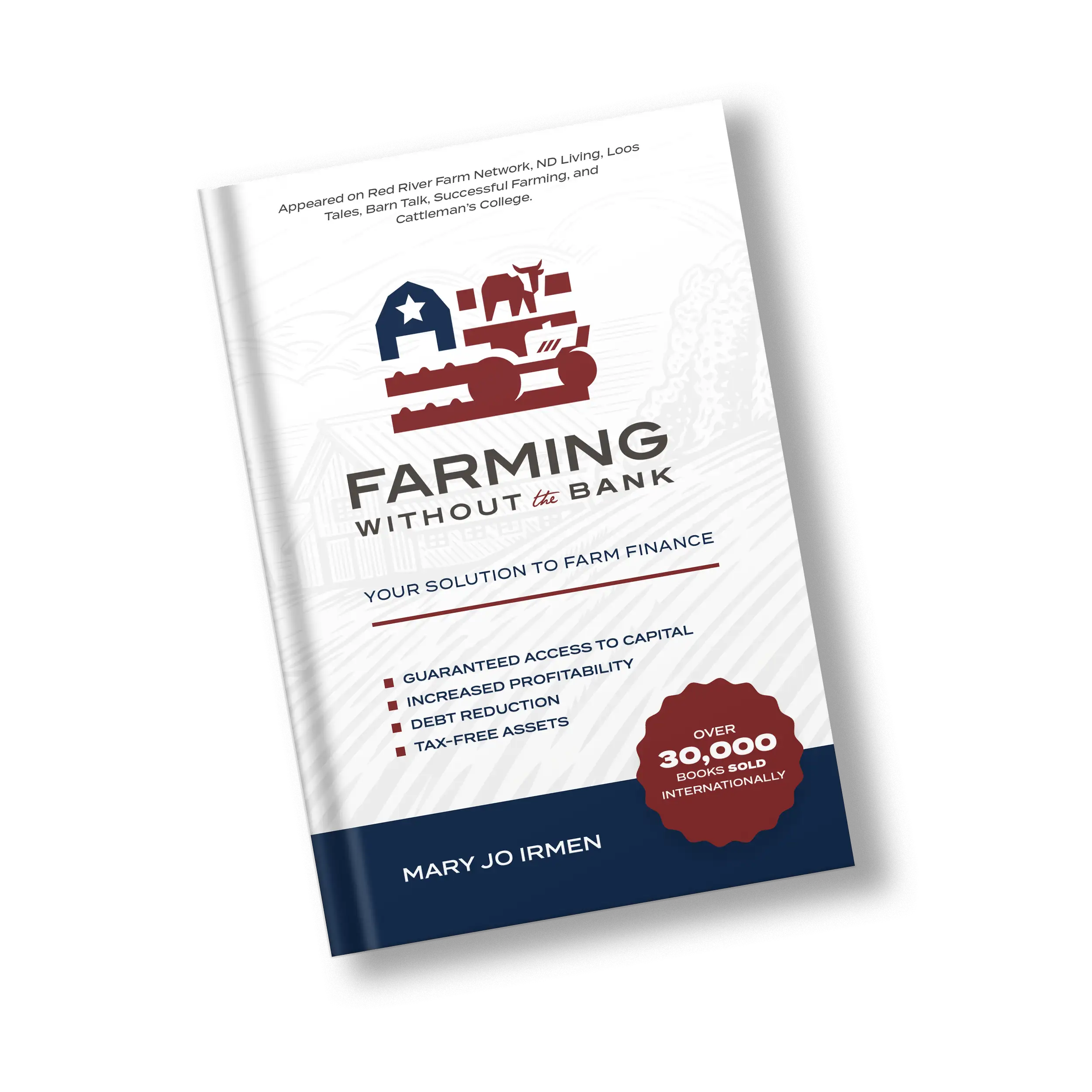
ready to start?
Your farm’s financial independence starts with one book.
30,000 farmers and ranchers have already made the shift. The only question is how long you’ll keep paying interest you could be keeping yourself.
MORE EPISODES
Keep Listening

Trolls vs. Productive People: Who Wins? (Ep. 371)
It's TROLL DAY on Farming Without the Bank Ep 371 with Mary Jo Irmen — and the trolls brought their best hate comments. Mary Jo reads them all and answers back: charging her own son 9% interest (vs 11% at the bank), helping a client farm 6,000 acres from scratch, why...
Stop Lending to Your Kids From ONE Policy (Do This Instead) (Ep. 370)
Lending money to your kids from ONE policy is a recipe for a family fight. In this episode, Mary Jo Irmen shares 2 creative strategies she used this week to solve real client problems around kids, money, and fairness. If you have 3 kids and help one start a business...
Why Farmers Stay Broke & How to Actually Keep More of Your Money (Ep. 369)
Mary Jo's back with three money topics every farmer and rancher needs to hear. The thread running through all of them: it's not how much money you make — it's how you USE it. In this episode: the private equity news making headlines in the life insurance world (and...