 GET THE BOOK
 GET THE BOOK




Podcast
EP. 304
Ep. 304 – You Don’t Need Big Money to Start IBC
May 29, 2025 ·
18 min
0:00 / 18:22
EPISODE OVERVIEW
ABOUT THIS EPISODE
Think you need $10,000 or more to start Infinite Banking? Not even close. In this episode, I break down exactly how farmers, ranchers, and even a 14-year-old can start small and build wealth with IBC over time.
Too many people believe they need to be rich to start an IBC policy. That’s just not true.
Whether you’re working with $1,200, $6,000, or $100,000 a year, Infinite Banking is a strategy, not a product, and it’s scalable. In this episode, we dive into why starting small is better than never starting, and how building a system (not just one policy) is what creates real, generational wealth.
✅ What You’ll Learn
- Why starting small is often smarter
- The truth about death benefit (and why it matters)
- How to fund a policy even on a tight budget
- Real-life stories of farmers and a 14-year-old starting IBC
- Why “all-or-nothing” thinking is stopping your wealth
- ► Learn more: farmingwithoutthebank.com
- ► Get the book
Audio Production by Podsworth Media
CHAPTER TIMESTAMPS
- 00:00Why Death Benefit Does Matter (Even If You Think It Doesn't)
- 00:39Can You Start IBC With "Too Little" Money?
- 01:45What Most Agents Get Wrong About Starting Small
- 03:17Why You Should Still Start at Age 65
- 04:53GoFundMe vs. Generational Wealth
- 06:00Busting the "All or Nothing" Mentality in Farming & Finance
- 07:23Money Management Mindset
- 08:39The 14-Year-Old Who Gets IBC Better Than Adults
- 10:00Why You Build a System, Not Just One Policy
- 11:16Growing Like a Farm: 10 Acres, Then 40, Then 100
- 11:51Real Client Case: Rejected by One Agent, Welcomed by Me
- 13:12Signs Someone Understands Money (and Who Doesn't)
- 14:30How to Build IBC Across Generations
- 15:39Planning for Mom, Dad, Kids & Grandkids
- 16:20You Don't Know If You Can Start Until You Look
- 17:01Pod vs. Podcast: Gen X Humor & Final Thoughts
- 18:12How to Get Started (Book, Appointment, Community)
YOUTUBE EPISODE
TRANSCRIPTION
“Death benefit is important. I don’t care if you think so or not. I think so. And so if you want to come in and say, you know, my wife’s going to be okay because she’ll just marry a sugar daddy next time, and she’ll have all kinds of money, and she’ll be able to sell my land and my equipment and my cows, and she’ll be just fine… Okay, what is stopping her from going to find that sugar daddy right now? That’s what I’d like to know. Because if that’s how much you think of your spouse, to not leave them something and take care of them, then ladies, maybe you should go start searching for that sugar daddy.”
Hello, hello, hello, and welcome back to the podcast. Thank you very much for being here. All right, today let’s talk about getting started, and where do I start, and how much do I start with, and is too little too little? And so I had a meeting today with somebody that had called another agent, and of course they didn’t ask him hardly any questions. You know, how much money do you have? How much do you have in payments? It was like, I don’t know, a few minutes of questions, not even a half an hour. And they said, “Oh, you don’t have any money to get started. Call us back in a year.” And I do tell people that sometimes. I am honest. I am not going to say, hey, you should start, when you don’t have the money to start. But I do that after an hour to an hour and a half conversation. We’re not doing that after a couple of minutes, because how do you get to know somebody in a couple minutes?
But this is interesting. So I suggested, hey, you can do like $6,000 a year. There are times, based on age, that we can start a policy at $4,000 a year. Now I’m talking like somebody under probably 35. We can do $4,000 a year. And then of course, the older you get… I need to have enough whole life portion of the policy to even write a policy, to even issue a policy. You know, the older we get, the more expensive that gets. And so if you’re somebody that’s, I don’t know, let’s say you’re 50, well, then I’m going to probably need $8,000 a year or $6,000 a year. It just depends on health and all these things. Anyway, the moral of the story is that you can start small. You don’t have to start ginormous. And frankly, most people do start small, even if they make $3, $4 million a year. I have clients that have made upper, you know, $15, $20 million a year, and they still start with a premium that’s like $100,000. It is rare to have somebody jump in with both feet.
And so I got an email too that’s like, well, how small can I start? How small can the policy be? Some people think, though, that if it’s too small, there’s no point in even starting it, because I’m never going to get anywhere. I need more money than that. That might be the case if you’re 65. Okay. And I say might, because if you start a policy, even at 65 years old, we’re creating death benefit. And if you say, “Hey, Mary Jo, I don’t need death benefit, because I don’t care if my heirs are going to get money or not,” then you probably should not be my client anyway. You should probably go find somebody else, because there is death benefit attached, and death benefit is important. I don’t care if you think so or not. I think so. I’m the one over here writing life insurance.
And so if you want to come in and say, you know, my wife’s going to be okay because she’ll just marry a sugar daddy next time, and she’ll have all kinds of money, and she’ll be able to sell my land and my equipment and my cows, and she’ll be just fine… Okay. What is stopping her from going to find that sugar daddy right now? That’s what I’d like to know. Because if that’s how much you think of your spouse, to not leave them something and take care of them, then ladies, or spouses, because it could be the other way around, right? Maybe you should go start searching for that sugar daddy. Okay. Probably not the best advice I’ve ever given on here, but come on, people, let’s get real. You’re going to die. And do you really want your spouse to end up selling everything at a fire sale? Do you want her to be the recipient of a GoFundMe account? I’ve talked about this a million times. No. Your job is to take care of one another. Wife? You should have a policy for your husband. Husband? You should have a policy for your wife. Okay? You should have a policy for your spouse.
So if the cash value is not going to be there, and you’re like, “Geez, Mary Jo, I need millions of dollars, and I’m 65,” well, guess what? We can at least start the generational wealth piece of it. And that is important. That is us saying, hey, let’s make it a little bit easier for you to hold on to the farm. We are not leaving anybody rich over here. We are leaving them with enough money so that they can maybe not have to borrow full operating. They can have a down payment for land, whatever that is.
But so many people think it’s all or nothing. If I can’t afford something big, then I can’t do this. I was talking to a guy this morning, and he said, you know, he only has about 130 acres that he was able to work with. And he said, “Yeah, you know, sell-buy marketing is just not okay for me right now, because I’m really small, and I need to get bigger.” I said, well, my new friend, guess what? You can start sell-buy marketing with a small number of head of cattle. You don’t have to have a hundred head to do it. You don’t need to have a feedlot to do it. I have clients that are doing it on very small acreages. It’s okay, because guess what? If you do it wrong, it’s at a much smaller scale, okay? And you’ve learned at a smaller scale. Then you’re a pro by the time you get to the big level. We can slowly grow into it. It is by us saying, we can’t start infinite banking. We can’t start sell-buy. We can’t start farming, right? There are people that I have talked to that have said, “Well, I can’t start a ranch. I need like 14,000 acres. I’m in Nebraska. I’m in Wyoming. I need 14,000 acres, or it doesn’t pay to ranch.” Really? Because, you know, not everybody has 14,000 acres. And so there are places that have much smaller operations. But this is that all-or-nothing mentality. We have to go all in, or it’s just not going to work. Or it’s going to work better for somebody else because they have more money.
Is it? Because here’s the thing, and you guys have heard me say this a million times as well: if you can’t manage a dollar, you can’t manage a million. So if I have somebody that can manage dollars better than somebody else can manage millions, guess who’s in a better position? The guy that can manage dollars. I looked the other day, because I was listening to something, and they were like, oh, this is what your profit margin should be. I think it’s like a 30% profit margin or something. That’s really good for a business. And I looked at my profit margin, and it’s above 30%. Why? Because I’m cheap. Because I’m cheap. I pay my staff very well. But guess what? I’m not taking somebody for a steak dinner in hopes that they’re going to buy some life insurance from me. I’m not doing foolish things with my money in hopes that, oh, I can save a little bit of money on taxes, or I can wine and dine somebody to do business with me. Nope, that’s not what happens over here. Instead, the money is in my account, and that can be used for more marketing. That can be used to expand the operation. That can be used for a number of things. And so if we can slowly get there, if we can manage dollars and start multiple policies, that’s awesome.
I met with a 14-year-old today. This was actually quite exciting. I didn’t even know how to talk to him. Let’s be honest. It’s not like I see 14-year-olds every day. He had a really good question. He said, “Well, how many policies can I have?” At 14. He understands the concept, right? That we’re going to have to build a system of banks. You don’t see one bank on the street corner. No, you see them on every corner. They have branches all over. Because if it’s convenient for me, I’m going to bank at that bank. I’m going to put money in, and then they can lend money out. So Nelson had 49 life insurance policies. I have colleagues that have many more than 49 life insurance policies. I personally do not have more than 49. I don’t even have close to 49 policies, because I don’t want to manage that many policies. I just have bigger policies. The older I’m getting, and the more I’m understanding the infinite banking concept, I just start bigger policies, because then I don’t have to manage so many little ones.
But if you really get the concept, you’re going to start, and you’re going to build onto it. You know, I think John said this to me one day: it’s like building a windbreak, right? You have multiple trees. You don’t just have one. You don’t just put one tree in the ground and go, do your thing so you can block the wind. No, you’re building a system. And so that system is going to start small, and then we’re going to get bigger and bigger, just like your operation did. You’re going to start where it’s comfortable. You’re going to buy the number of cows that you need to buy. And then you’ve got a fairly decent-size herd. You’ve got a fair amount of ground. You’re going to buy the ground that you can afford to buy. And I don’t care if that’s 10 acres. I don’t care if it’s 40 acres. And then, oh, now we can buy 100. And now we can maybe buy the next piece that’s 200. And maybe we buy another 100. Who cares? We’re buying what we can expand with. And that happens over time. None of that happened overnight.
And so keep in mind, I’m not dissing this other agent at all. I am saying, hey, maybe you should have had a longer meeting so you could understand this guy. Because like this guy said, “I’m not an idiot. I know where my cash flow is going.” And keep in mind, this particular potential client had done two years’ worth of research on infinite banking. He had read my book, Nelson’s book, watched many, many videos. He was extremely well-versed in what he needed to know for infinite banking and the utilization of money. So them not giving him the time was a bit disheartening. However, to say it’s too small is crazy. Because there are agents that I have heard say, “If you can’t start with $10,000 a year or you can’t start with $20,000 a year, then you may as well not get started.” What? I’ll do a policy that’s $3,000 a year. On my 14-year-old today, we did $1,200 a year. Because he’s going to get his first job, and that’s what he wants to do with his money. How awesome is that? Yes, his parents have to own the policy, but he is the one that’s going to be paying for it, because he’s going to get a job.
And this is the other thing that’s super exciting: he bought that policy before he got the job, because he’s going to need a place to warehouse wealth. How many of us are thinking about that? Now, granted, I get it. He doesn’t have a whole lot of risk. He’s 14. But if he’s already thinking about where do I warehouse my money, then he’s going to be successful. There’s no doubt. He is already considering how money works. And he has been for a long time, because this kid is over-the-top smart about watching YouTube videos, and everywhere he goes, he’s like, “What was the cost to build that building, Mom? How much do you think it costs them to run that building a month?” Like, he’s very, very in tune with business. But he’s already, at 14, thinking about how can I build my system? How many of these policies can I have? That’s not even an average adult thought. The average adult is like, man, let me get started.
And I think that I have shared with you guys before that I can tell when I meet with somebody, okay, we have to be very conservative, because these people are not super motivated, right? And typically those people don’t become my clients, in all honesty, because they don’t even have the money to get started. But we’ve talked about this: there are people in life that you knock them down, they’re just popping right back up. Like, they don’t care. Once you know how to make money, you can’t not make money. It’s not a rule written somewhere. But I have come across enough people that have been to the top and back down again, and they just go right back up to the top, because they understand how to use money. They understand how to build. They understand that they’re not going to go from the bottom to the top overnight. It’s going to take time.
Same thing with your policies. You’re building a system. You’re going to start with yourself. You’re going to do something on your kids or your grandkids. Maybe you’re going to start with Mom and Dad, and then you’re going to do something on yourself, because Mom and Dad are going to technically pass first, so now we’ve created the generational wealth. And so if Mom and Dad aren’t doing anything, how are we starting? What does that look like? Obviously, all that stuff we talk about in a meeting. Yes, there has to be money on Mom and Dad. $20,000 of premium is typically what I need for Mom and Dad in their 60s. I’m going to need about $20,000 a year for premium. So if that’s the case, and you can’t do $20,000, then that’s not an option, and we have to go to something affordable for now, and then we can possibly add them later. So where do we start? What does that scenario look like? Those are all things that John and I are both looking at when we have a meeting with you. Where is the money going? How much can you afford? What’s comfortable? What’s going to be not comfortable? Right? That is what’s going to help guide us.
But to say, I can’t make an appointment because I don’t have money, that is not accurate. Or, I can’t get started because I don’t have money. You don’t know if you have money until you make the appointment, because how you use money is going to determine if you have it. Just like this gentleman. One agent said, you don’t have it. I come in and say, oh, you’re paying out cash for a lot of stuff. So we could move some of that money into a policy, and then you could start borrowing against that in order to get started. Different utilization of money, something I’m looking for that another agent is not looking for.
So there you got it. That’s today’s podcast. Pod. Have you heard the new word? All these millennials: “Hey, can you listen to my pod?” What? Like, you know what a pod is? A pod is one of those little tin cans that you went to class in because the school wasn’t big enough. So they put a pod outside of the school, and then you would have to go into that thing, and here in North Dakota, you would be in class in that thing in the winter. So I never had to go to school in a pod, because I’m too old, and we actually had room in the schools. But I know younger people have. Like, my daughter, she has not been in a pod either. But, you know, there have been classes in pods. So they’re calling podcasts pods now. Please don’t use that with me. I’m a Gen Xer. I would like to use the word podcast. I think it’s funny. Millennials shorten everything. It’s like it’s too much energy to talk. I don’t know. I’m trying to figure it out. If you’re a millennial and you’re listening, let me know why you guys shorten all your words. This old lady is going to call it a podcast.
All right, you guys. If you need anything, you know where I’m at: maryjo@withoutthebank.com. Grab your book. Set up your appointment with John or I so we can help determine if you can get started. And then we’ll see you in the next podcast.
Thanks for listening to the Farming Without the Bank podcast. We hope today’s episode has inspired you to take control of your finances in new ways. Don’t forget to check out our website, farmingwithoutthebank.com, and engage with us on our Facebook page, Farming Without the Bank. Join us next week as we smash more financial myths and empower you to accomplish your financial goals.
View MoreHello, hello, hello, and welcome back to the podcast. Thank you very much for being here. All right, today let’s talk about getting started, and where do I start, and how much do I start with, and is too little too little? And so I had a meeting today with somebody that had called another agent, and of course they didn’t ask him hardly any questions. You know, how much money do you have? How much do you have in payments? It was like, I don’t know, a few minutes of questions, not even a half an hour. And they said, “Oh, you don’t have any money to get started. Call us back in a year.” And I do tell people that sometimes. I am honest. I am not going to say, hey, you should start, when you don’t have the money to start. But I do that after an hour to an hour and a half conversation. We’re not doing that after a couple of minutes, because how do you get to know somebody in a couple minutes?
But this is interesting. So I suggested, hey, you can do like $6,000 a year. There are times, based on age, that we can start a policy at $4,000 a year. Now I’m talking like somebody under probably 35. We can do $4,000 a year. And then of course, the older you get… I need to have enough whole life portion of the policy to even write a policy, to even issue a policy. You know, the older we get, the more expensive that gets. And so if you’re somebody that’s, I don’t know, let’s say you’re 50, well, then I’m going to probably need $8,000 a year or $6,000 a year. It just depends on health and all these things. Anyway, the moral of the story is that you can start small. You don’t have to start ginormous. And frankly, most people do start small, even if they make $3, $4 million a year. I have clients that have made upper, you know, $15, $20 million a year, and they still start with a premium that’s like $100,000. It is rare to have somebody jump in with both feet.
And so I got an email too that’s like, well, how small can I start? How small can the policy be? Some people think, though, that if it’s too small, there’s no point in even starting it, because I’m never going to get anywhere. I need more money than that. That might be the case if you’re 65. Okay. And I say might, because if you start a policy, even at 65 years old, we’re creating death benefit. And if you say, “Hey, Mary Jo, I don’t need death benefit, because I don’t care if my heirs are going to get money or not,” then you probably should not be my client anyway. You should probably go find somebody else, because there is death benefit attached, and death benefit is important. I don’t care if you think so or not. I think so. I’m the one over here writing life insurance.
And so if you want to come in and say, you know, my wife’s going to be okay because she’ll just marry a sugar daddy next time, and she’ll have all kinds of money, and she’ll be able to sell my land and my equipment and my cows, and she’ll be just fine… Okay. What is stopping her from going to find that sugar daddy right now? That’s what I’d like to know. Because if that’s how much you think of your spouse, to not leave them something and take care of them, then ladies, or spouses, because it could be the other way around, right? Maybe you should go start searching for that sugar daddy. Okay. Probably not the best advice I’ve ever given on here, but come on, people, let’s get real. You’re going to die. And do you really want your spouse to end up selling everything at a fire sale? Do you want her to be the recipient of a GoFundMe account? I’ve talked about this a million times. No. Your job is to take care of one another. Wife? You should have a policy for your husband. Husband? You should have a policy for your wife. Okay? You should have a policy for your spouse.
So if the cash value is not going to be there, and you’re like, “Geez, Mary Jo, I need millions of dollars, and I’m 65,” well, guess what? We can at least start the generational wealth piece of it. And that is important. That is us saying, hey, let’s make it a little bit easier for you to hold on to the farm. We are not leaving anybody rich over here. We are leaving them with enough money so that they can maybe not have to borrow full operating. They can have a down payment for land, whatever that is.
But so many people think it’s all or nothing. If I can’t afford something big, then I can’t do this. I was talking to a guy this morning, and he said, you know, he only has about 130 acres that he was able to work with. And he said, “Yeah, you know, sell-buy marketing is just not okay for me right now, because I’m really small, and I need to get bigger.” I said, well, my new friend, guess what? You can start sell-buy marketing with a small number of head of cattle. You don’t have to have a hundred head to do it. You don’t need to have a feedlot to do it. I have clients that are doing it on very small acreages. It’s okay, because guess what? If you do it wrong, it’s at a much smaller scale, okay? And you’ve learned at a smaller scale. Then you’re a pro by the time you get to the big level. We can slowly grow into it. It is by us saying, we can’t start infinite banking. We can’t start sell-buy. We can’t start farming, right? There are people that I have talked to that have said, “Well, I can’t start a ranch. I need like 14,000 acres. I’m in Nebraska. I’m in Wyoming. I need 14,000 acres, or it doesn’t pay to ranch.” Really? Because, you know, not everybody has 14,000 acres. And so there are places that have much smaller operations. But this is that all-or-nothing mentality. We have to go all in, or it’s just not going to work. Or it’s going to work better for somebody else because they have more money.
Is it? Because here’s the thing, and you guys have heard me say this a million times as well: if you can’t manage a dollar, you can’t manage a million. So if I have somebody that can manage dollars better than somebody else can manage millions, guess who’s in a better position? The guy that can manage dollars. I looked the other day, because I was listening to something, and they were like, oh, this is what your profit margin should be. I think it’s like a 30% profit margin or something. That’s really good for a business. And I looked at my profit margin, and it’s above 30%. Why? Because I’m cheap. Because I’m cheap. I pay my staff very well. But guess what? I’m not taking somebody for a steak dinner in hopes that they’re going to buy some life insurance from me. I’m not doing foolish things with my money in hopes that, oh, I can save a little bit of money on taxes, or I can wine and dine somebody to do business with me. Nope, that’s not what happens over here. Instead, the money is in my account, and that can be used for more marketing. That can be used to expand the operation. That can be used for a number of things. And so if we can slowly get there, if we can manage dollars and start multiple policies, that’s awesome.
I met with a 14-year-old today. This was actually quite exciting. I didn’t even know how to talk to him. Let’s be honest. It’s not like I see 14-year-olds every day. He had a really good question. He said, “Well, how many policies can I have?” At 14. He understands the concept, right? That we’re going to have to build a system of banks. You don’t see one bank on the street corner. No, you see them on every corner. They have branches all over. Because if it’s convenient for me, I’m going to bank at that bank. I’m going to put money in, and then they can lend money out. So Nelson had 49 life insurance policies. I have colleagues that have many more than 49 life insurance policies. I personally do not have more than 49. I don’t even have close to 49 policies, because I don’t want to manage that many policies. I just have bigger policies. The older I’m getting, and the more I’m understanding the infinite banking concept, I just start bigger policies, because then I don’t have to manage so many little ones.
But if you really get the concept, you’re going to start, and you’re going to build onto it. You know, I think John said this to me one day: it’s like building a windbreak, right? You have multiple trees. You don’t just have one. You don’t just put one tree in the ground and go, do your thing so you can block the wind. No, you’re building a system. And so that system is going to start small, and then we’re going to get bigger and bigger, just like your operation did. You’re going to start where it’s comfortable. You’re going to buy the number of cows that you need to buy. And then you’ve got a fairly decent-size herd. You’ve got a fair amount of ground. You’re going to buy the ground that you can afford to buy. And I don’t care if that’s 10 acres. I don’t care if it’s 40 acres. And then, oh, now we can buy 100. And now we can maybe buy the next piece that’s 200. And maybe we buy another 100. Who cares? We’re buying what we can expand with. And that happens over time. None of that happened overnight.
And so keep in mind, I’m not dissing this other agent at all. I am saying, hey, maybe you should have had a longer meeting so you could understand this guy. Because like this guy said, “I’m not an idiot. I know where my cash flow is going.” And keep in mind, this particular potential client had done two years’ worth of research on infinite banking. He had read my book, Nelson’s book, watched many, many videos. He was extremely well-versed in what he needed to know for infinite banking and the utilization of money. So them not giving him the time was a bit disheartening. However, to say it’s too small is crazy. Because there are agents that I have heard say, “If you can’t start with $10,000 a year or you can’t start with $20,000 a year, then you may as well not get started.” What? I’ll do a policy that’s $3,000 a year. On my 14-year-old today, we did $1,200 a year. Because he’s going to get his first job, and that’s what he wants to do with his money. How awesome is that? Yes, his parents have to own the policy, but he is the one that’s going to be paying for it, because he’s going to get a job.
And this is the other thing that’s super exciting: he bought that policy before he got the job, because he’s going to need a place to warehouse wealth. How many of us are thinking about that? Now, granted, I get it. He doesn’t have a whole lot of risk. He’s 14. But if he’s already thinking about where do I warehouse my money, then he’s going to be successful. There’s no doubt. He is already considering how money works. And he has been for a long time, because this kid is over-the-top smart about watching YouTube videos, and everywhere he goes, he’s like, “What was the cost to build that building, Mom? How much do you think it costs them to run that building a month?” Like, he’s very, very in tune with business. But he’s already, at 14, thinking about how can I build my system? How many of these policies can I have? That’s not even an average adult thought. The average adult is like, man, let me get started.
And I think that I have shared with you guys before that I can tell when I meet with somebody, okay, we have to be very conservative, because these people are not super motivated, right? And typically those people don’t become my clients, in all honesty, because they don’t even have the money to get started. But we’ve talked about this: there are people in life that you knock them down, they’re just popping right back up. Like, they don’t care. Once you know how to make money, you can’t not make money. It’s not a rule written somewhere. But I have come across enough people that have been to the top and back down again, and they just go right back up to the top, because they understand how to use money. They understand how to build. They understand that they’re not going to go from the bottom to the top overnight. It’s going to take time.
Same thing with your policies. You’re building a system. You’re going to start with yourself. You’re going to do something on your kids or your grandkids. Maybe you’re going to start with Mom and Dad, and then you’re going to do something on yourself, because Mom and Dad are going to technically pass first, so now we’ve created the generational wealth. And so if Mom and Dad aren’t doing anything, how are we starting? What does that look like? Obviously, all that stuff we talk about in a meeting. Yes, there has to be money on Mom and Dad. $20,000 of premium is typically what I need for Mom and Dad in their 60s. I’m going to need about $20,000 a year for premium. So if that’s the case, and you can’t do $20,000, then that’s not an option, and we have to go to something affordable for now, and then we can possibly add them later. So where do we start? What does that scenario look like? Those are all things that John and I are both looking at when we have a meeting with you. Where is the money going? How much can you afford? What’s comfortable? What’s going to be not comfortable? Right? That is what’s going to help guide us.
But to say, I can’t make an appointment because I don’t have money, that is not accurate. Or, I can’t get started because I don’t have money. You don’t know if you have money until you make the appointment, because how you use money is going to determine if you have it. Just like this gentleman. One agent said, you don’t have it. I come in and say, oh, you’re paying out cash for a lot of stuff. So we could move some of that money into a policy, and then you could start borrowing against that in order to get started. Different utilization of money, something I’m looking for that another agent is not looking for.
So there you got it. That’s today’s podcast. Pod. Have you heard the new word? All these millennials: “Hey, can you listen to my pod?” What? Like, you know what a pod is? A pod is one of those little tin cans that you went to class in because the school wasn’t big enough. So they put a pod outside of the school, and then you would have to go into that thing, and here in North Dakota, you would be in class in that thing in the winter. So I never had to go to school in a pod, because I’m too old, and we actually had room in the schools. But I know younger people have. Like, my daughter, she has not been in a pod either. But, you know, there have been classes in pods. So they’re calling podcasts pods now. Please don’t use that with me. I’m a Gen Xer. I would like to use the word podcast. I think it’s funny. Millennials shorten everything. It’s like it’s too much energy to talk. I don’t know. I’m trying to figure it out. If you’re a millennial and you’re listening, let me know why you guys shorten all your words. This old lady is going to call it a podcast.
All right, you guys. If you need anything, you know where I’m at: maryjo@withoutthebank.com. Grab your book. Set up your appointment with John or I so we can help determine if you can get started. And then we’ll see you in the next podcast.
Thanks for listening to the Farming Without the Bank podcast. We hope today’s episode has inspired you to take control of your finances in new ways. Don’t forget to check out our website, farmingwithoutthebank.com, and engage with us on our Facebook page, Farming Without the Bank. Join us next week as we smash more financial myths and empower you to accomplish your financial goals.
ready to start?
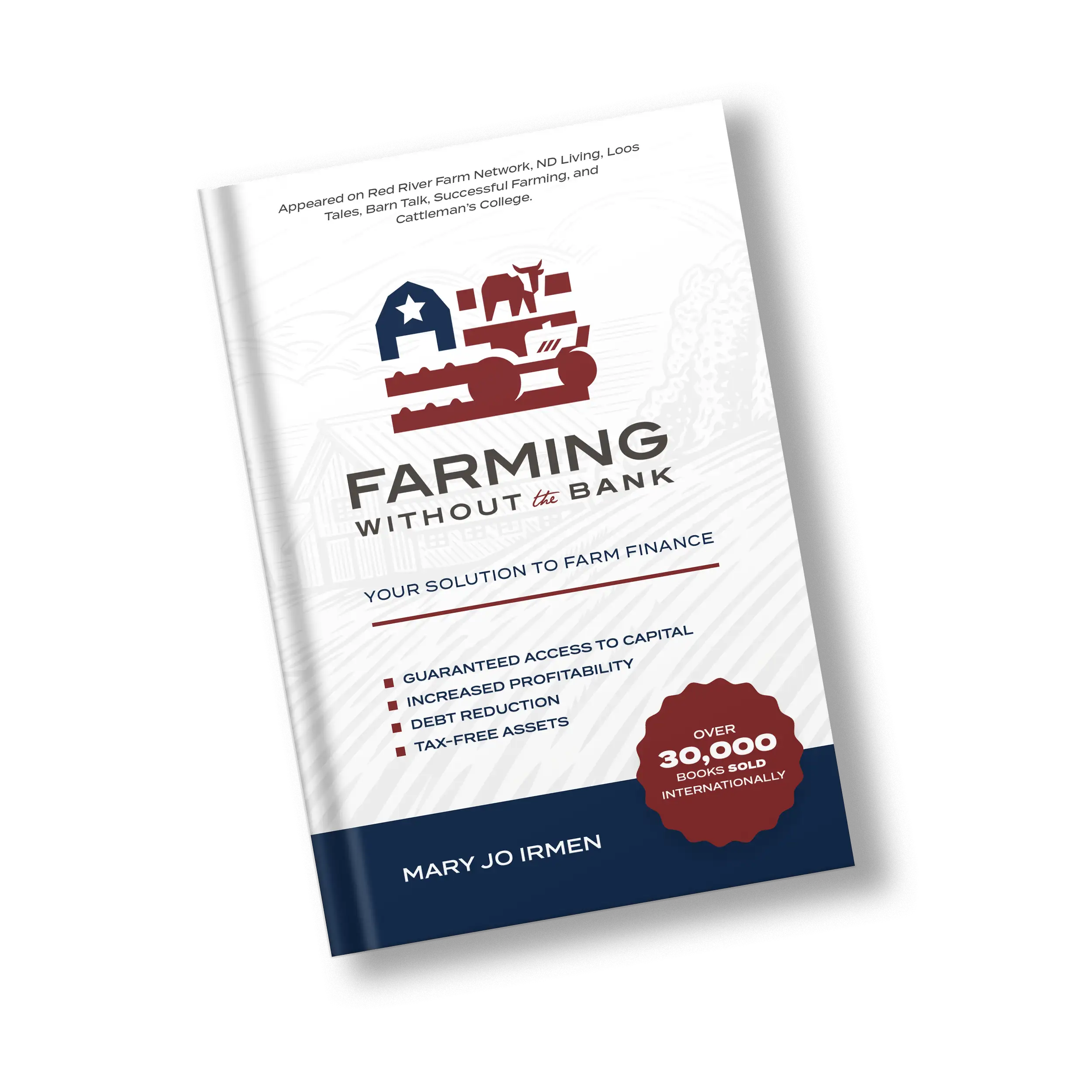
Your farm’s financial independence starts with one book.
30,000 farmers and ranchers have already made the shift. The only question is how long you’ll keep paying interest you could be keeping yourself.