 GET THE BOOK
 GET THE BOOK




Podcast
EP. 301
Ep. 301 – MILLENNIALS Saving Farms
May 9, 2025 ·
27 min
0:00 / 26:33
EPISODE OVERVIEW
ABOUT THIS EPISODE
Millennials fight to save family farms without sinking under debt or outdated thinking.
In this episode, John joins us to look into the growing trend of millennials and Gen Z stepping in to rescue family farms from financial collapse, often due to poor planning and mismanagement by older generations. We share real-life stories, practical strategies, and tough-love advice for making smart financial decisions without drowning in inherited debt.
- ► Learn more: farmingwithoutthebank.com
- ► Get the book
Audio Production by Podsworth Media
CHAPTER TIMESTAMPS
- 00:00Introduction: Saving the Day Without Drowning
- 00:25Podcast Welcome and Guest Introduction
- 01:03Insights From Farmer Meetings
- 04:02Challenges Faced by Young Farmers
- 06:30The Importance of Financial Planning
- 08:41Infinite Banking as a Solution
- 13:31Learning From Sell-Buy Marketing Classes
- 16:33Issues With Insurance Policies
- 24:24Conclusion and Final Thoughts
YOUTUBE EPISODE
TRANSCRIPTION
“If somebody is saving the day, whoever the person is that’s coming in to save the day needs to understand that you can’t drown yourself in the process. You cannot continue to take on all of this debt, and you better make sure that you’re making a really good decision, and you’re not going to go down with them. I’m just seeing some passion override numbers and logic.”
Hello, hello, hello, and welcome back to the podcast. Thank you very much for being here. I have John again today. So John and I were talking about some meetings he was having, and then we were comparing notes about what we’ve kind of been seeing in the farming world. And so I said, John, we should do a podcast about it. So here we are. You know, very last minute. So it helps that John doesn’t need to plan either.
Yeah, I didn’t have to put my makeup on or anything.
He just had to go change his shirt. I actually had to get ready for the day. So at least John’s got a polo on.
Yeah.
All right. So let’s talk about… I think it’s important that you guys hear kind of what we’re seeing. Because a lot of times you think I’m crazy, and I’m the biggest idiot you’ve ever met, because I’m like, oh no, this is going on, or that’s going on. And you’re like, no, it’s not. And so I think it’s going to be fun to have John also talk about it, because it’s not just myself that’s seeing it. John and I just went over our numbers yesterday, and I had 250 one-on-one meetings with clients last year. And you had?
About 230.
230 one-on-one meetings with clients. So between the two of us, 480 farmers, because I would say 97% of those people actively farm. The other 3% want to farm but don’t farm. It’s rare. I should say 0.01% maybe don’t have anything to do with farming, but we…
You’ll run into it usually.
I feel like, correct me if I’m wrong, but I feel like we really kind of get a good grasp on what’s happening all over the country financially with farmers.
Yeah, I would say so. I mean, you see people from all over the country, and all sorts of different crops and types of livestock, and a bunch of different structures on how they pass things down from one generation to the next, or how they do a buyout or something. So you end up with a fairly good feel for it.
And it’s not just row crops. Like, you’ve got pecan… you’ve got nut farmers, right? You’ve got your pecans and your almonds, and you’ve got…
Peppermint.
Yeah.
One of them. Yeah. I talked to them a couple years ago.
We should talk about that, because I heard the latest on that through our office grapevine. But yeah, we’ve had peppermint. We’ve had Timothy hay. We have people that raise rabbits to sell them to reptile places.
Christmas trees.
Yeah. Pumpkin patches. Like, anything. It’s not just cotton, soybeans, corn, which is, I think, what a lot of people see. We have citrus. We have blueberries. I mean, you’ve got your fruits and all the other things. And so I think it’s important that people understand that when I’m talking or when you’re talking about, hey, what’s going on, it’s not just, oh, Mary Jo and John are in the Dakotas, and they’re only seeing what’s happening in North Dakota and South Dakota. And by the way, I am North and John is South. So you rarely hear me say the Dakotas. We are not the same. So anyway, you had another client today, or potential client today, that was a millennial.
Yeah, he was 32.
32, and having to take over the operation because Dad failed.
Yeah, his dad kind of… They’ve been planning a retirement for Dad, you know. It sounded like they had about a five-year plan that they were going to do that on. And it sounded like two years into that, the dad was like, I’m done. I want to be done now. And it happened to coincide with a very poor yield year, with the drought and everything.
Just so happened to coincide?
Yeah, some bad years. It ended up being this younger guy’s first year with the bad yields.
Yeah, but I mean, did Dad… Okay, I won’t make a question.
He got out before that. But anyways, it kind of got dumped on him all at once. And so he had to do a big buyout to Dad and buy his equipment and everything. And it really put this guy behind the eight ball for the whole last year. And now he’s still trying to take any available cash he can to get the bank off his back, basically, because they’re putting a lot of pressure on him, the way it sounded, to get some debt paid down, because this younger guy doesn’t have very much collateral.
Right. So I’m sure they’re freaked out by that.
Yeah. And that’s… one, get that paid down ASAP.
So he didn’t necessarily bail Dad out? Was Dad in a financial hardship where he was like, I’m done, I don’t want this anymore, you can take over all this debt?
Kind of. I mean, he just wanted to be done, because it wasn’t going in a great direction.
Oh, okay. So kind of a bailout. Get his money for his equipment and be done.
And sold.
And the reason John and I were talking about it is because John would tell me this story… I just asked him who he met with today, which I don’t hardly ever get to hear about. And so he told me who he met with. And I was like, oh, that’s interesting. I had one of those. And I said, I’ve seen a lot of that. And John said that he has too. And we do not compare notes on a day-to-day basis. We’re lucky if we talk every couple of weeks. So we’re not talking about who we’re meeting with and how those meetings are going. So I found it very interesting.
I’ve talked about this before, I believe, on the podcast. I know I’ve done TikToks about it. I am seeing this huge amount of… and I don’t know when the Gen Xers started, but I’m seeing this huge amount of boomers and Gen Xers that did not operate as a business. And now the millennials and Gen Z are coming in and trying to save the day. They at least have momentum going in a positive direction. And what’s happening is they’re doing it with emotion tied to it. And so sometimes, with the millennials and the Gen Zers, I’ve sort of had to talk them off the ledge and say, if you take over this operation the way you need to, to bail them out, you are putting yourself in the same position. Because cattle prices are not in a great position. Commodity prices right now are not in the best position. So you’re taking on all their debt. You’re moving it to yourself, with interest rates where they’re at. And when you figure out their payments, and then you look at what Dad’s paying when they actually get you the numbers, you’re like, you’re going to pay more than Dad. You may as well just pay Dad’s debt. Right? But then how’s Dad going to live? Because he didn’t actually get the money for the buyout, even if you’re just paying his debt. And then I’m going to pay Dad’s debt, but Dad’s not going to have an estate plan that says I actually get it, and I don’t have to buy it from my siblings.
Yeah. In this case, it sounded like his dad kind of did end up walking away with just his equipment money. And the son had taken on all of his payments and everything. So he really got tossed to the wolves there, it sounded like. And yeah, he’s just scrambling to kind of get back on his feet, so that he can improve his situation. And he doesn’t want this to happen to his kids. He wants to change that, so that when he’s his dad’s age, he doesn’t have to do that same scenario and rely on a big buyout to survive the next 15, 20 years.
So hence comes infinite banking into play, so that he’s got the cash value to retire. He’s got the death benefit to leave to the kids. And he’s got a plan. Now, the older generation didn’t think they needed a plan. They don’t really care about a plan. Like, I get it. For some of them, it’s too late to do that. Their land was retirement. And they are not going to have that plan. But I think that my warning goes to: hey, if you are a boomer or a Gen Xer, and you are financially so strapped, in most cases it is going to be because you haven’t run it like a business.
I talked to a guy today that was 47. And he had a construction business with Dad that didn’t go well. And Dad didn’t know how to manage money. So he got out of the construction business. It sounded like Dad continued the construction business, and the construction business made a ton of money. They built a feedlot. They lost the feedlot. He ended up having to buy some of the land just to make sure that the family land stayed in the family. Some of it got lost, because Dad wasn’t paying attention to cattle prices. He wasn’t paying attention to expenses for cattle. He ran the construction business as a business, but he didn’t run the ranch as a business. And so when the construction slowed down, the ranch ate up all the money, and there was nothing left. And so in that scenario, we have Gen Xers saving the day. But if somebody is saving the day, whoever the person is that’s coming in to save the day needs to understand that you can’t drown yourself in the process. You cannot continue to take on all of this debt. And you better make sure that you’re making a really good decision, and you’re not going to go down with them.
Yeah.
I’m just seeing some passion override numbers and logic. And I get it. And I understand that that’s where you grew up. That’s your livelihood. I got a TikTok message from a guy that follows me on TikTok, a young guy. And he said, “Mary Jo, I just want you to know I’m leaving the operation.” Really? Dad’s running it into the ground. And he’s not getting paid, and there’s no estate plan. He literally works for free. How is he feeding his kids? The stress is huge. And they will not create an estate plan to even say that that’s what he’s working for and that’s what he’s going to get. And he’s out.
Yeah. In general, too, nowadays, it just takes too much money to operate a business like that, or, you know, a farm of any size, really, to not run it like a business. You just have to, because otherwise you end up with people working for free for however long, and then they’re not getting anything out of it in the end.
And the older generation was okay farming on a prayer.
Well, yeah, I mean, don’t get me wrong. Things happen where sometimes you can’t do anything about it. You’re going to get into a bad situation and have to bail somebody out. But I don’t like it when it’s somewhat obvious that that was their plan all along: just to kind of ride it out. I’m going to rely on a big bailout check from the younger generation to live off of, and it’ll be what it’ll be.
And here’s the thing, and I don’t know if you’re seeing this as much as I am, but the younger generation is looking at ways to save it. They’re looking at Ranching for Profit. They’re looking at the books. They’re going to sell-buy marketing classes. And the older generation tells them they’re idiots and they don’t know what they’re doing.
Well, yeah. Nowadays, it’s so easy to find or get access to things like that, that it’s almost silly not to at least investigate things like that and see if it is something that can help you.
Yeah. And for the older generation that’s losing it to say, you’re an idiot, you don’t know what you’re talking about because you’re 30… You know, my friend Jolene Brown would say this is a time when we need a two-by-four. Or a mirror. Because if you’re ready to lose it, and the bank is calling some notes or ready to come in and take the ground, then what? I don’t know that it’s such a dumb idea to be looking at other avenues.
Yeah. I think there’s always something you can be doing better, or thinking of a way to change this or that to make the farm or ranch make more money or be more efficient, and not just have it be a money suck.
Yep. Well, and you and I went to sell-buy marketing class.
Yep.
Which was awesome. Did you love it?
It was very fun. Very educational.
It was. John’s dad was there with colored markers and sticky notes and the whole nine yards. So, you know, my client Nate did a different class, the online one, Hand in Hand, hand to hand, whatever. And he was not able to come to Bismarck to the class with us. And he buys and sells calves, and then he feeds them out. He bottle feeds them, and then they go to the feedlot, and then they move on. And he actually took the online class, and he’s been doing this for years, and he makes money. So I thought it was funny when he called. I said, “Well, did you learn something?” And he goes, “Yeah, I actually am making more money than I thought I was. But now I have a system and a whole spreadsheet of how I need to buy.” And he’s like, “This is going to make it so much easier to make even more money.”
That was my biggest takeaway from that sell-buy class. Going into it, I didn’t know exactly what he was going to be teaching, but it wasn’t some crazy concept. I mean, he just showed you how to do the math behind how to make smart purchases.
Yeah. And you have to know your numbers.
Correct. But it’s similar to life insurance. Like, we’re not reinventing the wheel here. We’re just using a life insurance policy to bank with. I mean, he just showed you how to do the math to make money with cattle.
It’s just one more tool for somebody to come in and say, hey, my operation’s not profitable. How can we make it profitable, or how can we make it more profitable? And yes, you have to know your numbers. So you might have to go and put stuff in QuickBooks or have a really good Excel spreadsheet or whatever. I am sure that Doug does not have an Excel spreadsheet. I am sure that it is all in a notepad. But I did learn that Doug’s class is probably a better option. So you guys know that I really like Doug. Nate did the online class, and it didn’t talk about the human elements of going to a sale barn and what to watch for. Whereas Doug talked a lot about the human factors and the elements, and how people are responding, and watching auctioneers, and having relationships with cattle buyers, and all that kind of stuff. And I think some people maybe miss that. But all in all, we’re learning. So if our operation’s not making money, why are we not allowing the younger generation to go to these types of classes and say, hey, this is some information I brought back that could actually help the operation? Like, if we’re ready to lose it, how much more could it hurt?
Yeah. It doesn’t cost you much to go try something.
Right. Exactly. Okay. Beat that dead horse. Here’s another thing that we’ve been seeing a lot that we talked about: bad policies, or incorrectly structured policies, or agents that don’t know what they’re doing. And I’ve had a couple of clients that have asked their insurance agent… and one of these companies starts with an N. I always love the N companies. They asked them for a whole life policy. They’re like, “Hey, I want a whole life policy. Can you send me an illustration?” And I have one in my inbox right now from yesterday. And they sent him an IUL. An IUL. And this has happened numerous times in the last couple of weeks. Why are we sending universal life policies when we ask for whole life?
Yeah, that does happen all the time. And then they don’t even really know that that’s what they have, because they asked for a whole life.
But if they listen to us, they know.
Correct. I just met with a guy… his local agent… He first read Mary Jo’s book in 2019, I think he said. He took his local agent the book, and he’s like, “Oh, she spent six months trying to learn how to do this with her company.” And, you know, I think she got it partly right. You’re looking at it, and it’s a whole life, at least. So that’s partly correct. But he’s six years in now, and he doesn’t have hardly any cash value to show for it.
Yep. Because they don’t… And that particular company that you were talking about earlier doesn’t even have the paid-up additions rider. And so they can’t even do it. Or if they do do it, it’s a 20-pay, or it’s paid up at 65, to try to make it look like what we’re doing. And they don’t understand the concept. And so, A, we need to understand the concept. But B, it’s not right.
Like I told him, anybody can sell you a whole life policy. But if you really want to use the cash value like how you talk about in the book, and how people that do infinite banking do it, there’s only a handful-plus of companies that do that, where it’s really set up for it.
And I feel like we talk about this all the time, and it might sound salesy. But it’s the whole reason why you talk to John and I. It’s just kind of that simple. Like, you don’t go to the garden section at Ace to figure out how you’re going to plant your crop, you know? And it’s scary. I get that it’s scary that John’s in South Dakota, I’m in North Dakota. We’re two people on a podcast, and you don’t know us from Adam, and we could be these huge scammers. Well, if we were, number one, we’d both be in jail already, because we’d have been caught. But it’s your money. And you really have to think about… well, not only my money, but it’s also my death benefit. And so if you’re tying your universal life policy, your death benefit, up to the market… It’s either reflective of the market or directly tied to the market. If you’re tying your death benefit up to the market, why? The agent can sell life insurance, but if they don’t know the concept, it might be worth the risk to have the hour and a half consultation with John or I. Because my God, we are the least salesy people on the planet. My client George actually says, “It’s annoying how Mary Jo does not push. Because I could have started my policy earlier if she would have pushed me to do that.”
Yeah, I definitely don’t intend to do that ever. I like to think of it more as you’re just teaching somebody how the whole concept works. But like you said, if you’re going to spend the money to go try to get a policy to do this concept with, you might as well try to do it right.
Right. Because if the premium isn’t structured correctly, if the policy is not structured correctly, it’s going to take you a long time to have access to cash value. So then if you ever canceled your policy, you’re upside down, and you’re not doing yourself any justice. Or if you are meeting with somebody that doesn’t know anything about farming… And so I see that a lot too, that they’re like, “Oh yeah, I met with my agent.” You met with your agent for 10 minutes about buying a whole life insurance policy. It takes us an hour and a half.
Yeah, there’s a little more that goes into it.
And every meeting I had today went two hours. Every single meeting. I did not have time between meetings to use the restroom, because they all went long. Because there was a lot of estate stuff. There were a lot of plan Bs that needed to be addressed. We needed to talk about who the vulture is, how we need to prepare for that. And if somebody isn’t doing all of those things, then how do you know you’re even getting the policy that’s correct for you?
Yeah, that’s a good point.
You know, I did a strategy today that I’ve never done before. It was pretty exciting, actually. The guy has two vultures to deal with. And the family is just contentious. They just don’t get along. And I said, well, what if you just buy Dad out right now? There is nothing to be said. You just buy Dad out right now. He takes that money and puts it in a life insurance policy. He gives them the death benefit. Guess what? The death benefit was more per acre than what he paid for the land. I’m like, so you could give them less per acre, because the death benefit buys more, right? We’re buying discounted dollars. And now you could actually pay less for it, and they could get the death benefit. But the death benefit continued to rise. Dad was close to 80. And the death benefit continued to rise to the point where it was keeping up with inflation on what land values were doing. So really, why would we not do that? I said, go get yourself a HELOC and pay Dad off, and then he can take the money and put it in a policy. Like, if you don’t understand farming, and you don’t understand those strategies, and you don’t understand the dynamics of the family on the back end, and Dad wants to save it, but he doesn’t want to make anybody mad, and they’re already not getting along… they’re just going to sell you a policy. “Oh, John, you should just have a policy on you.” When in fact, no, no, no, no. We need some different strategies here of how we’re going to save this operation, right?
Yeah, it’s frustrating to deal with that. I mean, it sounds like you need to do it on the dad there, because there’s people to deal with.
It’s a matter of understanding your client. You can get life insurance, and it’s going to be wrong. But if the agent isn’t trying to understand what we’re doing, and they don’t know how to structure the policy, and then they don’t know how to help you with the policy… you stayed local, good for you. But it’s not helping you move forward financially in any way, shape, or form.
Yeah. Yeah, I felt bad for this guy today where, I mean, he was spending $1,400 a month on multiple different life insurance policies and really didn’t have any cash value to show for it.
And they’re good whole life. It’s a good mutual company.
Yeah, I mean, I wouldn’t have told them to get rid of them, but they’re not going to be that helpful for a while.
But because John and I don’t tell people to cancel policies, he’s going to have to hang in there until they actually start doing something in 15 to 20 years.
Yeah, you know? Yeah, I would never tell them to get rid of it. But yeah, it’ll be a minute before they’re helping them. It just kind of sucks.
Kind of sucks. So here’s the thing, guys. I think this is awesome. I mean, if you hate listening to John and I, then I suppose you can just stop it. But I like going over, and we’ll have to do more of these, just kind of going over what we’re seeing in the industry and sharing with people what’s going on financially. Because a lot of people, A, think you can’t make money farming and ranching, and that is not correct. And a lot of people think that, hey, you know what? The older generation, they all suck. No, they don’t all suck. We talked about some mismanagement today, but they are not all like that. And so we’ll have to come back with some success stories as well. But anyway, just a little update for everybody. Any final last comments?
No, thanks for having me back. I’ve been wanting to talk about this topic for a few weeks now, because I have had it so often here lately. But, you know, you just got to look for a solution.
Yeah, I think it seems like it kind of goes in spurts. Or maybe there’s just so much drama around them that we remember.
Yeah, sometimes you just remember it because there’s a lot going on.
All right, guys. Well, you know the routine: maryjo@withoutthebank.com, or you can email John at john@withoutthebank.com. If you haven’t scheduled your appointment, get scheduled with John or I. I think I’m booked out till June. John is almost always available within a couple of days or within a week. His calendar is far more open than mine. I’m doing some traveling the next couple of months, so mine is far more limited. But if you need to get in, schedule with him. And if you need anything, let us know. Otherwise, have a fantastic rest of your day.
Thanks for listening to the Farming Without the Bank podcast. We hope today’s episode has inspired you to take control of your finances in new ways. Don’t forget to check out our website, farmingwithoutthebank.com, and engage with us on our Facebook page, Farming Without the Bank. Join us next week as we smash more financial myths and empower you to accomplish your financial goals.
View MoreHello, hello, hello, and welcome back to the podcast. Thank you very much for being here. I have John again today. So John and I were talking about some meetings he was having, and then we were comparing notes about what we’ve kind of been seeing in the farming world. And so I said, John, we should do a podcast about it. So here we are. You know, very last minute. So it helps that John doesn’t need to plan either.
Yeah, I didn’t have to put my makeup on or anything.
He just had to go change his shirt. I actually had to get ready for the day. So at least John’s got a polo on.
Yeah.
All right. So let’s talk about… I think it’s important that you guys hear kind of what we’re seeing. Because a lot of times you think I’m crazy, and I’m the biggest idiot you’ve ever met, because I’m like, oh no, this is going on, or that’s going on. And you’re like, no, it’s not. And so I think it’s going to be fun to have John also talk about it, because it’s not just myself that’s seeing it. John and I just went over our numbers yesterday, and I had 250 one-on-one meetings with clients last year. And you had?
About 230.
230 one-on-one meetings with clients. So between the two of us, 480 farmers, because I would say 97% of those people actively farm. The other 3% want to farm but don’t farm. It’s rare. I should say 0.01% maybe don’t have anything to do with farming, but we…
You’ll run into it usually.
I feel like, correct me if I’m wrong, but I feel like we really kind of get a good grasp on what’s happening all over the country financially with farmers.
Yeah, I would say so. I mean, you see people from all over the country, and all sorts of different crops and types of livestock, and a bunch of different structures on how they pass things down from one generation to the next, or how they do a buyout or something. So you end up with a fairly good feel for it.
And it’s not just row crops. Like, you’ve got pecan… you’ve got nut farmers, right? You’ve got your pecans and your almonds, and you’ve got…
Peppermint.
Yeah.
One of them. Yeah. I talked to them a couple years ago.
We should talk about that, because I heard the latest on that through our office grapevine. But yeah, we’ve had peppermint. We’ve had Timothy hay. We have people that raise rabbits to sell them to reptile places.
Christmas trees.
Yeah. Pumpkin patches. Like, anything. It’s not just cotton, soybeans, corn, which is, I think, what a lot of people see. We have citrus. We have blueberries. I mean, you’ve got your fruits and all the other things. And so I think it’s important that people understand that when I’m talking or when you’re talking about, hey, what’s going on, it’s not just, oh, Mary Jo and John are in the Dakotas, and they’re only seeing what’s happening in North Dakota and South Dakota. And by the way, I am North and John is South. So you rarely hear me say the Dakotas. We are not the same. So anyway, you had another client today, or potential client today, that was a millennial.
Yeah, he was 32.
32, and having to take over the operation because Dad failed.
Yeah, his dad kind of… They’ve been planning a retirement for Dad, you know. It sounded like they had about a five-year plan that they were going to do that on. And it sounded like two years into that, the dad was like, I’m done. I want to be done now. And it happened to coincide with a very poor yield year, with the drought and everything.
Just so happened to coincide?
Yeah, some bad years. It ended up being this younger guy’s first year with the bad yields.
Yeah, but I mean, did Dad… Okay, I won’t make a question.
He got out before that. But anyways, it kind of got dumped on him all at once. And so he had to do a big buyout to Dad and buy his equipment and everything. And it really put this guy behind the eight ball for the whole last year. And now he’s still trying to take any available cash he can to get the bank off his back, basically, because they’re putting a lot of pressure on him, the way it sounded, to get some debt paid down, because this younger guy doesn’t have very much collateral.
Right. So I’m sure they’re freaked out by that.
Yeah. And that’s… one, get that paid down ASAP.
So he didn’t necessarily bail Dad out? Was Dad in a financial hardship where he was like, I’m done, I don’t want this anymore, you can take over all this debt?
Kind of. I mean, he just wanted to be done, because it wasn’t going in a great direction.
Oh, okay. So kind of a bailout. Get his money for his equipment and be done.
And sold.
And the reason John and I were talking about it is because John would tell me this story… I just asked him who he met with today, which I don’t hardly ever get to hear about. And so he told me who he met with. And I was like, oh, that’s interesting. I had one of those. And I said, I’ve seen a lot of that. And John said that he has too. And we do not compare notes on a day-to-day basis. We’re lucky if we talk every couple of weeks. So we’re not talking about who we’re meeting with and how those meetings are going. So I found it very interesting.
I’ve talked about this before, I believe, on the podcast. I know I’ve done TikToks about it. I am seeing this huge amount of… and I don’t know when the Gen Xers started, but I’m seeing this huge amount of boomers and Gen Xers that did not operate as a business. And now the millennials and Gen Z are coming in and trying to save the day. They at least have momentum going in a positive direction. And what’s happening is they’re doing it with emotion tied to it. And so sometimes, with the millennials and the Gen Zers, I’ve sort of had to talk them off the ledge and say, if you take over this operation the way you need to, to bail them out, you are putting yourself in the same position. Because cattle prices are not in a great position. Commodity prices right now are not in the best position. So you’re taking on all their debt. You’re moving it to yourself, with interest rates where they’re at. And when you figure out their payments, and then you look at what Dad’s paying when they actually get you the numbers, you’re like, you’re going to pay more than Dad. You may as well just pay Dad’s debt. Right? But then how’s Dad going to live? Because he didn’t actually get the money for the buyout, even if you’re just paying his debt. And then I’m going to pay Dad’s debt, but Dad’s not going to have an estate plan that says I actually get it, and I don’t have to buy it from my siblings.
Yeah. In this case, it sounded like his dad kind of did end up walking away with just his equipment money. And the son had taken on all of his payments and everything. So he really got tossed to the wolves there, it sounded like. And yeah, he’s just scrambling to kind of get back on his feet, so that he can improve his situation. And he doesn’t want this to happen to his kids. He wants to change that, so that when he’s his dad’s age, he doesn’t have to do that same scenario and rely on a big buyout to survive the next 15, 20 years.
So hence comes infinite banking into play, so that he’s got the cash value to retire. He’s got the death benefit to leave to the kids. And he’s got a plan. Now, the older generation didn’t think they needed a plan. They don’t really care about a plan. Like, I get it. For some of them, it’s too late to do that. Their land was retirement. And they are not going to have that plan. But I think that my warning goes to: hey, if you are a boomer or a Gen Xer, and you are financially so strapped, in most cases it is going to be because you haven’t run it like a business.
I talked to a guy today that was 47. And he had a construction business with Dad that didn’t go well. And Dad didn’t know how to manage money. So he got out of the construction business. It sounded like Dad continued the construction business, and the construction business made a ton of money. They built a feedlot. They lost the feedlot. He ended up having to buy some of the land just to make sure that the family land stayed in the family. Some of it got lost, because Dad wasn’t paying attention to cattle prices. He wasn’t paying attention to expenses for cattle. He ran the construction business as a business, but he didn’t run the ranch as a business. And so when the construction slowed down, the ranch ate up all the money, and there was nothing left. And so in that scenario, we have Gen Xers saving the day. But if somebody is saving the day, whoever the person is that’s coming in to save the day needs to understand that you can’t drown yourself in the process. You cannot continue to take on all of this debt. And you better make sure that you’re making a really good decision, and you’re not going to go down with them.
Yeah.
I’m just seeing some passion override numbers and logic. And I get it. And I understand that that’s where you grew up. That’s your livelihood. I got a TikTok message from a guy that follows me on TikTok, a young guy. And he said, “Mary Jo, I just want you to know I’m leaving the operation.” Really? Dad’s running it into the ground. And he’s not getting paid, and there’s no estate plan. He literally works for free. How is he feeding his kids? The stress is huge. And they will not create an estate plan to even say that that’s what he’s working for and that’s what he’s going to get. And he’s out.
Yeah. In general, too, nowadays, it just takes too much money to operate a business like that, or, you know, a farm of any size, really, to not run it like a business. You just have to, because otherwise you end up with people working for free for however long, and then they’re not getting anything out of it in the end.
And the older generation was okay farming on a prayer.
Well, yeah, I mean, don’t get me wrong. Things happen where sometimes you can’t do anything about it. You’re going to get into a bad situation and have to bail somebody out. But I don’t like it when it’s somewhat obvious that that was their plan all along: just to kind of ride it out. I’m going to rely on a big bailout check from the younger generation to live off of, and it’ll be what it’ll be.
And here’s the thing, and I don’t know if you’re seeing this as much as I am, but the younger generation is looking at ways to save it. They’re looking at Ranching for Profit. They’re looking at the books. They’re going to sell-buy marketing classes. And the older generation tells them they’re idiots and they don’t know what they’re doing.
Well, yeah. Nowadays, it’s so easy to find or get access to things like that, that it’s almost silly not to at least investigate things like that and see if it is something that can help you.
Yeah. And for the older generation that’s losing it to say, you’re an idiot, you don’t know what you’re talking about because you’re 30… You know, my friend Jolene Brown would say this is a time when we need a two-by-four. Or a mirror. Because if you’re ready to lose it, and the bank is calling some notes or ready to come in and take the ground, then what? I don’t know that it’s such a dumb idea to be looking at other avenues.
Yeah. I think there’s always something you can be doing better, or thinking of a way to change this or that to make the farm or ranch make more money or be more efficient, and not just have it be a money suck.
Yep. Well, and you and I went to sell-buy marketing class.
Yep.
Which was awesome. Did you love it?
It was very fun. Very educational.
It was. John’s dad was there with colored markers and sticky notes and the whole nine yards. So, you know, my client Nate did a different class, the online one, Hand in Hand, hand to hand, whatever. And he was not able to come to Bismarck to the class with us. And he buys and sells calves, and then he feeds them out. He bottle feeds them, and then they go to the feedlot, and then they move on. And he actually took the online class, and he’s been doing this for years, and he makes money. So I thought it was funny when he called. I said, “Well, did you learn something?” And he goes, “Yeah, I actually am making more money than I thought I was. But now I have a system and a whole spreadsheet of how I need to buy.” And he’s like, “This is going to make it so much easier to make even more money.”
That was my biggest takeaway from that sell-buy class. Going into it, I didn’t know exactly what he was going to be teaching, but it wasn’t some crazy concept. I mean, he just showed you how to do the math behind how to make smart purchases.
Yeah. And you have to know your numbers.
Correct. But it’s similar to life insurance. Like, we’re not reinventing the wheel here. We’re just using a life insurance policy to bank with. I mean, he just showed you how to do the math to make money with cattle.
It’s just one more tool for somebody to come in and say, hey, my operation’s not profitable. How can we make it profitable, or how can we make it more profitable? And yes, you have to know your numbers. So you might have to go and put stuff in QuickBooks or have a really good Excel spreadsheet or whatever. I am sure that Doug does not have an Excel spreadsheet. I am sure that it is all in a notepad. But I did learn that Doug’s class is probably a better option. So you guys know that I really like Doug. Nate did the online class, and it didn’t talk about the human elements of going to a sale barn and what to watch for. Whereas Doug talked a lot about the human factors and the elements, and how people are responding, and watching auctioneers, and having relationships with cattle buyers, and all that kind of stuff. And I think some people maybe miss that. But all in all, we’re learning. So if our operation’s not making money, why are we not allowing the younger generation to go to these types of classes and say, hey, this is some information I brought back that could actually help the operation? Like, if we’re ready to lose it, how much more could it hurt?
Yeah. It doesn’t cost you much to go try something.
Right. Exactly. Okay. Beat that dead horse. Here’s another thing that we’ve been seeing a lot that we talked about: bad policies, or incorrectly structured policies, or agents that don’t know what they’re doing. And I’ve had a couple of clients that have asked their insurance agent… and one of these companies starts with an N. I always love the N companies. They asked them for a whole life policy. They’re like, “Hey, I want a whole life policy. Can you send me an illustration?” And I have one in my inbox right now from yesterday. And they sent him an IUL. An IUL. And this has happened numerous times in the last couple of weeks. Why are we sending universal life policies when we ask for whole life?
Yeah, that does happen all the time. And then they don’t even really know that that’s what they have, because they asked for a whole life.
But if they listen to us, they know.
Correct. I just met with a guy… his local agent… He first read Mary Jo’s book in 2019, I think he said. He took his local agent the book, and he’s like, “Oh, she spent six months trying to learn how to do this with her company.” And, you know, I think she got it partly right. You’re looking at it, and it’s a whole life, at least. So that’s partly correct. But he’s six years in now, and he doesn’t have hardly any cash value to show for it.
Yep. Because they don’t… And that particular company that you were talking about earlier doesn’t even have the paid-up additions rider. And so they can’t even do it. Or if they do do it, it’s a 20-pay, or it’s paid up at 65, to try to make it look like what we’re doing. And they don’t understand the concept. And so, A, we need to understand the concept. But B, it’s not right.
Like I told him, anybody can sell you a whole life policy. But if you really want to use the cash value like how you talk about in the book, and how people that do infinite banking do it, there’s only a handful-plus of companies that do that, where it’s really set up for it.
And I feel like we talk about this all the time, and it might sound salesy. But it’s the whole reason why you talk to John and I. It’s just kind of that simple. Like, you don’t go to the garden section at Ace to figure out how you’re going to plant your crop, you know? And it’s scary. I get that it’s scary that John’s in South Dakota, I’m in North Dakota. We’re two people on a podcast, and you don’t know us from Adam, and we could be these huge scammers. Well, if we were, number one, we’d both be in jail already, because we’d have been caught. But it’s your money. And you really have to think about… well, not only my money, but it’s also my death benefit. And so if you’re tying your universal life policy, your death benefit, up to the market… It’s either reflective of the market or directly tied to the market. If you’re tying your death benefit up to the market, why? The agent can sell life insurance, but if they don’t know the concept, it might be worth the risk to have the hour and a half consultation with John or I. Because my God, we are the least salesy people on the planet. My client George actually says, “It’s annoying how Mary Jo does not push. Because I could have started my policy earlier if she would have pushed me to do that.”
Yeah, I definitely don’t intend to do that ever. I like to think of it more as you’re just teaching somebody how the whole concept works. But like you said, if you’re going to spend the money to go try to get a policy to do this concept with, you might as well try to do it right.
Right. Because if the premium isn’t structured correctly, if the policy is not structured correctly, it’s going to take you a long time to have access to cash value. So then if you ever canceled your policy, you’re upside down, and you’re not doing yourself any justice. Or if you are meeting with somebody that doesn’t know anything about farming… And so I see that a lot too, that they’re like, “Oh yeah, I met with my agent.” You met with your agent for 10 minutes about buying a whole life insurance policy. It takes us an hour and a half.
Yeah, there’s a little more that goes into it.
And every meeting I had today went two hours. Every single meeting. I did not have time between meetings to use the restroom, because they all went long. Because there was a lot of estate stuff. There were a lot of plan Bs that needed to be addressed. We needed to talk about who the vulture is, how we need to prepare for that. And if somebody isn’t doing all of those things, then how do you know you’re even getting the policy that’s correct for you?
Yeah, that’s a good point.
You know, I did a strategy today that I’ve never done before. It was pretty exciting, actually. The guy has two vultures to deal with. And the family is just contentious. They just don’t get along. And I said, well, what if you just buy Dad out right now? There is nothing to be said. You just buy Dad out right now. He takes that money and puts it in a life insurance policy. He gives them the death benefit. Guess what? The death benefit was more per acre than what he paid for the land. I’m like, so you could give them less per acre, because the death benefit buys more, right? We’re buying discounted dollars. And now you could actually pay less for it, and they could get the death benefit. But the death benefit continued to rise. Dad was close to 80. And the death benefit continued to rise to the point where it was keeping up with inflation on what land values were doing. So really, why would we not do that? I said, go get yourself a HELOC and pay Dad off, and then he can take the money and put it in a policy. Like, if you don’t understand farming, and you don’t understand those strategies, and you don’t understand the dynamics of the family on the back end, and Dad wants to save it, but he doesn’t want to make anybody mad, and they’re already not getting along… they’re just going to sell you a policy. “Oh, John, you should just have a policy on you.” When in fact, no, no, no, no. We need some different strategies here of how we’re going to save this operation, right?
Yeah, it’s frustrating to deal with that. I mean, it sounds like you need to do it on the dad there, because there’s people to deal with.
It’s a matter of understanding your client. You can get life insurance, and it’s going to be wrong. But if the agent isn’t trying to understand what we’re doing, and they don’t know how to structure the policy, and then they don’t know how to help you with the policy… you stayed local, good for you. But it’s not helping you move forward financially in any way, shape, or form.
Yeah. Yeah, I felt bad for this guy today where, I mean, he was spending $1,400 a month on multiple different life insurance policies and really didn’t have any cash value to show for it.
And they’re good whole life. It’s a good mutual company.
Yeah, I mean, I wouldn’t have told them to get rid of them, but they’re not going to be that helpful for a while.
But because John and I don’t tell people to cancel policies, he’s going to have to hang in there until they actually start doing something in 15 to 20 years.
Yeah, you know? Yeah, I would never tell them to get rid of it. But yeah, it’ll be a minute before they’re helping them. It just kind of sucks.
Kind of sucks. So here’s the thing, guys. I think this is awesome. I mean, if you hate listening to John and I, then I suppose you can just stop it. But I like going over, and we’ll have to do more of these, just kind of going over what we’re seeing in the industry and sharing with people what’s going on financially. Because a lot of people, A, think you can’t make money farming and ranching, and that is not correct. And a lot of people think that, hey, you know what? The older generation, they all suck. No, they don’t all suck. We talked about some mismanagement today, but they are not all like that. And so we’ll have to come back with some success stories as well. But anyway, just a little update for everybody. Any final last comments?
No, thanks for having me back. I’ve been wanting to talk about this topic for a few weeks now, because I have had it so often here lately. But, you know, you just got to look for a solution.
Yeah, I think it seems like it kind of goes in spurts. Or maybe there’s just so much drama around them that we remember.
Yeah, sometimes you just remember it because there’s a lot going on.
All right, guys. Well, you know the routine: maryjo@withoutthebank.com, or you can email John at john@withoutthebank.com. If you haven’t scheduled your appointment, get scheduled with John or I. I think I’m booked out till June. John is almost always available within a couple of days or within a week. His calendar is far more open than mine. I’m doing some traveling the next couple of months, so mine is far more limited. But if you need to get in, schedule with him. And if you need anything, let us know. Otherwise, have a fantastic rest of your day.
Thanks for listening to the Farming Without the Bank podcast. We hope today’s episode has inspired you to take control of your finances in new ways. Don’t forget to check out our website, farmingwithoutthebank.com, and engage with us on our Facebook page, Farming Without the Bank. Join us next week as we smash more financial myths and empower you to accomplish your financial goals.
ready to start?
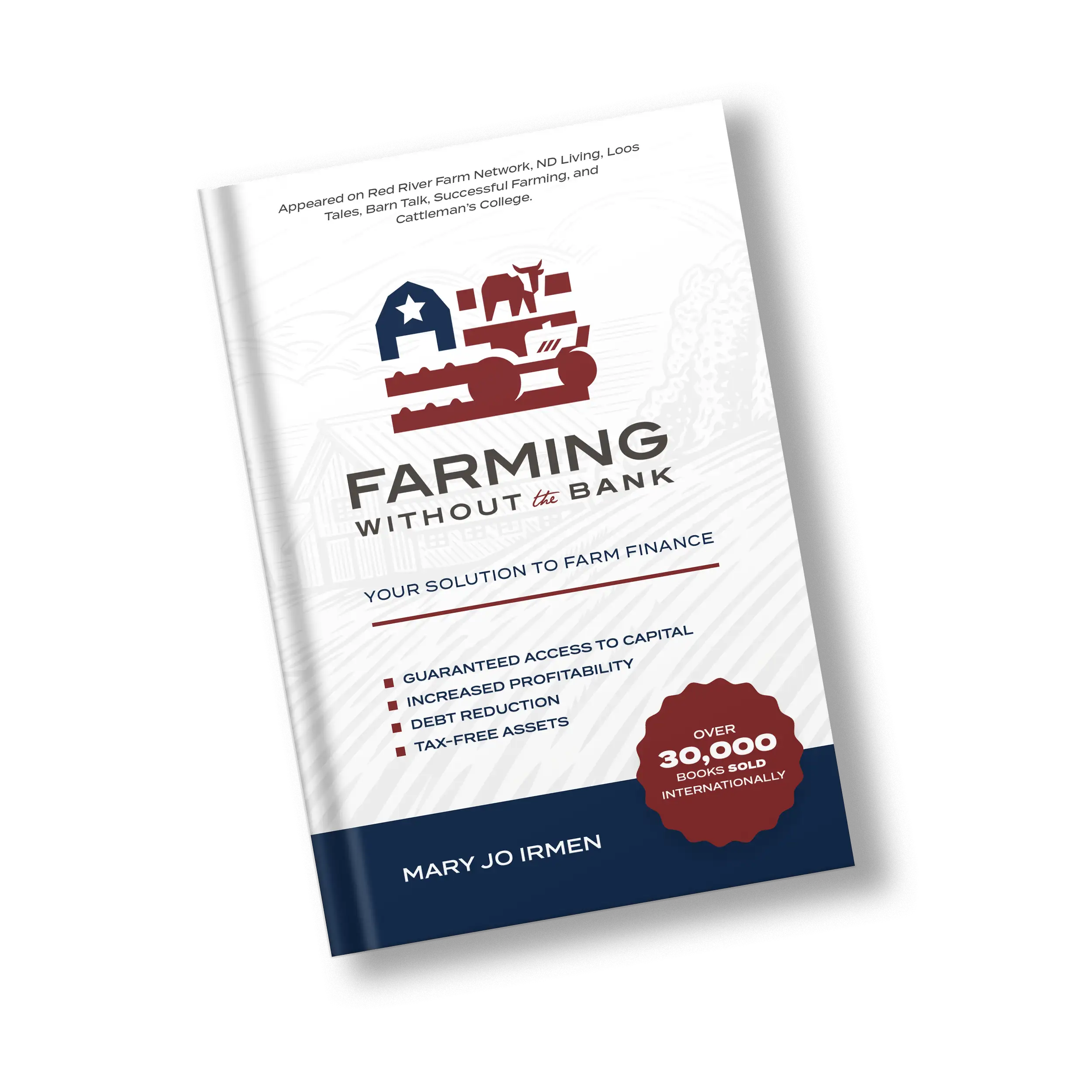
Your farm’s financial independence starts with one book.
30,000 farmers and ranchers have already made the shift. The only question is how long you’ll keep paying interest you could be keeping yourself.