 GET THE BOOK
 GET THE BOOK




Podcast
EP. 296
Ep. 296 – The Problem, with John Hasche
Apr 4, 2025 ·
12 min
0:00 / 11:49
EPISODE OVERVIEW
ABOUT THIS EPISODE
Discover how controlling your finances can combat rising interest and lead to long-term success.
We are continuing our review of Becoming Your Own Banker and looking into the financial struggles many face today, emphasizing the importance of understanding the volume of interest we pay over time, from car loans to mortgages. Join us as we discuss how controlling your own financial environment through strategies like the Infinite Banking Concept can create long-term success, regardless of prevailing economic headwinds.
- ► Learn more: farmingwithoutthebank.com
- ► Get the book
Audio Production by Podsworth Media
CHAPTER TIMESTAMPS
- 00:00You're Part of the Operation, Act Like It
- 00:17Why Most People Don't Understand the Basics
- 00:55Nelson Nash's "All-American Family" Parable
- 01:35Where Your Income Actually Goes
- 02:13The Cost of Living Trap
- 02:45It's the Volume of Interest That's Holding You Back
- 03:24Mortgage Math You Were Never Taught
- 04:06Why You're Always Paying, Never Owning
- 04:45The Illusion of High Returns vs. Reality
- 05:19The Headwinds vs. Tailwinds of Finance
- 06:19Control the Environment, Not Just the Numbers
- 07:21Why Financial Advisors Say "You're Too Dumb"
- 07:56The Truth About Women and Money
- 08:33The Industry's History of Excluding Women
- 09:10Women Understand Infinite Banking Faster
- 09:47A Challenge to Women: Step Into Financial Power
- 10:43Why Mary Jo Works with Beginners
- 11:49Final Thoughts and How to Take the Next Step
YOUTUBE EPISODE
TRANSCRIPTION
“You’re just as much a part of that farming operation, and your name is on everything, as anybody else’s. So pay attention to the numbers, and don’t believe that you are not smart enough. They might have to go back down to the basics, and they think, “Oh, you’re too stupid to understand because you don’t know the basics.” Of course you don’t know the basics. Nobody’s ever taught them to you.”
Hello, hello, hello, and welcome back to the podcast. Thank you very much for being here. Okay, John and I are back, and we are going over Becoming Your Own Banker. We are in “The Problem” in this episode. We’re going to take a shot at this one. Nelson has a very simple analogy here again, a parable, as we discovered in our last podcast. He has another parable for us, and it may not make sense to some people as they’re reading it today, because the numbers do seem like they’re outdated. But the whole point of what he’s trying to say is still relevant, and relative, as he would say. So I think that people still need to pay attention. It’s “the all-American family,” is what he calls this whole thing. What is everybody doing? And everybody is financing. And he talks about the fact that if we have 100% of income, 20% is going to automobiles, 30% is going to housing, 40% to living, and 10% to savings. Now, John, I don’t know about you, but I rarely see 10% to savings.
Yeah, I would say that’s probably higher than most.
And I would say that most people maybe have 3% going to savings. And the majority is going to be going to automobile payments or housing payments or just living expenses.
Yeah, that’s true. Those three things are pretty huge. We’ve kind of seen some of that: when the cost of living went up, people were struggling to make house payments.
And we’re struggling to make house payments because we bought a house that left us very little leeway, very little money to put in savings. Because we wanted this house, and it was a low interest rate, so it was no big deal. And so now we have this cost of living that rose. So as much as people want to say, “Well, this doesn’t apply today,” it does apply today. If I’m going to look at somebody’s numbers, this is still where money is going. It’s even bigger.
That’s where he says over here, “It never seems to dawn on anybody. It’s the volume of interest that is the real issue, not the rate.” And we have a bigger volume today than they did when he wrote this, even.
Well, you had a client that just talked about interest.
Yeah, they had figured that, I can’t remember if it was three or four years back, they’d spent $700,000, roughly, on interest expenses over that time. It’s like, that’s a big number when you actually sit down and figure it out.
And that is at low interest rates.
Relatively, yeah. None of them were terrible. But that’s a lot of money to be going out the door.
What Nelson is saying is that it doesn’t matter if you have one car loan at 5% or you have two or three car loans at 2%. It is the same volume of interest that is leaving your account. So we have interest that is leaving due to a mortgage. And guess what? When we buy a house, the majority of that money is going to interest. Nelson actually did the math here and said that 86% of every dollar goes to mortgage interest in the first five years. And it’s really interesting when I do strategies with clients and I pull up the calculators and say, “Oh, if they owner finance at a lower interest rate versus a higher interest rate,” and then I show them what the interest is. It’s huge.
You can see it amortized out in a calculator, that you basically don’t have any principal the first couple of years.
And people are notorious for trading their vehicles in, moving houses, never having anything paid for. And all we ever do is pay interest. And so what Nelson is saying is, over your lifetime, if you never pay anything off, how much interest have you given to financial institutions?
In most cases, you’re only getting to the point where that’s all you’re paying. So it’s just a never-ending cycle.
Yep. But then he is giving you the benefit of the doubt and saying at 10% you’re saving money, but you’re going to go to the water cooler and you’re going to talk with all your friends, or you’re going to go golfing with all your friends, and your buddies are sitting in the bar talking about the rate of return you got on your investment. The majority of your income is being lost, but you have this tiny little bit that you save, and you try to get the best rate of return you possibly can. Then he goes on to say everything you do in the financial world is compared with what everyone else is doing. And so then he gets into headwinds and tailwinds, which made zero sense to me for years until I heard him do a presentation. The majority of us are fighting a headwind. We are trying to push against the narrative of high rates of return, while the life insurance policy is over here creating tailwinds and pushing us with uninterrupted compound interest and dividends, and giving us liquidity of money and control.
Yeah. In a different direction than everybody else is going.
Yeah. And so we question it when we’re getting help with something and we’re actually making a little more. It’s almost like we just like to fight stuff: “Oh, that’s really hard, and so it must be better,” when in fact we don’t have to do that.
I like where he says, “Most people in that situation concentrate all their attention on trying to make the airplane go 105 miles an hour. They would do well to spend their energy instead on controlling the environment in which they fly.” If you control the banking function in your life, you are doing something different than everybody else. You’re not fighting the jet stream.
Because he also says it never dawns on most financial gurus that you can control the financial environment in which you operate. “Perhaps it is caused by a lack of imagination. But whatever the cause, learning to control it is the most profitable thing you will do over your lifetime.” I mean, it seems simple. And we make it hard. And as my client Nate says, “It’s really easy when you quit making it so hard.” It’s not a hard concept. It is actually really, really simple. We make it hard because we have all this noise on the outside saying it should be hard. We have financial advisors saying, “You’re too dumb, John. You should not be putting your money into an IRA by yourself. Why don’t you give that to me? Because it’s hard to understand how to manage money.” So therefore we move along in the world, and we’re like, “Okay, this is really, really tough. I can’t understand this.”
And I’m going to touch on this, and it’s probably going to piss some people off. But we have another agent that John and I work with, and she said, “You know, it just must be my area, but women don’t seem to respond to the infinite banking concept.” And I said, “It’s not just your area.” Women can make a bunch of money. They can have successful businesses. They can run farming operations. But when it comes to the finances of retirement and managing money, their husband takes over, as if men are the only ones that can understand money, right? Because, to some extent, it’s been a male-dominated industry forever. Financial advisors… there’s plenty of women out there, but historically it was a male-dominated industry. Historically, your teachers would say men are better at math than women. Right? So women just say, “Well, I can’t understand it. I’m dumb.” And I’ve had a lot of women say that financial advisors will talk down to them and say, “Oh, well, did you bring your husband today?” First of all, that would not end well if that was my case.
There’s a lot of loan officers that will not talk to the wives or include the wives and stuff, because “the man’s got it.”
And so, just a little blurb for the women out there: you are not too dumb to understand money. That is the biggest lie ever. This is not hard. This is very simple. In fact, if I am sitting with a husband and a wife, and the wife has not read the book, she will typically get this faster than the husband who has read the book. Do you also notice that?
Yeah, I would agree with that.
And that is because she does not have all these preconceived notions about rates of return, and that we have to go to the stock market, and that we have to have money segregated. She has actually not been trained to think that way, where men kind of have. And so I’m not making excuses for women. I am actually on the very opposite, saying, why are you not stepping up to the plate to understand finances and take control of your part of your life as well? You’re just as much a part of that farming operation, and your name is on everything, as anybody else’s. So pay attention to the numbers, and don’t believe that you are not smart enough. They might have to go back down to the basics, and they think, “Oh, you’re too stupid to understand because you don’t know the basics.” Well, of course you don’t know the basics. Nobody’s ever taught them to you.
You’ve got to start somewhere.
Yeah, this is not hard. It’s not hard for anybody. I had a young couple today that I just love. And this is why… People have told me, “Oh, Mary Jo, you should just work with the high-income farmers.” And I’m okay working with the people that don’t have any money, because they’re so excited to learn. And there is a lot of stuff that they didn’t know. They didn’t know really what a land contract was, what a contract for deed is. I was having to explain some basic-type stuff that would be basic to other people. But they were so excited to learn about it. It just made the whole thing fun.
It makes it exciting.
Yeah, it’s super exciting, because they’re so eager to learn. And then they’re so happy that somebody told them about it. I just love them. They’re like some of my favorite clients. We love all of our clients, obviously, but it’s fun when somebody is excited to learn about something.
Yeah, definitely.
Okay, you guys, you know the routine. If you have comments, questions, concerns, maryjo@withoutthebank.com. Grab your books. Schedule your appointments with John and me after you read the book. And then we’ll sit down and see if this works for you. Otherwise, you have a fantastic rest of your day.
Thanks for listening to the Farming Without the Bank podcast. We hope today’s episode has inspired you to take control of your finances in new ways. Don’t forget to check out our website, farmingwithoutthebank.com, and engage with us on our Facebook page, Farming Without the Bank. Join us next week as we smash more financial myths and empower you to accomplish your financial goals.
View MoreHello, hello, hello, and welcome back to the podcast. Thank you very much for being here. Okay, John and I are back, and we are going over Becoming Your Own Banker. We are in “The Problem” in this episode. We’re going to take a shot at this one. Nelson has a very simple analogy here again, a parable, as we discovered in our last podcast. He has another parable for us, and it may not make sense to some people as they’re reading it today, because the numbers do seem like they’re outdated. But the whole point of what he’s trying to say is still relevant, and relative, as he would say. So I think that people still need to pay attention. It’s “the all-American family,” is what he calls this whole thing. What is everybody doing? And everybody is financing. And he talks about the fact that if we have 100% of income, 20% is going to automobiles, 30% is going to housing, 40% to living, and 10% to savings. Now, John, I don’t know about you, but I rarely see 10% to savings.
Yeah, I would say that’s probably higher than most.
And I would say that most people maybe have 3% going to savings. And the majority is going to be going to automobile payments or housing payments or just living expenses.
Yeah, that’s true. Those three things are pretty huge. We’ve kind of seen some of that: when the cost of living went up, people were struggling to make house payments.
And we’re struggling to make house payments because we bought a house that left us very little leeway, very little money to put in savings. Because we wanted this house, and it was a low interest rate, so it was no big deal. And so now we have this cost of living that rose. So as much as people want to say, “Well, this doesn’t apply today,” it does apply today. If I’m going to look at somebody’s numbers, this is still where money is going. It’s even bigger.
That’s where he says over here, “It never seems to dawn on anybody. It’s the volume of interest that is the real issue, not the rate.” And we have a bigger volume today than they did when he wrote this, even.
Well, you had a client that just talked about interest.
Yeah, they had figured that, I can’t remember if it was three or four years back, they’d spent $700,000, roughly, on interest expenses over that time. It’s like, that’s a big number when you actually sit down and figure it out.
And that is at low interest rates.
Relatively, yeah. None of them were terrible. But that’s a lot of money to be going out the door.
What Nelson is saying is that it doesn’t matter if you have one car loan at 5% or you have two or three car loans at 2%. It is the same volume of interest that is leaving your account. So we have interest that is leaving due to a mortgage. And guess what? When we buy a house, the majority of that money is going to interest. Nelson actually did the math here and said that 86% of every dollar goes to mortgage interest in the first five years. And it’s really interesting when I do strategies with clients and I pull up the calculators and say, “Oh, if they owner finance at a lower interest rate versus a higher interest rate,” and then I show them what the interest is. It’s huge.
You can see it amortized out in a calculator, that you basically don’t have any principal the first couple of years.
And people are notorious for trading their vehicles in, moving houses, never having anything paid for. And all we ever do is pay interest. And so what Nelson is saying is, over your lifetime, if you never pay anything off, how much interest have you given to financial institutions?
In most cases, you’re only getting to the point where that’s all you’re paying. So it’s just a never-ending cycle.
Yep. But then he is giving you the benefit of the doubt and saying at 10% you’re saving money, but you’re going to go to the water cooler and you’re going to talk with all your friends, or you’re going to go golfing with all your friends, and your buddies are sitting in the bar talking about the rate of return you got on your investment. The majority of your income is being lost, but you have this tiny little bit that you save, and you try to get the best rate of return you possibly can. Then he goes on to say everything you do in the financial world is compared with what everyone else is doing. And so then he gets into headwinds and tailwinds, which made zero sense to me for years until I heard him do a presentation. The majority of us are fighting a headwind. We are trying to push against the narrative of high rates of return, while the life insurance policy is over here creating tailwinds and pushing us with uninterrupted compound interest and dividends, and giving us liquidity of money and control.
Yeah. In a different direction than everybody else is going.
Yeah. And so we question it when we’re getting help with something and we’re actually making a little more. It’s almost like we just like to fight stuff: “Oh, that’s really hard, and so it must be better,” when in fact we don’t have to do that.
I like where he says, “Most people in that situation concentrate all their attention on trying to make the airplane go 105 miles an hour. They would do well to spend their energy instead on controlling the environment in which they fly.” If you control the banking function in your life, you are doing something different than everybody else. You’re not fighting the jet stream.
Because he also says it never dawns on most financial gurus that you can control the financial environment in which you operate. “Perhaps it is caused by a lack of imagination. But whatever the cause, learning to control it is the most profitable thing you will do over your lifetime.” I mean, it seems simple. And we make it hard. And as my client Nate says, “It’s really easy when you quit making it so hard.” It’s not a hard concept. It is actually really, really simple. We make it hard because we have all this noise on the outside saying it should be hard. We have financial advisors saying, “You’re too dumb, John. You should not be putting your money into an IRA by yourself. Why don’t you give that to me? Because it’s hard to understand how to manage money.” So therefore we move along in the world, and we’re like, “Okay, this is really, really tough. I can’t understand this.”
And I’m going to touch on this, and it’s probably going to piss some people off. But we have another agent that John and I work with, and she said, “You know, it just must be my area, but women don’t seem to respond to the infinite banking concept.” And I said, “It’s not just your area.” Women can make a bunch of money. They can have successful businesses. They can run farming operations. But when it comes to the finances of retirement and managing money, their husband takes over, as if men are the only ones that can understand money, right? Because, to some extent, it’s been a male-dominated industry forever. Financial advisors… there’s plenty of women out there, but historically it was a male-dominated industry. Historically, your teachers would say men are better at math than women. Right? So women just say, “Well, I can’t understand it. I’m dumb.” And I’ve had a lot of women say that financial advisors will talk down to them and say, “Oh, well, did you bring your husband today?” First of all, that would not end well if that was my case.
There’s a lot of loan officers that will not talk to the wives or include the wives and stuff, because “the man’s got it.”
And so, just a little blurb for the women out there: you are not too dumb to understand money. That is the biggest lie ever. This is not hard. This is very simple. In fact, if I am sitting with a husband and a wife, and the wife has not read the book, she will typically get this faster than the husband who has read the book. Do you also notice that?
Yeah, I would agree with that.
And that is because she does not have all these preconceived notions about rates of return, and that we have to go to the stock market, and that we have to have money segregated. She has actually not been trained to think that way, where men kind of have. And so I’m not making excuses for women. I am actually on the very opposite, saying, why are you not stepping up to the plate to understand finances and take control of your part of your life as well? You’re just as much a part of that farming operation, and your name is on everything, as anybody else’s. So pay attention to the numbers, and don’t believe that you are not smart enough. They might have to go back down to the basics, and they think, “Oh, you’re too stupid to understand because you don’t know the basics.” Well, of course you don’t know the basics. Nobody’s ever taught them to you.
You’ve got to start somewhere.
Yeah, this is not hard. It’s not hard for anybody. I had a young couple today that I just love. And this is why… People have told me, “Oh, Mary Jo, you should just work with the high-income farmers.” And I’m okay working with the people that don’t have any money, because they’re so excited to learn. And there is a lot of stuff that they didn’t know. They didn’t know really what a land contract was, what a contract for deed is. I was having to explain some basic-type stuff that would be basic to other people. But they were so excited to learn about it. It just made the whole thing fun.
It makes it exciting.
Yeah, it’s super exciting, because they’re so eager to learn. And then they’re so happy that somebody told them about it. I just love them. They’re like some of my favorite clients. We love all of our clients, obviously, but it’s fun when somebody is excited to learn about something.
Yeah, definitely.
Okay, you guys, you know the routine. If you have comments, questions, concerns, maryjo@withoutthebank.com. Grab your books. Schedule your appointments with John and me after you read the book. And then we’ll sit down and see if this works for you. Otherwise, you have a fantastic rest of your day.
Thanks for listening to the Farming Without the Bank podcast. We hope today’s episode has inspired you to take control of your finances in new ways. Don’t forget to check out our website, farmingwithoutthebank.com, and engage with us on our Facebook page, Farming Without the Bank. Join us next week as we smash more financial myths and empower you to accomplish your financial goals.
ready to start?
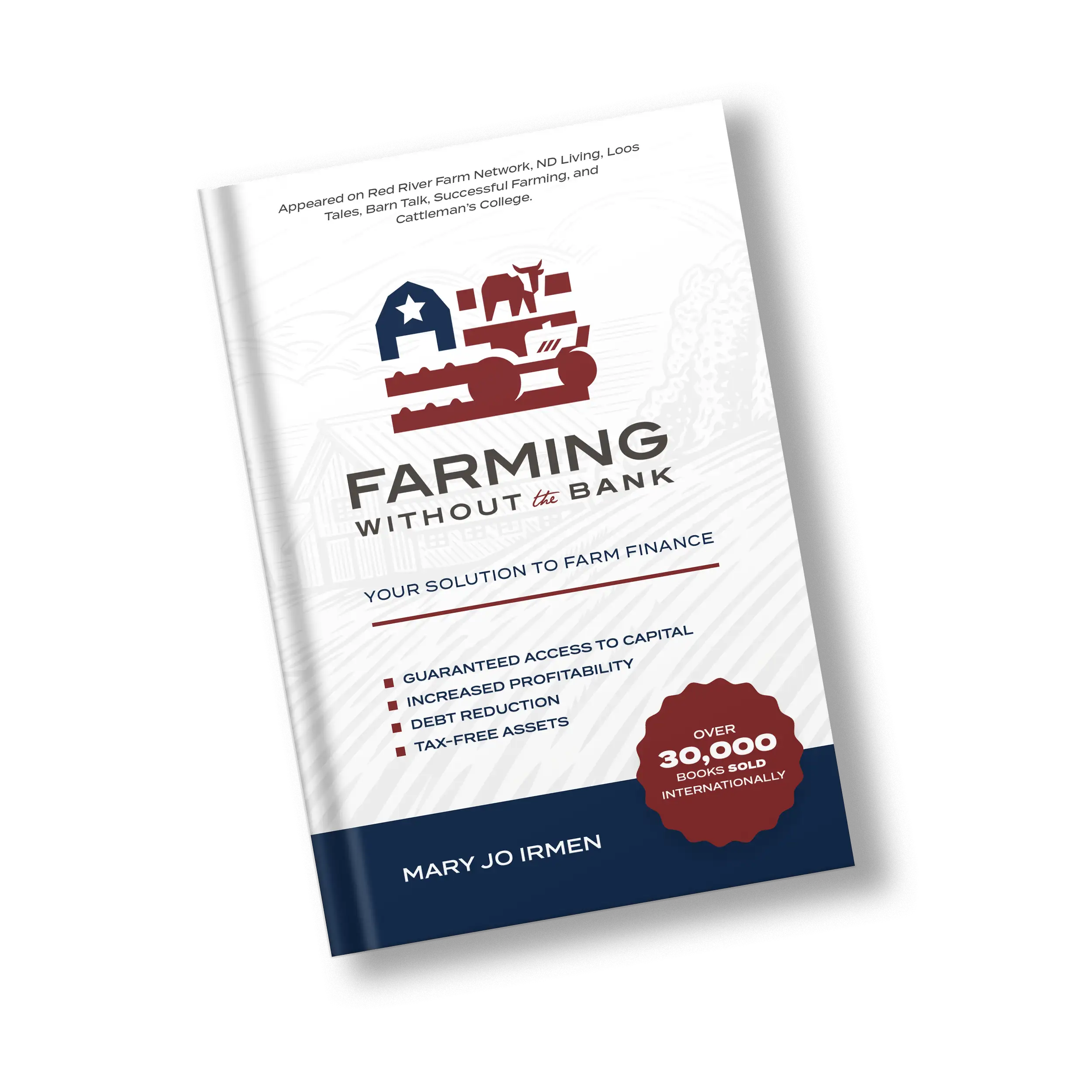
Your farm’s financial independence starts with one book.
30,000 farmers and ranchers have already made the shift. The only question is how long you’ll keep paying interest you could be keeping yourself.