 GET THE BOOK
 GET THE BOOK



Podcast
EP. 293
Ep. 293 – Agricultural Education
Mar 13, 2025 ·
17 min
0:00 / 17:18
EPISODE OVERVIEW
ABOUT THIS EPISODE
Transforming Agricultural Education: The Role of Millennials in the Ag Industry
In this episode, we are discussing the growth of ag-focused podcasts, especially among millennials, and how it’s shifting farming to a more business-like approach. Tune in to learn how younger farmers are reshaping the industry with open conversations about soil health, finance, and modern farming strategies.
- ► Learn more: farmingwithoutthebank.com
- ► Get the book
Audio Production by Podsworth Media
CHAPTER TIMESTAMPS
- 00:00Introduction and Welcome
- 00:20The Evolution of Education in Agriculture
- 01:20Generational Differences in Farming
- 05:17The Importance of Financial Literacy
- 06:52Challenges and Opportunities in Modern Farming
- 13:10The Role of Technology and Media
- 16:31Conclusion and Final Thoughts
YOUTUBE EPISODE
TRANSCRIPTION
“We are in such a position that we are so fortunate. We can go online, we can go to shows, we can go to classes. We are in such a position to get so much information. It is awesome. It’s awesome.”
Hello, hello, hello, and welcome back to the podcast. Thank you very much for being here.
Hey, today let’s talk about education in the ag industry. Because I was lying in bed this morning thinking about, you know, there are so many podcasts in the ag sector that were not there even when I started my podcast. And so even in the last, I would say, two to three years, it has blown up, and it is absolutely awesome. And the reason I was thinking about this is because as a business owner, I am going to conferences, I’m always talking to people, learning stuff, reading books, all that kind of jazz. And I am sure that I did a podcast about this in the past. And now that podcast is obsolete. Because in the past, farmers wouldn’t leave their county, right? They were only going to their county extension meetings, they’re having coffee with just the local people, and they’re not actually running it like a business.
And what’s exciting is this younger generation that’s come in. I am seeing podcasts mostly from the millennial group. There’s some Gen Xers, but it’s mostly millennials that are starting these podcasts and really sharing information in the agriculture world. It is not information that necessarily existed before. Their outlook in agriculture is so different than Gen X possibly, or the boomers, or the Silent Generation. Because we still have a lot of the Silent Generation that are owning operations. We still have a lot of boomers that are owning operations. But they didn’t have the means. It’s not that they didn’t want to. It’s just that they didn’t have the means for all of the information. How did that information get to them? Magazines, radio shows, TV shows, right? They had the local news. They didn’t really get to talk to people across the country and say, hey, what are you doing financially? What are you doing with your planting practices? What are you doing with fertilizer, chemicals, seed, feed? How are you buying cows?
It is so exciting now. You’ve got people that have podcasts on just about everything. But then you’ve got a lot of people that are going to the farm shows, and they’re meeting up with one another, and they’ve got seminars. And there are just so many things. And you’ve got sell-by marketing, which they’re holding courses on. You have Ranching for Profit, and people are going to that for six, seven days, and they’re committing to make their business better and successful. And so at the end of the day, we’re seeing it being treated like a business, not like a farm.
I was listening to the… Let me look, just to be sure that I get it right, because this is a new podcast to me, and oh, I’m just loving it. The Singular Ag Podcast. They do a lot with soil nutrition. But they were talking about all kinds of stuff on there. And the podcast that I was listening to, they all look like they’re millennials. Don’t know how old they are. Guessing they’re millennials. But it’s really interesting when I start watching. And I follow a lot of people on social media that are in agriculture. And it’s really fun to see. And I’m sure there were some Gen X that did this. But the millennial group of farmers are really making farming fun and educational for their kids. It’s not yelling and screaming and so stressful. Some of them want to get big, and some of them are okay staying small, because they still want a life.
They were talking in one of their latest podcasts about how the family piece means more. They want to make sure their kids come to their funeral and they don’t dislike them. They want to make sure that they’re handing the farm off at 50, 55, and that they don’t have this farm until they’re 60, 65 years old. Now, for them, that’s probably doable, because they already have kids that would be able to take over. They’ll be in their 20s. If you’re not starting to have kids until you’re 30, 35 years old, 40, then maybe that’s not doable. Whatever works for you, the moral of the story is that they’re handing stuff off. They’re talking about that. It’s a very open relationship. Finances is a very open topic. And this is stuff that we just didn’t see as Gen Xers, as boomers. Gen X didn’t see it. Boomers didn’t see it. Everything was very closed off, very quiet.
I am sure there’s still going to be some millennials that don’t have that information, and planning isn’t talked about. But how are we supposed to educate the next generation if we’re not talking about the financials? How are they supposed to run a business if they never are taught how to look at numbers and how to run a business? It’s very interesting when I start talking to millennials and they don’t know how to read a balance sheet. They don’t know what a profit and loss statement is. And they don’t know that stuff because Dad didn’t know that stuff. Grandpa didn’t know that stuff. We didn’t look at it. We just said, hey, here’s our taxes, and this is what our taxes look like.
And I see that even now when people meet with me. They’ll pull out their taxes. I don’t want your taxes. I don’t want to see your taxes. Your taxes are not a true indication of what you did last year for income. That is a lie for the government, so you don’t have to pay a bunch of taxes. It is not showing me exactly what you made, where we spent money, how much we’re borrowing. I don’t care. And on the other side of that, I’m not the bank, so I don’t need exact numbers. I’m just over here getting a big idea of what you guys are doing, because I’m not, at the end of the day, running your operation. I’m not going to tell you how to code something within QuickBooks. I’m not going to tell you how to make more profit. And heaven forbid, for those of you that are listening, I’m not a damn bank. Like, if you think I’m a bank, then go do some due diligence. It’s crazy how many people recently have thought I’m a bank and I’m a lender. No, go do your due diligence.
But if we don’t pass that knowledge off, we’re not going to ever have that knowledge for the next generation. And so, you know, I write about in my book that by the third generation, wealth is lost. Why are the Rockefellers still in such a good position? Because they have passed off that information. Love Trump or hate Trump, I really don’t frankly care. But he’s got his kids involved, right? His kids know what’s going on in his business. His grandkids are going to be involved in that. And so the fact that he is doing that, and these people seem to be involved… From the outside, I don’t know how involved they truly are, but they seem to be involved in what he’s doing and running his companies. When you listen to the kids talk, they’re a part of his companies. And so if he is including them, that one just makes the company better, because they’re willing to listen.
Your farm can be better if you’re willing to listen to the next generation and try some of the things they want to try. Why not? Give them a little bit of the reins, so when you give them the full reins, you know… Maybe it will work, maybe it won’t work. If we’re 60 years old and we quit doing research, and we’re no longer looking at the business side of the farming, we just got into some routine, then is that the best thing that we can do? One must question, right? And so if we pass that off, like if Trump is doing that, if he is actually passing that knowledge off and then they’re passing that to the grandkids, we’re going to have more opportunity for success. The problem is that we did not do that in the boomer generation, and even some of the older Gen X generation. They are not having those conversations.
And you guys heard my podcast a couple of weeks ago with Brian Munger, a client of mine. He’s got a very large family, and that family is very involved in the finances. He’s planning to make that transition early. That has been something that has been well known for a very long period of time. It’s not going to be some big, huge surprise.
And so it’s just so fun to see where agriculture has come in the last three years. I think my podcast is three years old. I don’t know. I think this is going to be episode 501. My podcasting team told me last week, when I said, oh, I have like 300 podcasts, they told me, Mary Jo, you have 500. Your next one will be 500. I did not know I had so much to say. And so between this podcast and my Without the Bank podcast, I believe we have close to 500. And so I’ve been around for a while, is the moral of that story. And others were not there in this space. And it is just… We are in such a position that we are so fortunate. We can go online. We can go to shows. We can go to classes. We are in such a position to get so much information. It is awesome. It’s awesome.
And I am excited to see really what happens as I get older with the millennials and how that goes. If they turn into Gen X and boomers themselves, or if they truly do make the changes. Because here’s the thing that happened to the boomers. They were really mad at the Silent Generation, right? They were really mad at that generation for not giving them an opportunity. And now some of them, not all of them, are doing that to Gen X, and they’re not getting that opportunity. And the millennials are talking a big talk right now. The millennials are saying, hey, this is going to stop with me. The change is going to start here. And I do hope that they do that.
Once you get into that position, I can tell you, like Gen Xers, even the boomers I talk to… And I’ve talked about this before, it takes some big shoulders to say, it can skip me. Even though I farmed it forever, I’m not going to own it. It’s okay. It can skip me so we can go to the next generation. We can talk about the fact that it’s okay. But once that happens, that’s hard. That’s an ego tester right there. I honestly don’t know that I could do it. And so I am never going to blame anybody. You do what you want for your operation. Nobody can tell you what to do. You own it. You do what you want.
There is a level of frustration because we don’t know what’s happening. This older generation is living longer. People are living into their 80s and 90s, which was not the case. I always hear people say, oh, we’re not living as long. If we weren’t living as long, why would the actuaries at the life insurance company say, hey, let’s move our policies from age 100 to age 121, because people are going to live longer? Nobody has a party anymore if you’re 100. You know, you get parties if you’re 110, but you’re not going to get a party for 100, because that just happens on a daily basis.
So what’s happening is they’re living longer, and we’re not passing… We didn’t want to pay capital gains, right? So we didn’t sell it, we didn’t transition it. Is there a better way? Absolutely, 100%, there’s a better way. I talk about it. Do some owner financing, where you’re going to double your money if you charge them interest. Some people say that shouldn’t happen. It may not be the best option for you. I’m not saying that this is the only thing that you can do. Come on, people. I’m just saying it’s an option, and let’s think outside of the box of how we can do this, instead of just continuing to wait until somebody dies, because, you know, we’re living longer. We’re living longer.
Anyway, I was excited about that as I was thinking about it this morning, that this industry truly has changed, and there are so many podcasts out there. Just in the last year, so many podcasts have popped up talking about soil health, talking about finance management, people that are just working inside of the agriculture sector that are sharing information that was not there before, because the only place you were going to get it was RFD-TV or your local news or something like that. And that’s just podcasts. I can’t even imagine how many YouTubers have popped up just sharing their life in the farming sector. And that’s good too, because people need to understand what happens in farming.
And I’m just going to give you a little example of this. I was talking to one of my friends that lives in Arizona. She’s a colleague of mine, and she lives in Arizona in the city. She’s never been on a farm. She doesn’t know anything about farming. And she said the neighbors bought some chickens. And she doesn’t know why, but I’m guessing, because this is what I’ve seen happening locally, that people in town think, well, eggs are $6 a dozen, so I’m going to go buy some chickens, because this is ridiculous. Okay. I said, oh, so your neighbors bought chickens so that they don’t have to buy $6 eggs. Do they understand they have to feed the chickens? Right? So you’re going to have to buy chicken feed. You’re going to have to have a house for the chickens. You’re going to have a messy yard, right? But you got to go out and make sure the chickens are okay. You got to make sure no predators get the chickens. In this particular case, now you’ve pissed off all your neighbors, because you live in suburbia and you have a rooster. Hello. Anyway, and they live in an HOA. Anywho.
So we live out of town. I don’t care if you live on two acres and, oh, I’m going to have some chickens for eggs. You have to feed those chickens. And then I said, what people don’t understand is chickens don’t always lay eggs. Like, here in the North, chickens aren’t going to lay eggs in the wintertime if their nutrition isn’t perfect, if their heat isn’t perfect, because it’s winter. So you don’t always get eggs all year round. So now you have to feed these stupid chickens and they’re not even providing eggs. So you’re still going to the grocery store and you’re buying eggs. And she said, I had no idea chickens didn’t lay eggs all the time. No, they don’t.
And so what happens is, if we in the agriculture world have the podcasts, and we have all these people out there sharing this information, it’s just going to be better all the way around. Because people think, oh, farmers are bad because they spray, and they don’t understand bushels per acre. They don’t understand the cost that it takes to get into all that stuff. And so it’s so awesome. It’s so awesome that everybody is talking, and the younger generation is okay sharing what they’re doing, or they seem to be okay sharing what they’re doing, because they want to get better. Even though farms are selling and there’s still competitiveness out there, obviously, the millennials and younger seem to be sharing that information more openly to help one another across the country, not just keep everything to themselves and have to reinvent the wheel every single time. So it was interesting this morning.
All right. Let me know if you guys have comments, questions, concerns. I am happy to answer those via email. If you need quotes via email, not happening, not happening, right? If you need to make an appointment, call in, go online, whatever, get scheduled. If you have the book, the link is in there. Get scheduled with myself or John. We’ll make sure to take care of you, see if this is something that is right for you and if it’s a fit, and go from there. Grab your books at farmingwithoutthebank.com. All right, you guys, have a fantastic rest of your day.
Thanks for listening to the Farming Without the Bank podcast. We hope today’s episode has inspired you to take control of your finances in new ways. Don’t forget to check out our website, farmingwithoutthebank.com, and engage with us on our Facebook page, Farming Without the Bank. Join us next week as we smash more financial myths and empower you to accomplish your financial goals.
View MoreHello, hello, hello, and welcome back to the podcast. Thank you very much for being here.
Hey, today let’s talk about education in the ag industry. Because I was lying in bed this morning thinking about, you know, there are so many podcasts in the ag sector that were not there even when I started my podcast. And so even in the last, I would say, two to three years, it has blown up, and it is absolutely awesome. And the reason I was thinking about this is because as a business owner, I am going to conferences, I’m always talking to people, learning stuff, reading books, all that kind of jazz. And I am sure that I did a podcast about this in the past. And now that podcast is obsolete. Because in the past, farmers wouldn’t leave their county, right? They were only going to their county extension meetings, they’re having coffee with just the local people, and they’re not actually running it like a business.
And what’s exciting is this younger generation that’s come in. I am seeing podcasts mostly from the millennial group. There’s some Gen Xers, but it’s mostly millennials that are starting these podcasts and really sharing information in the agriculture world. It is not information that necessarily existed before. Their outlook in agriculture is so different than Gen X possibly, or the boomers, or the Silent Generation. Because we still have a lot of the Silent Generation that are owning operations. We still have a lot of boomers that are owning operations. But they didn’t have the means. It’s not that they didn’t want to. It’s just that they didn’t have the means for all of the information. How did that information get to them? Magazines, radio shows, TV shows, right? They had the local news. They didn’t really get to talk to people across the country and say, hey, what are you doing financially? What are you doing with your planting practices? What are you doing with fertilizer, chemicals, seed, feed? How are you buying cows?
It is so exciting now. You’ve got people that have podcasts on just about everything. But then you’ve got a lot of people that are going to the farm shows, and they’re meeting up with one another, and they’ve got seminars. And there are just so many things. And you’ve got sell-by marketing, which they’re holding courses on. You have Ranching for Profit, and people are going to that for six, seven days, and they’re committing to make their business better and successful. And so at the end of the day, we’re seeing it being treated like a business, not like a farm.
I was listening to the… Let me look, just to be sure that I get it right, because this is a new podcast to me, and oh, I’m just loving it. The Singular Ag Podcast. They do a lot with soil nutrition. But they were talking about all kinds of stuff on there. And the podcast that I was listening to, they all look like they’re millennials. Don’t know how old they are. Guessing they’re millennials. But it’s really interesting when I start watching. And I follow a lot of people on social media that are in agriculture. And it’s really fun to see. And I’m sure there were some Gen X that did this. But the millennial group of farmers are really making farming fun and educational for their kids. It’s not yelling and screaming and so stressful. Some of them want to get big, and some of them are okay staying small, because they still want a life.
They were talking in one of their latest podcasts about how the family piece means more. They want to make sure their kids come to their funeral and they don’t dislike them. They want to make sure that they’re handing the farm off at 50, 55, and that they don’t have this farm until they’re 60, 65 years old. Now, for them, that’s probably doable, because they already have kids that would be able to take over. They’ll be in their 20s. If you’re not starting to have kids until you’re 30, 35 years old, 40, then maybe that’s not doable. Whatever works for you, the moral of the story is that they’re handing stuff off. They’re talking about that. It’s a very open relationship. Finances is a very open topic. And this is stuff that we just didn’t see as Gen Xers, as boomers. Gen X didn’t see it. Boomers didn’t see it. Everything was very closed off, very quiet.
I am sure there’s still going to be some millennials that don’t have that information, and planning isn’t talked about. But how are we supposed to educate the next generation if we’re not talking about the financials? How are they supposed to run a business if they never are taught how to look at numbers and how to run a business? It’s very interesting when I start talking to millennials and they don’t know how to read a balance sheet. They don’t know what a profit and loss statement is. And they don’t know that stuff because Dad didn’t know that stuff. Grandpa didn’t know that stuff. We didn’t look at it. We just said, hey, here’s our taxes, and this is what our taxes look like.
And I see that even now when people meet with me. They’ll pull out their taxes. I don’t want your taxes. I don’t want to see your taxes. Your taxes are not a true indication of what you did last year for income. That is a lie for the government, so you don’t have to pay a bunch of taxes. It is not showing me exactly what you made, where we spent money, how much we’re borrowing. I don’t care. And on the other side of that, I’m not the bank, so I don’t need exact numbers. I’m just over here getting a big idea of what you guys are doing, because I’m not, at the end of the day, running your operation. I’m not going to tell you how to code something within QuickBooks. I’m not going to tell you how to make more profit. And heaven forbid, for those of you that are listening, I’m not a damn bank. Like, if you think I’m a bank, then go do some due diligence. It’s crazy how many people recently have thought I’m a bank and I’m a lender. No, go do your due diligence.
But if we don’t pass that knowledge off, we’re not going to ever have that knowledge for the next generation. And so, you know, I write about in my book that by the third generation, wealth is lost. Why are the Rockefellers still in such a good position? Because they have passed off that information. Love Trump or hate Trump, I really don’t frankly care. But he’s got his kids involved, right? His kids know what’s going on in his business. His grandkids are going to be involved in that. And so the fact that he is doing that, and these people seem to be involved… From the outside, I don’t know how involved they truly are, but they seem to be involved in what he’s doing and running his companies. When you listen to the kids talk, they’re a part of his companies. And so if he is including them, that one just makes the company better, because they’re willing to listen.
Your farm can be better if you’re willing to listen to the next generation and try some of the things they want to try. Why not? Give them a little bit of the reins, so when you give them the full reins, you know… Maybe it will work, maybe it won’t work. If we’re 60 years old and we quit doing research, and we’re no longer looking at the business side of the farming, we just got into some routine, then is that the best thing that we can do? One must question, right? And so if we pass that off, like if Trump is doing that, if he is actually passing that knowledge off and then they’re passing that to the grandkids, we’re going to have more opportunity for success. The problem is that we did not do that in the boomer generation, and even some of the older Gen X generation. They are not having those conversations.
And you guys heard my podcast a couple of weeks ago with Brian Munger, a client of mine. He’s got a very large family, and that family is very involved in the finances. He’s planning to make that transition early. That has been something that has been well known for a very long period of time. It’s not going to be some big, huge surprise.
And so it’s just so fun to see where agriculture has come in the last three years. I think my podcast is three years old. I don’t know. I think this is going to be episode 501. My podcasting team told me last week, when I said, oh, I have like 300 podcasts, they told me, Mary Jo, you have 500. Your next one will be 500. I did not know I had so much to say. And so between this podcast and my Without the Bank podcast, I believe we have close to 500. And so I’ve been around for a while, is the moral of that story. And others were not there in this space. And it is just… We are in such a position that we are so fortunate. We can go online. We can go to shows. We can go to classes. We are in such a position to get so much information. It is awesome. It’s awesome.
And I am excited to see really what happens as I get older with the millennials and how that goes. If they turn into Gen X and boomers themselves, or if they truly do make the changes. Because here’s the thing that happened to the boomers. They were really mad at the Silent Generation, right? They were really mad at that generation for not giving them an opportunity. And now some of them, not all of them, are doing that to Gen X, and they’re not getting that opportunity. And the millennials are talking a big talk right now. The millennials are saying, hey, this is going to stop with me. The change is going to start here. And I do hope that they do that.
Once you get into that position, I can tell you, like Gen Xers, even the boomers I talk to… And I’ve talked about this before, it takes some big shoulders to say, it can skip me. Even though I farmed it forever, I’m not going to own it. It’s okay. It can skip me so we can go to the next generation. We can talk about the fact that it’s okay. But once that happens, that’s hard. That’s an ego tester right there. I honestly don’t know that I could do it. And so I am never going to blame anybody. You do what you want for your operation. Nobody can tell you what to do. You own it. You do what you want.
There is a level of frustration because we don’t know what’s happening. This older generation is living longer. People are living into their 80s and 90s, which was not the case. I always hear people say, oh, we’re not living as long. If we weren’t living as long, why would the actuaries at the life insurance company say, hey, let’s move our policies from age 100 to age 121, because people are going to live longer? Nobody has a party anymore if you’re 100. You know, you get parties if you’re 110, but you’re not going to get a party for 100, because that just happens on a daily basis.
So what’s happening is they’re living longer, and we’re not passing… We didn’t want to pay capital gains, right? So we didn’t sell it, we didn’t transition it. Is there a better way? Absolutely, 100%, there’s a better way. I talk about it. Do some owner financing, where you’re going to double your money if you charge them interest. Some people say that shouldn’t happen. It may not be the best option for you. I’m not saying that this is the only thing that you can do. Come on, people. I’m just saying it’s an option, and let’s think outside of the box of how we can do this, instead of just continuing to wait until somebody dies, because, you know, we’re living longer. We’re living longer.
Anyway, I was excited about that as I was thinking about it this morning, that this industry truly has changed, and there are so many podcasts out there. Just in the last year, so many podcasts have popped up talking about soil health, talking about finance management, people that are just working inside of the agriculture sector that are sharing information that was not there before, because the only place you were going to get it was RFD-TV or your local news or something like that. And that’s just podcasts. I can’t even imagine how many YouTubers have popped up just sharing their life in the farming sector. And that’s good too, because people need to understand what happens in farming.
And I’m just going to give you a little example of this. I was talking to one of my friends that lives in Arizona. She’s a colleague of mine, and she lives in Arizona in the city. She’s never been on a farm. She doesn’t know anything about farming. And she said the neighbors bought some chickens. And she doesn’t know why, but I’m guessing, because this is what I’ve seen happening locally, that people in town think, well, eggs are $6 a dozen, so I’m going to go buy some chickens, because this is ridiculous. Okay. I said, oh, so your neighbors bought chickens so that they don’t have to buy $6 eggs. Do they understand they have to feed the chickens? Right? So you’re going to have to buy chicken feed. You’re going to have to have a house for the chickens. You’re going to have a messy yard, right? But you got to go out and make sure the chickens are okay. You got to make sure no predators get the chickens. In this particular case, now you’ve pissed off all your neighbors, because you live in suburbia and you have a rooster. Hello. Anyway, and they live in an HOA. Anywho.
So we live out of town. I don’t care if you live on two acres and, oh, I’m going to have some chickens for eggs. You have to feed those chickens. And then I said, what people don’t understand is chickens don’t always lay eggs. Like, here in the North, chickens aren’t going to lay eggs in the wintertime if their nutrition isn’t perfect, if their heat isn’t perfect, because it’s winter. So you don’t always get eggs all year round. So now you have to feed these stupid chickens and they’re not even providing eggs. So you’re still going to the grocery store and you’re buying eggs. And she said, I had no idea chickens didn’t lay eggs all the time. No, they don’t.
And so what happens is, if we in the agriculture world have the podcasts, and we have all these people out there sharing this information, it’s just going to be better all the way around. Because people think, oh, farmers are bad because they spray, and they don’t understand bushels per acre. They don’t understand the cost that it takes to get into all that stuff. And so it’s so awesome. It’s so awesome that everybody is talking, and the younger generation is okay sharing what they’re doing, or they seem to be okay sharing what they’re doing, because they want to get better. Even though farms are selling and there’s still competitiveness out there, obviously, the millennials and younger seem to be sharing that information more openly to help one another across the country, not just keep everything to themselves and have to reinvent the wheel every single time. So it was interesting this morning.
All right. Let me know if you guys have comments, questions, concerns. I am happy to answer those via email. If you need quotes via email, not happening, not happening, right? If you need to make an appointment, call in, go online, whatever, get scheduled. If you have the book, the link is in there. Get scheduled with myself or John. We’ll make sure to take care of you, see if this is something that is right for you and if it’s a fit, and go from there. Grab your books at farmingwithoutthebank.com. All right, you guys, have a fantastic rest of your day.
Thanks for listening to the Farming Without the Bank podcast. We hope today’s episode has inspired you to take control of your finances in new ways. Don’t forget to check out our website, farmingwithoutthebank.com, and engage with us on our Facebook page, Farming Without the Bank. Join us next week as we smash more financial myths and empower you to accomplish your financial goals.
ready to start?
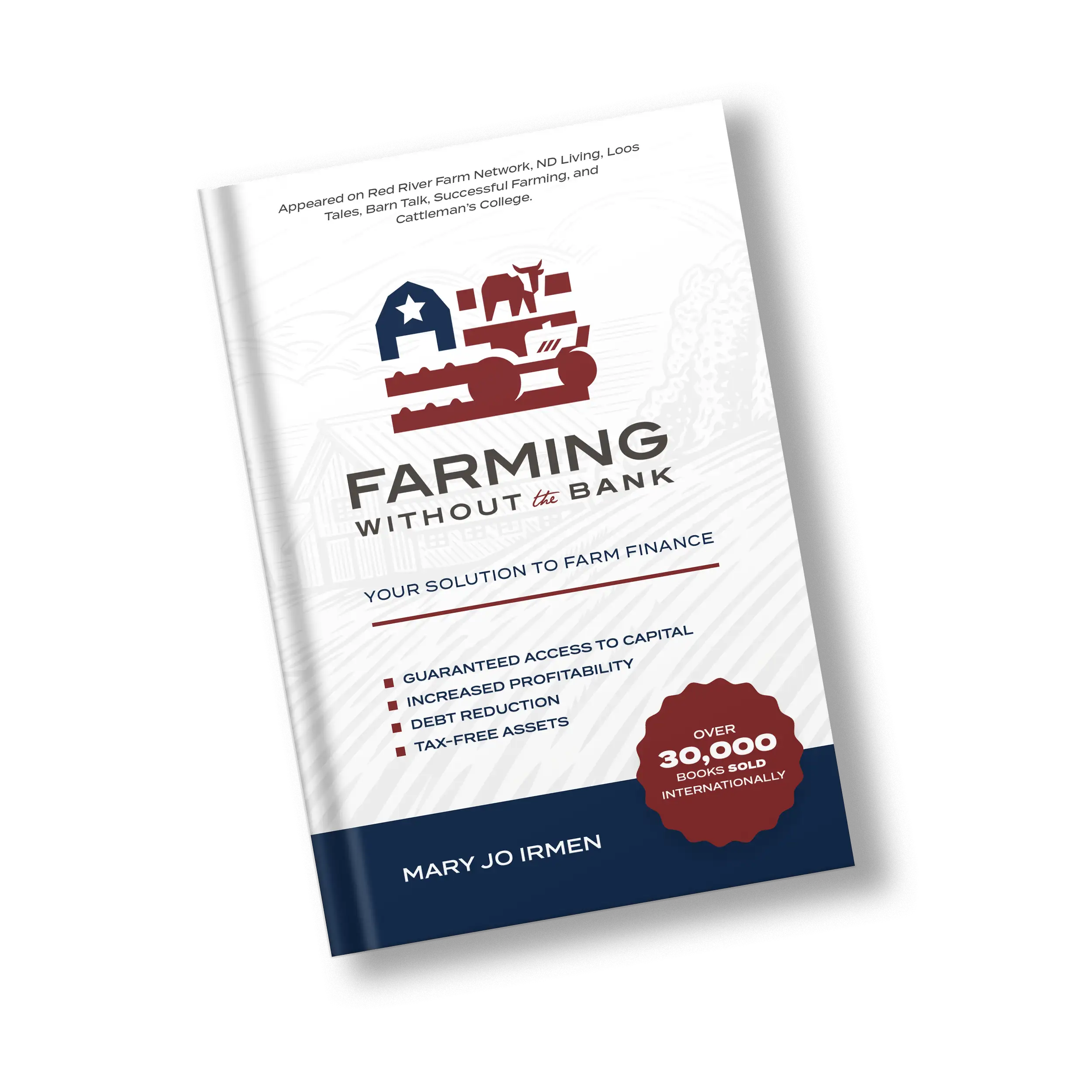
Your farm’s financial independence starts with one book.
30,000 farmers and ranchers have already made the shift. The only question is how long you’ll keep paying interest you could be keeping yourself.