 GET THE BOOK
 GET THE BOOK




Podcast
EP. 288
Ep. 288 – Client Interview: Brian Munger
Feb 6, 2025 ·
42 min
0:00 / 41:38
EPISODE OVERVIEW
ABOUT THIS EPISODE
From Farm to Financial Freedom: How Brian Munger Uses Whole Life Policies for Generational Wealth
Today Brian Munger is talking with us about his journey adopting the Infinite Banking financial strategy, his ranching operations, the importance of financial education for his children, and the family’s unique approach to financial management. Learn how the Munger family transitioned their ranch management, involved their kids in financial decisions, and utilized life insurance policies to secure their financial future.
- ► Learn more: farmingwithoutthebank.com
- ► Get the book
Audio Production by Podsworth Media
Video Production by The Post Production Shop
CHAPTER TIMESTAMPS
- 00:00Introduction and Welcome
- 00:26Meet Brian Munger
- 00:58Brian's Background and Family Involvement
- 01:34Discovering Farming Without the Bank
- 02:49Brian's Ranching Operations
- 03:44Financial Education for the Kids
- 11:50Transitioning the Family Ranch
- 20:54Family Milestones and Future Plans
- 21:56Importance of Communication in Family
- 23:09Utilizing Policies for Financial Growth
- 27:26Family Banking and Lending Strategies
- 30:36Community and Networking Benefits
- 36:52Continuous Learning and Education
- 40:11Final Thoughts and Contact Information
YOUTUBE EPISODE
TRANSCRIPTION
“If you don’t use it, you lose it. And I have had people come back to me and go, what do you mean I have a whole life policy? What do you mean you don’t know you have a whole life policy? Like, at what point, like you buy it and think it’s just magic and it’s going to happen? You’ve got to put the effort and time into it because you’re now the banker and you have to put the banker hat on.”
Hello, hello, hello, and welcome back to the podcast. Thank you very much for being here. I appreciate it. Okay, today is exciting. You guys always want client interviews and not everybody wants to be interviewed. And so I’m excited today that Brian Munger from Nebraska, I will not give away his town. He can if he wants you to stalk him. But, you know, Nebraska is a big state. You go find Brian. So Brian has agreed to be on the podcast and he has a lot of super exciting stuff that we’re going to talk about. So thanks, Brian, for being here.
Hey, I’m excited as well. Thank you for having me.
Oh, so Brian and I met in 2020. I was looking back today to prepare and I thought, oh, it’s only been five years. It feels, it feels like it’s been longer than that.
Definitely. It’s been a long five years. Yeah.
I’m not sure. But it feels longer because you guys have done so many things with your policies. And we have the family involved and all that stuff we’re going to talk about. So it feels like it’s been longer than five years.
Yeah. It’s. Yeah.
So anyway. Okay. So we met in 2020. How did you hear? Do you remember how you heard about Farming Without the Bank?
Yeah. If anybody remembers what happened in 2020, it was COVID, right? And so it’s March of 2020. And I had two kids in college at the time and they got sent home at spring break and to not return. And so we started doing a lot more reading at that time. And, and I’m also part of Farrow Cattle Company in Colorado and they have a discussion group. And part of that discussion during the time came up with the book recommendations and reading lists and stuff. And one of the recommendations that came up was your book, Farming Without the Bank. So being the readers that we were, we ordered it right away. And simply, I mean, I read it in a couple hours and I was hooked. I drank the Kool-Aid right there. And got on your calendar. And I think by the end of May, we had policies lined up and ready to go. So.
So Brian got on my calendar before it was a three month wait.
Right.
That is not the case any longer today, but that it’s close. It’s close. Can you tell us just a little bit about your operation and what you guys have going on?
Sure. As you said, we live in Nebraska. We’re in North Central Nebraska. Springview is the name of my town. It’s one of those small towns you don’t find on every map. So North Central Nebraska, right on the South Dakota border. Actually, the ranch that we live on is actually my great, great grandfather’s homestead. 1883. Pretty excited. I’m fifth generation. And of course, then my kids are the sixth generation to operate this land. So excited about that. We do run a registered Black Angus cow herd for Farrow Cattle Company. I also develop all of the bulls for Farrow Cattle Company for their Nebraska bull sale. Then we custom graze some cattle for some other guys. And then we do some Sell-By marketing and trading yearlings of our own in the fall and winter and summer months.
Okay. And so here’s the big thing that I was excited about is how many kids do you have?
I have six kids.
And guess what, everyone? They all showed up in our first meeting. And if I, how old was the littlest? Was he, I want to say like eight or nine or something?
Probably 12.
12?
He just turned 17 this month. So.
Oh, okay. He would have been, yeah, probably 11.
Yeah. Yep.
Okay. So it was fun because all, had they all read the book or was it just the older kids?
No, I had everyone read the book before we scheduled our meeting with you.
Okay. So we all want to know, are you holding a gun to their head? Like, what are you doing to get all the kids to read the book? Because here’s the thing, you’re not homeschooling. At that time, we were not homeschooling. So typically, if it’s a homeschool situation, that’s all understandable. But when we’re going to public school, because I thought, these guys are homeschooling. They have, why else would these kids be reading books that their parents told them to read? So I think that’s a big piece of, and a big reason why I wanted to talk to you today is because how did you, how are you getting them to buy in to everything that you guys are doing?
Yeah, great question. We’ve always been, well, even my dad was very progressive in the things that he did here on the ranch. And so we’ve always tried to be continual learners, to be educated in a lot of different things. And so reading books, listening to podcasts has been kind of our thing that we do. And COVID enhanced that to some degree. But being a short read, and as excited as I got after I read it, you know, it kind of flowed over to each of the kids. And they were willing to read it and saw the value in it right then. And then not only did the Farming Without the Bank book, but then I ordered Nelson’s Becoming Your Own Banker book. And with the combination of those two, it really cemented the whole idea for, and I had each of the kids read it as well. I don’t think they all had it read before a meeting with you, but I did have them all read that as well.
So are you talking about finances with the kids? Did they just grow up in a situation where you guys shared the money? You shared the business side of it with them, so there was never any secrets?
Not really secrets, no. But what we did with each of the kids when they turned eight years old, we gave them a heifer calf. Or a bred heifer, I guess it was. And at that same point, then they each opened their own checking account. And from then on, they had to pay for their own stuff. Clothes, school lunches, shoes, anything that they wanted to buy, except groceries and stuff in the house. We paid for that, but they were responsible for paying for their own stuff. And so finances has been, you know, throughout their growing up ages, has been a priority for us. Because my wife didn’t grow up with that. And we wanted that for our kids to have that financial literacy and understanding of how money works.
So did you have kids that were like, oh, well, who cares how much school lunches were? Could you see that? Because you know every kid is not the same. So could you see the difference in, oh, well, you spent all yours. Were they borrowing? Were they lending money to one another at that point?
No, not really. But the different personalities of the different kids is very, very evident. You know, my oldest son, Ethan, would save up his money and then he would buy a motorcycle. He was into those toys. My oldest daughter, Kailin, she wouldn’t spend money on a backpack because she wanted to save all of her money until she could buy one more cow. We gave each of the kids five bred heifers. That’s what it ended up. And then after that, they had to purchase their own or whatever it may be. And so her whole goal was to buy as many cows as she could. And I think when she graduated high school, she had over 20 cows.
Did she have to pay you rent?
What we did was the first five calves that they sold for the year, they got 100 percent. And then we split 50 percent, everything over and above that. And plus they were working for me and that was part of their paycheck. So.
Yeah. So I have I don’t know. Did you know that my folks did something very similar?
No.
I’ve never told you that story. So my parents did something very similar. We all got one. And then whatever, if it was a bull and it was in the bull sale, then we got the proceeds of the bull. Right. So the boys were always like, oh, I have a bull and you had a heifer. And I’m like, who cares? Because I’m compounding my money. Like, of course, I didn’t know what I was then, you know, but I’m like, I don’t care. So when it came time for my folks to disperse, I had like five cows or seven cows or something. And my dad’s like, I’m going to have to start charging you.
Exactly.
And then at the last bull sale, I had a whole ton of bulls. I didn’t get any of the money because my parents were not in a situation to be sharing that at the moment. But, you know, it really like it. It’s a great way because we had to if I didn’t have to pay for clothes and that sort of thing. But I did have to like if I wanted to go on a trip or if I wanted a vehicle, I had to use that money to pay for some of that stuff. And we could not access the money without my mom signing off and saying, yeah, they can take money from savings. But it was great. If we had a bull in the sale, we had to pay auctioneer fees. We had to pay cleaning fees. We had to pay barn fees. All of that came out of the bull check. We didn’t just get a bull. And then if somebody bought it, we had to write a thank you letter. So we already knew that whole process. That was very normal, you know. And I think that I did that with I did it late with my daughter. She was about 17, I think. And I said, OK, here’s the deal. You’re going to mail all my books out and then I’m done paying for everything. And it was the best thing ever, because when she moved out, the only shocker was food costs because I was buying all the groceries. But it’s great to get them to manage money. If you want clothes, if you want a prom dress, if you want makeup, if you want all this expensive skin care, you want you need to fill gas. That’s all on you. I’m not paying for any of that stuff. But it really makes them learn how to manage money.
Well, and it really makes them think about the things that they do buy. When their friends are going to the buckle to buy jeans and my kids are going to the thrift store and finding basically brand new jeans for way less money. It really changed how they looked at what they spent their money on.
And even your oldest one has a, doesn’t he have a four-wheeler shop?
Yep. Four-wheeler business.
Yeah. And so, but even his love of toys turned into a business.
Exactly. Yep.
You know, so it’s not like he was buying that stuff, but it still ended up being a passion that he followed. And now he’s got the shop.
Yep.
Yeah. So that, it’s just so exciting to see like what people are doing to get their kids involved. Because so many people don’t. And I think some of that is that we don’t talk about money. It’s this poo-pooed idea of we don’t need to give them any insight to our business. We don’t need to talk about how we’re making money. And that very much was something when I grew up. The supper table was just where we talked about what’s the gain? What do we got to feed? What’s that going to cost? Like dad had a calculator in his pocket all the time. It was just a common occurrence at the supper table.
Yep.
So you have a transition that, and maybe I’m wrong. And if I am, we’ll edit this out. But your dad started that transition when he was 55 to you, right? And so your intention is to do the same thing, correct?
Correct. Actually, he was 48.
Oh.
When I was able to take over. And that’s a neat story as well. My dad being in the position, one, to let me take over, but also him being willing to hand the reins over to me, who I was 27 at the time. Not many fathers are in that position or willing to hand the reins over to their son at that age. Very, very fortunate in that.
Yeah. So can we talk about that a little bit? Like, what did that, if you’re willing to share, what did that look like? Like, what’s dad doing now? How did, how long did that transition take? All that kind of stuff.
Yeah, sure. It all kind of precipitated. Well, I went to the University of Nebraska. I got an animal science degree. So I graduated from Lincoln in 1997. Jill and I were married in 1995. So we were able to spend two years in Lincoln, you know, away from family, away from financial pressures. And I would sure recommend that for any young couple to not get married and move right into the family ranch. That’s a high stress period if, you know, finances and work and all that stuff. So if you can take a year or two years to spend, you know, away from all of that without those financial pressures and just build your relationship with your spouse, I think that’s tremendous. You know, Jill, she’d went to a two-year college, was graduated when we got married. I was still going to school, but then she had a full-time job in Lincoln. You know, so finances were not pressure for us. And we just had two years to spend together without all the family trivia that can go on.
And so graduated in ’97, came back and pretty much at that time took over the day-to-day routine with my dad. You know, he still made all the major decisions and wrote all the checks and all that. But as far as deciding when to move cows and stuff like that, I pretty much took care of all that.
2002, my dad had got to a point with his body. He’d had trouble with his back ever since high school football and had been told by three different orthopedic surgeons that he needed to take it as long as he could. And when he couldn’t take it anymore, then fuse his vertebrae together and go on. And he had got to that point where he couldn’t sit in a tractor. He couldn’t sit in church. It just hurt. So he had surgery scheduled. And that’s kind of what led to me wanting to take over for my dad, knowing he was going to be laid up, you know, for an extended amount of time with his back surgery. And so in 2002, then we drew up some lease agreements where I leased all of his cows, leased his land, and leased his machinery. The after story of that was he had got one of his friends and suggested that he get a second opinion, even though he’d already had three. They said, you need to go to see a neurosurgeon instead of an orthopedic surgeon. And so he was able to. I mean, sometimes that’s hard getting into, but called him on a Friday. And I think they said, if you can be here on Wednesday, we’ll look at you. Took his old x-rays, gave them to the PA when he walked in. And PA looked at those old x-rays and said, I don’t think you have a herniated disc in your back. I think you have a cyst. And so surgeon came in, they took new x-rays, looked at them and surgeon said, yeah, you do not have a herniated disc. You have a cyst in your back. We can go in this afternoon, cut it out and you can go home tomorrow. So just a tip for all of you out there. Sometimes we get so specialized, we can only see certain things.
Yeah.
Sometimes it does take another specialist to look at the same information.
Or four of them.
Yeah. And come up with a different diagnosis. And so he did. They cut it out. He came home and I said, dad, this isn’t near what you thought it was going to be. If you want the ranch back, you know, we’ll tear up these papers and you can have it back. And he said, Brian, no. I said, I’m done ranching. He said, this is where you need to be. This is where you want to be. This is how we’re going to proceed.
And so my dad worked for me for a little bit. Then he would help out the neighbors and drive truck for them during harvest and different things like that. And came to a point where he likes to study his Bible a lot and was teaching adult Sunday school. And we had a reunion at our church, an anniversary, a 30th anniversary for our church. And several of the old pastors came back. And without me saying anything, a couple of them told my dad, you need to go be a pastor. And so he thought about it and thought about it. And then as the story goes on, my grandmother plays horseshoe. And my mom and dad took her to the World Horseshoe Tournament out in California. And my dad was just kind of irritable and stuff. And my mom finally looked at him and said, are you going to turn in that application for that pastor position? And so that’s when he did. And then they became associate pastors. He became an associate pastor with Village Missions and was able to travel around the country, filling in at small rural churches, small ranching communities just like ours, fill in at those places until they found a full-time pastor. And so he spent, this is just a guess because I can’t remember exactly, but probably seven or eight years traveling to different parts of the country, filling in at these churches. And so huge learning curve for me during that whole time. You know, I was so dependent upon my dad during those early years. And he was there for me all the time. But then he left. And that is when I really started learning how to make decisions for myself and to grow in my own management skills and stuff when he wasn’t there for me to always fall back onto. So that was a huge opportunity for us and even for Jill and I, because, you know, I relied on my dad so much during that time. When he was here and then when they left, then it became Jill and I again, you know, as a team and leaning on each other more even during that time.
So a bit of a blessing in disguise. Like you, not only did you have to, you got to farm the way you wanted, but you didn’t have, I mean, I’m sure he was just a call away, but it wasn’t a daily, hey, what would you do here? What would you do there? You now had to farm with Jill, right? Because before you’re farming with dad.
Exactly. Yeah. But we got to stop here, Mary Jo, because you just said farm.
Oh, sorry.
And I was going to bring this up earlier and I kind of forgot, but I almost did not read your book because it was called Farming Without the Bank.
I know. There’s a couple of you guys that are like, I ranch. I do not farm. So people will say something about ranching or farming and I’m like, it depends where you are in the country. Up here, it’s farming. If you go west or south, it is ranching.
Yeah. We have no row crops. All we do is cattle and we do put up some hay meadows. But yes, I just thought I better rub that in just a little bit.
There’s another guy that drives him crazy too. He will email me. It is not farming. So that is super interesting. And so how old are you now?
I am going to turn 50 in just a few weeks.
So what are your, well, happy early birthday.
Well, thank you.
What are your plans? Are you, is the transition to start happening at 55?
I don’t know exactly. I still have two kids home that are still living here. So Courtney and Shane are 17 and 18. Not planning to make any huge major decisions while they’re still here at the house. We do currently homeschool them. That’s been a change since we first started working together. But they are probably both going to graduate this coming May. So we’ve started some family discussions now that…
But you’re not going to wait until you’re 85.
I am not going to wait until I’m 85.
So kids, if you’re listening, he’s not waiting.
Pretty, been pretty blessed. Both of my oldest daughters got married within the last year and a half. And my two oldest boys are getting married in the next two months, three months. Very exciting times. And actually, my middle daughter that got married first is going to put Jill and I in the realm of grandparents this…
Oh!
In about a month.
Oh, a lot’s happening in the next month. Oh, man.
It is exciting times.
That is exciting. I didn’t know that the boys were getting married. So it’s very exciting.
Yeah. So we’ve started Thanksgiving. Everybody was able to be home. We’ve started having some family discussions about what things will or will not look like in the future. Nothing definite. Like I said, we still have two kids at home and looking forward to seeing what they do. But Colton, he has a custom fencing business but would like to be more here at the ranch. And so he’s getting married in June. I think after that time, you know, the fencing will start to decline. And his time here at the ranch will probably start to increase. We’ll see what happens after that.
Here’s the key, though. You’ve already had discussions. Like the communication is open. And so when we don’t communicate, that’s when the problems start to happen. And so it’s like… And the communication’s always been there, right? Read the book. Get involved. Let’s look at… Let’s teach you how to handle your finances and all that good stuff. I think that that is a big takeaway here. If you guys are listening and saying, well, how do I get my kids involved? Well, they don’t get involved if you don’t involve them. And so you have… And it’s harder as they’re older. Like my kids were older when I started this. Obviously not Haley because she was at home and little. But my stepkids were older. It’s harder to get that mindset when they’re not… A, they’re not with you all the time. And they’re just… They’re already kind of doing their thing. But you still have to communicate. You still have to talk about money. It’s just money. It’s not like… It’s just money. You know? And if we don’t… We’re so worried to talk about it because we’re scared they’re going to tell somebody how much money we make or whatever. Well, what if you learn something? What if? You know, you never know. So let’s talk about how you’re using your policies because this is exciting.
Sure. You know, for Jill and I, we both started policies on ourselves when we first started. And I think with the cash value from those two policies together, I think we bought a group of cows. And they’re what we would call trade cows. They weren’t something that I was going to keep forever. But we saw an opportunity. And so we had the cash value. We pulled that out and bought this group of cows. And then when we sold them, then we paid it off. And then pretty much since then, our goal has been to, you know, get away from the bank and the operating line as much as we can. So since that original cow purchase and paying that back off, then pretty much now we’ve just been transferring operating note to the policy and using that for our operating. That’s been the main goal right now. You know, I may never get away from the bank in my generation just because of land purchases and stuff like that. But if I can get away from the operating side, that’s our main goal right now with Jill’s and my policies.
Yeah. And it’s not an all or nothing approach. Right. You’re still creating generational wealth that will help the kids possibly get to be in a different position upon your passing.
Yep. Yeah. And then we also have a policy on each one of the kids.
Yep. And the kids, unless we’ve changed it, three of the kids own a policy on you.
Correct. Yep.
Which is exciting.
Originally.
Yeah. Yeah. Well, what’s exciting is not that they own a policy on you per se. What’s exciting to me is that those three together were like, oh, we should have a policy on dad, but we can’t afford it individually because this was, you know, what, four years ago? We can’t afford it individually. So let’s just all pool our money together and let’s have a policy on dad.
Yep. Yep. Yeah. And the whole thought process was, yeah, I am the oldest and, you know, most likely the one to die first. So why not, why not give the family a jumpstart to get this thing rolling, you know, at some point down the road? So, yeah, pretty excited about that. It’s not without its challenges. Having three owners and now, you know, with them all growing up and getting married, it does add another layer of complication to that.
I don’t know. How are they managing it?
Pretty much we’re just using an Excel spreadsheet right now to…
What happens when one wants to take a loan? Like, what are they using the loans for?
So when we started this, they all kind of came up with the amount of money that they thought they could put in. So that is how we’ve handled it. That’s their percentage. So each kid has, you know, they put in the same premium each year and that’s their percentage. That’s what they can borrow back out. They originally, the first loan that we did on that policy, they loaned it to Jill and I to buy our Yukon. And so we just took their whole cash value and then we make monthly payments back into that policy with interest. And then since then, they’ve made more premium deposits and we’ve made loan repayments back. And so just based on their percentage that they put in, that’s how much that they can take out individually. So just using a spreadsheet to try and keep track of that. Not completely perfect. Our numbers aren’t always exact, but close enough that they know what they have available and what they can do with it.
And at some point, if somebody wants to buy somebody out, they can do that. Right. If two of them said, I want out, this is just too complicated. Just buy me out. They could, whoever is left owning that policy could borrow against that policy and lend them the money to buy them out. And they could take that money and go start more policies with it. But we also had, what I also like is that you guys are lending money. Like they lent you money for a Yukon, but they also lent money to one of the girls.
Yep. So Keely was wanting to go to culinary school. And then of course, this was during COVID as well. And so she ended up, they were going to loan her the money to pay because that was an upfront. It was a one-year school. They wanted all of it upfront. And so the kids were going to loan her the money for that. Yeah. Ended up because of COVID and other circumstances, she did not go, but had an opportunity to buy some bred heifers instead. And so she took the same amount of money then and applied it towards those bred heifers. Then she made payments back to the kids as well. For, I think we amortized that over five years.
So do they make each other sign contracts? Do you guys all sign a lending contract or do you just run an amortization schedule?
We’ve done both.
Okay.
I think we’ve had your office actually on one of those. I think we actually had Tiara or somebody do an actual amortization contract. But for the most part, we probably just do a, I just print off an amortization schedule and a handshake or a hug.
It’s so fun to watch because most people don’t get the family banking piece that we can be lending them to siblings. Now, would I lend money to a sibling that probably doesn’t know how to manage their money? No, but we already know that, right? Because you’ve given them money this whole time. We know who’s going to pay back or who’s not going to pay back or whatever. And do they, because they could always have the cows as collateral.
Yep.
Or they have your Yukon as collateral.
Right.
If something crazy happens. Any other things that, these are all just the things I know going on because I can, I kind of, we either talk or I hear about it from the kids or whatever. But I do know, like I see text messages coming in from the kids once in a while to borrow money. Do they talk to you about every time they want to borrow or are they so comfortable already that they’re just like, oh, I know that I want to borrow. So I’m just going to borrow.
You know, we still talk about it quite a bit.
Okay.
Just because of strategy more or less, you know, should I actually take this? Should I be buying this? So those are the kind of things that we talk about. And then, yeah, do I have some cash value available? Then, yeah, let’s go ahead and utilize that. And so Colton actually bought some bred heifers this year, actually went to the bank and got a note for them. But now after his last premium deposit, then hold the cash value out of that and he’s going to go pay the bank off. So, so we try and utilize, you know, as best we can. The bank is still involved and they know what we’re doing as well. So, yeah, just trying to make the best use of what we can.
Yeah. Any, so do you still meet with, I know for a while there was another, a friend of yours that was also doing Infinite Banking. He was using a different practitioner, but you guys would get together and meet and talk about strategies and that kind of stuff. Are you still doing that?
Yeah, there’s actually my neighbor and my brother-in-law both are here and we talk about it fairly regular. In fact, I think Saturday, my neighbor and I were discussing quite lengthy different strategies and different things that he was doing with their policy and with his kids as well, because he’s got three kids and two of the three are involved with the Infinite Banking. And the third one has not chose to do that yet. But yeah, just trying to keep adding value to our families. And so actually looking at different strategies, how we can help each other out, not just within my family, but, you know, between our two families and how that, what that might look like. So that’s exciting. Just trying to keep the money in our community. First, as much as we can within our family. But second, if we can help out our community, that’s the next step that we would like to go to.
And I think it’s Nelson talks about it in his book. You need to find like-minded people so that you have a place to talk about stuff. Right. Which is why I’ve created for clients, the Coffee with MJ, the client summits, that kind of stuff, like trying to keep people involved. But it’s like you can see all the pins on my map. Like you probably have a neighbor. You probably have somebody in your state that is working with me. And so it’s really, it’s like, I obviously I can’t give people’s names because that’s confidential, but we do have a Facebook group. And so if you are a client listening, you can go in that Facebook group and say, hey, anybody from X state in here? And if they want to volunteer that information, great. Not everybody’s in there, but we have quite a few. Because it is nice to have somebody to talk to. I have clients that have come to my Client Summits, you know, a couple of them, and they’ve become friends and now they text and talk every morning. And it’s really nice. Like I have a couple of clients that I think they text, they actually text like a daily devotion or something back and forth to one another, which is super cool. Super cool. So, but then they’re always talking about strategies and all that kind of stuff because they don’t know anybody else in their community, you know, and they’ve kind of bonded over it. But Nelson said, that is extremely important. And it doesn’t matter that it’s not with the same practitioner, that I’m not their agent. That does not matter. Who cares? You guys are both doing the same thing. But that’s exciting that you’re going to try to start borrowing or helping one another.
Yeah, I’m pretty excited about that. And I just, I think of, you know, just, oh, I don’t even know how to say this, but you have a circle around you. And the more people you get to know, that circle just keeps getting bigger. And the more people you meet, then the more people that you meet. And it’s been pretty cool. Different educational things. That’s something else that’s been important to us is continuing education. So different schools, whether it’s stockmanship or Sell-By marketing or, you know, any of those things you get, the education is valuable, but the networking that’s done at those events, to me, is worth far more than the education itself.
Yeah. And it’s fun because when I talk to a client, I talked to a client not that long ago that said, oh, Brian’s doing Wally Olson stuff. I was like, what the heck? I haven’t talked to Brian forever. He’s not keeping me up to date with what he’s doing, you know? And so you’re as, and it, like my circle tends to be that same circle, right? The IBC people are still thinking like the Sell-By people, like the Ranching for Profit people or Sell-By people. So it’s still like, it’s a very small community of those people that think like that.
Yes.
And so when you go to Ranching for Profit, oh, hey, Mary Jo, or Farrow even. Like there’s a lot of people within, I learned about Farrow a long time ago, like right almost after my book was published. And so Farrow is a very common thought process amongst all those people as well. So yeah, it’s not real hard to find another fellow IBCer or person that’s at least read the book, you know?
Yeah.
Are you tracking your loans in QuickBooks? How are you tracking your, the loans and the paybacks and all that kind of stuff?
Yeah, we do use QuickBooks. And yes, I do. When we take a policy loan, we do put it into QuickBooks as a liability. And then, as I mentioned, you know, trying to transfer all of our operating note and stuff over. So on those two policies, we are only making interest payments currently. And then on the other policies, we’re making, you know, loan repayments with interest back on those. So that’s all amortized out and accounted for in QuickBooks.
How do you account for your cash value in QuickBooks?
I have not done that side. I’ve done the liability side and not the asset side.
Okay. Okay. Everybody does it a little bit differently, but that’s just a common question. So I thought that I would ask.
Yeah. No, I think it would probably be good. I just, I’m not smart enough to know how to do it yet.
We had Jordan Steele. Do you know Jordan?
Yep, I do.
So Jordan actually presented at the summit and he did a presentation on it. But we’re going to have him talk at one of Coffee with MJ too. So that, yeah, that’ll be good. So, you know, get an idea of how Jordan’s doing it anyway.
No, he’s a smart guy.
Yeah. Yeah. Everybody loves, it’s hard not to like Jordan.
Yeah, right. He’s awesome.
Okay. I don’t think I have any other questions for you. Is there anything that you would add that you would like to add before we sign off?
Yeah. It’s a continuum. If you don’t keep reading the books, if you don’t keep listening to the podcast, you know, as Nelson said, if you don’t use it, you lose it. And that’s true in this as well. And so I just encourage everyone. I try to read Nelson’s book or your book every year. I don’t always get it done. And I also encourage my kids to reread it because, you know, sometimes they start to rely on me or, you know, other people. And I keep pushing them back to go back and read the book. The answers are in there. The answers are in there. And it’s going to bring up other questions or other insights as you read through it again. Because, you know, Zig Ziglar says you have to read something or hear something, I think he says, 16 times before you get it all. That’s a lot of times you’re reading through or you’re listening to something and something catches your ear and you’re thinking about that and you miss, you know, what’s being said next. And the next time you listen to it, you know, you get that next part. So I just encourage everyone to go back and keep learning. Don’t ever stop or you’re going backwards.
Yeah. And it is a, no, I read it. And I think I talked about this on a podcast. I read BYOB from the standpoint of teaching it. So I’ve always read it from a standpoint of, oh, okay, I’m going to learn. Right. This is what Nelson says in the book. But now that I’m on the council for NNI and we have coaching academy for these other agents, I have had to read it from the standpoint of teaching it. Holy cow. I am like, my whole book is just, my husband said, why don’t you just highlight every word in that book? And I’m like, well, all of these words are important. But then I started underlining red and green. And it’s just been really eye opening from that standpoint. Or I’ve started to, this might sound bad, but when I fly, I fall asleep. Like sometimes the plane’s not even off the ground. And so if my plane crashes, I probably didn’t even know.
Might be better.
Yeah. That’s what I’m thinking. But so I have downloaded the audio version of Nelson’s book.
Yep.
And it’s amazing what I’m hearing versus what I’m reading. So as I’m listening, I’m like, oh, I don’t remember him ever saying that in the book. And so all of those different versions of how your mindset is, how you’re reading it, what you’re hearing, I would encourage people even to just get the audio. And that’s on Audible. But just get the audio of both of them, mine and Nelson’s, and then reread it. But you’re right, 100%. If you don’t use it, you lose it. And I have had people come back to me and go, what do you mean I have a whole life policy? What do you mean you don’t know you have a whole life policy? Like, you buy it and think it’s just magic and it’s going to happen. You’ve got to put the effort and time into it because you’re now the banker. And you have to put the banker hat on.
Yep.
So, yeah, that’s awesome. I love it. All right. Well, thank you. Okay. So if people want to reach out to you, do you have a way that they can get a hold of you?
Yeah. I’m more than willing to share my cell phone number if anybody wants to text.
Go ahead.
Yep. 402-382-8814.
Okay.
And feel free to text or call. More than willing to visit with anybody. As kind of one of our family quotes is one of Zig Ziglar’s: you can have everything you want in life, if you’ll just help enough other people get what they want. And I think that’s what you’re doing. It’s our goal in life is to help other people.
Awesome. Thank you.
Feel free.
All right. Well, guys, you know the routine. If you have questions, comments, whatever. maryjo@withoutthebank.com. Otherwise, go grab your book. Schedule your appointment. And then we’ll sit down and talk about how it works and if it works. Have a good rest of your day.
Thanks for listening to the Farming Without the Bank podcast. We hope today’s episode has inspired you to take control of your finances in new ways. Don’t forget to check out our website, farmingwithoutthebank.com. And engage with us on our Facebook page, Farming Without the Bank. Join us next week as we smash more financial myths and empower you to accomplish your financial goals.
View MoreHello, hello, hello, and welcome back to the podcast. Thank you very much for being here. I appreciate it. Okay, today is exciting. You guys always want client interviews and not everybody wants to be interviewed. And so I’m excited today that Brian Munger from Nebraska, I will not give away his town. He can if he wants you to stalk him. But, you know, Nebraska is a big state. You go find Brian. So Brian has agreed to be on the podcast and he has a lot of super exciting stuff that we’re going to talk about. So thanks, Brian, for being here.
Hey, I’m excited as well. Thank you for having me.
Oh, so Brian and I met in 2020. I was looking back today to prepare and I thought, oh, it’s only been five years. It feels, it feels like it’s been longer than that.
Definitely. It’s been a long five years. Yeah.
I’m not sure. But it feels longer because you guys have done so many things with your policies. And we have the family involved and all that stuff we’re going to talk about. So it feels like it’s been longer than five years.
Yeah. It’s. Yeah.
So anyway. Okay. So we met in 2020. How did you hear? Do you remember how you heard about Farming Without the Bank?
Yeah. If anybody remembers what happened in 2020, it was COVID, right? And so it’s March of 2020. And I had two kids in college at the time and they got sent home at spring break and to not return. And so we started doing a lot more reading at that time. And, and I’m also part of Farrow Cattle Company in Colorado and they have a discussion group. And part of that discussion during the time came up with the book recommendations and reading lists and stuff. And one of the recommendations that came up was your book, Farming Without the Bank. So being the readers that we were, we ordered it right away. And simply, I mean, I read it in a couple hours and I was hooked. I drank the Kool-Aid right there. And got on your calendar. And I think by the end of May, we had policies lined up and ready to go. So.
So Brian got on my calendar before it was a three month wait.
Right.
That is not the case any longer today, but that it’s close. It’s close. Can you tell us just a little bit about your operation and what you guys have going on?
Sure. As you said, we live in Nebraska. We’re in North Central Nebraska. Springview is the name of my town. It’s one of those small towns you don’t find on every map. So North Central Nebraska, right on the South Dakota border. Actually, the ranch that we live on is actually my great, great grandfather’s homestead. 1883. Pretty excited. I’m fifth generation. And of course, then my kids are the sixth generation to operate this land. So excited about that. We do run a registered Black Angus cow herd for Farrow Cattle Company. I also develop all of the bulls for Farrow Cattle Company for their Nebraska bull sale. Then we custom graze some cattle for some other guys. And then we do some Sell-By marketing and trading yearlings of our own in the fall and winter and summer months.
Okay. And so here’s the big thing that I was excited about is how many kids do you have?
I have six kids.
And guess what, everyone? They all showed up in our first meeting. And if I, how old was the littlest? Was he, I want to say like eight or nine or something?
Probably 12.
12?
He just turned 17 this month. So.
Oh, okay. He would have been, yeah, probably 11.
Yeah. Yep.
Okay. So it was fun because all, had they all read the book or was it just the older kids?
No, I had everyone read the book before we scheduled our meeting with you.
Okay. So we all want to know, are you holding a gun to their head? Like, what are you doing to get all the kids to read the book? Because here’s the thing, you’re not homeschooling. At that time, we were not homeschooling. So typically, if it’s a homeschool situation, that’s all understandable. But when we’re going to public school, because I thought, these guys are homeschooling. They have, why else would these kids be reading books that their parents told them to read? So I think that’s a big piece of, and a big reason why I wanted to talk to you today is because how did you, how are you getting them to buy in to everything that you guys are doing?
Yeah, great question. We’ve always been, well, even my dad was very progressive in the things that he did here on the ranch. And so we’ve always tried to be continual learners, to be educated in a lot of different things. And so reading books, listening to podcasts has been kind of our thing that we do. And COVID enhanced that to some degree. But being a short read, and as excited as I got after I read it, you know, it kind of flowed over to each of the kids. And they were willing to read it and saw the value in it right then. And then not only did the Farming Without the Bank book, but then I ordered Nelson’s Becoming Your Own Banker book. And with the combination of those two, it really cemented the whole idea for, and I had each of the kids read it as well. I don’t think they all had it read before a meeting with you, but I did have them all read that as well.
So are you talking about finances with the kids? Did they just grow up in a situation where you guys shared the money? You shared the business side of it with them, so there was never any secrets?
Not really secrets, no. But what we did with each of the kids when they turned eight years old, we gave them a heifer calf. Or a bred heifer, I guess it was. And at that same point, then they each opened their own checking account. And from then on, they had to pay for their own stuff. Clothes, school lunches, shoes, anything that they wanted to buy, except groceries and stuff in the house. We paid for that, but they were responsible for paying for their own stuff. And so finances has been, you know, throughout their growing up ages, has been a priority for us. Because my wife didn’t grow up with that. And we wanted that for our kids to have that financial literacy and understanding of how money works.
So did you have kids that were like, oh, well, who cares how much school lunches were? Could you see that? Because you know every kid is not the same. So could you see the difference in, oh, well, you spent all yours. Were they borrowing? Were they lending money to one another at that point?
No, not really. But the different personalities of the different kids is very, very evident. You know, my oldest son, Ethan, would save up his money and then he would buy a motorcycle. He was into those toys. My oldest daughter, Kailin, she wouldn’t spend money on a backpack because she wanted to save all of her money until she could buy one more cow. We gave each of the kids five bred heifers. That’s what it ended up. And then after that, they had to purchase their own or whatever it may be. And so her whole goal was to buy as many cows as she could. And I think when she graduated high school, she had over 20 cows.
Did she have to pay you rent?
What we did was the first five calves that they sold for the year, they got 100 percent. And then we split 50 percent, everything over and above that. And plus they were working for me and that was part of their paycheck. So.
Yeah. So I have I don’t know. Did you know that my folks did something very similar?
No.
I’ve never told you that story. So my parents did something very similar. We all got one. And then whatever, if it was a bull and it was in the bull sale, then we got the proceeds of the bull. Right. So the boys were always like, oh, I have a bull and you had a heifer. And I’m like, who cares? Because I’m compounding my money. Like, of course, I didn’t know what I was then, you know, but I’m like, I don’t care. So when it came time for my folks to disperse, I had like five cows or seven cows or something. And my dad’s like, I’m going to have to start charging you.
Exactly.
And then at the last bull sale, I had a whole ton of bulls. I didn’t get any of the money because my parents were not in a situation to be sharing that at the moment. But, you know, it really like it. It’s a great way because we had to if I didn’t have to pay for clothes and that sort of thing. But I did have to like if I wanted to go on a trip or if I wanted a vehicle, I had to use that money to pay for some of that stuff. And we could not access the money without my mom signing off and saying, yeah, they can take money from savings. But it was great. If we had a bull in the sale, we had to pay auctioneer fees. We had to pay cleaning fees. We had to pay barn fees. All of that came out of the bull check. We didn’t just get a bull. And then if somebody bought it, we had to write a thank you letter. So we already knew that whole process. That was very normal, you know. And I think that I did that with I did it late with my daughter. She was about 17, I think. And I said, OK, here’s the deal. You’re going to mail all my books out and then I’m done paying for everything. And it was the best thing ever, because when she moved out, the only shocker was food costs because I was buying all the groceries. But it’s great to get them to manage money. If you want clothes, if you want a prom dress, if you want makeup, if you want all this expensive skin care, you want you need to fill gas. That’s all on you. I’m not paying for any of that stuff. But it really makes them learn how to manage money.
Well, and it really makes them think about the things that they do buy. When their friends are going to the buckle to buy jeans and my kids are going to the thrift store and finding basically brand new jeans for way less money. It really changed how they looked at what they spent their money on.
And even your oldest one has a, doesn’t he have a four-wheeler shop?
Yep. Four-wheeler business.
Yeah. And so, but even his love of toys turned into a business.
Exactly. Yep.
You know, so it’s not like he was buying that stuff, but it still ended up being a passion that he followed. And now he’s got the shop.
Yep.
Yeah. So that, it’s just so exciting to see like what people are doing to get their kids involved. Because so many people don’t. And I think some of that is that we don’t talk about money. It’s this poo-pooed idea of we don’t need to give them any insight to our business. We don’t need to talk about how we’re making money. And that very much was something when I grew up. The supper table was just where we talked about what’s the gain? What do we got to feed? What’s that going to cost? Like dad had a calculator in his pocket all the time. It was just a common occurrence at the supper table.
Yep.
So you have a transition that, and maybe I’m wrong. And if I am, we’ll edit this out. But your dad started that transition when he was 55 to you, right? And so your intention is to do the same thing, correct?
Correct. Actually, he was 48.
Oh.
When I was able to take over. And that’s a neat story as well. My dad being in the position, one, to let me take over, but also him being willing to hand the reins over to me, who I was 27 at the time. Not many fathers are in that position or willing to hand the reins over to their son at that age. Very, very fortunate in that.
Yeah. So can we talk about that a little bit? Like, what did that, if you’re willing to share, what did that look like? Like, what’s dad doing now? How did, how long did that transition take? All that kind of stuff.
Yeah, sure. It all kind of precipitated. Well, I went to the University of Nebraska. I got an animal science degree. So I graduated from Lincoln in 1997. Jill and I were married in 1995. So we were able to spend two years in Lincoln, you know, away from family, away from financial pressures. And I would sure recommend that for any young couple to not get married and move right into the family ranch. That’s a high stress period if, you know, finances and work and all that stuff. So if you can take a year or two years to spend, you know, away from all of that without those financial pressures and just build your relationship with your spouse, I think that’s tremendous. You know, Jill, she’d went to a two-year college, was graduated when we got married. I was still going to school, but then she had a full-time job in Lincoln. You know, so finances were not pressure for us. And we just had two years to spend together without all the family trivia that can go on.
And so graduated in ’97, came back and pretty much at that time took over the day-to-day routine with my dad. You know, he still made all the major decisions and wrote all the checks and all that. But as far as deciding when to move cows and stuff like that, I pretty much took care of all that.
2002, my dad had got to a point with his body. He’d had trouble with his back ever since high school football and had been told by three different orthopedic surgeons that he needed to take it as long as he could. And when he couldn’t take it anymore, then fuse his vertebrae together and go on. And he had got to that point where he couldn’t sit in a tractor. He couldn’t sit in church. It just hurt. So he had surgery scheduled. And that’s kind of what led to me wanting to take over for my dad, knowing he was going to be laid up, you know, for an extended amount of time with his back surgery. And so in 2002, then we drew up some lease agreements where I leased all of his cows, leased his land, and leased his machinery. The after story of that was he had got one of his friends and suggested that he get a second opinion, even though he’d already had three. They said, you need to go to see a neurosurgeon instead of an orthopedic surgeon. And so he was able to. I mean, sometimes that’s hard getting into, but called him on a Friday. And I think they said, if you can be here on Wednesday, we’ll look at you. Took his old x-rays, gave them to the PA when he walked in. And PA looked at those old x-rays and said, I don’t think you have a herniated disc in your back. I think you have a cyst. And so surgeon came in, they took new x-rays, looked at them and surgeon said, yeah, you do not have a herniated disc. You have a cyst in your back. We can go in this afternoon, cut it out and you can go home tomorrow. So just a tip for all of you out there. Sometimes we get so specialized, we can only see certain things.
Yeah.
Sometimes it does take another specialist to look at the same information.
Or four of them.
Yeah. And come up with a different diagnosis. And so he did. They cut it out. He came home and I said, dad, this isn’t near what you thought it was going to be. If you want the ranch back, you know, we’ll tear up these papers and you can have it back. And he said, Brian, no. I said, I’m done ranching. He said, this is where you need to be. This is where you want to be. This is how we’re going to proceed.
And so my dad worked for me for a little bit. Then he would help out the neighbors and drive truck for them during harvest and different things like that. And came to a point where he likes to study his Bible a lot and was teaching adult Sunday school. And we had a reunion at our church, an anniversary, a 30th anniversary for our church. And several of the old pastors came back. And without me saying anything, a couple of them told my dad, you need to go be a pastor. And so he thought about it and thought about it. And then as the story goes on, my grandmother plays horseshoe. And my mom and dad took her to the World Horseshoe Tournament out in California. And my dad was just kind of irritable and stuff. And my mom finally looked at him and said, are you going to turn in that application for that pastor position? And so that’s when he did. And then they became associate pastors. He became an associate pastor with Village Missions and was able to travel around the country, filling in at small rural churches, small ranching communities just like ours, fill in at those places until they found a full-time pastor. And so he spent, this is just a guess because I can’t remember exactly, but probably seven or eight years traveling to different parts of the country, filling in at these churches. And so huge learning curve for me during that whole time. You know, I was so dependent upon my dad during those early years. And he was there for me all the time. But then he left. And that is when I really started learning how to make decisions for myself and to grow in my own management skills and stuff when he wasn’t there for me to always fall back onto. So that was a huge opportunity for us and even for Jill and I, because, you know, I relied on my dad so much during that time. When he was here and then when they left, then it became Jill and I again, you know, as a team and leaning on each other more even during that time.
So a bit of a blessing in disguise. Like you, not only did you have to, you got to farm the way you wanted, but you didn’t have, I mean, I’m sure he was just a call away, but it wasn’t a daily, hey, what would you do here? What would you do there? You now had to farm with Jill, right? Because before you’re farming with dad.
Exactly. Yeah. But we got to stop here, Mary Jo, because you just said farm.
Oh, sorry.
And I was going to bring this up earlier and I kind of forgot, but I almost did not read your book because it was called Farming Without the Bank.
I know. There’s a couple of you guys that are like, I ranch. I do not farm. So people will say something about ranching or farming and I’m like, it depends where you are in the country. Up here, it’s farming. If you go west or south, it is ranching.
Yeah. We have no row crops. All we do is cattle and we do put up some hay meadows. But yes, I just thought I better rub that in just a little bit.
There’s another guy that drives him crazy too. He will email me. It is not farming. So that is super interesting. And so how old are you now?
I am going to turn 50 in just a few weeks.
So what are your, well, happy early birthday.
Well, thank you.
What are your plans? Are you, is the transition to start happening at 55?
I don’t know exactly. I still have two kids home that are still living here. So Courtney and Shane are 17 and 18. Not planning to make any huge major decisions while they’re still here at the house. We do currently homeschool them. That’s been a change since we first started working together. But they are probably both going to graduate this coming May. So we’ve started some family discussions now that…
But you’re not going to wait until you’re 85.
I am not going to wait until I’m 85.
So kids, if you’re listening, he’s not waiting.
Pretty, been pretty blessed. Both of my oldest daughters got married within the last year and a half. And my two oldest boys are getting married in the next two months, three months. Very exciting times. And actually, my middle daughter that got married first is going to put Jill and I in the realm of grandparents this…
Oh!
In about a month.
Oh, a lot’s happening in the next month. Oh, man.
It is exciting times.
That is exciting. I didn’t know that the boys were getting married. So it’s very exciting.
Yeah. So we’ve started Thanksgiving. Everybody was able to be home. We’ve started having some family discussions about what things will or will not look like in the future. Nothing definite. Like I said, we still have two kids at home and looking forward to seeing what they do. But Colton, he has a custom fencing business but would like to be more here at the ranch. And so he’s getting married in June. I think after that time, you know, the fencing will start to decline. And his time here at the ranch will probably start to increase. We’ll see what happens after that.
Here’s the key, though. You’ve already had discussions. Like the communication is open. And so when we don’t communicate, that’s when the problems start to happen. And so it’s like… And the communication’s always been there, right? Read the book. Get involved. Let’s look at… Let’s teach you how to handle your finances and all that good stuff. I think that that is a big takeaway here. If you guys are listening and saying, well, how do I get my kids involved? Well, they don’t get involved if you don’t involve them. And so you have… And it’s harder as they’re older. Like my kids were older when I started this. Obviously not Haley because she was at home and little. But my stepkids were older. It’s harder to get that mindset when they’re not… A, they’re not with you all the time. And they’re just… They’re already kind of doing their thing. But you still have to communicate. You still have to talk about money. It’s just money. It’s not like… It’s just money. You know? And if we don’t… We’re so worried to talk about it because we’re scared they’re going to tell somebody how much money we make or whatever. Well, what if you learn something? What if? You know, you never know. So let’s talk about how you’re using your policies because this is exciting.
Sure. You know, for Jill and I, we both started policies on ourselves when we first started. And I think with the cash value from those two policies together, I think we bought a group of cows. And they’re what we would call trade cows. They weren’t something that I was going to keep forever. But we saw an opportunity. And so we had the cash value. We pulled that out and bought this group of cows. And then when we sold them, then we paid it off. And then pretty much since then, our goal has been to, you know, get away from the bank and the operating line as much as we can. So since that original cow purchase and paying that back off, then pretty much now we’ve just been transferring operating note to the policy and using that for our operating. That’s been the main goal right now. You know, I may never get away from the bank in my generation just because of land purchases and stuff like that. But if I can get away from the operating side, that’s our main goal right now with Jill’s and my policies.
Yeah. And it’s not an all or nothing approach. Right. You’re still creating generational wealth that will help the kids possibly get to be in a different position upon your passing.
Yep. Yeah. And then we also have a policy on each one of the kids.
Yep. And the kids, unless we’ve changed it, three of the kids own a policy on you.
Correct. Yep.
Which is exciting.
Originally.
Yeah. Yeah. Well, what’s exciting is not that they own a policy on you per se. What’s exciting to me is that those three together were like, oh, we should have a policy on dad, but we can’t afford it individually because this was, you know, what, four years ago? We can’t afford it individually. So let’s just all pool our money together and let’s have a policy on dad.
Yep. Yep. Yeah. And the whole thought process was, yeah, I am the oldest and, you know, most likely the one to die first. So why not, why not give the family a jumpstart to get this thing rolling, you know, at some point down the road? So, yeah, pretty excited about that. It’s not without its challenges. Having three owners and now, you know, with them all growing up and getting married, it does add another layer of complication to that.
I don’t know. How are they managing it?
Pretty much we’re just using an Excel spreadsheet right now to…
What happens when one wants to take a loan? Like, what are they using the loans for?
So when we started this, they all kind of came up with the amount of money that they thought they could put in. So that is how we’ve handled it. That’s their percentage. So each kid has, you know, they put in the same premium each year and that’s their percentage. That’s what they can borrow back out. They originally, the first loan that we did on that policy, they loaned it to Jill and I to buy our Yukon. And so we just took their whole cash value and then we make monthly payments back into that policy with interest. And then since then, they’ve made more premium deposits and we’ve made loan repayments back. And so just based on their percentage that they put in, that’s how much that they can take out individually. So just using a spreadsheet to try and keep track of that. Not completely perfect. Our numbers aren’t always exact, but close enough that they know what they have available and what they can do with it.
And at some point, if somebody wants to buy somebody out, they can do that. Right. If two of them said, I want out, this is just too complicated. Just buy me out. They could, whoever is left owning that policy could borrow against that policy and lend them the money to buy them out. And they could take that money and go start more policies with it. But we also had, what I also like is that you guys are lending money. Like they lent you money for a Yukon, but they also lent money to one of the girls.
Yep. So Keely was wanting to go to culinary school. And then of course, this was during COVID as well. And so she ended up, they were going to loan her the money to pay because that was an upfront. It was a one-year school. They wanted all of it upfront. And so the kids were going to loan her the money for that. Yeah. Ended up because of COVID and other circumstances, she did not go, but had an opportunity to buy some bred heifers instead. And so she took the same amount of money then and applied it towards those bred heifers. Then she made payments back to the kids as well. For, I think we amortized that over five years.
So do they make each other sign contracts? Do you guys all sign a lending contract or do you just run an amortization schedule?
We’ve done both.
Okay.
I think we’ve had your office actually on one of those. I think we actually had Tiara or somebody do an actual amortization contract. But for the most part, we probably just do a, I just print off an amortization schedule and a handshake or a hug.
It’s so fun to watch because most people don’t get the family banking piece that we can be lending them to siblings. Now, would I lend money to a sibling that probably doesn’t know how to manage their money? No, but we already know that, right? Because you’ve given them money this whole time. We know who’s going to pay back or who’s not going to pay back or whatever. And do they, because they could always have the cows as collateral.
Yep.
Or they have your Yukon as collateral.
Right.
If something crazy happens. Any other things that, these are all just the things I know going on because I can, I kind of, we either talk or I hear about it from the kids or whatever. But I do know, like I see text messages coming in from the kids once in a while to borrow money. Do they talk to you about every time they want to borrow or are they so comfortable already that they’re just like, oh, I know that I want to borrow. So I’m just going to borrow.
You know, we still talk about it quite a bit.
Okay.
Just because of strategy more or less, you know, should I actually take this? Should I be buying this? So those are the kind of things that we talk about. And then, yeah, do I have some cash value available? Then, yeah, let’s go ahead and utilize that. And so Colton actually bought some bred heifers this year, actually went to the bank and got a note for them. But now after his last premium deposit, then hold the cash value out of that and he’s going to go pay the bank off. So, so we try and utilize, you know, as best we can. The bank is still involved and they know what we’re doing as well. So, yeah, just trying to make the best use of what we can.
Yeah. Any, so do you still meet with, I know for a while there was another, a friend of yours that was also doing Infinite Banking. He was using a different practitioner, but you guys would get together and meet and talk about strategies and that kind of stuff. Are you still doing that?
Yeah, there’s actually my neighbor and my brother-in-law both are here and we talk about it fairly regular. In fact, I think Saturday, my neighbor and I were discussing quite lengthy different strategies and different things that he was doing with their policy and with his kids as well, because he’s got three kids and two of the three are involved with the Infinite Banking. And the third one has not chose to do that yet. But yeah, just trying to keep adding value to our families. And so actually looking at different strategies, how we can help each other out, not just within my family, but, you know, between our two families and how that, what that might look like. So that’s exciting. Just trying to keep the money in our community. First, as much as we can within our family. But second, if we can help out our community, that’s the next step that we would like to go to.
And I think it’s Nelson talks about it in his book. You need to find like-minded people so that you have a place to talk about stuff. Right. Which is why I’ve created for clients, the Coffee with MJ, the client summits, that kind of stuff, like trying to keep people involved. But it’s like you can see all the pins on my map. Like you probably have a neighbor. You probably have somebody in your state that is working with me. And so it’s really, it’s like, I obviously I can’t give people’s names because that’s confidential, but we do have a Facebook group. And so if you are a client listening, you can go in that Facebook group and say, hey, anybody from X state in here? And if they want to volunteer that information, great. Not everybody’s in there, but we have quite a few. Because it is nice to have somebody to talk to. I have clients that have come to my Client Summits, you know, a couple of them, and they’ve become friends and now they text and talk every morning. And it’s really nice. Like I have a couple of clients that I think they text, they actually text like a daily devotion or something back and forth to one another, which is super cool. Super cool. So, but then they’re always talking about strategies and all that kind of stuff because they don’t know anybody else in their community, you know, and they’ve kind of bonded over it. But Nelson said, that is extremely important. And it doesn’t matter that it’s not with the same practitioner, that I’m not their agent. That does not matter. Who cares? You guys are both doing the same thing. But that’s exciting that you’re going to try to start borrowing or helping one another.
Yeah, I’m pretty excited about that. And I just, I think of, you know, just, oh, I don’t even know how to say this, but you have a circle around you. And the more people you get to know, that circle just keeps getting bigger. And the more people you meet, then the more people that you meet. And it’s been pretty cool. Different educational things. That’s something else that’s been important to us is continuing education. So different schools, whether it’s stockmanship or Sell-By marketing or, you know, any of those things you get, the education is valuable, but the networking that’s done at those events, to me, is worth far more than the education itself.
Yeah. And it’s fun because when I talk to a client, I talked to a client not that long ago that said, oh, Brian’s doing Wally Olson stuff. I was like, what the heck? I haven’t talked to Brian forever. He’s not keeping me up to date with what he’s doing, you know? And so you’re as, and it, like my circle tends to be that same circle, right? The IBC people are still thinking like the Sell-By people, like the Ranching for Profit people or Sell-By people. So it’s still like, it’s a very small community of those people that think like that.
Yes.
And so when you go to Ranching for Profit, oh, hey, Mary Jo, or Farrow even. Like there’s a lot of people within, I learned about Farrow a long time ago, like right almost after my book was published. And so Farrow is a very common thought process amongst all those people as well. So yeah, it’s not real hard to find another fellow IBCer or person that’s at least read the book, you know?
Yeah.
Are you tracking your loans in QuickBooks? How are you tracking your, the loans and the paybacks and all that kind of stuff?
Yeah, we do use QuickBooks. And yes, I do. When we take a policy loan, we do put it into QuickBooks as a liability. And then, as I mentioned, you know, trying to transfer all of our operating note and stuff over. So on those two policies, we are only making interest payments currently. And then on the other policies, we’re making, you know, loan repayments with interest back on those. So that’s all amortized out and accounted for in QuickBooks.
How do you account for your cash value in QuickBooks?
I have not done that side. I’ve done the liability side and not the asset side.
Okay. Okay. Everybody does it a little bit differently, but that’s just a common question. So I thought that I would ask.
Yeah. No, I think it would probably be good. I just, I’m not smart enough to know how to do it yet.
We had Jordan Steele. Do you know Jordan?
Yep, I do.
So Jordan actually presented at the summit and he did a presentation on it. But we’re going to have him talk at one of Coffee with MJ too. So that, yeah, that’ll be good. So, you know, get an idea of how Jordan’s doing it anyway.
No, he’s a smart guy.
Yeah. Yeah. Everybody loves, it’s hard not to like Jordan.
Yeah, right. He’s awesome.
Okay. I don’t think I have any other questions for you. Is there anything that you would add that you would like to add before we sign off?
Yeah. It’s a continuum. If you don’t keep reading the books, if you don’t keep listening to the podcast, you know, as Nelson said, if you don’t use it, you lose it. And that’s true in this as well. And so I just encourage everyone. I try to read Nelson’s book or your book every year. I don’t always get it done. And I also encourage my kids to reread it because, you know, sometimes they start to rely on me or, you know, other people. And I keep pushing them back to go back and read the book. The answers are in there. The answers are in there. And it’s going to bring up other questions or other insights as you read through it again. Because, you know, Zig Ziglar says you have to read something or hear something, I think he says, 16 times before you get it all. That’s a lot of times you’re reading through or you’re listening to something and something catches your ear and you’re thinking about that and you miss, you know, what’s being said next. And the next time you listen to it, you know, you get that next part. So I just encourage everyone to go back and keep learning. Don’t ever stop or you’re going backwards.
Yeah. And it is a, no, I read it. And I think I talked about this on a podcast. I read BYOB from the standpoint of teaching it. So I’ve always read it from a standpoint of, oh, okay, I’m going to learn. Right. This is what Nelson says in the book. But now that I’m on the council for NNI and we have coaching academy for these other agents, I have had to read it from the standpoint of teaching it. Holy cow. I am like, my whole book is just, my husband said, why don’t you just highlight every word in that book? And I’m like, well, all of these words are important. But then I started underlining red and green. And it’s just been really eye opening from that standpoint. Or I’ve started to, this might sound bad, but when I fly, I fall asleep. Like sometimes the plane’s not even off the ground. And so if my plane crashes, I probably didn’t even know.
Might be better.
Yeah. That’s what I’m thinking. But so I have downloaded the audio version of Nelson’s book.
Yep.
And it’s amazing what I’m hearing versus what I’m reading. So as I’m listening, I’m like, oh, I don’t remember him ever saying that in the book. And so all of those different versions of how your mindset is, how you’re reading it, what you’re hearing, I would encourage people even to just get the audio. And that’s on Audible. But just get the audio of both of them, mine and Nelson’s, and then reread it. But you’re right, 100%. If you don’t use it, you lose it. And I have had people come back to me and go, what do you mean I have a whole life policy? What do you mean you don’t know you have a whole life policy? Like, you buy it and think it’s just magic and it’s going to happen. You’ve got to put the effort and time into it because you’re now the banker. And you have to put the banker hat on.
Yep.
So, yeah, that’s awesome. I love it. All right. Well, thank you. Okay. So if people want to reach out to you, do you have a way that they can get a hold of you?
Yeah. I’m more than willing to share my cell phone number if anybody wants to text.
Go ahead.
Yep. 402-382-8814.
Okay.
And feel free to text or call. More than willing to visit with anybody. As kind of one of our family quotes is one of Zig Ziglar’s: you can have everything you want in life, if you’ll just help enough other people get what they want. And I think that’s what you’re doing. It’s our goal in life is to help other people.
Awesome. Thank you.
Feel free.
All right. Well, guys, you know the routine. If you have questions, comments, whatever. maryjo@withoutthebank.com. Otherwise, go grab your book. Schedule your appointment. And then we’ll sit down and talk about how it works and if it works. Have a good rest of your day.
Thanks for listening to the Farming Without the Bank podcast. We hope today’s episode has inspired you to take control of your finances in new ways. Don’t forget to check out our website, farmingwithoutthebank.com. And engage with us on our Facebook page, Farming Without the Bank. Join us next week as we smash more financial myths and empower you to accomplish your financial goals.
ready to start?
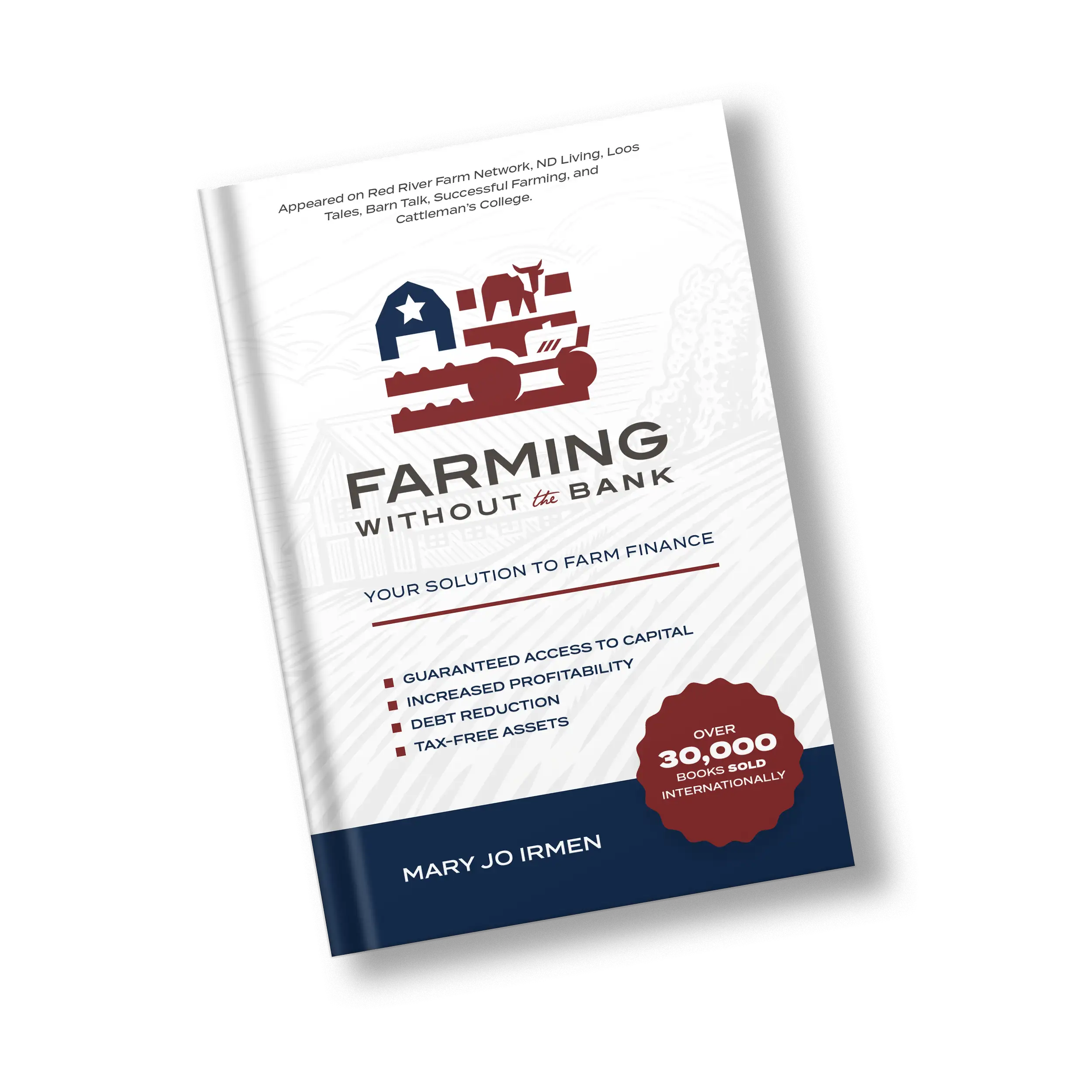
Your farm’s financial independence starts with one book.
30,000 farmers and ranchers have already made the shift. The only question is how long you’ll keep paying interest you could be keeping yourself.