 GET THE BOOK
 GET THE BOOK



Podcast
EP. 335
Commodity Prices Trap Farmers In Debt (Ep. 335)
Jan 2, 2026 ·
18 min
0:00 / 17:44
EPISODE OVERVIEW
ABOUT THIS EPISODE
Most farmers still buy equipment the old way—cash or bank loans—losing years of compound growth. What if the problem isn't your policy… It's when the money runs through it?
In this episode, Mary Jo breaks down the "before asset" idea: running money through your whole life policy before you buy equipment, cattle, or cover operating expenses. She explains why premium is what makes you money, why loans themselves don't, and how to think differently about "I can't make the payment this year" when you are the banker.
Whether commodity prices are down or cattle checks are big, this mindset shift can change how you finance your entire operation.
What You'll Learn
- Why paying a premium creates wealth, not just taking policy loans
- How to run purchases through your policy first without losing tax write-offs
- What to do in bad years when you can't make a full loan repayment
- Why life insurance is not an investment—and why that matters
- How negative thinking and "keyboard warriors" keep people broke
- A simple way to create your operating line inside the policy
👍 If this helped you think differently about your money, hit Like and subscribe for more real-world Infinite Banking conversations for farmers and ranchers.
💬 Got questions about premiums, policy loans, or timing money through your policy? Drop a comment below or send Mary Jo an email—your question may end up in a future episode.
🎧 Want more? Check out the Without the Bank podcast, where Mary Jo and Tarisa walk through Nelson Nash's books and real client scenarios in detail.
Links Mentioned
CHAPTER TIMESTAMPS
- 00:00Policy loans vs bank loans: what really changes
- 00:46Premium as a "before asset," not an afterthought
- 02:31Why money should run through the policy before you buy
- 04:58Cash vs policy example: financing equipment the smart way
- 08:18"I can't make the payment!" and how flexibility really works
- 12:53Life insurance isn't an investment (and why that's good)
- 16:04Mindset, inflation, and the negative "keyboard warrior" trap
YOUTUBE EPISODE
TRANSCRIPTION
"We have to think through the whole thing. Our brain says, oh, but it's a loan. So what? Now what? I don't know what to do. But it's the same concept as what happens if you would have gone to the bank to borrow money for that piece of equipment. And they would have said, this is your payment every year. And now what happens if you can't make the payment? A lot of people are buying things based on today's numbers and saying, well, I'll be good. And in seven years, the commodity prices could drop. And now we can't make the payment. You don't worry about that. But you're so worried about not being able to make a loan repayment to your policy when in fact that's guaranteed by your death benefit."
Hello, hello, hello. And welcome back to the podcast. Thank you very much for being here. Today, we are not doing a book study. It's just me. So, you know, you and me today. I want to talk about money flowing through the policy.
I know I just talked about this. And you guys are probably thinking, Mary Jo, some new content, please, please. Well, my content is really, truly based around conversations that I'm having with people. And those are conversations either with clients or those are conversations with new people. And typically, new potential clients that I'm meeting with are listening to every single podcast. And this topic comes up all the time recently.
And it's because we are in a state of commodity prices not being great as far as beans and wheat and corn and all that kind of stuff. The cattle guys, different conversation at the moment. But for our farmers, this conversation is coming up a lot. And it is, Mary Jo, I don't know where I'm going to get the money to pay that premium. You know, we're going to have to start our premium a little bit smaller. Or I'm not going to be able to pay my full premium this year. I'm going to have to just pay the minimum.
And I have a colleague that calls this the before asset. I love it. I absolutely love it. And I've been using it since I heard him talk about it. So shout out to him. But he's truly correct. I call it the and asset a lot. And that is also correct. So let's just talk about it.
The before asset. Think about this. Before you go buy something, it should run through the policy. Why should it run through the policy? Because paying premium makes money. If we do not get premium paid, we do not have money in the policy earning compound interest and dividends.
A lot of people have a misconception that what's making them money is taking a loan on the policy. Taking a loan does not make you money. If you borrow $10,000 and you pay back $10,000, you have $10,000. Right? A little bit of interest went to the insurance company.
What happens when you pay premium is that the cash value increases. It increases by what you paid. And then it increases when it earns interest. And then it increases again when it earns a dividend. Okay? Now we have that pool of money. Now what happens with that pool of money? That interest now earns interest and it earns dividends. And we add more money on top.
And so just like they say that your IRA is supposed to compound or your 401(k) is supposed to compound, that's interrupted. Right? That's compounding. And then it gets interrupted. That's not happening in the policy. So if we can get our money into the policy before we use it to go buy something, that's ideally what we need to be doing.
I had a gentleman that I talked to three years ago. And I've had two of these actually in the last two weeks, that two people that have said, you know, now I get it. Now I understand what you were trying to explain. It took a couple years, but it finally clicked. And Nelson always used to say, this is caught, not taught. It has to eventually make sense that, oh, I have — I'm earning interest on top of interest and I'm earning dividends on top of dividends and on top of that interest.
Let's just walk through an example. If we're going to buy a piece of equipment and we say, hey, we're going to buy that piece of equipment with cash. Hey, this is a cash example. We're going to buy that piece of equipment with cash so we can have a tax write-off at the end of the year, or we just need that piece of equipment.
If we use cash, we gave that to the dealership. We no longer have access to the cash. We exchanged it for a piece of equipment. But if we run that through the policy and we pay our premium and 10 days later, we can borrow that money and we can go buy that same piece of equipment. We still created the tax write-off, right? Because we purchased the piece of equipment. But now the money is in the policy earning interest.
Yes, you have to pay the policy back. And this is where a lot of people get hung up. Well, I have to pay that policy back. I have to pay that cash value loan back. Yes, you do. But you don't have to pay it back in a year. If you're going to have that piece of equipment for seven years, then pay it back over seven years.
Well, I didn't have — if I paid cash for it, I didn't have the payment. Correct. But next year, you may have the same amount of cash, right? Not guaranteed, but you may have the same amount of cash. So if we are making money every single year, we should have the same amount of cash to make the payment with.
If we don't make money, let's say that all hell breaks loose and we don't make any money. You're like, I don't have any money to make the loan repayment. Then just don't make the loan repayment because you're the banker. Make an interest-only payment if you want. There's flexibility there. Well, what if I can't make any payment for two years? Then don't make any payment for two years.
What happens if you can't make the payment at the bank? They're going to come after your piece of equipment. They're going to not give you an extended line of credit, whatever that is. You are much easier to deal with than the banker because the banker is saying, hey, I'm over here running a business and y'all aren't paying me.
So we have to consider, like we have to think through the whole thing. Our brain says, oh, but it's a loan. So, so, so, so, so, so what? Now what? I don't know. I don't know what to do. Right? But it's the same concept is what happens if you would have gone to the bank to borrow money for that piece of equipment? And they would have said, this is your payment every year. And now what happens if you can't make the payment?
A lot of people are buying things based on today's numbers and saying, well, I'll be, I'll be good. And in seven years, the commodity prices could drop and now we can't make the payment. You don't worry about that, but you're so worried about not being able to make a loan repayment to your policy when, in fact, that's guaranteed by your death benefit. So really, it's not the end of the world if you have to skip a year.
So what we're doing is we're saying, hey, I'm going to make a premium payment when all is said and done. When all of my income comes in and all my expenses are paid, then I'm going to pay premium. Why are we waiting until after? When it is truly a before asset, I want to get as much money in there before I have to use it.
The bigger problem we should be concerned about is, is my premium big enough? How is the timing of my premium? Because when does my money come in? What is the timing of that so that I can get it through the policy? Do I have enough policies? Instead, we're concerned about not being able to make a payment because we're not thinking about it right.
And I wish I could say that I have all kinds of new information for you here. But Nelson talks about this in the book, right? If you're listening to the Without the Bank podcast, Tarisa and I currently are going through Nelson's book over there. All of this is talked about. He talks about this in Warehouse of Wealth.
And so we really have to get our mindset around our thought process. How are we thinking of money? Another reason why it's important to have an agent that understands infinite banking. So if you're a client and you're not thinking about this correctly, that's a matter of you making a phone call to me. We make phone calls to you, but you need to actually answer the phone.
If you're not answering the phone, if you're not tuning in, if you're not listening to podcasts, your thought process is going to go back to where it was. If you're not using the policy, use it or lose it. It's all going to go back to the very simple aspect of, oh, well, I don't have enough in there, so I'm going to cancel my policy.
We just recently had a client cancel her policies because she wasn't using it. I've had conversations with her. She just does not get it. It's a mindset thing. They're dealing with a lot of money and she was looking at it as an expense. Not a good banker. Probably should have never had a policy to begin with. You have to participate in the process.
If you are not understanding that premium makes you money, that's going to be a problem, because then you're going to say, I'm going to put peanuts in and then you're going to wonder why you're getting peanuts out. You're sort of getting peanuts out because you put peanuts in, right?
We structure the policy in such a way that you want to pay that max premium every single year. You don't want to pay the minimum premium. That's like saying, I want to build a herd of cattle, but I'm just going to buy a few cows. But I want to do this in a very short amount of time. You're not going to build your operation in a short amount of time with a couple of head of cattle, right? You're not going to be a big farmer overnight when you start with a small amount of acres. You slowly build up to get there. So if you're going to put a little in, it's going to take you longer.
Now, if we look at Nelson's book, here's another thing that throws people off. When we look at equipment financing in Nelson's book, it looks like he's paying himself the interest. And it looks like that because you don't read the book fully, okay? If you think that taking loans makes you money, you need to go back to equipment financing and you need to read the footnotes. You need to really read that chapter.
The interest goes to the insurance company. The extra interest that Nelson is paying himself goes into the policy as a premium payment. Premiums make you money. And so the more we can get in, the better. We can set the terms on how we want to pay that back. But if we are using cash, we need to put that through the policy before we use it. So it's really the before and the end asset. It's just a very, very cool asset to have.
Some extremely highly intelligent individual, keyboard warrior, posted on one of my ads and said that life insurance is a scam. It is the worst investment you could ever put money in. Dude, it's not an investment. Nobody's ever called it an investment. The fact that people are calling whole life an investment means that they don't understand the product.
If you have an agent that calls it an investment, if you hear an agent calling it an investment or somebody online calling, oh, this is a great investment. It's not an investment. It is a life insurance policy. It is how they've worked forever.
Is it going to take time to capitalize that thing? Yeah, it is. But you know what else took time? Capitalizing your farm. Capitalizing your cattle herd. Capitalizing your household. Everything takes time to capitalize. So we have to be cognizant about that. We have to change our thought process.
But it's absolutely crazy how many conversations I've had of this very thing. Put it in here before. It's not just because we have lower commodity prices. I'm also having that challenge with the ranchers who are saying, hey, I've got a whole ton of money right now. And so I need to go buy stuff by the end of the year. I need to get rid of some of this stuff for, you know, I need to go avoid taxes.
And so if they're putting it through the policy first, that's great. Because now we can put this big chunk in year one. We can put extra premium in year one. I don't show that in my book. Nelson doesn't show that in his book. That's something that I started after I wrote my book. So we can put a large, extra large sum of money in year one and it won't MEC the policy.
So now we're going to sell cattle and we're going to run it through the policy first. And then we can go buy more cattle. Then we can go buy a piece of equipment. We can pay for our operating out of that. Putting that extra money in year one is a really good way to create your operating note in the policy. But we have to put it there before we do anything else. And so we really need to just, again, change the thought process.
But we have people that don't want to pay their premium or that are thinking small because commodity prices are bad right now. And I'm all conservative. So that's not a big deal if you think small, but you got to think correctly.
And then we've got people that have so much money that because we're selling cattle and now those people have so much money, they're like, hey, I need to figure out what to do with it. Or I need to postpone this income coming in because of taxes. Right? I have a lot of people right now. This is December. They're moving that money. They're not selling until January. They're not taking the money till January. Whatever they're trying to play the game. So I have it on both sides.
And it's so funny. This is also funny kind of off this topic. But social media is just an absolute pool of keyboard warriors. Some guy comments. Has anybody told her that us cattle guys still have expenses and those expenses went up? Sir, has anybody told you to get out of the county and that people do make money in this industry?
Like, think about the mindset of it doesn't matter what clip we run. There's always the negative Nelly. That is just, oh, everything is so bad. I just wonder, and I would love to comment it and I just shut my mouth. But do you ever wonder why you are where you're at? When that is your mindset? Your mindset is that everything in the world is going to fall apart on you. And everything is bad.
And you could be handed — somebody could come in with a truckload of gold. And you wouldn't be okay with that because you'd have to take it to town and you'd have to exchange it for cash. You know, or where am I going to store it? My gosh, how are we going to get it out of the truck? You would not be happy if somebody gave you everything. You would still find a problem with that.
And so if our mindset is just sitting on all the negativity and, oh, cattle prices are great, but we still have all this inflation. You know what? You have inflation along with everybody else in this country right now. Inflation is not just hurting one person. It's hurting everybody. But we can figure out how we're going to deal with it and go, all right, well, what are we going to do about it? Like, what do I get to do about inflation?
If you ask Nelson, he would say buy a life insurance policy so they can quit printing money. But all in all, my one little policy is probably not going to make that big of a difference. So I'm just going to have to deal with it and figure out how to pivot around it. And be thankful that cattle prices are up so that I can have a better outcome to the inflation and the extra expenses.
I'm telling you, I collect these special keyboard warrior comments. And I just can't decide if I want to do a whole episode on them because these guys are one of a kind, man.
All right. That's what I got for you today. Think about it as the before asset and understand that your money is compounding every single year. You're earning interest on top of interest and dividends on top of dividends. And that is why we put it in the policy first.
Okay. You guys let me know if you have comments, questions, concerns, and email me. I will be happy to answer those for you. Otherwise, you have a fantastic rest of your day.
Thanks for listening to the Farming Without the Bank podcast. We hope today's episode has inspired you to take control of your finances in new ways. Don't forget to check out our website, farmingwithoutthebank.com, and engage with us on our Facebook page, Farming Without the Bank. Join us next week as we smash more financial myths and empower you to accomplish your financial goals.
View MoreHello, hello, hello. And welcome back to the podcast. Thank you very much for being here. Today, we are not doing a book study. It's just me. So, you know, you and me today. I want to talk about money flowing through the policy.
I know I just talked about this. And you guys are probably thinking, Mary Jo, some new content, please, please. Well, my content is really, truly based around conversations that I'm having with people. And those are conversations either with clients or those are conversations with new people. And typically, new potential clients that I'm meeting with are listening to every single podcast. And this topic comes up all the time recently.
And it's because we are in a state of commodity prices not being great as far as beans and wheat and corn and all that kind of stuff. The cattle guys, different conversation at the moment. But for our farmers, this conversation is coming up a lot. And it is, Mary Jo, I don't know where I'm going to get the money to pay that premium. You know, we're going to have to start our premium a little bit smaller. Or I'm not going to be able to pay my full premium this year. I'm going to have to just pay the minimum.
And I have a colleague that calls this the before asset. I love it. I absolutely love it. And I've been using it since I heard him talk about it. So shout out to him. But he's truly correct. I call it the and asset a lot. And that is also correct. So let's just talk about it.
The before asset. Think about this. Before you go buy something, it should run through the policy. Why should it run through the policy? Because paying premium makes money. If we do not get premium paid, we do not have money in the policy earning compound interest and dividends.
A lot of people have a misconception that what's making them money is taking a loan on the policy. Taking a loan does not make you money. If you borrow $10,000 and you pay back $10,000, you have $10,000. Right? A little bit of interest went to the insurance company.
What happens when you pay premium is that the cash value increases. It increases by what you paid. And then it increases when it earns interest. And then it increases again when it earns a dividend. Okay? Now we have that pool of money. Now what happens with that pool of money? That interest now earns interest and it earns dividends. And we add more money on top.
And so just like they say that your IRA is supposed to compound or your 401(k) is supposed to compound, that's interrupted. Right? That's compounding. And then it gets interrupted. That's not happening in the policy. So if we can get our money into the policy before we use it to go buy something, that's ideally what we need to be doing.
I had a gentleman that I talked to three years ago. And I've had two of these actually in the last two weeks, that two people that have said, you know, now I get it. Now I understand what you were trying to explain. It took a couple years, but it finally clicked. And Nelson always used to say, this is caught, not taught. It has to eventually make sense that, oh, I have — I'm earning interest on top of interest and I'm earning dividends on top of dividends and on top of that interest.
Let's just walk through an example. If we're going to buy a piece of equipment and we say, hey, we're going to buy that piece of equipment with cash. Hey, this is a cash example. We're going to buy that piece of equipment with cash so we can have a tax write-off at the end of the year, or we just need that piece of equipment.
If we use cash, we gave that to the dealership. We no longer have access to the cash. We exchanged it for a piece of equipment. But if we run that through the policy and we pay our premium and 10 days later, we can borrow that money and we can go buy that same piece of equipment. We still created the tax write-off, right? Because we purchased the piece of equipment. But now the money is in the policy earning interest.
Yes, you have to pay the policy back. And this is where a lot of people get hung up. Well, I have to pay that policy back. I have to pay that cash value loan back. Yes, you do. But you don't have to pay it back in a year. If you're going to have that piece of equipment for seven years, then pay it back over seven years.
Well, I didn't have — if I paid cash for it, I didn't have the payment. Correct. But next year, you may have the same amount of cash, right? Not guaranteed, but you may have the same amount of cash. So if we are making money every single year, we should have the same amount of cash to make the payment with.
If we don't make money, let's say that all hell breaks loose and we don't make any money. You're like, I don't have any money to make the loan repayment. Then just don't make the loan repayment because you're the banker. Make an interest-only payment if you want. There's flexibility there. Well, what if I can't make any payment for two years? Then don't make any payment for two years.
What happens if you can't make the payment at the bank? They're going to come after your piece of equipment. They're going to not give you an extended line of credit, whatever that is. You are much easier to deal with than the banker because the banker is saying, hey, I'm over here running a business and y'all aren't paying me.
So we have to consider, like we have to think through the whole thing. Our brain says, oh, but it's a loan. So, so, so, so, so, so what? Now what? I don't know. I don't know what to do. Right? But it's the same concept is what happens if you would have gone to the bank to borrow money for that piece of equipment? And they would have said, this is your payment every year. And now what happens if you can't make the payment?
A lot of people are buying things based on today's numbers and saying, well, I'll be, I'll be good. And in seven years, the commodity prices could drop and now we can't make the payment. You don't worry about that, but you're so worried about not being able to make a loan repayment to your policy when, in fact, that's guaranteed by your death benefit. So really, it's not the end of the world if you have to skip a year.
So what we're doing is we're saying, hey, I'm going to make a premium payment when all is said and done. When all of my income comes in and all my expenses are paid, then I'm going to pay premium. Why are we waiting until after? When it is truly a before asset, I want to get as much money in there before I have to use it.
The bigger problem we should be concerned about is, is my premium big enough? How is the timing of my premium? Because when does my money come in? What is the timing of that so that I can get it through the policy? Do I have enough policies? Instead, we're concerned about not being able to make a payment because we're not thinking about it right.
And I wish I could say that I have all kinds of new information for you here. But Nelson talks about this in the book, right? If you're listening to the Without the Bank podcast, Tarisa and I currently are going through Nelson's book over there. All of this is talked about. He talks about this in Warehouse of Wealth.
And so we really have to get our mindset around our thought process. How are we thinking of money? Another reason why it's important to have an agent that understands infinite banking. So if you're a client and you're not thinking about this correctly, that's a matter of you making a phone call to me. We make phone calls to you, but you need to actually answer the phone.
If you're not answering the phone, if you're not tuning in, if you're not listening to podcasts, your thought process is going to go back to where it was. If you're not using the policy, use it or lose it. It's all going to go back to the very simple aspect of, oh, well, I don't have enough in there, so I'm going to cancel my policy.
We just recently had a client cancel her policies because she wasn't using it. I've had conversations with her. She just does not get it. It's a mindset thing. They're dealing with a lot of money and she was looking at it as an expense. Not a good banker. Probably should have never had a policy to begin with. You have to participate in the process.
If you are not understanding that premium makes you money, that's going to be a problem, because then you're going to say, I'm going to put peanuts in and then you're going to wonder why you're getting peanuts out. You're sort of getting peanuts out because you put peanuts in, right?
We structure the policy in such a way that you want to pay that max premium every single year. You don't want to pay the minimum premium. That's like saying, I want to build a herd of cattle, but I'm just going to buy a few cows. But I want to do this in a very short amount of time. You're not going to build your operation in a short amount of time with a couple of head of cattle, right? You're not going to be a big farmer overnight when you start with a small amount of acres. You slowly build up to get there. So if you're going to put a little in, it's going to take you longer.
Now, if we look at Nelson's book, here's another thing that throws people off. When we look at equipment financing in Nelson's book, it looks like he's paying himself the interest. And it looks like that because you don't read the book fully, okay? If you think that taking loans makes you money, you need to go back to equipment financing and you need to read the footnotes. You need to really read that chapter.
The interest goes to the insurance company. The extra interest that Nelson is paying himself goes into the policy as a premium payment. Premiums make you money. And so the more we can get in, the better. We can set the terms on how we want to pay that back. But if we are using cash, we need to put that through the policy before we use it. So it's really the before and the end asset. It's just a very, very cool asset to have.
Some extremely highly intelligent individual, keyboard warrior, posted on one of my ads and said that life insurance is a scam. It is the worst investment you could ever put money in. Dude, it's not an investment. Nobody's ever called it an investment. The fact that people are calling whole life an investment means that they don't understand the product.
If you have an agent that calls it an investment, if you hear an agent calling it an investment or somebody online calling, oh, this is a great investment. It's not an investment. It is a life insurance policy. It is how they've worked forever.
Is it going to take time to capitalize that thing? Yeah, it is. But you know what else took time? Capitalizing your farm. Capitalizing your cattle herd. Capitalizing your household. Everything takes time to capitalize. So we have to be cognizant about that. We have to change our thought process.
But it's absolutely crazy how many conversations I've had of this very thing. Put it in here before. It's not just because we have lower commodity prices. I'm also having that challenge with the ranchers who are saying, hey, I've got a whole ton of money right now. And so I need to go buy stuff by the end of the year. I need to get rid of some of this stuff for, you know, I need to go avoid taxes.
And so if they're putting it through the policy first, that's great. Because now we can put this big chunk in year one. We can put extra premium in year one. I don't show that in my book. Nelson doesn't show that in his book. That's something that I started after I wrote my book. So we can put a large, extra large sum of money in year one and it won't MEC the policy.
So now we're going to sell cattle and we're going to run it through the policy first. And then we can go buy more cattle. Then we can go buy a piece of equipment. We can pay for our operating out of that. Putting that extra money in year one is a really good way to create your operating note in the policy. But we have to put it there before we do anything else. And so we really need to just, again, change the thought process.
But we have people that don't want to pay their premium or that are thinking small because commodity prices are bad right now. And I'm all conservative. So that's not a big deal if you think small, but you got to think correctly.
And then we've got people that have so much money that because we're selling cattle and now those people have so much money, they're like, hey, I need to figure out what to do with it. Or I need to postpone this income coming in because of taxes. Right? I have a lot of people right now. This is December. They're moving that money. They're not selling until January. They're not taking the money till January. Whatever they're trying to play the game. So I have it on both sides.
And it's so funny. This is also funny kind of off this topic. But social media is just an absolute pool of keyboard warriors. Some guy comments. Has anybody told her that us cattle guys still have expenses and those expenses went up? Sir, has anybody told you to get out of the county and that people do make money in this industry?
Like, think about the mindset of it doesn't matter what clip we run. There's always the negative Nelly. That is just, oh, everything is so bad. I just wonder, and I would love to comment it and I just shut my mouth. But do you ever wonder why you are where you're at? When that is your mindset? Your mindset is that everything in the world is going to fall apart on you. And everything is bad.
And you could be handed — somebody could come in with a truckload of gold. And you wouldn't be okay with that because you'd have to take it to town and you'd have to exchange it for cash. You know, or where am I going to store it? My gosh, how are we going to get it out of the truck? You would not be happy if somebody gave you everything. You would still find a problem with that.
And so if our mindset is just sitting on all the negativity and, oh, cattle prices are great, but we still have all this inflation. You know what? You have inflation along with everybody else in this country right now. Inflation is not just hurting one person. It's hurting everybody. But we can figure out how we're going to deal with it and go, all right, well, what are we going to do about it? Like, what do I get to do about inflation?
If you ask Nelson, he would say buy a life insurance policy so they can quit printing money. But all in all, my one little policy is probably not going to make that big of a difference. So I'm just going to have to deal with it and figure out how to pivot around it. And be thankful that cattle prices are up so that I can have a better outcome to the inflation and the extra expenses.
I'm telling you, I collect these special keyboard warrior comments. And I just can't decide if I want to do a whole episode on them because these guys are one of a kind, man.
All right. That's what I got for you today. Think about it as the before asset and understand that your money is compounding every single year. You're earning interest on top of interest and dividends on top of dividends. And that is why we put it in the policy first.
Okay. You guys let me know if you have comments, questions, concerns, and email me. I will be happy to answer those for you. Otherwise, you have a fantastic rest of your day.
Thanks for listening to the Farming Without the Bank podcast. We hope today's episode has inspired you to take control of your finances in new ways. Don't forget to check out our website, farmingwithoutthebank.com, and engage with us on our Facebook page, Farming Without the Bank. Join us next week as we smash more financial myths and empower you to accomplish your financial goals.
ready to start?
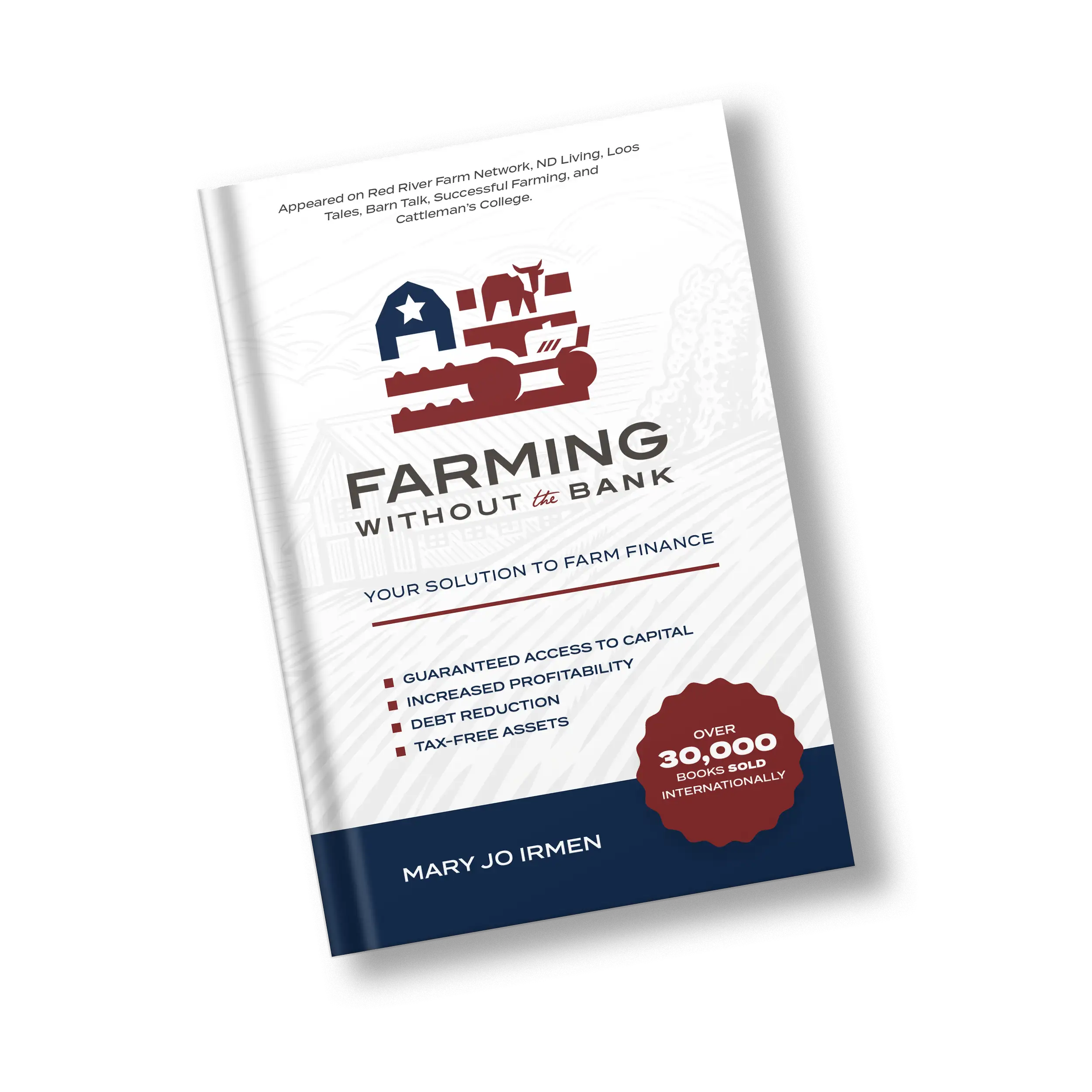
Your farm’s financial independence starts with one book.
30,000 farmers and ranchers have already made the shift. The only question is how long you’ll keep paying interest you could be keeping yourself.