 GET THE BOOK
 GET THE BOOK




Podcast
EP. 286
Ep. 286 – Talking 1980’s Crisis Again
Jan 23, 2025 ·
18 min
0:00 / 18:16
EPISODE OVERVIEW
ABOUT THIS EPISODE
Preparing for Economic Downturns: Lessons for Us to Learn Today from the 1980s Farming Crisis
We are discussing the importance of preparing for economic downturns and the benefits of using life insurance policies for financial control and stability. We need to be thinking long-term in the good times and bad times.
- ► Learn more: farmingwithoutthebank.com
- ► Get the book
Audio Production by Podsworth Media
Video Production by The Post Production Shop
CHAPTER TIMESTAMPS
- 00:00Introduction: Preparing for Bad Times
- 00:30Current Economic Climate and Historical Comparisons
- 01:38Interest Rates and Land Notes
- 04:07Financial Strategies for Farmers
- 10:36The Role of Life Insurance in Financial Planning
- 13:47Conclusion: Preparing for Future Crises
YOUTUBE EPISODE
TRANSCRIPTION
“We have to remember and we have to prepare for bad times. And it does not matter if you are a farmer, if you are a business owner, it absolutely does not matter. We should all be preparing for bad times. And if we can control our money in a life insurance policy, isn’t that better? Because we can make that payment back when we want. Interest rates didn’t go to 8%, 9%, 10%, and 11% in the policies. And even if they had, we get to control that loan repayment.”
Hello, hello, hello, and welcome back to the podcast. Thank you very much for being here.
Okay, today let’s talk about what’s going on on the streets. And I hear that the old timers are saying that commodity prices right now, everything in the farming world is equally as bad as it was in the ’80s. And so if you guys recall back in 2022, I did a podcast on, hey, that we’re gonna have another ’80s crisis if high interest rates continue, yada, yada, yada. A lot of people believed me. Some people did not believe me. But I find it interesting that we are talking about this again. And now a lot of the farmers and ranchers that have gone through the ’80s are saying that it’s gonna happen again.
Here is what I am seeing. And this, for whatever reason, I’m not gonna say that I’m some genius, you guys. Never am I going to say that. But I, for whatever reason, did not think about this prior to seeing it recently. And so what I am seeing recently is that we’ve done land notes. We bought a lot of land when interest rates were 3%, 4% on land. Your FSA notes were like 1.5% to 3%. Now they’re 5%, 5.5% is what I’m seeing. But here is where we’re gonna get into trouble and what we need to watch. I have had this happen now a handful of times where we have bought land and during this 2023, 2024, now into 2025 high interest rates, that land note came due again. You know how you have a land note and it goes out for, they finance it for 25 years, 20, 25 years. But every five years or every three years, some people are, every three to five years, that note basically is going to renew. They’re going to refinance it at a new interest rate, whatever the interest rate is in three to five years. So what was happening, and they do that normally, but what we also saw or have seen is that people, when interest rates were 2% and 3%, they were like, oh yeah, I’ll do a balloon note. It’s no big deal. We’ll refinance it five years. Interest rates will be lower. No, they aren’t. No, they aren’t.
So here’s an example. We bought land in 2020. You can’t do a locked in note on farm ground. I’ve never seen a note like that, ever. So if some of y’all have a locked in note outside of FSA, I want to know where you’re getting those because I’ve never seen one. And they will renew every three to five years or refinance, reconfigure, whatever they call it. And so I was like, gosh, I don’t like that idea, right? Because I know interest rates are going to go up. I knew in 2020, interest rates were going up. And I knew that because I knew inflation was extremely high. I am in that world. And so I’m like, gosh, I do not want this note. But I’m going to plan to either pay it off then or I am going to plan on a higher interest rate. And I am going to know that I can make that payment, that new payment.
So here’s what’s happening is I’ve come across a few people who that has renewed. I had one couple the other day that it went, I don’t know what it was, probably four or five, and it went to 10%. Now they are having to refinance again because interest rates have dropped. So some people just got super lucky, right? If you want to call that lucky, that their interest rates, their loan had to renew at a time when interest rates were just astronomically high. This is not good.
Why? Because you’ve got equipment payments, you’ve got land payments, you might have cattle payments, you have operating notes that are high. When we had interest rates that were 2% and 3%, we were so fortunate that we just went and bought all kinds of crap that we thought we were going to be able to pay for for the next five to seven years. We didn’t think what’s going to happen if interest rates on my operating goes to 10%, if my land renews, and then that’s going to be at 7, 8, 9, 10. Am I going to be able to make all those payments on that equipment? People with cattle, cattle prices are high, so it’s offsetting some of that burden, but it’s not making us money, right? Because any extra money we’re making on cattle might be going to interest. So we have to look at the big picture.
Are we going to have an ’80s crisis? Yeah, we’re well on our way. Because here is my prediction based on all the things that I have seen with clients. The 2,000 plus meetings that I have had one-on-one looking at people’s numbers. We are all two, three, four years away from a crisis. Two for those people that have land notes, operating notes, equipment notes, cattle notes. We have a note on absolutely every single thing. We are going to be in trouble. We have two to maybe three years for those people. For people that don’t have all of that debt, it is going to be a better option.
Now, if cattle prices continue to stay, great, because people with cattle maybe aren’t suffering quite as badly because they’ve got some cows that are high-priced right now. But what happens as our land notes keep coming due? And if we bought a lot of land in the 10 plus years that we had 2% to 3% interest rates, now we’ve got maybe two or three of those that are increasing. And land’s not cheap anywhere you go. It’s all relative. You know, you can go to Iowa and be like, oh yeah, land is $20,000, $25,000 an acre, $15,000 an acre, depending on where you’re at. You can come to North Dakota and get land for $2,000 an acre, depending on where you’re at. Production levels are different. Farming practices are different. So, you know, it’s all relative.
It is going to hurt. And we are going to see either people get out of the industry because we can’t make the notes. So we’re going to have to start selling land that we bought in order to make a note. We’re going to have to sell equipment. We’re going to have to downsize. We’re going to have to give up leased ground. There is going to be a shift. And if we don’t get out, we’re going to try to save it. But there has to be a shift somewhere, either in equipment sales or land sales or something, in order to get out from underneath it.
Because exactly what happened in the ’80s is we bought land. And then guess what? Interest rates skyrocketed. And if the banks have done this forever, which I’m assuming that they have, I did not own land in the ’80s. I have not talked to anybody from the ’80s to ask. It’ll be a question I need to ask. Did they do these five-year renewals back then too? Because that’s getting people into trouble.
And so we have to plan long-term when we’re buying things. And again, I’ve said this over and over and over in my conferences, wherever I’m speaking, is the bank is not looking out for 20 years on your profit and loss statements, right? When they’re looking at your balance sheets, they’re saying, oh, what do you got going on this year? What do you maybe have going on next year? That’s all they’re looking at. Your accountant isn’t looking out that far. And by gosh, you aren’t looking out that far. And so we have to plan for these ups and these downs. We know they’re coming. We have to plan for commodity ups and downs. We know that that’s happening. Cattle ups and downs. We have to look at all of that stuff without expecting a government payment because we can’t depend on them either.
And so if we factor all of that in, guess what happens? We become the clients I have that maybe have land payments, no equipment payments. And granted, they’re typically not super big farmers. And sometimes they’re decent medium-sized farmers. Well, most of the time, they’re decent medium-sized farmers. They have a land note and they’re freaking out about the land note. But when all hell breaks loose, they’re in a much better position because they don’t owe money on all of these things. And why don’t they owe money on all of these things? Because when times were good, they didn’t buy things to avoid taxes. I will say that until I am blue in the face. Stop buying things to avoid taxes. Things you do not need. If you need them, great. If you don’t need them, why are we not saving the difference and using it to operate with cash, using it to pay down equipment, whatever that looks like.
So let me just tie Infinite Banking into this for a sec. All those people that said, Mary Jo, you are a moron. Why would I buy a life insurance policy and use that to operate or use that to buy land or cattle or equipment? Why would I do that when the interest rate in the policy is 4% and I can go to the bank and get two? Well, guess what, my friends? The people that didn’t think I was a moron and they were like, oh, I’m going to buy a policy and prepare for the bad times. Now when their land note goes to 7%, they have money in cash value that they can use to pay down that note. They can use it to pay off that note. They could use it for operating. So maybe they have a 5% operating note now instead of 7, 8, 9, 10, 11, wherever we’re at in operating, that’s come down a little bit.
So we have to look at, hey, times are really, really good. I don’t need you. Well, why would you not prepare for times to be really, really bad? Because if you’re not preparing for the bad, that means that you are in a little bit of a dream world thinking that interest rates are going to stay low forever. No, that’s not going to happen.
And so I’m recording this on Tuesday. The inauguration was yesterday. I listened to the inauguration and Trump said he is going to give them the ability to do whatever they need to do to get inflation down. Well, I’m super curious to see what that means. Does that mean that he’s going to print money like a madman and then we just have all kinds of inflation because of extra money, but then that brings inflation down because we’ve got more stuff? Does that mean that he’s going to raise interest rates even higher, which he can’t necessarily do because the feds are not government owned, right? The Federal Reserve is, they are an independent agency. And if you did not know that, you need to Google fractional reserve banking. You need to understand that the Federal Reserve has nothing to do with the government. So are interest rates going to go high? Is the person that gets appointed into the Federal Reserve going to make a difference? I don’t know.
I’m really anxious to see how he thinks he’s going to do that because in order to bring something down and inflation down, we have to have people quit spending money, right? And whatever we’ve done in the past and raising interest rates has not affected it because apparently people just keep spending money and they keep buying things. And so are we going to see, and I get like, farmers haven’t been buying equipment. Equipment sales have gone down. And I’ve noticed that people are being a little more cautious about what they’re doing. But the second that interest rates come down, we are going to be back in spend central. You guys, what in the heck? Prepare for the bad times.
Do we need another ’80s crisis that we are so far in debt that we have to get out because we didn’t plan for the worst? That’s my question. I can see that it’s going to happen or it’s sort of happening depending now on what happens with interest rates, depending on what happens with all the tariffs that are going to go on, depending on a lot of things, right? That’s just interest rates and tariffs. That’s not rain. That’s not tornadoes. That’s not all the other stuff that can wipe out your crops. That’s not weather that can kill your animals. And so if we sit back and prepare for those things, are we going to be part of the crisis of the, you know, 2020s? Or are we going to take 1980s information and remember it so that we don’t repeat it?
No, interest rates are not that high. Should they be that high? Probably. Probably. Because that’s the only way to bring down inflation without possibly printing more money. And I don’t like the idea of printing more money.
So, you guys, think about the long-term piece of that. So many people say to, well, starting a policy back, you know, when interest rates were low, Mary Jo, you’re a moron. Today, people are saying, hey, I don’t have any money to start the policy. When did Nelson start his life insurance policies? In the ’80s when interest rates were 23%? Because it was in the bad times.
I talked to a client last week that said he took the farm over this year or in 2024. And he’s like, worst year I could have done it. I’m like, no, actually, it’s probably the best year you could have done it. If you do stuff in the bad times and you can get through, the good times are going to be great. But when we start in the good times, we never prepare for the bad times because we spend all of our money and think it’s just so easy. It’s not a big deal.
We have to remember and we have to prepare for bad times. And it does not matter if you are a farmer, if you are a business owner, it absolutely does not matter. We should all be preparing for bad times. And if we can control our money in a life insurance policy, isn’t that better? Because we can make that payment back when we want. Interest rates didn’t go to 8%, 9%, 10%, and 11% in the policies. And even if they had, we get to control that loan repayment.
So think about the fact that if we are using our money from our system, we have liquidity and control, and then we, of course, we have the guarantees on top of it. But liquidity and control is what people are missing. They think, the banks make you think you have liquidity and control. But you only have liquidity and control if they approve it, which they could just decide the very next day they’re not going to approve it. So, you know, sorry, sucks to be you.
Okay. Think about those things. Are we going to see an ’80s crisis? If this continues and people don’t prepare? Yeah. I think there’s going to be land for sale, which there always is. But I think there’s going to be land for sale and I think there’s going to be opportunities for those people that did prepare and have their finances in check. Borrowing money to buy things you don’t need could set you up for disaster if you’re not prepared.
All right, guys. Doom and gloom this morning, today. And whenever you’re listening to this, I’m sure you will have comments and I’m sure you will have concerns. So you let me know if you do. Go over to the Without the Bank podcast because I’m going to be talking about do the banks look at your cash value loan and have they held any of my clients back because they have a cash value loan? Fun story over there today. Okay. Let me know. maryjo@withoutthebank.com. Grab your books. Schedule your appointment. And then we will talk to you then. And you have a fantastic rest of your day.
Thanks for listening to the Farming Without the Bank podcast. We hope today’s episode has inspired you to take control of your finances in new ways. Don’t forget to check out our website, farmingwithoutthebank.com and engage with us on our Facebook page, Farming Without the Bank. Join us next week as we smash more financial myths and empower you to accomplish your financial goals.
View MoreHello, hello, hello, and welcome back to the podcast. Thank you very much for being here.
Okay, today let’s talk about what’s going on on the streets. And I hear that the old timers are saying that commodity prices right now, everything in the farming world is equally as bad as it was in the ’80s. And so if you guys recall back in 2022, I did a podcast on, hey, that we’re gonna have another ’80s crisis if high interest rates continue, yada, yada, yada. A lot of people believed me. Some people did not believe me. But I find it interesting that we are talking about this again. And now a lot of the farmers and ranchers that have gone through the ’80s are saying that it’s gonna happen again.
Here is what I am seeing. And this, for whatever reason, I’m not gonna say that I’m some genius, you guys. Never am I going to say that. But I, for whatever reason, did not think about this prior to seeing it recently. And so what I am seeing recently is that we’ve done land notes. We bought a lot of land when interest rates were 3%, 4% on land. Your FSA notes were like 1.5% to 3%. Now they’re 5%, 5.5% is what I’m seeing. But here is where we’re gonna get into trouble and what we need to watch. I have had this happen now a handful of times where we have bought land and during this 2023, 2024, now into 2025 high interest rates, that land note came due again. You know how you have a land note and it goes out for, they finance it for 25 years, 20, 25 years. But every five years or every three years, some people are, every three to five years, that note basically is going to renew. They’re going to refinance it at a new interest rate, whatever the interest rate is in three to five years. So what was happening, and they do that normally, but what we also saw or have seen is that people, when interest rates were 2% and 3%, they were like, oh yeah, I’ll do a balloon note. It’s no big deal. We’ll refinance it five years. Interest rates will be lower. No, they aren’t. No, they aren’t.
So here’s an example. We bought land in 2020. You can’t do a locked in note on farm ground. I’ve never seen a note like that, ever. So if some of y’all have a locked in note outside of FSA, I want to know where you’re getting those because I’ve never seen one. And they will renew every three to five years or refinance, reconfigure, whatever they call it. And so I was like, gosh, I don’t like that idea, right? Because I know interest rates are going to go up. I knew in 2020, interest rates were going up. And I knew that because I knew inflation was extremely high. I am in that world. And so I’m like, gosh, I do not want this note. But I’m going to plan to either pay it off then or I am going to plan on a higher interest rate. And I am going to know that I can make that payment, that new payment.
So here’s what’s happening is I’ve come across a few people who that has renewed. I had one couple the other day that it went, I don’t know what it was, probably four or five, and it went to 10%. Now they are having to refinance again because interest rates have dropped. So some people just got super lucky, right? If you want to call that lucky, that their interest rates, their loan had to renew at a time when interest rates were just astronomically high. This is not good.
Why? Because you’ve got equipment payments, you’ve got land payments, you might have cattle payments, you have operating notes that are high. When we had interest rates that were 2% and 3%, we were so fortunate that we just went and bought all kinds of crap that we thought we were going to be able to pay for for the next five to seven years. We didn’t think what’s going to happen if interest rates on my operating goes to 10%, if my land renews, and then that’s going to be at 7, 8, 9, 10. Am I going to be able to make all those payments on that equipment? People with cattle, cattle prices are high, so it’s offsetting some of that burden, but it’s not making us money, right? Because any extra money we’re making on cattle might be going to interest. So we have to look at the big picture.
Are we going to have an ’80s crisis? Yeah, we’re well on our way. Because here is my prediction based on all the things that I have seen with clients. The 2,000 plus meetings that I have had one-on-one looking at people’s numbers. We are all two, three, four years away from a crisis. Two for those people that have land notes, operating notes, equipment notes, cattle notes. We have a note on absolutely every single thing. We are going to be in trouble. We have two to maybe three years for those people. For people that don’t have all of that debt, it is going to be a better option.
Now, if cattle prices continue to stay, great, because people with cattle maybe aren’t suffering quite as badly because they’ve got some cows that are high-priced right now. But what happens as our land notes keep coming due? And if we bought a lot of land in the 10 plus years that we had 2% to 3% interest rates, now we’ve got maybe two or three of those that are increasing. And land’s not cheap anywhere you go. It’s all relative. You know, you can go to Iowa and be like, oh yeah, land is $20,000, $25,000 an acre, $15,000 an acre, depending on where you’re at. You can come to North Dakota and get land for $2,000 an acre, depending on where you’re at. Production levels are different. Farming practices are different. So, you know, it’s all relative.
It is going to hurt. And we are going to see either people get out of the industry because we can’t make the notes. So we’re going to have to start selling land that we bought in order to make a note. We’re going to have to sell equipment. We’re going to have to downsize. We’re going to have to give up leased ground. There is going to be a shift. And if we don’t get out, we’re going to try to save it. But there has to be a shift somewhere, either in equipment sales or land sales or something, in order to get out from underneath it.
Because exactly what happened in the ’80s is we bought land. And then guess what? Interest rates skyrocketed. And if the banks have done this forever, which I’m assuming that they have, I did not own land in the ’80s. I have not talked to anybody from the ’80s to ask. It’ll be a question I need to ask. Did they do these five-year renewals back then too? Because that’s getting people into trouble.
And so we have to plan long-term when we’re buying things. And again, I’ve said this over and over and over in my conferences, wherever I’m speaking, is the bank is not looking out for 20 years on your profit and loss statements, right? When they’re looking at your balance sheets, they’re saying, oh, what do you got going on this year? What do you maybe have going on next year? That’s all they’re looking at. Your accountant isn’t looking out that far. And by gosh, you aren’t looking out that far. And so we have to plan for these ups and these downs. We know they’re coming. We have to plan for commodity ups and downs. We know that that’s happening. Cattle ups and downs. We have to look at all of that stuff without expecting a government payment because we can’t depend on them either.
And so if we factor all of that in, guess what happens? We become the clients I have that maybe have land payments, no equipment payments. And granted, they’re typically not super big farmers. And sometimes they’re decent medium-sized farmers. Well, most of the time, they’re decent medium-sized farmers. They have a land note and they’re freaking out about the land note. But when all hell breaks loose, they’re in a much better position because they don’t owe money on all of these things. And why don’t they owe money on all of these things? Because when times were good, they didn’t buy things to avoid taxes. I will say that until I am blue in the face. Stop buying things to avoid taxes. Things you do not need. If you need them, great. If you don’t need them, why are we not saving the difference and using it to operate with cash, using it to pay down equipment, whatever that looks like.
So let me just tie Infinite Banking into this for a sec. All those people that said, Mary Jo, you are a moron. Why would I buy a life insurance policy and use that to operate or use that to buy land or cattle or equipment? Why would I do that when the interest rate in the policy is 4% and I can go to the bank and get two? Well, guess what, my friends? The people that didn’t think I was a moron and they were like, oh, I’m going to buy a policy and prepare for the bad times. Now when their land note goes to 7%, they have money in cash value that they can use to pay down that note. They can use it to pay off that note. They could use it for operating. So maybe they have a 5% operating note now instead of 7, 8, 9, 10, 11, wherever we’re at in operating, that’s come down a little bit.
So we have to look at, hey, times are really, really good. I don’t need you. Well, why would you not prepare for times to be really, really bad? Because if you’re not preparing for the bad, that means that you are in a little bit of a dream world thinking that interest rates are going to stay low forever. No, that’s not going to happen.
And so I’m recording this on Tuesday. The inauguration was yesterday. I listened to the inauguration and Trump said he is going to give them the ability to do whatever they need to do to get inflation down. Well, I’m super curious to see what that means. Does that mean that he’s going to print money like a madman and then we just have all kinds of inflation because of extra money, but then that brings inflation down because we’ve got more stuff? Does that mean that he’s going to raise interest rates even higher, which he can’t necessarily do because the feds are not government owned, right? The Federal Reserve is, they are an independent agency. And if you did not know that, you need to Google fractional reserve banking. You need to understand that the Federal Reserve has nothing to do with the government. So are interest rates going to go high? Is the person that gets appointed into the Federal Reserve going to make a difference? I don’t know.
I’m really anxious to see how he thinks he’s going to do that because in order to bring something down and inflation down, we have to have people quit spending money, right? And whatever we’ve done in the past and raising interest rates has not affected it because apparently people just keep spending money and they keep buying things. And so are we going to see, and I get like, farmers haven’t been buying equipment. Equipment sales have gone down. And I’ve noticed that people are being a little more cautious about what they’re doing. But the second that interest rates come down, we are going to be back in spend central. You guys, what in the heck? Prepare for the bad times.
Do we need another ’80s crisis that we are so far in debt that we have to get out because we didn’t plan for the worst? That’s my question. I can see that it’s going to happen or it’s sort of happening depending now on what happens with interest rates, depending on what happens with all the tariffs that are going to go on, depending on a lot of things, right? That’s just interest rates and tariffs. That’s not rain. That’s not tornadoes. That’s not all the other stuff that can wipe out your crops. That’s not weather that can kill your animals. And so if we sit back and prepare for those things, are we going to be part of the crisis of the, you know, 2020s? Or are we going to take 1980s information and remember it so that we don’t repeat it?
No, interest rates are not that high. Should they be that high? Probably. Probably. Because that’s the only way to bring down inflation without possibly printing more money. And I don’t like the idea of printing more money.
So, you guys, think about the long-term piece of that. So many people say to, well, starting a policy back, you know, when interest rates were low, Mary Jo, you’re a moron. Today, people are saying, hey, I don’t have any money to start the policy. When did Nelson start his life insurance policies? In the ’80s when interest rates were 23%? Because it was in the bad times.
I talked to a client last week that said he took the farm over this year or in 2024. And he’s like, worst year I could have done it. I’m like, no, actually, it’s probably the best year you could have done it. If you do stuff in the bad times and you can get through, the good times are going to be great. But when we start in the good times, we never prepare for the bad times because we spend all of our money and think it’s just so easy. It’s not a big deal.
We have to remember and we have to prepare for bad times. And it does not matter if you are a farmer, if you are a business owner, it absolutely does not matter. We should all be preparing for bad times. And if we can control our money in a life insurance policy, isn’t that better? Because we can make that payment back when we want. Interest rates didn’t go to 8%, 9%, 10%, and 11% in the policies. And even if they had, we get to control that loan repayment.
So think about the fact that if we are using our money from our system, we have liquidity and control, and then we, of course, we have the guarantees on top of it. But liquidity and control is what people are missing. They think, the banks make you think you have liquidity and control. But you only have liquidity and control if they approve it, which they could just decide the very next day they’re not going to approve it. So, you know, sorry, sucks to be you.
Okay. Think about those things. Are we going to see an ’80s crisis? If this continues and people don’t prepare? Yeah. I think there’s going to be land for sale, which there always is. But I think there’s going to be land for sale and I think there’s going to be opportunities for those people that did prepare and have their finances in check. Borrowing money to buy things you don’t need could set you up for disaster if you’re not prepared.
All right, guys. Doom and gloom this morning, today. And whenever you’re listening to this, I’m sure you will have comments and I’m sure you will have concerns. So you let me know if you do. Go over to the Without the Bank podcast because I’m going to be talking about do the banks look at your cash value loan and have they held any of my clients back because they have a cash value loan? Fun story over there today. Okay. Let me know. maryjo@withoutthebank.com. Grab your books. Schedule your appointment. And then we will talk to you then. And you have a fantastic rest of your day.
Thanks for listening to the Farming Without the Bank podcast. We hope today’s episode has inspired you to take control of your finances in new ways. Don’t forget to check out our website, farmingwithoutthebank.com and engage with us on our Facebook page, Farming Without the Bank. Join us next week as we smash more financial myths and empower you to accomplish your financial goals.
ready to start?
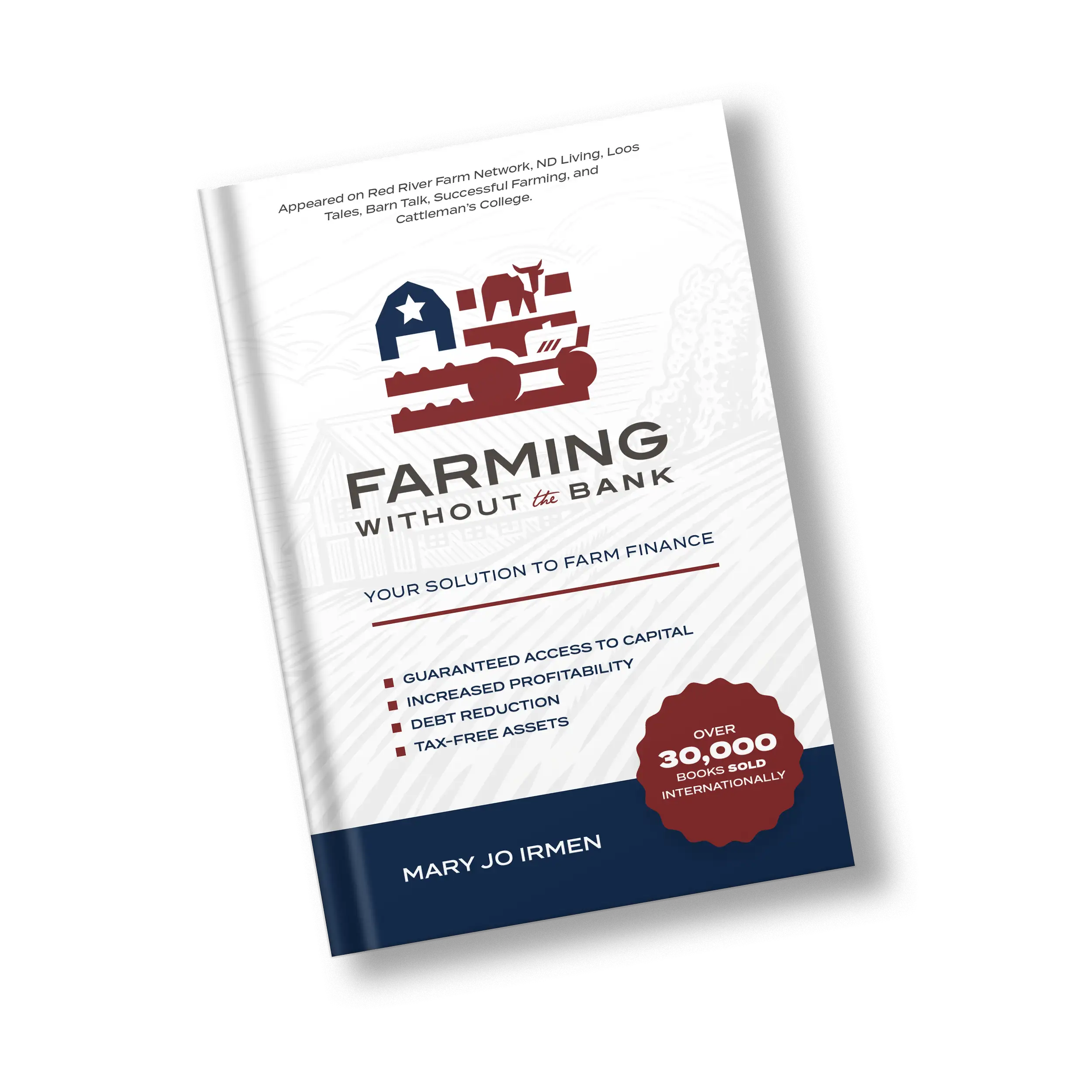
Your farm’s financial independence starts with one book.
30,000 farmers and ranchers have already made the shift. The only question is how long you’ll keep paying interest you could be keeping yourself.