 GET THE BOOK
 GET THE BOOK




Podcast
EP. 291
Ep. 291 – BYOB Intro Review & Becoming Your Own Banker
Feb 28, 2025 ·
40 min
0:00 / 40:06
EPISODE OVERVIEW
ABOUT THIS EPISODE
Unlocking Financial Freedom: Diving into Infinite Banking and Becoming Your Own Banker
This week, John Hasche joins us to discuss Becoming Your Own Banker. Here is your chance to dive into its key concepts with us as we review important sections of the book, emphasizing its financial principles, ultimate objectives, and how it serves as the ultimate guide to understanding the Infinite Banking Concept.
- ► Learn more: farmingwithoutthebank.com
- ► Get the book
Audio Production by Podsworth Media
Video Production by The Post Production Shop
CHAPTER TIMESTAMPS
- 00:00Introduction to Financial Independence
- 00:36Welcome Back to the Podcast
- 00:53Deep Dive into BYOB
- 02:05Importance of the Introduction
- 03:32Breaking Down Key Concepts
- 06:15Understanding Life Insurance
- 11:56Mindset and Financial Education
- 18:17Long-Term Planning and Generational Wealth
- 19:21Understanding Life Insurance and Taxation
- 21:04The Concept of Wealth Residency
- 23:06Financing Big Purchases Without Banks
- 23:47Rethinking Retirement: Passive Income and Cash Flow
- 25:03The Importance of Continuous Education
- 29:33The Flow of Money in the Financial System
- 33:22Creating Your Own Banking System
- 38:10Starting Your Own Banking System
YOUTUBE EPISODE
TRANSCRIPTION
“Somebody has to hold the money. Somebody else needs the money. Do you want to be both of those people? Or do you always want to go to the guy with the money? You own part of the life insurance company. You don’t own part of the bank. Who do you want to make that money? Who wants to control those loan paybacks? I do, right? Interest is going to get paid. You’re either going to pay it or you’re going to lose opportunity for it. But I would rather that interest go back to my company than go to the bank, and they drive off in their Cadillac Escalade and then tell me one year that they can’t give me any money.”
Hello, hello, hello, and welcome back to the podcast. Thank you very much for being here. I appreciate it, as always. Okay, today, well, not just today, but John is back. Welcome again, John.
Yeah, thanks for having me.
Okay, you guys, it’s going to be fun. So John and I are going to go through BYOB. And it’s going to be fun because it’s going to give you guys an opportunity to learn about the Becoming Your Own Banker book, and it’s going to introduce you to John more. So John and I are just going to go through BYOB. We’re going to talk about the important things in BYOB that we like. If you listened to the Without the Bank podcast in November, when I went through the introduction… I’m going to do it again, but I’m going to do it with John. And then we’re going to do the Becoming Your Own Banker chapter. Essentially, that would be chapter one of this book. So you should listen anyway. But if you guys did not listen to that podcast, the question really becomes why? Like, why are you not listening to both podcasts? But if you didn’t, I get it. I understand. But I just want to show you the highlights. And John and I were just talking before we got on about how many highlights he has in his book, too. And I have more than John. Yeah, I have more than John. But John told me that there’s a fine line. You can’t highlight the whole thing, even though the whole thing is good. So…
Yep.
So there’s that. All right. So we are going to start with the introduction and just talk about what we feel is important in the introduction. I actually am on the council for the Nelson Nash Institute, and we have what was called the Coaching Academy for Agents. And I teach the introduction for the Coaching Academy. And so I actually break out every single paragraph of the introduction, because I think the introduction is that important. So if you guys do not have BYOB, order it. If you have it, grab the book and listen to this podcast at the same time. Like, read the introduction and then listen to the podcast. Use the book as your study guide, because this is important stuff. John, you hadn’t read the book in a while, you said, right?
Correct. Yeah, it’s probably been a little over a year.
Okay. So even John, going back in and rereading the book… As you advance through the process of Infinite Banking and the more things you learn about it, the more some of the stuff that Nelson talks about in the book relates. So we’re going to kind of break it down. And I may go paragraph by paragraph. I don’t know. But let me ask first, John, do you have anything in the first paragraph that you have highlighted?
“It is not a sales tool for life insurance agents. It is education that the life insurance industry should have taught the last 200 years.” I just don’t ever look at it like I’m selling somebody something. Like, you’re just teaching them a concept. And that’s that.
Exactly. Because we are teaching. Are we actually selling you something? Yes. We’re selling you a life insurance policy. But we are teaching you how to use the concept.
Right.
And here’s what I love about this chapter. I have in green all the things that Nelson says this is, and then in red, I have all the things Nelson says this is not. So John just said it is not a sales tool. I have that underlined in red, because this is not a sales tool. It is education that the life insurance industry should have been teaching. So, hey, we’re just bringing in the education of 200 years. A lot of people say, well, this is new. I’ve not heard of this. Why is it so great? It’s 200 years old.
Didn’t reinvent the wheel here.
Exactly. We’re not out here coming up with something new and sexy so we can make some commission. This has been around forever. However, I also have highlighted in green, “The Infinite Banking Concept is a text for a 10-hour course of instruction.” And so when Nelson did his seminars way back when, he did a 10-hour course, because people could not get this all in an hour or two hours. So if you’re going to read the book, and it’s going to take you three, four hours to read the book, and you think you got it all? Nope. Not happening. John, I’ve been doing this 15 years. Eat, sleep, and breathe it. That’s all I do. You’ve been at this how many years?
At least five. It might be six.
Yeah. And do you know everything?
No.
So as a client, if you’re not rereading this, and reading this and going over it, and surrounding yourself with people, or calling John and me if you’re a client and saying, hey, what about this, or what about that, how are you going to get a 10-hour course done? Because you met with us for an hour and a half, or for an hour, and all of a sudden you think that you know everything. I wish that it would go that way, but it just doesn’t work that way. But that’s just paragraph one, you guys, where he says this is something that should have been taught forever. So we are teaching stuff.
I also have underlined, “Life insurance companies must put premium income to work in various investments in order to pay death claims.” And we get that question a lot. Where does a life insurance company put your money? What are they doing with the money? How can they afford to pay these death claims? Because there’s this big misconception that life insurance is a scam and that it’s not going to pay out. That is not the case. Insurance companies try very, very hard to always pay their claims. They don’t want to ever not pay a claim, but they have to put that money to work. And that is in bonds and real estate, most of the time. So would you agree that you get that question a lot from people? What are they doing with that money?
Yeah, that is pretty common. But it’s just like within somebody’s business, like, it has to flow. So they go out and put it into motion and keep it working in various different things so that they can pay out those claims. And even in the crop insurance world, like, you sell crop insurance, the insurance companies are doing the same thing so that they can pay that crop claim.
Yep. It’s not put in the stock market. It’s bonds and real estate, something that’s very secure, because they know that they have a contract to fulfill for 120 years, or 121 years, down the road. Okay. Paragraph two. You got anything there?
Oh, yes. I highlighted the first sentence there. “This book demonstrates that your need for finance during your lifetime is much greater than your need for protection.” I mean, you’re always going to need that as long as you’re alive. You’re going to need money on hand. And so why not put some of it through here?
The point of this sentence that is so important: “If you solve the need for finance, the death benefit will be more than you ever needed for protection.” So meaning, if you put all the money that you need through the policy to finance all the things that you’re going to buy in life, then you are going to have more death benefit than you would have had if you had just come to John and me and said, hey, I need some term insurance.
Yeah.
Right?
I feel like that’s something we get a lot, too, where somebody would be like, well, I just want a million dollars of death benefit. And we don’t really look at it that way, because that part of it will come. Like you said, it’s how much money flow can we run through here? The byproduct of that will be a lot of death benefit.
Right.
Yep. I just did one today for somebody, and he’s like, oh, oh, that’s a lot more death benefit than I thought it would be.
Or you get those people that say, I don’t need the death benefit.
Yeah. It is life insurance.
Well, it isn’t for them. It’s for their beneficiaries.
Right.
But we are not even structuring that policy for max death benefit. We’re structuring that policy for cash value purposes. And there’s still more death benefit there than most people would think. I also underlined, “Solve this need and you will end up with more life insurance than the companies will issue on you.” Because insurance companies will only issue 30 times your gross income, or 20, or 15, depending on the factor for your age. But what are we buying? Are we paying cash for tractors? Are we paying cash for equipment, cattle? What are we paying cash for that’s not going through the policy? If that would be going through the policy, it’s going to buy death benefit, which is going to what? Create generational wealth.
Yeah.
Right? And our clients don’t always think of that. It is a matter of, you have to be able to afford it.
Absolutely.
But if you can afford it because you’re buying these other things, what are you financing in your life? We have to sit down and look at our numbers and say, okay, what are we buying with cash that was gone otherwise? And that should be able to be run through a policy, if we paid cash for that item. I also highlighted in this chapter, “because of how little premiums they pay, there is limited access to money to finance major items needed during a lifetime.” And I think there’s a couple of things here. People will say, well, whole life is bad because we don’t have cash value. Well, you don’t have cash value because, as Nelson told me one time, you put peanuts in and you’re going to get peanuts out.
Yeah.
Right? We want to buy life insurance like we’re going to Walmart, but then we want all the money.
Yeah. You want to replace your line of credit, but you don’t want to put, you know, a sizable amount of money through a policy. That doesn’t equal out.
Right. And you’re like, well, I can’t afford it. Okay, but you just paid cash for a new tractor. Or you just paid cash for cows, or whatever it is. And it’s major items. He mentions that twice in this chapter. This is to purchase major items in your life. This is not to go to McDonald’s and buy a Big Mac. Okay, this is major items. Pickups, tractors, combines, cattle, operating notes. What are those major things that you are paying cash for that can go through the policy? Okay, how about paragraph three?
Well, I’m realizing I should have had this first sentence highlighted here. “The fact that the principles have been there all along and no one taught them to me makes me rather angry.” That’s a good quote there.
Mm-hmm. And I have that highlighted as well. And also, “Someone should have recognized them and taught them long ago. But this didn’t take place because of mindset.” And I think the word mindset there is extremely important.
Yeah. I think that’s what Nelson’s book is good for, is it puts you back in the mindset of, like, how this all works. Like, he breaks it down so simply that you can kind of frame your mind around how money does have to flow through you.
Mm-hmm. And cash buyers, people that use cash, have the hardest time with their mindset around this. And a lot of people will say, well, how come I didn’t know? How come I didn’t get taught? The answer is right there. Right? It’s mindset. And what is our mindset around it? I just had a meeting with a potential client that has a bunch of money in an IRA. And he’s like, well, why wouldn’t I just take my IRA money and run it through the policy and then pay off all my credit card debt? And he has credit card debt at 20%. And his accountant said, oh, no, no, no, no, don’t do that. That’s your retirement. That’s all mindset. The mindset has been, we segregate our money. We can’t use our retirement money today. We have to let it sit there. And that’s because nobody has ever told us we can borrow against it and pay it back if it were in a policy, and then use it for retirement. So it’s a mindset of people just telling us what to think. And then we think, oh, that’s a really good idea. And we don’t question it. And then in the next paragraph, this is for the layman, not for the financial advisor, and y’all listening are not agents, so we don’t need to go over that with you. Okay, how about the next paragraph?
Yeah, I have that first sentence. “The whole idea is to recapture the interest that one is paying to banks and finance companies for the major items that we need,” which, there’s where he mentions that again, “during a lifetime, such as automobiles, major appliances, education, homes, investment opportunities.”
Major items. There are people out in this world of social media and Infinite Banking that are saying you can use this to buy a coffee, use this to go to McDonald’s, whatever that might be. That’s not a major item.
Yeah. Those are living expenses.
Should you run your Walmart grocery bill through the policy? No, no, I don’t believe so. Now, there’s another agent out there that might believe so, but I don’t believe so. I think that’s a bit excessive. And then in the next paragraph, he said, “This is not about investments of any kind. It’s about how one finances the things of their life, which can certainly include investments.” Did you catch that? When you read it… People will tell you, hey, I can get a better rate of return in my investment. Go ahead, then. Borrow against your cash value. That’s where I go back to: it’s an “and” asset, not an “or” asset. If you want to buy investments, go do that with your cash value. And it’s an asset, not an investment. It is not an investment. It is an asset. But if you want to make it an investment, borrow against cash value, go put money into your investment. And then when your investment makes money, you can pay back the cash value if you want. So I did not catch that, probably, the first 10 times I read the book. And I caught that the last time. And then he says, “This is not about a rate of return, but it is about a process of banking, which goes on no matter what is happening.” The fact that banks make more money during times of low interest rates than when rates are high. Y’all know this is not about a rate of return. I’m not going to lose my mind here today, but it is not about a rate of return. It is about liquidity, control, and guarantees. It is about taking back the banking function of your life.
I actually didn’t have anything highlighted in this next paragraph here. I kind of took a break there for a second.
In the one that I just got done with?
No, the next one down. “A word of caution is in order.” Because I guess that is the one thing about Nelson’s book now, is, like, I mean, it is 25 years old now. So, like, the number part of it is not something that I would sit and harp on, but more just the mindset stuff.
Right. And that’s exactly right. The numbers don’t matter. As Nelson always said, it’s all relative.
Doesn’t matter. It’s all relative.
Right. It doesn’t matter if interest rates were 23% when he did this, or if they are 8% today, or were 3% way back when. It didn’t matter. Because you still have…
No, the contract principles still apply, but not the numbers.
Exactly. The numbers might be a little bit off, but even that does not matter. In my opinion, if you’re in the numbers, you’re in the weeds. Because it is about liquidity, control, and guarantees. And if we don’t have those things, then what? Then what? And so I underlined the word caution in that chapter. And then I underlined, “The dividend scale is lower now just because interest rates are lower, and the difference in results remains the same.” He is just saying, hey, it’s all relative, you guys.
Yeah.
And Nelson was saying this stuff. If Mary Jo said this stuff, I’d be like, use your brain. Think about it. Right? And Nelson is just being a little bit nicer, because he’s saying, hey, it’s all relative. And it is. And we want exact numbers. And when we want exact numbers, we’re focusing on the wrong thing. Money has to flow. The banking function is the piece that we should be focused on. Oh, I like the next paragraph.
I do too. I have that one. “It’s not a procedure to get rich quick. It requires long-range planning.” That’s all I have highlighted in that next chapter. I had one other thing. But I mean, you have to think long term with this, because it might solve some of your problems short term. But long term, I mean, that’s where it really just goes crazy.
Well, I did have the last sentence highlighted. Did you highlight that one?
No, I had the “plan as if you’re going to live forever and live as if you’re going to die today.”
And then he said, “I learned to think beyond the lifespan of my current generation.” So what he’s saying is generational wealth is extremely important. You should be thinking about the next generation and how you can make them better. It’s not about leaving your kids rich, spoiled little brats. If they’re rich, spoiled little brats, that’s on you. That’s on you, because you did that. You raised them. But if we teach them how to do this, we can keep it going for generations.
Yeah. I like the next sentence. “Becoming Your Own Banker is not a tax-qualified idea of any sort. Life insurance has been around for over 200 years and is not a creature of any tax code.”
Yep, because it’s always been… People will say, well, why isn’t the dividend taxed? Because the IRS tax code says it is a return of premium. So then you have people like Dave the dipstick who will say, well, that means you paid too much in. No, it means that the company mitigated risk by anticipating more deaths than occurred, because they are trying to be conservative. And they’re like, oh, hey, not as many people died, so we’re going to give you a dividend in return for not having as many people die. He also says it’s “nothing more than like-minded people contracting with one another to solve a financial problem.” And so some of what he’s talking about there is, Nelson was really big on contractual stuff and not doing business with the government or having the government in his business. And so the fact that the life insurance policy is a contract between you and the insurance company, he loved that, because there was no third party. There were no banks. There was no Federal Reserve. None of that.
I’m just sitting here thinking that, you know, if he was still around today, he would be a huge fan of DOGE.
He would want to be on the team. Yeah, I can actually… That’s funny. I can actually hear him.
Yeah, no. Yeah. He’d be slashing everything.
Yep. Yep. He would be. “There is no such thing as having too much money in the bank. Wealth must reside somewhere. From this residence, one can do anything that one can conceive. This is the advantage that most folks ignore in the thought process, and therefore limit their effectiveness.” And at first glance, those two paragraphs don’t seem like a big deal. But wealth must reside somewhere. So it’s either going to reside in your 401(k), or your IRA, or your savings account, or your brokerage account. It’s going to reside somewhere. Can it reside somewhere that it remains liquid? Can it reside somewhere that it has uninterrupted compound growth?
I just had a meeting today with some people, actually, that the last 10 years or so, they’ve had multiple times where they’ve had a windfall of some type, you know, whatever it may be from. And they were like, oh, we took it and paid down land debt. And it’s like, well, but now you’re in a tougher spot, because you gave all that money away. Whereas, you know, they didn’t even get their loans refinanced when they did it. So it’s like, what did you really gain by doing that?
Yeah.
You know, they didn’t recalculate their payment.
You mean…?
Correct.
Yeah. But they gave all that wealth away to the bank for almost nothing in return. And now, in order to go get it again, they have to go back to the bank and beg for it. Or maybe their banker’s nice.
Oh, yeah.
But they have to pay an interest rate to access it.
And they still have a land payment.
Yep. And so if wealth must reside somewhere, and from this residence one can do anything that one can conceive, meaning it’s liquid, you can do whatever you want with it. The insurance company is not going to ask you about what you’re doing with it. It’s not going to be a question. And that kind of ties into, what is it, two or three chapters into the book, the Imagination one. You can do anything with it. And then he said, “Let me make this abundantly clear. I am not talking about a bank in the conventional sense of the word. I am demonstrating how one can use dividend-paying whole life to solve one’s needs for finance throughout one’s life.” A lot of people will say, well, do I still need a bank? Yes. You still need a bank to deposit your money into. It is about financing the big purchases in life, so we don’t have to go to the bank, and the bank can turn money 10 times. It’s about us controlling those big purchases, not about, hey, I need to write a check because I’m going to go buy groceries or something. Anything that you want to add on that?
Not on that. But I like in the next paragraph down, when he talks about the idea of retirement, and that we should all get rid of that word and think about passive income and cash flow instead.
Mm-hmm. Yep. And that very much is a huge… I actually missed that. Why didn’t I highlight retirement and passive income?
I don’t get crazy with the highlighter there.
Well, good job, John. I have not… I’ve actually not even highlighted those. But it is true. And how many times do I talk about it? If you want to retire, fine. But you need passive income to live. You’re going to need some kind of cash flow to live. And so where is that cash flow going to come from? “You will see that very high premium dividend-paying whole life insurance is the ultimate vehicle to produce such income.” Very high premium. He is not saying you put peanuts in and then you can retire on a ton of cash flow. So there’s a lot of people that think, oh, this life insurance policy is just going to be the next best thing and I’m going to be able to retire on it. And I tell y’all, that’s not going to happen. You’re going to need cash flow, because you’re not paying very high premium. You’re putting in peanuts, and you’re going to get peanuts that are not going to be equal because of inflation. Yep. “It will require several thorough readings for a full understanding.” Several thorough readings, not one reading and I’m done and I know everything. Thorough readings. It’s not complicated. It’s just different.
Yep. I would say to that, you can tell in a meeting if somebody has read the books multiple times or just glanced them over. The people that read them, you can tell.
Oh, 100%. And people that will listen to the book and read the book. I’ve even listened to the book, and I’m like, wow, wow.
Yeah.
I never saw that in the book. And then I’ll have to go open the book up and highlight that, because I’ve not heard that, or I’ve not read it, because hearing it is different as well. And then he just says, “Education is an ongoing process.” And so you can’t read it once and then just think that you know everything. John and I do not know everything. It is a constant learning curve. I told somebody today, I’ve been doing it wrong for like 13 years. In the last couple of years, I’m like, well, why am I paying my loans back right away? Why am I not using that extra money to start new premiums? What? It’s just this mindset, and when money comes in, for timing of what I need to do. And then, “Read it with an open mind and you will discover a whole new financial world.” That’s actually really funny, because I say almost the same thing in my book. Obviously, I have it underlined, but it never registered that I have that in my book, too, that you need to read it with an open mind.
Yeah. You know, I’ve never read this quote at the bottom here by Will Rogers, either. “The problem in America isn’t so much what people don’t know. The problem is what people think they know that just ain’t so.” I never noticed he had that there.
Oh, yeah. I’ve heard the quote before, but it’s all about a thought process, right? All about a thought process. Okay. We are about a half an hour into this podcast, but this next chapter is really, really small, so I want to go over that with you. And you guys have probably heard me say this every time I do a review of Nelson’s book. Of course, I skipped the introduction, because why would anybody read an introduction? I hadn’t read the introduction for probably 10 years after I was in this industry. And so when I read Nelson’s book, this was the first paragraph I read. And this paragraph made 100% sense to me, because my dad and uncle had talked about this. “If we distribute money equally in the world, within a shorter period of time, 97% of the people would be broke and 3% would be wealthy.” It does not matter. We could take all the money and divide it equally. Why is that?
Some people just don’t know how to handle it. I know I can think of people that, if you gave them a billion dollars, they’d be broke in a week. I mean, no amount of money could fix it.
Yep. If you can’t manage a dollar, you can’t manage a million.
Yeah. It doesn’t matter.
I’ve seen it over and over and over and over. People that can’t manage money will end up right where they’re at. So if we think the wealthy people are bad, we should be asking, how did they get there? What did they do differently? The first client that I happened to have today, he was like, I need to know. I need to know if all these big farmers around me are using whole life insurance. They got to be doing something. I’ve been asking these guys for years what they’ve been doing. And he’s asking the right questions. Instead of being jealous of these guys, he’s like, what are they doing that’s so different? And again, it’s all mindset around money. The top income earners in our country, in any country, understand finances. Some of them are bad, and they might be screwing people and doing shady things, right? But that is not the majority of people. They understand how to run a business. They understand how to spend money. They understand cash flow and how to make money. It is all mindset. And so if we can do that all through a policy, how awesome is that? To me, because I had already heard that, and it made sense to me as a teenager, and then Nelson said it, I was like, whoa, this dude knows. Like, he must know my uncle.
Yeah.
This is crazy.
Well, yeah. Well, just in this page and a half here, whatever it is, I think he mentions “money must flow” or “the flow of money” like seven or eight different times. Because that’s a lot of what I have highlighted, is just every time he wrote “money must flow.” Because you got to keep her moving.
Yep.
“Banking is the most important business in the world. Without it, business comes to a screeching halt.”
Yep. Think about that. Think about just the world of farming. If there was no bank, there would be a couple farms.
Yep. A couple.
“Whenever a business transaction takes place, money must flow from one party to another in a short amount of time.” Somebody has to hold the money. Somebody else needs the money. Do you want to be both of those people? Or do you always want to go to the guy with the money? It has to flow. Because as soon as I lend it to you, you give it back to me, and then I can lend it to Susie. And then Susie gives it back to me, and I can lend it again. All it’s doing is flowing. It’s a big cycle.
Mm-hmm.
So when we have our own money, like the client I talked about today that had his IRA money, if he lends that to the farm and the farm pays him back, he still has his money. It just flowed through his hands, back to his hands, right? It’s one big pool. It’s not like this is magic.
That’s what he says in the beginning of the third paragraph. “There is only one pool of money in the world. The fact that this pool is managed by any number of institutions, banks, insurance companies, corporations, and individuals in various countries with various currency denominations is incidental.”
I have that underlined because I think that’s important. There’s one pool of money in the world, and it is held in banks, in financial institutions, insurance companies. And when you talk to the CFOs of these life insurance companies and I say, hey, what’s going on, because of cryptocurrency and the gold standard and all the stuff that’s going on in the financial world, they will say, Mary Jo, there’s nothing to be alarmed about. We sit at the same tables as everybody else, because there’s only so much money that’s managed, and it’s all put into the same spots. Like, that’s crazy.
Yeah.
Like, we think, oh, life insurance is the best. Well, they’re the most conservative at managing the money. But they’re still at the same table as the banks. They’re still at the same tables as the financial advisors of the world. And they all are putting their money into the same spots. Even some life insurance companies will have money in the stock market. Guess what? It’s the same stock market everybody else has money in. Right? They’re just professional money managers. And so it’s managed differently, versus, oh, I’m just going to go to the broker down the street, the financial advisor who went to school for four years and just doesn’t really do anything.
Yep.
He said it’s all part of a system. And then on the next page, it must flow through you and me. And then in the last paragraph, “Money flows from the pool through our hands to meet our needs. But somewhere in the process, it all ends up back in the banking system. How much of the banking function do you control as it relates to your needs? This book is all about how to create your own banking system so that you can control 100% of your needs: becoming your own banker.” So again, in green, I have highlighted what this book is about. Did you notice how he did not say it’s about a rate of return?
I did. Yeah.
It’s about the banking system. So how much do we want to put through the system so we can control it, to lend back to ourselves? We can have it for retirement if we need it for retirement. I don’t believe in retiring. I don’t believe that the majority of our clients are going to retire. But if we do retire and we’ve put enough premium through, we can retire. We could sell the farm to the kids.
Yeah, you’ll have something there to fall back on, at the very least.
Well, and you won’t need to rent the farm to the kids and live off of rental income, right?
Yeah.
So it’s going to give you some options. So for a lot of people that have high operating expenses, how much can you get through? It’s scary. Don’t get me wrong. It’s scary. But when we structure a policy so that a lot can go in year one, and we can put extra premium in year one, and then the premium every year after goes down, that’s to your benefit. We can get more in to start that process of borrowing, and we can load our bank up quicker, so then it’s not so much premium going forward.
Yeah, and it gives you more flexibility within the policy if you do that as well.
And I’m sure that your clients are the same as the people that I’m talking to, that we have a lot of operating expenses, but we have a very little operating note. I don’t see very often that those are equal.
Yeah, I don’t either. Actually, one of the people I met with today, they had sat down and figured out how much interest they had paid in the last four years. They had a large operation, but it was like 700 grand, and she actually sat and figured that out. And I was like, oh, you shouldn’t have figured that out. That’s a disgusting number. But, you know, that made her mad, though, right? Like, it was frustrating to her. So she was like, I have to figure out a way to get around that.
Yeah. And here’s the thing. Here’s a great point to that: who’s going to make that $700,000? Is the bank going to make it, or is the life insurance company going to make it? Because you got to pay interest to the life insurance company. You own part of the life insurance company. You don’t own part of the bank. Who do you want to make that money?
The life insurance company.
Right. Who wants to control those loan paybacks? I do. And so that’s such a good example. Interest is going to get paid. You’re either going to pay it or you’re going to lose opportunity for it. But I would rather that interest go back to my company than go to the bank, and they drive off in their Cadillac Escalade and then tell me one year that they can’t give me any money. I got nothing against Cadillac Escalades, by the way.
Yeah.
But I do have something against it when you tell me no, and then I paid you $700,000 of interest.
Yeah. Her husband said, you know, I think they started a new bank downtown, and then they invite you in for a hot dog for lunch and say thank you, you know, but…
And it should be a steak.
Yeah.
Yeah. But it is a matter of, if we don’t have a bank, we don’t have a farm. So, I mean, we have so many people using the bank. And then our operating expenses are not the same as what we borrow. I talked to a client today, and we did a little review on his stuff. He’s got $600,000 or $400,000 of operating expenses, but he’s only borrowing 200. Does he have $200,000 sitting around? No. No, because he puts it right back in. But he has $200,000 going through his system that he is using for cash. So if y’all are listening to this and you have operating expenses that are double, triple your line of credit, or you’ve got $500,000 of operating and you’re only borrowing 200, $300,000 of cash is moving through your system. No, you don’t have it. I get it. But it’s going through. It could make one quick stop and then be borrowed against. And now it’s earning.
Well, now you’ve started your own system.
Yes, you’ve started your own bank. You’re paying interest to your bank. You have control of it. And it’s earning uninterrupted compound interest. And we’ve created death benefit, more death benefit than you would ever need.
Yep.
It’s all right here, folks. So if you haven’t gotten it, I don’t know why, unless you’re new here. You should have this book. So go to farmingwithoutthebank.com, grab this book, grab Farming Without the Bank, get them as a bundle, get the audios, whatever. And then when you are done reading that, you can schedule an appointment with John or me. I am typically booked out about three months. John is booked out a week or so. So you can get in a little faster with John, but you’re going to get the same customer service. It does not matter who you go to. John knows the system. Like he said, he’s been doing this for five or six years. So figure out where you want your banking system to start. Do you want to start it with peanuts? If you only have peanuts, then we need to start with peanuts. But if you have dollars and you want to put a little more in, then put a little more in, so you see that you’re getting somewhere. If you have comments, questions, concerns, you know the routine. Email me, maryjo@withoutthebank.com, and I’m happy to answer any of those. Otherwise, we’ll see you in the next podcast.
Thanks for listening to the Farming Without the Bank podcast. We hope today’s episode has inspired you to take control of your finances in new ways. Don’t forget to check out our website, farmingwithoutthebank.com, and engage with us on our Facebook page, Farming Without the Bank. Join us next week as we smash more financial myths and empower you to accomplish your financial goals.
View MoreHello, hello, hello, and welcome back to the podcast. Thank you very much for being here. I appreciate it, as always. Okay, today, well, not just today, but John is back. Welcome again, John.
Yeah, thanks for having me.
Okay, you guys, it’s going to be fun. So John and I are going to go through BYOB. And it’s going to be fun because it’s going to give you guys an opportunity to learn about the Becoming Your Own Banker book, and it’s going to introduce you to John more. So John and I are just going to go through BYOB. We’re going to talk about the important things in BYOB that we like. If you listened to the Without the Bank podcast in November, when I went through the introduction… I’m going to do it again, but I’m going to do it with John. And then we’re going to do the Becoming Your Own Banker chapter. Essentially, that would be chapter one of this book. So you should listen anyway. But if you guys did not listen to that podcast, the question really becomes why? Like, why are you not listening to both podcasts? But if you didn’t, I get it. I understand. But I just want to show you the highlights. And John and I were just talking before we got on about how many highlights he has in his book, too. And I have more than John. Yeah, I have more than John. But John told me that there’s a fine line. You can’t highlight the whole thing, even though the whole thing is good. So…
Yep.
So there’s that. All right. So we are going to start with the introduction and just talk about what we feel is important in the introduction. I actually am on the council for the Nelson Nash Institute, and we have what was called the Coaching Academy for Agents. And I teach the introduction for the Coaching Academy. And so I actually break out every single paragraph of the introduction, because I think the introduction is that important. So if you guys do not have BYOB, order it. If you have it, grab the book and listen to this podcast at the same time. Like, read the introduction and then listen to the podcast. Use the book as your study guide, because this is important stuff. John, you hadn’t read the book in a while, you said, right?
Correct. Yeah, it’s probably been a little over a year.
Okay. So even John, going back in and rereading the book… As you advance through the process of Infinite Banking and the more things you learn about it, the more some of the stuff that Nelson talks about in the book relates. So we’re going to kind of break it down. And I may go paragraph by paragraph. I don’t know. But let me ask first, John, do you have anything in the first paragraph that you have highlighted?
“It is not a sales tool for life insurance agents. It is education that the life insurance industry should have taught the last 200 years.” I just don’t ever look at it like I’m selling somebody something. Like, you’re just teaching them a concept. And that’s that.
Exactly. Because we are teaching. Are we actually selling you something? Yes. We’re selling you a life insurance policy. But we are teaching you how to use the concept.
Right.
And here’s what I love about this chapter. I have in green all the things that Nelson says this is, and then in red, I have all the things Nelson says this is not. So John just said it is not a sales tool. I have that underlined in red, because this is not a sales tool. It is education that the life insurance industry should have been teaching. So, hey, we’re just bringing in the education of 200 years. A lot of people say, well, this is new. I’ve not heard of this. Why is it so great? It’s 200 years old.
Didn’t reinvent the wheel here.
Exactly. We’re not out here coming up with something new and sexy so we can make some commission. This has been around forever. However, I also have highlighted in green, “The Infinite Banking Concept is a text for a 10-hour course of instruction.” And so when Nelson did his seminars way back when, he did a 10-hour course, because people could not get this all in an hour or two hours. So if you’re going to read the book, and it’s going to take you three, four hours to read the book, and you think you got it all? Nope. Not happening. John, I’ve been doing this 15 years. Eat, sleep, and breathe it. That’s all I do. You’ve been at this how many years?
At least five. It might be six.
Yeah. And do you know everything?
No.
So as a client, if you’re not rereading this, and reading this and going over it, and surrounding yourself with people, or calling John and me if you’re a client and saying, hey, what about this, or what about that, how are you going to get a 10-hour course done? Because you met with us for an hour and a half, or for an hour, and all of a sudden you think that you know everything. I wish that it would go that way, but it just doesn’t work that way. But that’s just paragraph one, you guys, where he says this is something that should have been taught forever. So we are teaching stuff.
I also have underlined, “Life insurance companies must put premium income to work in various investments in order to pay death claims.” And we get that question a lot. Where does a life insurance company put your money? What are they doing with the money? How can they afford to pay these death claims? Because there’s this big misconception that life insurance is a scam and that it’s not going to pay out. That is not the case. Insurance companies try very, very hard to always pay their claims. They don’t want to ever not pay a claim, but they have to put that money to work. And that is in bonds and real estate, most of the time. So would you agree that you get that question a lot from people? What are they doing with that money?
Yeah, that is pretty common. But it’s just like within somebody’s business, like, it has to flow. So they go out and put it into motion and keep it working in various different things so that they can pay out those claims. And even in the crop insurance world, like, you sell crop insurance, the insurance companies are doing the same thing so that they can pay that crop claim.
Yep. It’s not put in the stock market. It’s bonds and real estate, something that’s very secure, because they know that they have a contract to fulfill for 120 years, or 121 years, down the road. Okay. Paragraph two. You got anything there?
Oh, yes. I highlighted the first sentence there. “This book demonstrates that your need for finance during your lifetime is much greater than your need for protection.” I mean, you’re always going to need that as long as you’re alive. You’re going to need money on hand. And so why not put some of it through here?
The point of this sentence that is so important: “If you solve the need for finance, the death benefit will be more than you ever needed for protection.” So meaning, if you put all the money that you need through the policy to finance all the things that you’re going to buy in life, then you are going to have more death benefit than you would have had if you had just come to John and me and said, hey, I need some term insurance.
Yeah.
Right?
I feel like that’s something we get a lot, too, where somebody would be like, well, I just want a million dollars of death benefit. And we don’t really look at it that way, because that part of it will come. Like you said, it’s how much money flow can we run through here? The byproduct of that will be a lot of death benefit.
Right.
Yep. I just did one today for somebody, and he’s like, oh, oh, that’s a lot more death benefit than I thought it would be.
Or you get those people that say, I don’t need the death benefit.
Yeah. It is life insurance.
Well, it isn’t for them. It’s for their beneficiaries.
Right.
But we are not even structuring that policy for max death benefit. We’re structuring that policy for cash value purposes. And there’s still more death benefit there than most people would think. I also underlined, “Solve this need and you will end up with more life insurance than the companies will issue on you.” Because insurance companies will only issue 30 times your gross income, or 20, or 15, depending on the factor for your age. But what are we buying? Are we paying cash for tractors? Are we paying cash for equipment, cattle? What are we paying cash for that’s not going through the policy? If that would be going through the policy, it’s going to buy death benefit, which is going to what? Create generational wealth.
Yeah.
Right? And our clients don’t always think of that. It is a matter of, you have to be able to afford it.
Absolutely.
But if you can afford it because you’re buying these other things, what are you financing in your life? We have to sit down and look at our numbers and say, okay, what are we buying with cash that was gone otherwise? And that should be able to be run through a policy, if we paid cash for that item. I also highlighted in this chapter, “because of how little premiums they pay, there is limited access to money to finance major items needed during a lifetime.” And I think there’s a couple of things here. People will say, well, whole life is bad because we don’t have cash value. Well, you don’t have cash value because, as Nelson told me one time, you put peanuts in and you’re going to get peanuts out.
Yeah.
Right? We want to buy life insurance like we’re going to Walmart, but then we want all the money.
Yeah. You want to replace your line of credit, but you don’t want to put, you know, a sizable amount of money through a policy. That doesn’t equal out.
Right. And you’re like, well, I can’t afford it. Okay, but you just paid cash for a new tractor. Or you just paid cash for cows, or whatever it is. And it’s major items. He mentions that twice in this chapter. This is to purchase major items in your life. This is not to go to McDonald’s and buy a Big Mac. Okay, this is major items. Pickups, tractors, combines, cattle, operating notes. What are those major things that you are paying cash for that can go through the policy? Okay, how about paragraph three?
Well, I’m realizing I should have had this first sentence highlighted here. “The fact that the principles have been there all along and no one taught them to me makes me rather angry.” That’s a good quote there.
Mm-hmm. And I have that highlighted as well. And also, “Someone should have recognized them and taught them long ago. But this didn’t take place because of mindset.” And I think the word mindset there is extremely important.
Yeah. I think that’s what Nelson’s book is good for, is it puts you back in the mindset of, like, how this all works. Like, he breaks it down so simply that you can kind of frame your mind around how money does have to flow through you.
Mm-hmm. And cash buyers, people that use cash, have the hardest time with their mindset around this. And a lot of people will say, well, how come I didn’t know? How come I didn’t get taught? The answer is right there. Right? It’s mindset. And what is our mindset around it? I just had a meeting with a potential client that has a bunch of money in an IRA. And he’s like, well, why wouldn’t I just take my IRA money and run it through the policy and then pay off all my credit card debt? And he has credit card debt at 20%. And his accountant said, oh, no, no, no, no, don’t do that. That’s your retirement. That’s all mindset. The mindset has been, we segregate our money. We can’t use our retirement money today. We have to let it sit there. And that’s because nobody has ever told us we can borrow against it and pay it back if it were in a policy, and then use it for retirement. So it’s a mindset of people just telling us what to think. And then we think, oh, that’s a really good idea. And we don’t question it. And then in the next paragraph, this is for the layman, not for the financial advisor, and y’all listening are not agents, so we don’t need to go over that with you. Okay, how about the next paragraph?
Yeah, I have that first sentence. “The whole idea is to recapture the interest that one is paying to banks and finance companies for the major items that we need,” which, there’s where he mentions that again, “during a lifetime, such as automobiles, major appliances, education, homes, investment opportunities.”
Major items. There are people out in this world of social media and Infinite Banking that are saying you can use this to buy a coffee, use this to go to McDonald’s, whatever that might be. That’s not a major item.
Yeah. Those are living expenses.
Should you run your Walmart grocery bill through the policy? No, no, I don’t believe so. Now, there’s another agent out there that might believe so, but I don’t believe so. I think that’s a bit excessive. And then in the next paragraph, he said, “This is not about investments of any kind. It’s about how one finances the things of their life, which can certainly include investments.” Did you catch that? When you read it… People will tell you, hey, I can get a better rate of return in my investment. Go ahead, then. Borrow against your cash value. That’s where I go back to: it’s an “and” asset, not an “or” asset. If you want to buy investments, go do that with your cash value. And it’s an asset, not an investment. It is not an investment. It is an asset. But if you want to make it an investment, borrow against cash value, go put money into your investment. And then when your investment makes money, you can pay back the cash value if you want. So I did not catch that, probably, the first 10 times I read the book. And I caught that the last time. And then he says, “This is not about a rate of return, but it is about a process of banking, which goes on no matter what is happening.” The fact that banks make more money during times of low interest rates than when rates are high. Y’all know this is not about a rate of return. I’m not going to lose my mind here today, but it is not about a rate of return. It is about liquidity, control, and guarantees. It is about taking back the banking function of your life.
I actually didn’t have anything highlighted in this next paragraph here. I kind of took a break there for a second.
In the one that I just got done with?
No, the next one down. “A word of caution is in order.” Because I guess that is the one thing about Nelson’s book now, is, like, I mean, it is 25 years old now. So, like, the number part of it is not something that I would sit and harp on, but more just the mindset stuff.
Right. And that’s exactly right. The numbers don’t matter. As Nelson always said, it’s all relative.
Doesn’t matter. It’s all relative.
Right. It doesn’t matter if interest rates were 23% when he did this, or if they are 8% today, or were 3% way back when. It didn’t matter. Because you still have…
No, the contract principles still apply, but not the numbers.
Exactly. The numbers might be a little bit off, but even that does not matter. In my opinion, if you’re in the numbers, you’re in the weeds. Because it is about liquidity, control, and guarantees. And if we don’t have those things, then what? Then what? And so I underlined the word caution in that chapter. And then I underlined, “The dividend scale is lower now just because interest rates are lower, and the difference in results remains the same.” He is just saying, hey, it’s all relative, you guys.
Yeah.
And Nelson was saying this stuff. If Mary Jo said this stuff, I’d be like, use your brain. Think about it. Right? And Nelson is just being a little bit nicer, because he’s saying, hey, it’s all relative. And it is. And we want exact numbers. And when we want exact numbers, we’re focusing on the wrong thing. Money has to flow. The banking function is the piece that we should be focused on. Oh, I like the next paragraph.
I do too. I have that one. “It’s not a procedure to get rich quick. It requires long-range planning.” That’s all I have highlighted in that next chapter. I had one other thing. But I mean, you have to think long term with this, because it might solve some of your problems short term. But long term, I mean, that’s where it really just goes crazy.
Well, I did have the last sentence highlighted. Did you highlight that one?
No, I had the “plan as if you’re going to live forever and live as if you’re going to die today.”
And then he said, “I learned to think beyond the lifespan of my current generation.” So what he’s saying is generational wealth is extremely important. You should be thinking about the next generation and how you can make them better. It’s not about leaving your kids rich, spoiled little brats. If they’re rich, spoiled little brats, that’s on you. That’s on you, because you did that. You raised them. But if we teach them how to do this, we can keep it going for generations.
Yeah. I like the next sentence. “Becoming Your Own Banker is not a tax-qualified idea of any sort. Life insurance has been around for over 200 years and is not a creature of any tax code.”
Yep, because it’s always been… People will say, well, why isn’t the dividend taxed? Because the IRS tax code says it is a return of premium. So then you have people like Dave the dipstick who will say, well, that means you paid too much in. No, it means that the company mitigated risk by anticipating more deaths than occurred, because they are trying to be conservative. And they’re like, oh, hey, not as many people died, so we’re going to give you a dividend in return for not having as many people die. He also says it’s “nothing more than like-minded people contracting with one another to solve a financial problem.” And so some of what he’s talking about there is, Nelson was really big on contractual stuff and not doing business with the government or having the government in his business. And so the fact that the life insurance policy is a contract between you and the insurance company, he loved that, because there was no third party. There were no banks. There was no Federal Reserve. None of that.
I’m just sitting here thinking that, you know, if he was still around today, he would be a huge fan of DOGE.
He would want to be on the team. Yeah, I can actually… That’s funny. I can actually hear him.
Yeah, no. Yeah. He’d be slashing everything.
Yep. Yep. He would be. “There is no such thing as having too much money in the bank. Wealth must reside somewhere. From this residence, one can do anything that one can conceive. This is the advantage that most folks ignore in the thought process, and therefore limit their effectiveness.” And at first glance, those two paragraphs don’t seem like a big deal. But wealth must reside somewhere. So it’s either going to reside in your 401(k), or your IRA, or your savings account, or your brokerage account. It’s going to reside somewhere. Can it reside somewhere that it remains liquid? Can it reside somewhere that it has uninterrupted compound growth?
I just had a meeting today with some people, actually, that the last 10 years or so, they’ve had multiple times where they’ve had a windfall of some type, you know, whatever it may be from. And they were like, oh, we took it and paid down land debt. And it’s like, well, but now you’re in a tougher spot, because you gave all that money away. Whereas, you know, they didn’t even get their loans refinanced when they did it. So it’s like, what did you really gain by doing that?
Yeah.
You know, they didn’t recalculate their payment.
You mean…?
Correct.
Yeah. But they gave all that wealth away to the bank for almost nothing in return. And now, in order to go get it again, they have to go back to the bank and beg for it. Or maybe their banker’s nice.
Oh, yeah.
But they have to pay an interest rate to access it.
And they still have a land payment.
Yep. And so if wealth must reside somewhere, and from this residence one can do anything that one can conceive, meaning it’s liquid, you can do whatever you want with it. The insurance company is not going to ask you about what you’re doing with it. It’s not going to be a question. And that kind of ties into, what is it, two or three chapters into the book, the Imagination one. You can do anything with it. And then he said, “Let me make this abundantly clear. I am not talking about a bank in the conventional sense of the word. I am demonstrating how one can use dividend-paying whole life to solve one’s needs for finance throughout one’s life.” A lot of people will say, well, do I still need a bank? Yes. You still need a bank to deposit your money into. It is about financing the big purchases in life, so we don’t have to go to the bank, and the bank can turn money 10 times. It’s about us controlling those big purchases, not about, hey, I need to write a check because I’m going to go buy groceries or something. Anything that you want to add on that?
Not on that. But I like in the next paragraph down, when he talks about the idea of retirement, and that we should all get rid of that word and think about passive income and cash flow instead.
Mm-hmm. Yep. And that very much is a huge… I actually missed that. Why didn’t I highlight retirement and passive income?
I don’t get crazy with the highlighter there.
Well, good job, John. I have not… I’ve actually not even highlighted those. But it is true. And how many times do I talk about it? If you want to retire, fine. But you need passive income to live. You’re going to need some kind of cash flow to live. And so where is that cash flow going to come from? “You will see that very high premium dividend-paying whole life insurance is the ultimate vehicle to produce such income.” Very high premium. He is not saying you put peanuts in and then you can retire on a ton of cash flow. So there’s a lot of people that think, oh, this life insurance policy is just going to be the next best thing and I’m going to be able to retire on it. And I tell y’all, that’s not going to happen. You’re going to need cash flow, because you’re not paying very high premium. You’re putting in peanuts, and you’re going to get peanuts that are not going to be equal because of inflation. Yep. “It will require several thorough readings for a full understanding.” Several thorough readings, not one reading and I’m done and I know everything. Thorough readings. It’s not complicated. It’s just different.
Yep. I would say to that, you can tell in a meeting if somebody has read the books multiple times or just glanced them over. The people that read them, you can tell.
Oh, 100%. And people that will listen to the book and read the book. I’ve even listened to the book, and I’m like, wow, wow.
Yeah.
I never saw that in the book. And then I’ll have to go open the book up and highlight that, because I’ve not heard that, or I’ve not read it, because hearing it is different as well. And then he just says, “Education is an ongoing process.” And so you can’t read it once and then just think that you know everything. John and I do not know everything. It is a constant learning curve. I told somebody today, I’ve been doing it wrong for like 13 years. In the last couple of years, I’m like, well, why am I paying my loans back right away? Why am I not using that extra money to start new premiums? What? It’s just this mindset, and when money comes in, for timing of what I need to do. And then, “Read it with an open mind and you will discover a whole new financial world.” That’s actually really funny, because I say almost the same thing in my book. Obviously, I have it underlined, but it never registered that I have that in my book, too, that you need to read it with an open mind.
Yeah. You know, I’ve never read this quote at the bottom here by Will Rogers, either. “The problem in America isn’t so much what people don’t know. The problem is what people think they know that just ain’t so.” I never noticed he had that there.
Oh, yeah. I’ve heard the quote before, but it’s all about a thought process, right? All about a thought process. Okay. We are about a half an hour into this podcast, but this next chapter is really, really small, so I want to go over that with you. And you guys have probably heard me say this every time I do a review of Nelson’s book. Of course, I skipped the introduction, because why would anybody read an introduction? I hadn’t read the introduction for probably 10 years after I was in this industry. And so when I read Nelson’s book, this was the first paragraph I read. And this paragraph made 100% sense to me, because my dad and uncle had talked about this. “If we distribute money equally in the world, within a shorter period of time, 97% of the people would be broke and 3% would be wealthy.” It does not matter. We could take all the money and divide it equally. Why is that?
Some people just don’t know how to handle it. I know I can think of people that, if you gave them a billion dollars, they’d be broke in a week. I mean, no amount of money could fix it.
Yep. If you can’t manage a dollar, you can’t manage a million.
Yeah. It doesn’t matter.
I’ve seen it over and over and over and over. People that can’t manage money will end up right where they’re at. So if we think the wealthy people are bad, we should be asking, how did they get there? What did they do differently? The first client that I happened to have today, he was like, I need to know. I need to know if all these big farmers around me are using whole life insurance. They got to be doing something. I’ve been asking these guys for years what they’ve been doing. And he’s asking the right questions. Instead of being jealous of these guys, he’s like, what are they doing that’s so different? And again, it’s all mindset around money. The top income earners in our country, in any country, understand finances. Some of them are bad, and they might be screwing people and doing shady things, right? But that is not the majority of people. They understand how to run a business. They understand how to spend money. They understand cash flow and how to make money. It is all mindset. And so if we can do that all through a policy, how awesome is that? To me, because I had already heard that, and it made sense to me as a teenager, and then Nelson said it, I was like, whoa, this dude knows. Like, he must know my uncle.
Yeah.
This is crazy.
Well, yeah. Well, just in this page and a half here, whatever it is, I think he mentions “money must flow” or “the flow of money” like seven or eight different times. Because that’s a lot of what I have highlighted, is just every time he wrote “money must flow.” Because you got to keep her moving.
Yep.
“Banking is the most important business in the world. Without it, business comes to a screeching halt.”
Yep. Think about that. Think about just the world of farming. If there was no bank, there would be a couple farms.
Yep. A couple.
“Whenever a business transaction takes place, money must flow from one party to another in a short amount of time.” Somebody has to hold the money. Somebody else needs the money. Do you want to be both of those people? Or do you always want to go to the guy with the money? It has to flow. Because as soon as I lend it to you, you give it back to me, and then I can lend it to Susie. And then Susie gives it back to me, and I can lend it again. All it’s doing is flowing. It’s a big cycle.
Mm-hmm.
So when we have our own money, like the client I talked about today that had his IRA money, if he lends that to the farm and the farm pays him back, he still has his money. It just flowed through his hands, back to his hands, right? It’s one big pool. It’s not like this is magic.
That’s what he says in the beginning of the third paragraph. “There is only one pool of money in the world. The fact that this pool is managed by any number of institutions, banks, insurance companies, corporations, and individuals in various countries with various currency denominations is incidental.”
I have that underlined because I think that’s important. There’s one pool of money in the world, and it is held in banks, in financial institutions, insurance companies. And when you talk to the CFOs of these life insurance companies and I say, hey, what’s going on, because of cryptocurrency and the gold standard and all the stuff that’s going on in the financial world, they will say, Mary Jo, there’s nothing to be alarmed about. We sit at the same tables as everybody else, because there’s only so much money that’s managed, and it’s all put into the same spots. Like, that’s crazy.
Yeah.
Like, we think, oh, life insurance is the best. Well, they’re the most conservative at managing the money. But they’re still at the same table as the banks. They’re still at the same tables as the financial advisors of the world. And they all are putting their money into the same spots. Even some life insurance companies will have money in the stock market. Guess what? It’s the same stock market everybody else has money in. Right? They’re just professional money managers. And so it’s managed differently, versus, oh, I’m just going to go to the broker down the street, the financial advisor who went to school for four years and just doesn’t really do anything.
Yep.
He said it’s all part of a system. And then on the next page, it must flow through you and me. And then in the last paragraph, “Money flows from the pool through our hands to meet our needs. But somewhere in the process, it all ends up back in the banking system. How much of the banking function do you control as it relates to your needs? This book is all about how to create your own banking system so that you can control 100% of your needs: becoming your own banker.” So again, in green, I have highlighted what this book is about. Did you notice how he did not say it’s about a rate of return?
I did. Yeah.
It’s about the banking system. So how much do we want to put through the system so we can control it, to lend back to ourselves? We can have it for retirement if we need it for retirement. I don’t believe in retiring. I don’t believe that the majority of our clients are going to retire. But if we do retire and we’ve put enough premium through, we can retire. We could sell the farm to the kids.
Yeah, you’ll have something there to fall back on, at the very least.
Well, and you won’t need to rent the farm to the kids and live off of rental income, right?
Yeah.
So it’s going to give you some options. So for a lot of people that have high operating expenses, how much can you get through? It’s scary. Don’t get me wrong. It’s scary. But when we structure a policy so that a lot can go in year one, and we can put extra premium in year one, and then the premium every year after goes down, that’s to your benefit. We can get more in to start that process of borrowing, and we can load our bank up quicker, so then it’s not so much premium going forward.
Yeah, and it gives you more flexibility within the policy if you do that as well.
And I’m sure that your clients are the same as the people that I’m talking to, that we have a lot of operating expenses, but we have a very little operating note. I don’t see very often that those are equal.
Yeah, I don’t either. Actually, one of the people I met with today, they had sat down and figured out how much interest they had paid in the last four years. They had a large operation, but it was like 700 grand, and she actually sat and figured that out. And I was like, oh, you shouldn’t have figured that out. That’s a disgusting number. But, you know, that made her mad, though, right? Like, it was frustrating to her. So she was like, I have to figure out a way to get around that.
Yeah. And here’s the thing. Here’s a great point to that: who’s going to make that $700,000? Is the bank going to make it, or is the life insurance company going to make it? Because you got to pay interest to the life insurance company. You own part of the life insurance company. You don’t own part of the bank. Who do you want to make that money?
The life insurance company.
Right. Who wants to control those loan paybacks? I do. And so that’s such a good example. Interest is going to get paid. You’re either going to pay it or you’re going to lose opportunity for it. But I would rather that interest go back to my company than go to the bank, and they drive off in their Cadillac Escalade and then tell me one year that they can’t give me any money. I got nothing against Cadillac Escalades, by the way.
Yeah.
But I do have something against it when you tell me no, and then I paid you $700,000 of interest.
Yeah. Her husband said, you know, I think they started a new bank downtown, and then they invite you in for a hot dog for lunch and say thank you, you know, but…
And it should be a steak.
Yeah.
Yeah. But it is a matter of, if we don’t have a bank, we don’t have a farm. So, I mean, we have so many people using the bank. And then our operating expenses are not the same as what we borrow. I talked to a client today, and we did a little review on his stuff. He’s got $600,000 or $400,000 of operating expenses, but he’s only borrowing 200. Does he have $200,000 sitting around? No. No, because he puts it right back in. But he has $200,000 going through his system that he is using for cash. So if y’all are listening to this and you have operating expenses that are double, triple your line of credit, or you’ve got $500,000 of operating and you’re only borrowing 200, $300,000 of cash is moving through your system. No, you don’t have it. I get it. But it’s going through. It could make one quick stop and then be borrowed against. And now it’s earning.
Well, now you’ve started your own system.
Yes, you’ve started your own bank. You’re paying interest to your bank. You have control of it. And it’s earning uninterrupted compound interest. And we’ve created death benefit, more death benefit than you would ever need.
Yep.
It’s all right here, folks. So if you haven’t gotten it, I don’t know why, unless you’re new here. You should have this book. So go to farmingwithoutthebank.com, grab this book, grab Farming Without the Bank, get them as a bundle, get the audios, whatever. And then when you are done reading that, you can schedule an appointment with John or me. I am typically booked out about three months. John is booked out a week or so. So you can get in a little faster with John, but you’re going to get the same customer service. It does not matter who you go to. John knows the system. Like he said, he’s been doing this for five or six years. So figure out where you want your banking system to start. Do you want to start it with peanuts? If you only have peanuts, then we need to start with peanuts. But if you have dollars and you want to put a little more in, then put a little more in, so you see that you’re getting somewhere. If you have comments, questions, concerns, you know the routine. Email me, maryjo@withoutthebank.com, and I’m happy to answer any of those. Otherwise, we’ll see you in the next podcast.
Thanks for listening to the Farming Without the Bank podcast. We hope today’s episode has inspired you to take control of your finances in new ways. Don’t forget to check out our website, farmingwithoutthebank.com, and engage with us on our Facebook page, Farming Without the Bank. Join us next week as we smash more financial myths and empower you to accomplish your financial goals.
ready to start?
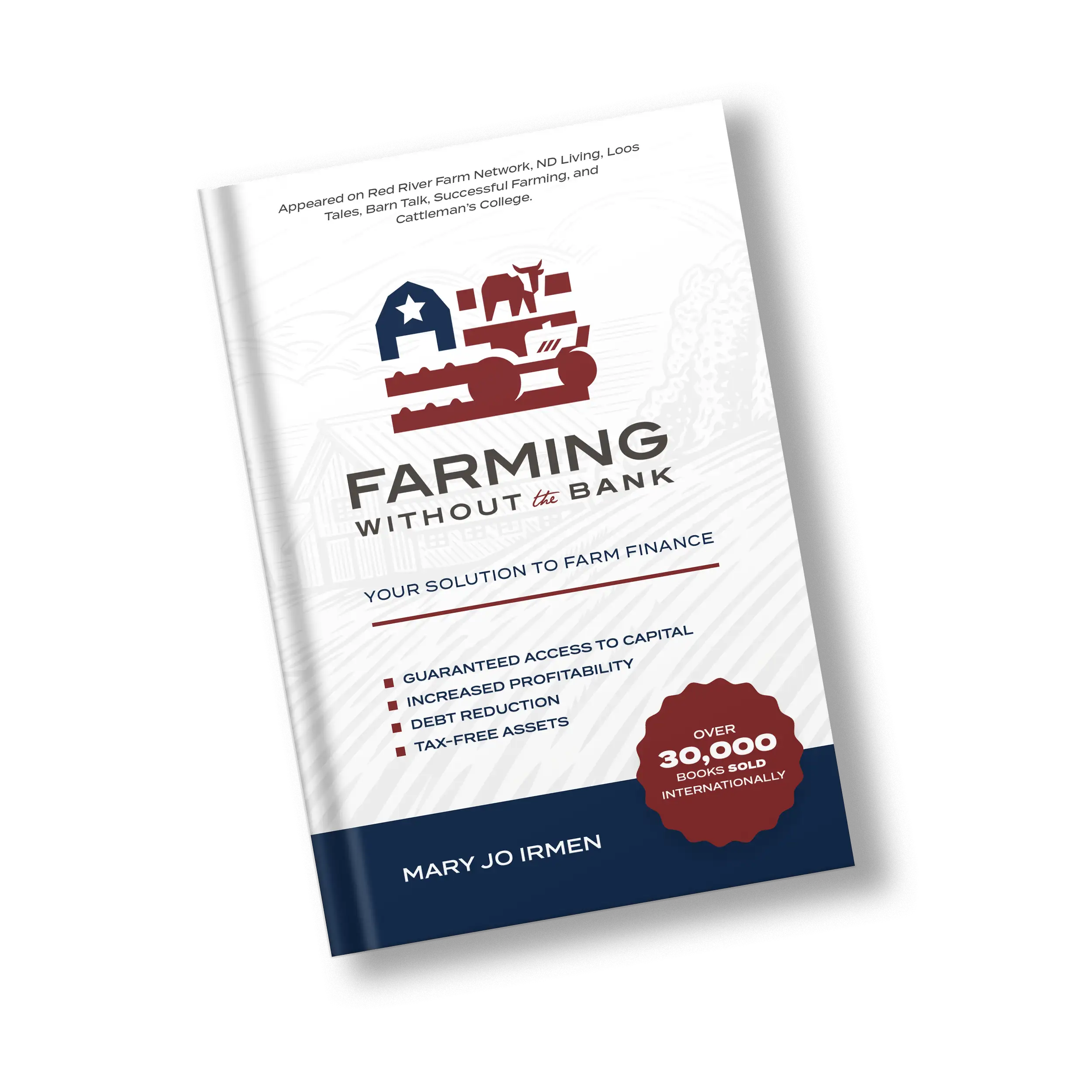
Your farm’s financial independence starts with one book.
30,000 farmers and ranchers have already made the shift. The only question is how long you’ll keep paying interest you could be keeping yourself.