 GET THE BOOK
 GET THE BOOK



Podcast
EP. 295
Ep. 295 – Don’t Sell to China or the Highest Bidder
Mar 27, 2025 ·
16 min
0:00 / 15:38
EPISODE OVERVIEW
ABOUT THIS EPISODE
Explore creative solutions for farmland sales with owner financing and keep control of your land.
Explore the impact of selling farmland to the highest bidder, whether it’s China, a developer, or a large farmer, and discuss how owner financing can offer a creative solution for both landowners and younger farmers. Let’s dive into how thinking outside the box can help landowners retain control, generate income, and potentially double their money, without relying on traditional buyers.
- ► Learn more: farmingwithoutthebank.com
- ► Get the book
Audio Production by Podsworth Media
CHAPTER TIMESTAMPS
- 00:00Introduction and Podcast Welcome
- 00:06The Problem with Selling Farmland
- 00:45Exploring Solutions to Farmland Sales
- 02:54Creative Financing Options
- 06:44The Impact of Development on Farmland
- 08:23Balancing Development and Farmland Preservation
- 16:16Conclusion and Final Thoughts
YOUTUBE EPISODE
TRANSCRIPTION
“We have to think about the big picture. I get your side. I 100% agree with you. I am on your side. I don’t want neighbors either. I wish we could keep farm ground as farm ground. I 100% agree. But I also have to look at the other side of it and say, where are they supposed to go then? If we don’t allow developers to develop, where should they go?”
Hello, hello, hello, and welcome back to the podcast. Thank you very much for being here. Okay, today I want to talk to you about, “Oh, these farmers, they’re selling to the developer. They’re selling to China. They’re selling to the highest bidder. And so this younger generation is not getting a chance to start out because they can’t afford it.” So instead of just complaining about this, let’s talk about it and let’s provide some solutions. Because frankly, I just don’t like people complaining when they don’t have any solution to anything, right? Because if we complain, that doesn’t mean that our brain is going to create the solution for us. It just means we’re going to complain. So let’s talk about some options here.
Number one, you have the highest bidder. I frankly don’t care if that’s China. I don’t care if that’s the big farmer next door. I don’t care if it’s a developer. It’s the highest bidder. So a lot of people think, “Well, I didn’t create any retirement, right? So I’m going to have to sell to the highest bidder, because all I have is my land. I stuck every red cent into there. I didn’t do the infinite banking concept. So now I have no retirement. So I can’t sell it to my kids, because then I’m going to have to pay capital gains.” But maybe the kids aren’t coming back. “So we’re going to sell it to a developer.” But some young farmer next door says, “Hey, you know what? I would love to have the opportunity to farm. If you’re selling this, could I buy it?” And you’re like, “Well, you know, it’s worth $5,000 an acre, but they’re going to give me 10. So I wish I could sell it to you, but, you know, I’ve got to retire. So I’m going to sell it to the developer, or I’m going to sell it to China, because they’re going to give me $10,000 an acre.”
Okay, that’s awesome. So let’s run over that scenario. China or the developer comes in and gives you $10,000 an acre. That $10,000, you get to pay capital gains tax on. So you get $10,000 minus any capital gains, but you’re done. Sale is over. China’s got it. You kind of hated them all this time. You hated that big farmer too, but when it came time to sell, that’s the guy that you sold to.
Now, let’s go back to the young guy. The young guy is like, “Well, that’s unfortunate, but I guess that’s the way it goes. It’s your land. You can sell to whoever you want,” right? What if we gave that young guy an opportunity and said, “You know what? I’m going to sell it to you for $5,000 an acre, but I’m going to charge you 5, maybe 6% interest, and I’ll finance you over 30 years.” If you finance that guy over 30 years, you make double your money. So you are going to make $10,000 an acre regardless. You’re just going to make the other half in interest. And guess what? You don’t pay capital gains on interest. It’s interest income. It’s only federal and state. No Social Security, no Medicare. And you have 30 years’ worth of payments.
If you’re 80, you may not live to 100. You’re like, “Well, who cares, Mary Jo?” All right. But let’s just say you’re 80 and you finance somebody for 30 years. Is that payment enough for you to live on at 80? Because if it is, then great. Take the payment and leave the rest of it to your estate, so they can continue to pay your estate. Because if they would have paid you all at once, those heirs would have inherited it. And where were they going to inherit it from? Most likely some sort of IRA. Because you would have been talked into putting money into an IRA, and then they would have inherited it, and it would be all taxable. This way, they too are going to get the benefit. Whoever it is, is just going to keep making payments to them. You could even be super creative with your owner finance and say, “Upon your passing, your heirs can call that debt in five years or 10 years,” or whatever. You can get very creative with your owner finance options.
But here’s the thing. We are all complaining about China and the big guys and the developers coming in and buying something, when in fact we just are not being creative enough to figure out how to make the same amount of money by selling it to the smaller guy. And if the smaller guy wants that opportunity, and you want him to have that opportunity, why wouldn’t you do that? Why wouldn’t you think creatively? Your accountant and your attorney are not the only ones that have a brain to think. Okay? And if more accountants and attorneys would actually use the creative side of their brain, they would think of these things. They would propose these things, but they’re not.
And those of you that are listening that are saying, “Well, China’s buying up all of our stuff. The big guys just keep getting bigger,” then how about you stop selling to them? Guess what? Whoever owns the land has the ability to say yes or no to a potential buyer. And you are the one that gets to decide that if you are the landowner. So we don’t want them to have it, but yet we sell out to them. We don’t want the wind towers. We don’t want the pipelines. But guess what? We sell out. And we forget about our neighbors in the process. It’s just mind-boggling to me.
Here’s another thing. While we’re talking about developers, there’s a lot of people that are super, super upset because towns keep getting bigger and we’re losing farm ground to developers. Number one, if you don’t want that to happen, then don’t sell to them. And we do it because we didn’t plan for retirement. That’s back on us too. But I ask you as a farmer, where are the people supposed to go? I don’t like that town is creeping out on me. I don’t like it. I don’t love it. Okay? I would prefer to live where there’s no traffic, where I don’t see people. That would be great. But where are they supposed to go? We have all these millennials that are building homes. We are short on homes for millennials. You do realize, if we don’t go out, we go up. Would you like someone to put you in a skyscraper?
Let’s say that you live on 500 acres. You don’t have any neighbors because you live on a farm. Your closest neighbor is a mile away. Would you like us to move you back to town? If other people want to get out of town and live on two acres, is that really that bad? I don’t know. I don’t understand why in the agriculture world we are so upset with people that want to develop farm ground to provide housing for other people. Is it ideal if I am the neighbor? No, I don’t want to be their neighbor. I get that point of it. I 100% understand. Your neighbor should not have sold. But your neighbor sold. And we’re mad because all these town people are moving out. And yes, they can be complete nuisances, but they can also be very nice people. But where are they supposed to go? That’s my question to you. Where would you like them to reside? If there are no homes in town for them, if your town does not have enough housing, where would you prefer these people go?
Because these people are most likely working in your community. They are working for your accountant, working for your bank, working for your insurance company that’s local. They’re waiters, waitresses, mechanics. They’re people actually providing a service in your town, and they’re driving to town, or maybe they’re in town because now town has expanded. But without them, you maybe don’t have a mechanic in town, or you might have to wait a couple of weeks before your vehicle can get fixed, because they don’t have employees. Your mechanic doesn’t have employees, but you don’t want the employees, because they’re going to have to take up land to build a home on.
I mean, we have to think about the big picture. I get your side. I 100% agree with you. I am on your side. I don’t want neighbors either. I wish we could keep farm ground as farm ground. I 100% agree. But I also have to look at the other side of it and say, where are they supposed to go then? If we don’t allow developers to develop, where should they go? I would like to tell a developer to maybe not build every house to look the same. For the love of Pete, the developments around here, every single house looks exactly the same. I would love to tell them, “Could you be a little creative, for heaven’s sake, and build a different house?” But again, what’s the other side of that? Housing needs to be affordable. And the easiest way to make it affordable is cookie-cutter. So everything is the same. They get a huge discount on the carpet, on the countertops, on the cabinets, all the things, right? “We’re going to do it in bulk, and we don’t have to have different sizes, and we don’t have to have different measurements, and everything goes in fast and easy,” and all the stuff. So there’s that side as well.
We seem to be, as humans, not as farmers and ranchers, as humans, we like to just have it our way, and we don’t really like to think about the other side of things. Put the other person’s shoes on. If we have to sell to China, and we want to sell to the highest bidder, I get it. I get it. You didn’t do any retirement planning. I get it. You need to sell your ground. Maybe you can make more money that way than renting it. There’s a reason why you’re doing it. But is there another option? Can we look at the other side and see that, hey, there’s another option to maybe keep this small guy going? And that would be if we could owner finance him. And you have to have everything paid off to do that. But if you do, can you owner finance him on a little bit? You don’t even have to do all of it. Maybe you just want to do a small amount of acres, and then every year you can add some. Every three, four years you can add some. Somebody’s going to make the interest. Who is it? The bank. You’re going to let the bank make the interest. Oh, and you complained about that guy too, right? You complained about the banker taking everything from you. Well, now he’s taking interest.
I had a client call me today and say, “Mary Jo, we’re looking at buying a building, and the guy said absolutely no to owner financing, because he bought another building and he wants $100,000 to pay for that building. And that will help him with his payments.” He’s even renting spots in that building out so that that can help with his payments. And I said, “Huh, $100,000 doesn’t make a big difference on a payment over 25 years. It’s kind of pocket change.” So I said, “I know he said no to owner financing, but if he owner financed you the couple hundred thousand dollars, that would actually be about a $1,500 payment a month, based on the interest rate that we had suggested.” I said, “If he takes the $100,000 and puts it on his loan, that is not going to reduce his payment by $1,500 a month. If he owner financed you on this building, he could use that money to apply to his new building and actually reduce his payment by $1,500 a month.” I said, “You know, I would maybe just go back to him and propose that he just look at the numbers and maybe think about it differently.”
So all we’ve got to do is think about it differently. Look at the other side. Ask the question, how can we? How can we double our money on this land without having to sell to China, developers, or the big farmer? If we have the ability to owner finance somebody, why aren’t we doing it? Why are we allowing the bank to make that interest? Is it because we are so scared of taking that risk that we won’t do that? And I understand that as well. I understand taking the risk. But once you are putting yourself in the position of the banker, you start to ask all the stupid questions that the banker asked. So now you go back and go, “Oh, I can’t even be mad at the banker, because now I’m carrying the risk and I’m asking the stupid questions.” How do I know this? Because that’s what happens to me. I start asking stupid questions when it’s my money on the line. I used to get irritated with the bankers for asking all the dumb questions. Now I give them a lot of slack. Yeah, I’m going to have a lot more patience with the banker now that I understand what it’s like to be on the other side of that.
Think about it. We don’t have to sell. We have the option. We can make just as much money. We just have to do it in a different manner. All right, you guys. If you have comments, questions, concerns, maryjo@withoutthebank.com. If you have not read the book, read my book or Nelson’s book, and schedule your appointment. And then I am 100% happy to talk to you and figure out what works for you. All right. Have a good rest of your day.
Thanks for listening to the Farming Without the Bank podcast. We hope today’s episode has inspired you to take control of your finances in new ways. Don’t forget to check out our website, farmingwithoutthebank.com, and engage with us on our Facebook page, Farming Without the Bank. Join us next week as we smash more financial myths and empower you to accomplish your financial goals.
View MoreHello, hello, hello, and welcome back to the podcast. Thank you very much for being here. Okay, today I want to talk to you about, “Oh, these farmers, they’re selling to the developer. They’re selling to China. They’re selling to the highest bidder. And so this younger generation is not getting a chance to start out because they can’t afford it.” So instead of just complaining about this, let’s talk about it and let’s provide some solutions. Because frankly, I just don’t like people complaining when they don’t have any solution to anything, right? Because if we complain, that doesn’t mean that our brain is going to create the solution for us. It just means we’re going to complain. So let’s talk about some options here.
Number one, you have the highest bidder. I frankly don’t care if that’s China. I don’t care if that’s the big farmer next door. I don’t care if it’s a developer. It’s the highest bidder. So a lot of people think, “Well, I didn’t create any retirement, right? So I’m going to have to sell to the highest bidder, because all I have is my land. I stuck every red cent into there. I didn’t do the infinite banking concept. So now I have no retirement. So I can’t sell it to my kids, because then I’m going to have to pay capital gains.” But maybe the kids aren’t coming back. “So we’re going to sell it to a developer.” But some young farmer next door says, “Hey, you know what? I would love to have the opportunity to farm. If you’re selling this, could I buy it?” And you’re like, “Well, you know, it’s worth $5,000 an acre, but they’re going to give me 10. So I wish I could sell it to you, but, you know, I’ve got to retire. So I’m going to sell it to the developer, or I’m going to sell it to China, because they’re going to give me $10,000 an acre.”
Okay, that’s awesome. So let’s run over that scenario. China or the developer comes in and gives you $10,000 an acre. That $10,000, you get to pay capital gains tax on. So you get $10,000 minus any capital gains, but you’re done. Sale is over. China’s got it. You kind of hated them all this time. You hated that big farmer too, but when it came time to sell, that’s the guy that you sold to.
Now, let’s go back to the young guy. The young guy is like, “Well, that’s unfortunate, but I guess that’s the way it goes. It’s your land. You can sell to whoever you want,” right? What if we gave that young guy an opportunity and said, “You know what? I’m going to sell it to you for $5,000 an acre, but I’m going to charge you 5, maybe 6% interest, and I’ll finance you over 30 years.” If you finance that guy over 30 years, you make double your money. So you are going to make $10,000 an acre regardless. You’re just going to make the other half in interest. And guess what? You don’t pay capital gains on interest. It’s interest income. It’s only federal and state. No Social Security, no Medicare. And you have 30 years’ worth of payments.
If you’re 80, you may not live to 100. You’re like, “Well, who cares, Mary Jo?” All right. But let’s just say you’re 80 and you finance somebody for 30 years. Is that payment enough for you to live on at 80? Because if it is, then great. Take the payment and leave the rest of it to your estate, so they can continue to pay your estate. Because if they would have paid you all at once, those heirs would have inherited it. And where were they going to inherit it from? Most likely some sort of IRA. Because you would have been talked into putting money into an IRA, and then they would have inherited it, and it would be all taxable. This way, they too are going to get the benefit. Whoever it is, is just going to keep making payments to them. You could even be super creative with your owner finance and say, “Upon your passing, your heirs can call that debt in five years or 10 years,” or whatever. You can get very creative with your owner finance options.
But here’s the thing. We are all complaining about China and the big guys and the developers coming in and buying something, when in fact we just are not being creative enough to figure out how to make the same amount of money by selling it to the smaller guy. And if the smaller guy wants that opportunity, and you want him to have that opportunity, why wouldn’t you do that? Why wouldn’t you think creatively? Your accountant and your attorney are not the only ones that have a brain to think. Okay? And if more accountants and attorneys would actually use the creative side of their brain, they would think of these things. They would propose these things, but they’re not.
And those of you that are listening that are saying, “Well, China’s buying up all of our stuff. The big guys just keep getting bigger,” then how about you stop selling to them? Guess what? Whoever owns the land has the ability to say yes or no to a potential buyer. And you are the one that gets to decide that if you are the landowner. So we don’t want them to have it, but yet we sell out to them. We don’t want the wind towers. We don’t want the pipelines. But guess what? We sell out. And we forget about our neighbors in the process. It’s just mind-boggling to me.
Here’s another thing. While we’re talking about developers, there’s a lot of people that are super, super upset because towns keep getting bigger and we’re losing farm ground to developers. Number one, if you don’t want that to happen, then don’t sell to them. And we do it because we didn’t plan for retirement. That’s back on us too. But I ask you as a farmer, where are the people supposed to go? I don’t like that town is creeping out on me. I don’t like it. I don’t love it. Okay? I would prefer to live where there’s no traffic, where I don’t see people. That would be great. But where are they supposed to go? We have all these millennials that are building homes. We are short on homes for millennials. You do realize, if we don’t go out, we go up. Would you like someone to put you in a skyscraper?
Let’s say that you live on 500 acres. You don’t have any neighbors because you live on a farm. Your closest neighbor is a mile away. Would you like us to move you back to town? If other people want to get out of town and live on two acres, is that really that bad? I don’t know. I don’t understand why in the agriculture world we are so upset with people that want to develop farm ground to provide housing for other people. Is it ideal if I am the neighbor? No, I don’t want to be their neighbor. I get that point of it. I 100% understand. Your neighbor should not have sold. But your neighbor sold. And we’re mad because all these town people are moving out. And yes, they can be complete nuisances, but they can also be very nice people. But where are they supposed to go? That’s my question to you. Where would you like them to reside? If there are no homes in town for them, if your town does not have enough housing, where would you prefer these people go?
Because these people are most likely working in your community. They are working for your accountant, working for your bank, working for your insurance company that’s local. They’re waiters, waitresses, mechanics. They’re people actually providing a service in your town, and they’re driving to town, or maybe they’re in town because now town has expanded. But without them, you maybe don’t have a mechanic in town, or you might have to wait a couple of weeks before your vehicle can get fixed, because they don’t have employees. Your mechanic doesn’t have employees, but you don’t want the employees, because they’re going to have to take up land to build a home on.
I mean, we have to think about the big picture. I get your side. I 100% agree with you. I am on your side. I don’t want neighbors either. I wish we could keep farm ground as farm ground. I 100% agree. But I also have to look at the other side of it and say, where are they supposed to go then? If we don’t allow developers to develop, where should they go? I would like to tell a developer to maybe not build every house to look the same. For the love of Pete, the developments around here, every single house looks exactly the same. I would love to tell them, “Could you be a little creative, for heaven’s sake, and build a different house?” But again, what’s the other side of that? Housing needs to be affordable. And the easiest way to make it affordable is cookie-cutter. So everything is the same. They get a huge discount on the carpet, on the countertops, on the cabinets, all the things, right? “We’re going to do it in bulk, and we don’t have to have different sizes, and we don’t have to have different measurements, and everything goes in fast and easy,” and all the stuff. So there’s that side as well.
We seem to be, as humans, not as farmers and ranchers, as humans, we like to just have it our way, and we don’t really like to think about the other side of things. Put the other person’s shoes on. If we have to sell to China, and we want to sell to the highest bidder, I get it. I get it. You didn’t do any retirement planning. I get it. You need to sell your ground. Maybe you can make more money that way than renting it. There’s a reason why you’re doing it. But is there another option? Can we look at the other side and see that, hey, there’s another option to maybe keep this small guy going? And that would be if we could owner finance him. And you have to have everything paid off to do that. But if you do, can you owner finance him on a little bit? You don’t even have to do all of it. Maybe you just want to do a small amount of acres, and then every year you can add some. Every three, four years you can add some. Somebody’s going to make the interest. Who is it? The bank. You’re going to let the bank make the interest. Oh, and you complained about that guy too, right? You complained about the banker taking everything from you. Well, now he’s taking interest.
I had a client call me today and say, “Mary Jo, we’re looking at buying a building, and the guy said absolutely no to owner financing, because he bought another building and he wants $100,000 to pay for that building. And that will help him with his payments.” He’s even renting spots in that building out so that that can help with his payments. And I said, “Huh, $100,000 doesn’t make a big difference on a payment over 25 years. It’s kind of pocket change.” So I said, “I know he said no to owner financing, but if he owner financed you the couple hundred thousand dollars, that would actually be about a $1,500 payment a month, based on the interest rate that we had suggested.” I said, “If he takes the $100,000 and puts it on his loan, that is not going to reduce his payment by $1,500 a month. If he owner financed you on this building, he could use that money to apply to his new building and actually reduce his payment by $1,500 a month.” I said, “You know, I would maybe just go back to him and propose that he just look at the numbers and maybe think about it differently.”
So all we’ve got to do is think about it differently. Look at the other side. Ask the question, how can we? How can we double our money on this land without having to sell to China, developers, or the big farmer? If we have the ability to owner finance somebody, why aren’t we doing it? Why are we allowing the bank to make that interest? Is it because we are so scared of taking that risk that we won’t do that? And I understand that as well. I understand taking the risk. But once you are putting yourself in the position of the banker, you start to ask all the stupid questions that the banker asked. So now you go back and go, “Oh, I can’t even be mad at the banker, because now I’m carrying the risk and I’m asking the stupid questions.” How do I know this? Because that’s what happens to me. I start asking stupid questions when it’s my money on the line. I used to get irritated with the bankers for asking all the dumb questions. Now I give them a lot of slack. Yeah, I’m going to have a lot more patience with the banker now that I understand what it’s like to be on the other side of that.
Think about it. We don’t have to sell. We have the option. We can make just as much money. We just have to do it in a different manner. All right, you guys. If you have comments, questions, concerns, maryjo@withoutthebank.com. If you have not read the book, read my book or Nelson’s book, and schedule your appointment. And then I am 100% happy to talk to you and figure out what works for you. All right. Have a good rest of your day.
Thanks for listening to the Farming Without the Bank podcast. We hope today’s episode has inspired you to take control of your finances in new ways. Don’t forget to check out our website, farmingwithoutthebank.com, and engage with us on our Facebook page, Farming Without the Bank. Join us next week as we smash more financial myths and empower you to accomplish your financial goals.
ready to start?
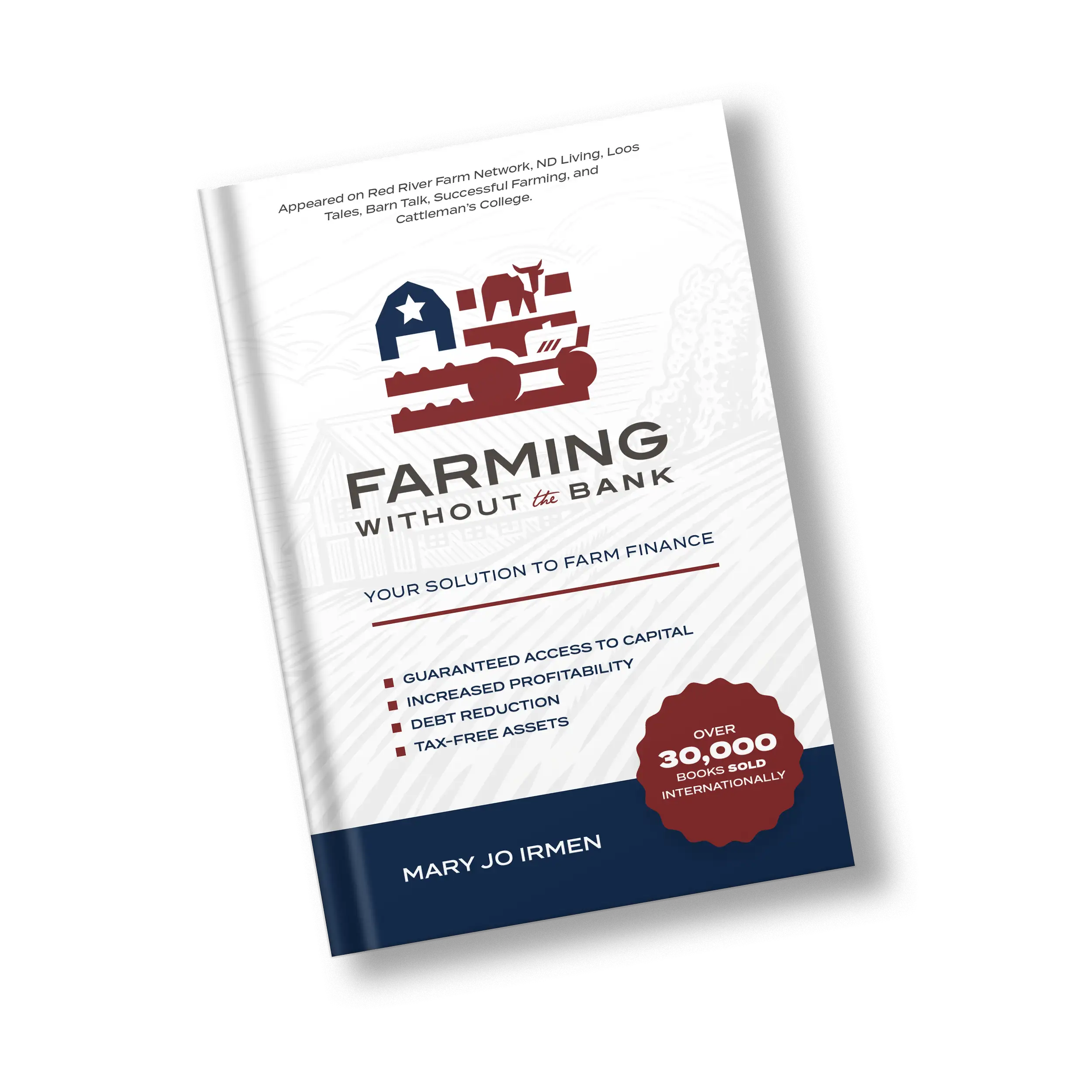
Your farm’s financial independence starts with one book.
30,000 farmers and ranchers have already made the shift. The only question is how long you’ll keep paying interest you could be keeping yourself.