 GET THE BOOK
 GET THE BOOK




Podcast
EP. 299
Ep. 299 – Not Everyone is a Top 3-Percenter
Apr 24, 2025 ·
17 min
0:00 / 16:39
EPISODE OVERVIEW
ABOUT THIS EPISODE
Only 1–3% of people actually take action on big ideas like Infinite Banking or sell-buy marketing. Let’s explore the mindset gap between dreamers and doers, and why success will never be the norm.
- ► Learn more: farmingwithoutthebank.com
- ► Get the book
Audio Production by Podsworth Media
CHAPTER TIMESTAMPS
- 00:00Introduction: Taking Action vs. Analysis Paralysis
- 00:25Welcome to the Podcast
- 00:31Understanding the Top 3%
- 00:43Insights from Doug Ferguson's Class
- 02:15The Reality of Action and Success
- 03:51The Infinite Banking Concept
- 06:34Human Nature and Financial Success
- 07:42Overcoming Fear and Taking Risks
- 10:22The Importance of Mindset and Community
- 15:39Conclusion and Call to Action
YOUTUBE EPISODE
TRANSCRIPTION
“Next time you see somebody that’s taking action, that’s doing something, are they trying to be a 3 percenter? And they’re making movement, and you have paralysis by analysis, and you’re not doing anything, because you are analyzing something to the extent that you’re just watching everybody else. And once they get there, you’re gonna start, and you’re too late. You’re too late. How long are you gonna sit and wait?”
Hello, hello, hello. Welcome back to the podcast. Thank you very much for being here. I appreciate it. All right, today let’s talk about the top 3%. Okay, we could narrow this down probably to 1%, but let’s just call it the top 3%. I was recently in a sell-buy marketing class with Doug Ferguson. So let’s just take a quick little side note on that. That was super awesome. So if you are broke, if you have cattle and you’re like, “There’s no money in cows,” then you need to go to mrcattlemaster.com. You need to register for one of Doug’s sell-buy marketing classes. It was amazing. Everything from mindset, to formulas on how to buy, to reading people’s body language in the sale barn. That was probably a lot of what I think people missed, because everybody wants the numbers and they want the formula. And he started talking about just human nature of a lot of things. A lot of what Doug teaches coincides very nicely with what infinite banking is. But, unsolicited advertising for Doug. Really like that guy.
Okay, so in this class, he’s teaching us all how to make money buying and selling cattle. Right? Doesn’t matter if it’s feedlot. Doesn’t matter if it’s pairs. Does not matter. He is showing us how to make money. Somebody at one point said, “Isn’t everybody in the sale barn going to be doing this, then? And so then how are we going to get these deals on cattle if everybody’s doing this?” Doug did not answer the question the way I would have answered the question. So I’m going to answer it here, because I remained quiet in Doug’s class. It was Doug’s class. The answer, I think, is no, not everybody’s going to be doing it. Because let’s take the 72 people that were in Doug’s class, and let’s look at how many of them are actually going to put into action what they learned. One to 3%. That is my guess.
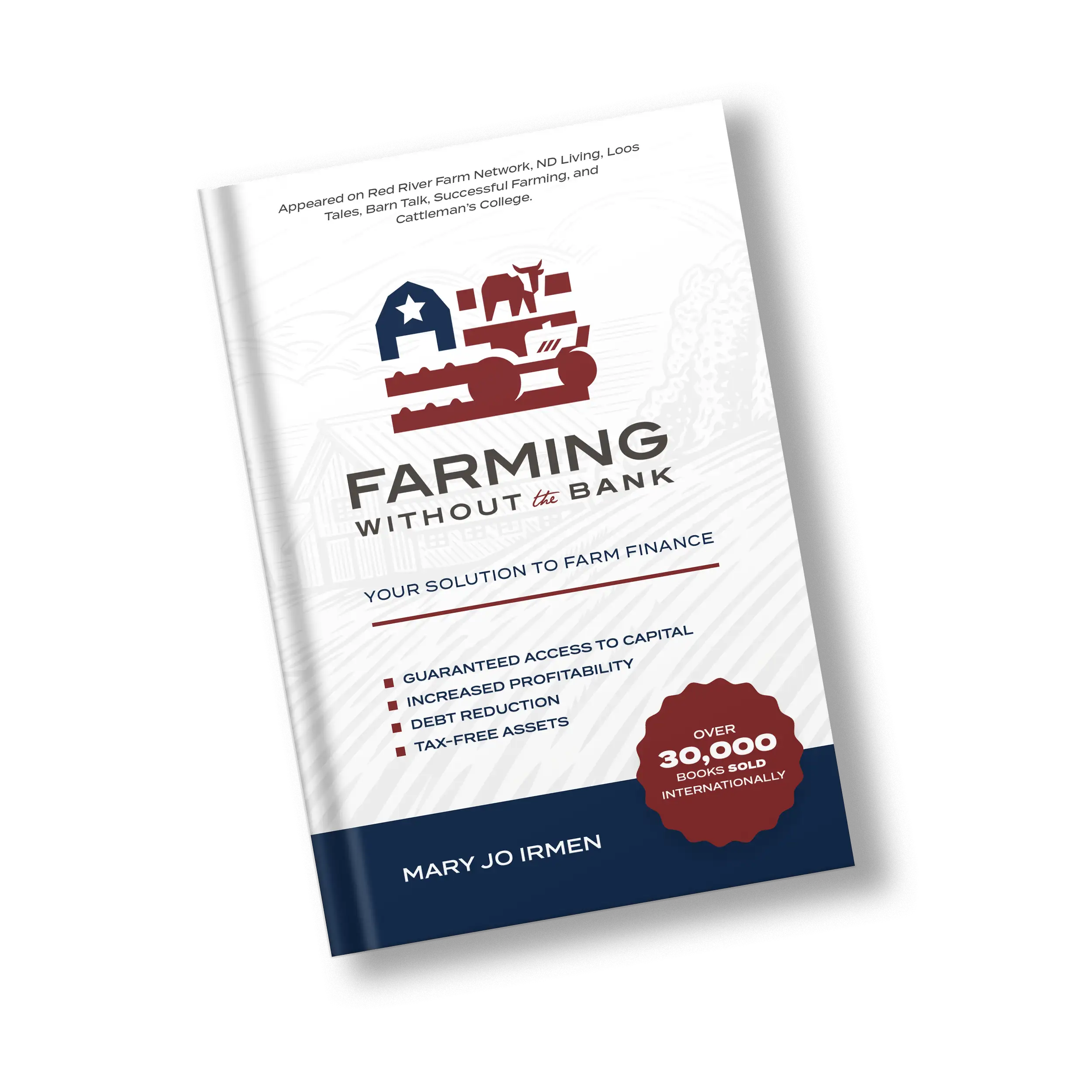
Let’s just use my books as an example. I have sold 35,000 Farming Without the Bank books. Some of those have gone to other agents. Some of those have, you know, gone through Amazon, whatever. They have been sold either through me or through other people. Now, there are people out there that did not come to me. Okay? But let’s just use a round number. Let’s say 2,000 clients, because I’m at about 2,000. If I have 2,000 clients, and those 35,000 books, let’s just say maybe another 2,000 people have gone to other agents around the country to buy their life insurance policies. I’m going to say that is extremely small, but let’s just say that. 4,000 people out of 35,000 books is a very, very small percentage. If it was 4,000 people, that is 0.1%. 0.1%.
This is something that I find interesting. When people hear about infinite banking and they get it, and they’re excited about it, they then think everybody else is going to do it. Because the same question that was asked to Doug has been asked to me over and over and over and over. In the last 15 years, people have asked me, “Mary Jo, what happens when the government finds out about infinite banking? They’re going to change all the rules.” The government found out about infinite banking back in the ’80s. That’s why we have the modified endowment contract. That is why the policies now MEC. If you get too much cash value into a policy, it’s all going to MEC and grow taxable. That’s why we need more than one policy, so that when we fill one policy up with cash, now we can start another policy. If we remember, Nelson had 49 policies. That’s why.
So we have to think about that. If everybody did what they could do to be successful, it wouldn’t be success, right? It would be a standard. It would be the norm. But guess what? It’s not the norm, because the majority of people are too darn lazy to do anything about it. Here’s another example. I cannot tell you how many people come to me and say, “I got this book from a friend.” Or, “A friend told me to buy the book.” Or, “A friend shared the link to the book with me.” Or, “A friend shared the podcast.” But the friend is not a client. The friend does not have their own policy. The friend has never even made an appointment with me. The friend got the book. The friend found it. But that person did not take the steps necessary to take action.
You can do anything. You can learn and learn and learn. I don’t care if you read a book a day. I don’t care if you read 12 books a year. People have all these goals: “Oh, I’m going to read X amount of books.” Who cares how many books you read? How many of those did you put into action? How many people are learning infinite banking and not actually putting it into action? How many people read Farming Without the Bank and never actually set up an appointment to take the next step? How many people go to Ranching for Profit, and they don’t actually go home and ever do their books? And then we complain that we’re stuck in the same spot we’ve always been stuck in forever, and we don’t know why. It’s because we never took action. So to think that everybody’s going to do something because you like the idea and you’re doing it, is not going to happen.
We have the top 3 percenters. And if we go back to Nelson’s book, and you guys have heard me say this before, the very first chapter of Nelson’s book, he says you can take all the money in the world, divide it equally, and in a very short amount of time, the rich will be rich and the poor will be poor. It is because the top 1 to 3% are always learning. They’re implementing. They are taking action. They are doing things. They didn’t get lucky. “Oh my gosh, yeah, they got lucky.” They got lucky that they took action. If I hand you an operation and you’re too lazy to take action and do anything, then what? You’re going to lose it all. You’re going to lose it all. If you have paralysis by analysis, you are never going anywhere. Right? You need to take a little bit of risk. You need to try something.
I was listening to a podcast this morning, and it just so happened the guy being interviewed is buying up ranches, and somebody said, “Well, I hope he fails. He’s going to lose that ranch. He is way out on a limb.” And he said, “You know, first of all, why would you wish that somebody would fail? Secondly, if I fail, I still end up with half the ranch. Because I might be able to save half the ranch, but I have to sell the other half of the ranch. I still have a half a ranch more than when I started.” Perspective, right?
And so we have to really look at what we are saying, what we are thinking, and what the top 1 to 3 percenters are doing. If we took all the money and divided it equally, we would end up back where we started. If we are poor, we are going to end up poor. I know I’ve talked about this before, but maybe it’s a good time to remind you. People that win the lottery end up being broke or committing suicide. The rate of suicide amongst lottery winners is crazy insane. I didn’t understand it, but it is because everybody comes out of the woodwork, and now all of a sudden, they want you to give them money. And there’s the stress of saying no. Or maybe these winners say yes, and then they go broke. They will overspend. If you can’t manage a dollar, you can’t manage a million.
If we look at what everybody is doing, this is not rocket science. If we take action, we can end up taking steps forward, even if we end up taking a step backwards because, “Oh man, we made a bad decision.” Okay, guess what? That bad decision was failing forward. I believe John Maxwell wrote that book, Failing Forward. I’ve never read it. But other people I know that are so terrified to take any type of step and be judged by it have read that book, and it has changed their life. I don’t care if I fail. What are you going to do? Like, make fun of me? While you’re sitting on your couch, and you haven’t done a damn thing, like, ever? Oh, really scared of you, Mr. Keyboard Warrior.
We have those people that have arrived. And this is why Nelson talks… the first half of Becoming Your Own Banker talks about human nature. He didn’t start the book with that because he liked that scenario of splitting all the money up. It’s not what he was talking about. When you get into the book, then you talk about Parkinson’s Law: a luxury once enjoyed becomes a necessity. Parkinson’s Law: your needs will rise to meet your income. If you don’t beat Parkinson’s Law, you will stay where you’ve always been, with all the other people. Nelson also talks about the fact that you should be hanging out with people that are like-minded, right? If you want to be wealthy, if you want to own a business, you should be hanging out with like-minded, wealthy business owners. People, preferably, that make more money than you. Not with people that are sitting doing nothing.
We have a thought process that needs to be broken. Nothing is going to change. Not everybody’s going to be sitting in the sale barn doing sell-buy marketing. Not everybody’s going to be doing the infinite banking concept. Not everybody understands it. Some people will never do it, because family says, “Oh, that’s a big scam.” Just this morning, before I recorded this, some keyboard warrior put “scam” on one of my Facebook posts. Scam? That’s the best you got? You can’t tell me why it’s a scam. You can’t tell me what the alternative is. You’re just over there clicking away on your keyboard, coming up from Mama’s basement to go get something to drink. Like, that’s the best you’ve got? Why would I believe you with one word? Yet some people will. 100%, some people will. And it will be the 97% of the population, because they don’t want to read. They don’t want to investigate things.
And I think the percentage of people willing to learn is actually decreasing on a daily basis, because we think there’s all this stuff on the internet, and we think we can absorb that, and that those people are right. Well, my friends, it’s called an algorithm. And when I get into the algorithm, guess what? I need to start looking at stuff outside of the algorithm, because the algorithm is just feeding me everything I want to hear. I want to investigate, right? I want to do my due diligence so I’m not making a bad decision.
Anyway, that was a tangent. But I really want you guys to understand the mindset. If you think it’s a good idea, that does not mean everybody else is going to, because we have a hierarchy in this country of finances. And those people are not screwing people to get ahead. Some of them, yes. Most of them, no. They are there because they are paying attention. They’re taking action. They’re doing. They’re learning. The other 97% are not doing that. They’re not doing anything. They’re not paying attention to anything. But they’re the ones watching and saying, “Oh, must be nice. Oh, you’re so lucky.” Must be nice, right? Must be nice for what? I mean, it is nice to be here. We all sacrificed to be here. We all learned. You’re choosing not to do any of the above.
So think about that. Next time you see somebody that’s taking action, that’s doing something, are they trying to be a 3 percenter? And they’re making movement, and you have paralysis by analysis, and you’re not doing anything, because you are analyzing something to the extent that you’re just watching everybody else. And once they get there, you’re going to start, and you’re too late. You’re too late. How long are you going to sit and wait? Right?
So I find it interesting that people make that comment. But think about it. 0.1% of people have taken the step to become clients. How many of those set up a meeting? If I go back and look at the numbers, we’re probably close to 1% of book buyers that have set up meetings. Very few of them have actually taken the step to move forward, because they are scared. Somebody’s told them no. They’re waiting for everybody else to do it first, and then they think we’re all going to get in. Is it any different than crypto? Is it any different than regenerative farming? Is it any different than no-till? Right? It’s the same with every single thing we do in life. Why isn’t everybody doing it? Why is it just the top 1 to 3% of those people?
Okay. I’ve beat that dead horse. Let me know if you have comments, questions, or concerns. Otherwise, go to farmingwithoutthebank.com, grab your book, set up your appointment with John or myself. We can help you figure out where to get started, what to do next. If it is not right for you, we are going to tell you. Okay? We’re not going to be here and be slimy salespeople. We can help you structure the life insurance policy. We can help you with the policy. It’s amazing to me how many people read the book and go, “Oh, where do I go to get that policy?” Right here. Right here. John and I are waiting for you. All right. Let us know if you need anything. Otherwise, you guys have a fantastic rest of your day.
Thanks for listening to the Farming Without the Bank podcast. We hope today’s episode has inspired you to take control of your finances in new ways. Don’t forget to check out our website, farmingwithoutthebank.com, and engage with us on our Facebook page, Farming Without the Bank. Join us next week as we smash more financial myths and empower you to accomplish your financial goals.
View MoreHello, hello, hello. Welcome back to the podcast. Thank you very much for being here. I appreciate it. All right, today let’s talk about the top 3%. Okay, we could narrow this down probably to 1%, but let’s just call it the top 3%. I was recently in a sell-buy marketing class with Doug Ferguson. So let’s just take a quick little side note on that. That was super awesome. So if you are broke, if you have cattle and you’re like, “There’s no money in cows,” then you need to go to mrcattlemaster.com. You need to register for one of Doug’s sell-buy marketing classes. It was amazing. Everything from mindset, to formulas on how to buy, to reading people’s body language in the sale barn. That was probably a lot of what I think people missed, because everybody wants the numbers and they want the formula. And he started talking about just human nature of a lot of things. A lot of what Doug teaches coincides very nicely with what infinite banking is. But, unsolicited advertising for Doug. Really like that guy.
Okay, so in this class, he’s teaching us all how to make money buying and selling cattle. Right? Doesn’t matter if it’s feedlot. Doesn’t matter if it’s pairs. Does not matter. He is showing us how to make money. Somebody at one point said, “Isn’t everybody in the sale barn going to be doing this, then? And so then how are we going to get these deals on cattle if everybody’s doing this?” Doug did not answer the question the way I would have answered the question. So I’m going to answer it here, because I remained quiet in Doug’s class. It was Doug’s class. The answer, I think, is no, not everybody’s going to be doing it. Because let’s take the 72 people that were in Doug’s class, and let’s look at how many of them are actually going to put into action what they learned. One to 3%. That is my guess.
Let’s just use my books as an example. I have sold 35,000 Farming Without the Bank books. Some of those have gone to other agents. Some of those have, you know, gone through Amazon, whatever. They have been sold either through me or through other people. Now, there are people out there that did not come to me. Okay? But let’s just use a round number. Let’s say 2,000 clients, because I’m at about 2,000. If I have 2,000 clients, and those 35,000 books, let’s just say maybe another 2,000 people have gone to other agents around the country to buy their life insurance policies. I’m going to say that is extremely small, but let’s just say that. 4,000 people out of 35,000 books is a very, very small percentage. If it was 4,000 people, that is 0.1%. 0.1%.
This is something that I find interesting. When people hear about infinite banking and they get it, and they’re excited about it, they then think everybody else is going to do it. Because the same question that was asked to Doug has been asked to me over and over and over and over. In the last 15 years, people have asked me, “Mary Jo, what happens when the government finds out about infinite banking? They’re going to change all the rules.” The government found out about infinite banking back in the ’80s. That’s why we have the modified endowment contract. That is why the policies now MEC. If you get too much cash value into a policy, it’s all going to MEC and grow taxable. That’s why we need more than one policy, so that when we fill one policy up with cash, now we can start another policy. If we remember, Nelson had 49 policies. That’s why.
So we have to think about that. If everybody did what they could do to be successful, it wouldn’t be success, right? It would be a standard. It would be the norm. But guess what? It’s not the norm, because the majority of people are too darn lazy to do anything about it. Here’s another example. I cannot tell you how many people come to me and say, “I got this book from a friend.” Or, “A friend told me to buy the book.” Or, “A friend shared the link to the book with me.” Or, “A friend shared the podcast.” But the friend is not a client. The friend does not have their own policy. The friend has never even made an appointment with me. The friend got the book. The friend found it. But that person did not take the steps necessary to take action.
You can do anything. You can learn and learn and learn. I don’t care if you read a book a day. I don’t care if you read 12 books a year. People have all these goals: “Oh, I’m going to read X amount of books.” Who cares how many books you read? How many of those did you put into action? How many people are learning infinite banking and not actually putting it into action? How many people read Farming Without the Bank and never actually set up an appointment to take the next step? How many people go to Ranching for Profit, and they don’t actually go home and ever do their books? And then we complain that we’re stuck in the same spot we’ve always been stuck in forever, and we don’t know why. It’s because we never took action. So to think that everybody’s going to do something because you like the idea and you’re doing it, is not going to happen.
We have the top 3 percenters. And if we go back to Nelson’s book, and you guys have heard me say this before, the very first chapter of Nelson’s book, he says you can take all the money in the world, divide it equally, and in a very short amount of time, the rich will be rich and the poor will be poor. It is because the top 1 to 3% are always learning. They’re implementing. They are taking action. They are doing things. They didn’t get lucky. “Oh my gosh, yeah, they got lucky.” They got lucky that they took action. If I hand you an operation and you’re too lazy to take action and do anything, then what? You’re going to lose it all. You’re going to lose it all. If you have paralysis by analysis, you are never going anywhere. Right? You need to take a little bit of risk. You need to try something.
I was listening to a podcast this morning, and it just so happened the guy being interviewed is buying up ranches, and somebody said, “Well, I hope he fails. He’s going to lose that ranch. He is way out on a limb.” And he said, “You know, first of all, why would you wish that somebody would fail? Secondly, if I fail, I still end up with half the ranch. Because I might be able to save half the ranch, but I have to sell the other half of the ranch. I still have a half a ranch more than when I started.” Perspective, right?
And so we have to really look at what we are saying, what we are thinking, and what the top 1 to 3 percenters are doing. If we took all the money and divided it equally, we would end up back where we started. If we are poor, we are going to end up poor. I know I’ve talked about this before, but maybe it’s a good time to remind you. People that win the lottery end up being broke or committing suicide. The rate of suicide amongst lottery winners is crazy insane. I didn’t understand it, but it is because everybody comes out of the woodwork, and now all of a sudden, they want you to give them money. And there’s the stress of saying no. Or maybe these winners say yes, and then they go broke. They will overspend. If you can’t manage a dollar, you can’t manage a million.
If we look at what everybody is doing, this is not rocket science. If we take action, we can end up taking steps forward, even if we end up taking a step backwards because, “Oh man, we made a bad decision.” Okay, guess what? That bad decision was failing forward. I believe John Maxwell wrote that book, Failing Forward. I’ve never read it. But other people I know that are so terrified to take any type of step and be judged by it have read that book, and it has changed their life. I don’t care if I fail. What are you going to do? Like, make fun of me? While you’re sitting on your couch, and you haven’t done a damn thing, like, ever? Oh, really scared of you, Mr. Keyboard Warrior.
We have those people that have arrived. And this is why Nelson talks… the first half of Becoming Your Own Banker talks about human nature. He didn’t start the book with that because he liked that scenario of splitting all the money up. It’s not what he was talking about. When you get into the book, then you talk about Parkinson’s Law: a luxury once enjoyed becomes a necessity. Parkinson’s Law: your needs will rise to meet your income. If you don’t beat Parkinson’s Law, you will stay where you’ve always been, with all the other people. Nelson also talks about the fact that you should be hanging out with people that are like-minded, right? If you want to be wealthy, if you want to own a business, you should be hanging out with like-minded, wealthy business owners. People, preferably, that make more money than you. Not with people that are sitting doing nothing.
We have a thought process that needs to be broken. Nothing is going to change. Not everybody’s going to be sitting in the sale barn doing sell-buy marketing. Not everybody’s going to be doing the infinite banking concept. Not everybody understands it. Some people will never do it, because family says, “Oh, that’s a big scam.” Just this morning, before I recorded this, some keyboard warrior put “scam” on one of my Facebook posts. Scam? That’s the best you got? You can’t tell me why it’s a scam. You can’t tell me what the alternative is. You’re just over there clicking away on your keyboard, coming up from Mama’s basement to go get something to drink. Like, that’s the best you’ve got? Why would I believe you with one word? Yet some people will. 100%, some people will. And it will be the 97% of the population, because they don’t want to read. They don’t want to investigate things.
And I think the percentage of people willing to learn is actually decreasing on a daily basis, because we think there’s all this stuff on the internet, and we think we can absorb that, and that those people are right. Well, my friends, it’s called an algorithm. And when I get into the algorithm, guess what? I need to start looking at stuff outside of the algorithm, because the algorithm is just feeding me everything I want to hear. I want to investigate, right? I want to do my due diligence so I’m not making a bad decision.
Anyway, that was a tangent. But I really want you guys to understand the mindset. If you think it’s a good idea, that does not mean everybody else is going to, because we have a hierarchy in this country of finances. And those people are not screwing people to get ahead. Some of them, yes. Most of them, no. They are there because they are paying attention. They’re taking action. They’re doing. They’re learning. The other 97% are not doing that. They’re not doing anything. They’re not paying attention to anything. But they’re the ones watching and saying, “Oh, must be nice. Oh, you’re so lucky.” Must be nice, right? Must be nice for what? I mean, it is nice to be here. We all sacrificed to be here. We all learned. You’re choosing not to do any of the above.
So think about that. Next time you see somebody that’s taking action, that’s doing something, are they trying to be a 3 percenter? And they’re making movement, and you have paralysis by analysis, and you’re not doing anything, because you are analyzing something to the extent that you’re just watching everybody else. And once they get there, you’re going to start, and you’re too late. You’re too late. How long are you going to sit and wait? Right?
So I find it interesting that people make that comment. But think about it. 0.1% of people have taken the step to become clients. How many of those set up a meeting? If I go back and look at the numbers, we’re probably close to 1% of book buyers that have set up meetings. Very few of them have actually taken the step to move forward, because they are scared. Somebody’s told them no. They’re waiting for everybody else to do it first, and then they think we’re all going to get in. Is it any different than crypto? Is it any different than regenerative farming? Is it any different than no-till? Right? It’s the same with every single thing we do in life. Why isn’t everybody doing it? Why is it just the top 1 to 3% of those people?
Okay. I’ve beat that dead horse. Let me know if you have comments, questions, or concerns. Otherwise, go to farmingwithoutthebank.com, grab your book, set up your appointment with John or myself. We can help you figure out where to get started, what to do next. If it is not right for you, we are going to tell you. Okay? We’re not going to be here and be slimy salespeople. We can help you structure the life insurance policy. We can help you with the policy. It’s amazing to me how many people read the book and go, “Oh, where do I go to get that policy?” Right here. Right here. John and I are waiting for you. All right. Let us know if you need anything. Otherwise, you guys have a fantastic rest of your day.
Thanks for listening to the Farming Without the Bank podcast. We hope today’s episode has inspired you to take control of your finances in new ways. Don’t forget to check out our website, farmingwithoutthebank.com, and engage with us on our Facebook page, Farming Without the Bank. Join us next week as we smash more financial myths and empower you to accomplish your financial goals.
ready to start?
Your farm’s financial independence starts with one book.
30,000 farmers and ranchers have already made the shift. The only question is how long you’ll keep paying interest you could be keeping yourself.