 GET THE BOOK
 GET THE BOOK




Podcast
EP. 308
Ep. 308 – Premiums Should be Recorded as an Expense
Jun 27, 2025 ·
20 min
0:00 / 19:43
EPISODE OVERVIEW
ABOUT THIS EPISODE
Too many farmers claim they “can’t afford” life insurance premiums, but turn around and spend thousands on tractors, trailers, and toys.
In this episode, Mary Jo Irmen challenges that mindset head-on. She walks through why premiums should be treated like any other farm expense, how to rewire your thinking around affordability, and why putting off Infinite Banking is a costlier mistake than you think. If you’ve ever said “I’ll start when I have more money,” this episode is your wake-up call.
🔑 Key Takeaways
- How to treat your premium like any other line-item farm expense
- Why “I can’t afford it” is usually just a mindset problem
- The difference between a luxury and a necessity, and why life insurance isn’t a luxury
- What farmers get wrong about return on investment in IBC
- How to shift your break-even numbers to include a policy premium
- Why waiting costs more than starting small
📚 Resources & Links
- 📘 Grab your copy of Farming Without the Bank: farmingwithoutthebank.com/book
- 📅 Read the book? Book a meeting with Mary Jo
- 💬 Got questions or a podcast topic? maryjo@withoutthebank.com
- 👍 Follow on Facebook: Farming Without the Bank
🔥 Want to Keep Learning?
Binge past episodes and learn how real farmers are using IBC to transform their operations. You’ll never look at money (or “expenses”) the same way again.
CHAPTER TIMESTAMPS
- 00:00Why Farmers Say They Don't Have "Extra Money"
- 00:29Make Your Premium a Fixed Expense
- 01:08You Borrow for Tractors, So Why Not for Banking?
- 02:08Rethinking Your Breakeven to Afford Premiums
- 03:17Why So Many Farmers Have Zero Life Insurance
- 04:24We Budget for Property Insurance, but Not Death?
- 06:00Whole Life + IBC Is Not a Luxury
- 07:22The Grain Bin Analogy: Investing Before Return
- 09:08If You Die, Who's Cleaning Up Your Mess?
- 09:54What If You Just Needed 5 Cents More per Bushel?
- 11:04Turning $500K/Year Into $24M of Death Benefit
- 13:14Life Insurance as a Scam? Or Is the Real Scam the 401(k)?
- 14:25The Power of a Steady, Boring Policy
- 16:04Calculate Your Premium and Just Bake It In
- 17:00Reread the Book and Rewire Your Brain
- 18:04Email Questions, but Don't Expect Magic Answers
- 18:45Book Your Appointment (Yes, It's Worth the Wait)
YOUTUBE EPISODE
TRANSCRIPTION
“I don’t honestly think that most farmers and ranchers understand how their own money is revolving. Because a lot of them say, well, I don’t have any extra money. But yet when we need a new squeeze chute, we need a new horse, we need a new trailer, we need a new semi, we find the money for that, because we need it. But we’re not finding the money for something in life that’s certain, and that’s that we’re going to die.”
Hello, hello, hello, and welcome back to the podcast. Thank you very much for being here. All right, today, let’s talk about something I’m pretty sure I’ve talked about in the past, but it’s going to be a very good reminder, which is: make your premium an expense. And I know some of you are not going to like this. However, I’m not here to please everybody, okay?
So here is the thing that all of you say: where am I going to get the money to pay the premium? How am I going to find the money to pay the premium? Well, my question to you is, how are you going to find the money to buy that new tractor, that new combine? And you might say, well, I’m not paying cash for it. You’re not. But you’re going to the bank and you’re borrowing money, and then you’re finding the money to make that payment. And if we think about this, if we all just said, I am going to build in X amount of dollars so that I can start my banking system and I can start creating my bank, then we would all eventually have a bank. But that’s not what we’re doing. Instead, we’re saying, well, I just… I can’t afford it. Well, if we needed tractors, if we needed cattle, if we needed equipment, if we needed any of those other things, we would figure out a way to get that money to make that payment.
And so, for example, it’s all going to matter on the size of your operation. But let’s say that you were like, I want a $10,000 premium. If I put that into my expenses, how much more do I have to sell my grain for each year to have that? How much more do I have to sell my cattle for each year to cover that expense? What is my cost per pound to make that happen? And this kind of goes back to even the sell-buy marketing on the cattle side. You know, when Doug Ferguson teaches that class, he teaches you to put a 20% profit margin on your buyback. Well, then if you know all of your expenses, you build in 20%, you buy them back, and you made a 20% return. That seems so simple. And yet we make it so hard. If we know what our break-even is, and we know what our basis is per acre, what if we just said, hey, I’m going to add in a premium as an expense? What do I then need to sell grain for?
And let’s just even pretend that we’re not building a banking system. How many farmers do I see without life insurance? It’s mind-boggling to me. You guys owe millions of dollars. Half a million dollars. I don’t care if it’s $300,000. And zero life insurance. It’s mind-boggling to me that the banks don’t require it. But it’s also more mind-boggling that so many of you are sitting out there saying, eh, I don’t even need term insurance. I don’t need any death benefit, because they’ll just sell the land. Yeah, that’s going to be what they want to do. They’re just going to sell the land. You’re going to die. The next day, they’re going to be like, “Oh, yeah, too bad. Too bad Fred died. Now we’re going to go sell the land. Put it up for sale. It’s not a big deal.” Hello. Nobody wants to sell Fred’s land. They want to keep it. You worked really, really hard. Why aren’t you protecting it?
And so we say, oh, we don’t have money to pay premium. We can’t afford that. But what do you do with your property and casualty insurance? You know you’re going to have to pay for property insurance. You know you’re going to need liability insurance. You know you’re going to have buildings you need to insure, equipment you need to insure, cattle you need to insure. All of that stuff you find money for. But you don’t find money for life insurance. And guess what? We’re all going to die. Nobody gets out alive. Nobody. So it’s a matter of when, not if. But it’s a matter of if your house burns down, if your barn burns down. But we’re more worried about that than we are our whole life, and our heirs that are going to have to clean up our mess when we’re gone. That we don’t worry about. Why isn’t that built into our expenses? I don’t know.
If we have our living, our cost of living… A lot of times you guys are figuring out, well, what’s my cost of living? I got to buy groceries. I got to buy fuel. I got to have a vehicle payment. The kids need to go to their activities. This is what we need for cost of living. We’re going to go out to eat. This is what we need for that. We need new clothes. We need haircuts. We need to go to the dentist. All of those things are figured in, but not life insurance. And we treat life insurance like it’s a luxury. It’s not a luxury. It’s a necessity. And then we wrap the infinite banking concept into that. And guess what? That also is not a luxury. That’s a necessity. We have to do business with banks. At some point, we’re going to have to do business with banks. So why don’t we start creating our own banking system now?
Does it matter where we start? Kind of. Depends on your age. I have to have enough premium to buy death benefit. But ultimately, it can be pretty low, right? You can be 50 years old with an $8,000 a year premium, and that’s with 75% of that going to cash value. So it can be a pretty low premium. That’s $2,000 buying whole life death benefit. I bet you spend more money than that on eating out, beer, and other things that you’re doing. $2,000, not a big deal. But when it comes to building your own bank, all of a sudden, we look at it like an expense. Is it? Depends how the policy is structured. Depends how you utilize the policy. It doesn’t have to act like an expense. It doesn’t have to feel like an expense. But it’s an expense.
I said this to somebody a few months back, because they just could not understand the infinite banking concept. And this particular person and I have been at this for 15 years. Okay. And they said to me, “Well, I couldn’t afford a policy 15 years ago.” And I said, “Oh, that’s interesting. You’ve built some grain bins in the meantime, right?”
“Yeah.”
I said, “Did you build those grain bins with the anticipation that you’re not going to be able to fill them?”
“No.”
I said, “Oh, but you built them anyway.”
“Yep.”
“Hmm. You found the money to build them.”
“Yep.”
“Okay. So when you buy new land, do you put all the fertilizer on it that you need?”
“Yep.”
I said, “Do you anticipate getting your yield immediately that year?”
“No.”
I said, “It’s going to take some time to get your yield where you need it to be.”
“Yep.”
I said, “But you still put the fertilizer on.”
“Yep.”
“So that’s an expense that you do not get a return from immediately.”
“Yep.”
“But you still do it.”
“Yep.”
Does that make sense? I mean, let’s just think about it, right? We’re not building grain bins with the anticipation that they’re going to be empty. We’re building them and saying, gosh, I really hope I need to use them. But we don’t want to pay for life insurance that can be used as a tool for banking. Because why? Oh, all of a sudden we can’t find the money. Hmm. “Well, Mary Jo, my grain’s going to spoil if I leave it outside, or I have to pay somebody else to store it.” Mm-hmm. And if you die, guess what? Your land’s going to be sold. Your land’s going to be sold. And if you tell me, well, I don’t care what happens when I die, then we have problems as well. Because why don’t you care? Why don’t you care about your heirs and what that’s going to do? Why are you getting up every day to work so hard when you’re not there to protect it?
Where there is a will, there is a way. And if you think you don’t have the money for this, you don’t have the money for this. But if you put it in your books as an expense, all of a sudden your break-even has to be different. And that break-even could be pennies more. That break-even could be a quarter more. It could be a dollar more, right? I don’t know what it looks like, because I’ve not met with you. But let’s just think about it: what if that break-even is 10 cents more per bushel? What if it’s 5 cents more per bushel? Is it doable? If it is, how are we getting that 5 cents? Are we cutting back on fertilizer, chemical? Are we hiring a consultant so that we can make 5 cents more? Are we contracting our grain? Are we doing puts and calls? What are we doing to make that extra 5 cents, or to make that extra cent? I don’t know what that is. But if you needed a tractor, you would figure out where to get that money from. If you needed anything, you would figure out where to get that money from, because you want it or you need it.
It’s a matter of what’s important to us. And for so many people, it’s mind-boggling to me that life insurance is not important to them. Millions of dollars of debt, and life insurance is not important. And I don’t care if it’s $200,000 of debt or if it’s $2 million of debt. The fact that you don’t have life insurance is crazy.
I had someone who is coming into some money. And the fact that we can take that and create $2 million of death benefit, or $22 million, that’s awesome. That’s absolutely awesome. There’s going to be an inheritance there and an estate plan. He’s not getting the money through inheritance, but he’s going to create an inheritance and an estate plan. That’s awesome. You can’t do that with another tool. But yet we’re over here saying, hey, we’re going to pass off this land. They’re going to get a step-up in basis. And we’re just going to get a step-up… Tax-free money to them with a discounted dollar. I don’t get it. I don’t get it.
So go through your numbers and think about how much we could afford every year. And if we did that and we put it in our expenses, could we pay for that without having to go to the line of credit to borrow? I don’t honestly think that most farmers and ranchers understand how their own money is revolving. Because a lot of them say, well, I don’t have any extra money. But yet when we need a new squeeze chute, we need a new horse, we need a new trailer, we need a new semi, we find the money for that, because we need it. But we’re not finding the money for something in life that’s certain, and that’s that we’re going to die.
Put it in your books. Look at it. How much can I afford every single year? And then I get to turn around and borrow against 75% of that immediately. In 10 days. So it’s not like we’re giving up access to it for years. But a lot of these same people are putting money into a 401(k) or into an IRA or into CDs with their excess money so that they can have that for retirement. So we’re sort of doing the same thing, and we found money to do it with. But when the words “life insurance” come into play, all of a sudden our brains start on fire. Nope, we can’t think. “Oh my God, what a scam.” Really? Have you ever thought that the scam might be all the normal things, because more people benefit from that than benefit from the life insurance piece of it?
I mean, let’s look at what the scam is. I’m happy to visit with you about it. Because eventually, when you start thinking differently, you’re like, oh, huh. Everybody’s supposed to be in a 401(k) and an IRA. Huh. Most people that are in the market are struggling. Not everybody, but most people that just hand their money over to a broker. It’s not doing well. Hmm. What is the scam? Is it that we’ve been taught that’s the way to do it, when there’s really no evidence that that is what’s working for the majority of the population? It’s only working for the few who truly understand it and are in it every day. But the average American, that’s not who it’s working for. Or is the scam this thing over here that is set to work just how it’s set to work?
I just had a client meeting where the guy’s had his policy for two years, and he’s like, “Oh, I just want to touch base and make sure I’m doing everything right.” I’m like, “Well, you’re paying your premium. You’re not borrowing against it, which is just fine. But you’re paying your max premium every year. You’re good. It’s doing exactly what it’s supposed to be doing. It’s earning dividends. It’s earning interest. The death benefit is there. The company’s still secure. Everything’s good.” I wish that I had more reason to have a conversation about, oh, the market’s up or down, and have some exciting news. But I don’t. Because it’s just this steady little Eddie turtle, and it’s just chugging along, and it’s just doing exactly what it’s supposed to be doing. And so a lot of my clients don’t even call to talk to me. Why? Because there’s nothing really super exciting to report over here. What the illustration showed day one is pretty darn close to what’s happening. It’s doing what it’s supposed to be doing. The more exciting thing is, what are you doing with your money to make more money? How is farming going? How is ranching going? What’s happening with partnerships? I want to know that stuff, because that’s exciting. What’s not exciting is this old life insurance policy that’s just chugging along.
So with that, I think I’ve beat the dead horse enough. You guys, look at your numbers. Figure out where you want your premium to be. Put it in there. Figure out, what if I sell my grain for one cent more per bushel? Or five cents more per bushel? Or whatever is doable. What if I called somebody to contract grain? What if I called somebody to do some puts and calls? What would that look like? And a lot of you might say, well, you’re just adding one more expense to my plate. Am I? Or am I saying, one, protect your family, and two, build your banking system? Because if we can pay premium and turn around and borrow 75% of that day one, is it all expense? And then by year four or five, we get access to all of it. By year eight, we’re breaking even, and we’ve just got access to more than what we’ve put in. What does that expense look like?
Read the book. If you’ve not read Farming Without the Bank, grab the book and read it. If you’ve bought it and you read it a long time ago, and you’re still wondering how you’re going to do this, read the book again and then set up your appointment. Because it’s about looking and rewiring your brain to say, hey, this is how it’s going to be done. It’s not easy to visualize it, because it’s not what we’ve been taught. But it is an easy concept when you stop making it so hard. Per Nate.
Okay. Let me know. Again, if you haven’t got the book, go to farmingwithoutthebank.com. Grab your book. If you have comments, questions, concerns, if you have a topic you want to hear, email me, maryjo@withoutthebank.com. People email me topics, and some of them are just either not something I’m going to talk about or something I maybe don’t know about. So if you’ve emailed me… I don’t know, I’ve probably got three or four requests that I’ve not talked about, because it’s not something that I’m going to address, or maybe I don’t have enough knowledge on it. I like to stay in my lane. But email me. Let me know if I can answer any questions for you.
If you’re going to ask me for advice in an email, do not be surprised if I email you back and say, “I don’t know,” because I have a lot more questions. When I do a meeting with people, it’s an hour and a half, and I have a lot of questions to try to understand their operation to give them the best advice I can. So if you’re going to send me an email with a paragraph or two, I’m probably not going to have enough information to give you advice. Anyway, email me regardless. Happy to answer.
Get your book, schedule your appointment, and thank you for waiting. If you are scheduling your appointment now, we’re out maybe a couple months, I think. Thank you for waiting to meet with me. I appreciate that. I know it’s a pain in the butt. I know it. But I appreciate you for waiting. Okay, that’s all I got, you guys. That’s it. You have a fantastic rest of your day.
Thanks for listening to the Farming Without the Bank podcast. We hope today’s episode has inspired you to take control of your finances in new ways. Don’t forget to check out our website, farmingwithoutthebank.com, and engage with us on our Facebook page, Farming Without the Bank. Join us next week as we smash more financial myths and empower you to accomplish your financial goals.
View MoreHello, hello, hello, and welcome back to the podcast. Thank you very much for being here. All right, today, let’s talk about something I’m pretty sure I’ve talked about in the past, but it’s going to be a very good reminder, which is: make your premium an expense. And I know some of you are not going to like this. However, I’m not here to please everybody, okay?
So here is the thing that all of you say: where am I going to get the money to pay the premium? How am I going to find the money to pay the premium? Well, my question to you is, how are you going to find the money to buy that new tractor, that new combine? And you might say, well, I’m not paying cash for it. You’re not. But you’re going to the bank and you’re borrowing money, and then you’re finding the money to make that payment. And if we think about this, if we all just said, I am going to build in X amount of dollars so that I can start my banking system and I can start creating my bank, then we would all eventually have a bank. But that’s not what we’re doing. Instead, we’re saying, well, I just… I can’t afford it. Well, if we needed tractors, if we needed cattle, if we needed equipment, if we needed any of those other things, we would figure out a way to get that money to make that payment.
And so, for example, it’s all going to matter on the size of your operation. But let’s say that you were like, I want a $10,000 premium. If I put that into my expenses, how much more do I have to sell my grain for each year to have that? How much more do I have to sell my cattle for each year to cover that expense? What is my cost per pound to make that happen? And this kind of goes back to even the sell-buy marketing on the cattle side. You know, when Doug Ferguson teaches that class, he teaches you to put a 20% profit margin on your buyback. Well, then if you know all of your expenses, you build in 20%, you buy them back, and you made a 20% return. That seems so simple. And yet we make it so hard. If we know what our break-even is, and we know what our basis is per acre, what if we just said, hey, I’m going to add in a premium as an expense? What do I then need to sell grain for?
And let’s just even pretend that we’re not building a banking system. How many farmers do I see without life insurance? It’s mind-boggling to me. You guys owe millions of dollars. Half a million dollars. I don’t care if it’s $300,000. And zero life insurance. It’s mind-boggling to me that the banks don’t require it. But it’s also more mind-boggling that so many of you are sitting out there saying, eh, I don’t even need term insurance. I don’t need any death benefit, because they’ll just sell the land. Yeah, that’s going to be what they want to do. They’re just going to sell the land. You’re going to die. The next day, they’re going to be like, “Oh, yeah, too bad. Too bad Fred died. Now we’re going to go sell the land. Put it up for sale. It’s not a big deal.” Hello. Nobody wants to sell Fred’s land. They want to keep it. You worked really, really hard. Why aren’t you protecting it?
And so we say, oh, we don’t have money to pay premium. We can’t afford that. But what do you do with your property and casualty insurance? You know you’re going to have to pay for property insurance. You know you’re going to need liability insurance. You know you’re going to have buildings you need to insure, equipment you need to insure, cattle you need to insure. All of that stuff you find money for. But you don’t find money for life insurance. And guess what? We’re all going to die. Nobody gets out alive. Nobody. So it’s a matter of when, not if. But it’s a matter of if your house burns down, if your barn burns down. But we’re more worried about that than we are our whole life, and our heirs that are going to have to clean up our mess when we’re gone. That we don’t worry about. Why isn’t that built into our expenses? I don’t know.
If we have our living, our cost of living… A lot of times you guys are figuring out, well, what’s my cost of living? I got to buy groceries. I got to buy fuel. I got to have a vehicle payment. The kids need to go to their activities. This is what we need for cost of living. We’re going to go out to eat. This is what we need for that. We need new clothes. We need haircuts. We need to go to the dentist. All of those things are figured in, but not life insurance. And we treat life insurance like it’s a luxury. It’s not a luxury. It’s a necessity. And then we wrap the infinite banking concept into that. And guess what? That also is not a luxury. That’s a necessity. We have to do business with banks. At some point, we’re going to have to do business with banks. So why don’t we start creating our own banking system now?
Does it matter where we start? Kind of. Depends on your age. I have to have enough premium to buy death benefit. But ultimately, it can be pretty low, right? You can be 50 years old with an $8,000 a year premium, and that’s with 75% of that going to cash value. So it can be a pretty low premium. That’s $2,000 buying whole life death benefit. I bet you spend more money than that on eating out, beer, and other things that you’re doing. $2,000, not a big deal. But when it comes to building your own bank, all of a sudden, we look at it like an expense. Is it? Depends how the policy is structured. Depends how you utilize the policy. It doesn’t have to act like an expense. It doesn’t have to feel like an expense. But it’s an expense.
I said this to somebody a few months back, because they just could not understand the infinite banking concept. And this particular person and I have been at this for 15 years. Okay. And they said to me, “Well, I couldn’t afford a policy 15 years ago.” And I said, “Oh, that’s interesting. You’ve built some grain bins in the meantime, right?”
“Yeah.”
I said, “Did you build those grain bins with the anticipation that you’re not going to be able to fill them?”
“No.”
I said, “Oh, but you built them anyway.”
“Yep.”
“Hmm. You found the money to build them.”
“Yep.”
“Okay. So when you buy new land, do you put all the fertilizer on it that you need?”
“Yep.”
I said, “Do you anticipate getting your yield immediately that year?”
“No.”
I said, “It’s going to take some time to get your yield where you need it to be.”
“Yep.”
I said, “But you still put the fertilizer on.”
“Yep.”
“So that’s an expense that you do not get a return from immediately.”
“Yep.”
“But you still do it.”
“Yep.”
Does that make sense? I mean, let’s just think about it, right? We’re not building grain bins with the anticipation that they’re going to be empty. We’re building them and saying, gosh, I really hope I need to use them. But we don’t want to pay for life insurance that can be used as a tool for banking. Because why? Oh, all of a sudden we can’t find the money. Hmm. “Well, Mary Jo, my grain’s going to spoil if I leave it outside, or I have to pay somebody else to store it.” Mm-hmm. And if you die, guess what? Your land’s going to be sold. Your land’s going to be sold. And if you tell me, well, I don’t care what happens when I die, then we have problems as well. Because why don’t you care? Why don’t you care about your heirs and what that’s going to do? Why are you getting up every day to work so hard when you’re not there to protect it?
Where there is a will, there is a way. And if you think you don’t have the money for this, you don’t have the money for this. But if you put it in your books as an expense, all of a sudden your break-even has to be different. And that break-even could be pennies more. That break-even could be a quarter more. It could be a dollar more, right? I don’t know what it looks like, because I’ve not met with you. But let’s just think about it: what if that break-even is 10 cents more per bushel? What if it’s 5 cents more per bushel? Is it doable? If it is, how are we getting that 5 cents? Are we cutting back on fertilizer, chemical? Are we hiring a consultant so that we can make 5 cents more? Are we contracting our grain? Are we doing puts and calls? What are we doing to make that extra 5 cents, or to make that extra cent? I don’t know what that is. But if you needed a tractor, you would figure out where to get that money from. If you needed anything, you would figure out where to get that money from, because you want it or you need it.
It’s a matter of what’s important to us. And for so many people, it’s mind-boggling to me that life insurance is not important to them. Millions of dollars of debt, and life insurance is not important. And I don’t care if it’s $200,000 of debt or if it’s $2 million of debt. The fact that you don’t have life insurance is crazy.
I had someone who is coming into some money. And the fact that we can take that and create $2 million of death benefit, or $22 million, that’s awesome. That’s absolutely awesome. There’s going to be an inheritance there and an estate plan. He’s not getting the money through inheritance, but he’s going to create an inheritance and an estate plan. That’s awesome. You can’t do that with another tool. But yet we’re over here saying, hey, we’re going to pass off this land. They’re going to get a step-up in basis. And we’re just going to get a step-up… Tax-free money to them with a discounted dollar. I don’t get it. I don’t get it.
So go through your numbers and think about how much we could afford every year. And if we did that and we put it in our expenses, could we pay for that without having to go to the line of credit to borrow? I don’t honestly think that most farmers and ranchers understand how their own money is revolving. Because a lot of them say, well, I don’t have any extra money. But yet when we need a new squeeze chute, we need a new horse, we need a new trailer, we need a new semi, we find the money for that, because we need it. But we’re not finding the money for something in life that’s certain, and that’s that we’re going to die.
Put it in your books. Look at it. How much can I afford every single year? And then I get to turn around and borrow against 75% of that immediately. In 10 days. So it’s not like we’re giving up access to it for years. But a lot of these same people are putting money into a 401(k) or into an IRA or into CDs with their excess money so that they can have that for retirement. So we’re sort of doing the same thing, and we found money to do it with. But when the words “life insurance” come into play, all of a sudden our brains start on fire. Nope, we can’t think. “Oh my God, what a scam.” Really? Have you ever thought that the scam might be all the normal things, because more people benefit from that than benefit from the life insurance piece of it?
I mean, let’s look at what the scam is. I’m happy to visit with you about it. Because eventually, when you start thinking differently, you’re like, oh, huh. Everybody’s supposed to be in a 401(k) and an IRA. Huh. Most people that are in the market are struggling. Not everybody, but most people that just hand their money over to a broker. It’s not doing well. Hmm. What is the scam? Is it that we’ve been taught that’s the way to do it, when there’s really no evidence that that is what’s working for the majority of the population? It’s only working for the few who truly understand it and are in it every day. But the average American, that’s not who it’s working for. Or is the scam this thing over here that is set to work just how it’s set to work?
I just had a client meeting where the guy’s had his policy for two years, and he’s like, “Oh, I just want to touch base and make sure I’m doing everything right.” I’m like, “Well, you’re paying your premium. You’re not borrowing against it, which is just fine. But you’re paying your max premium every year. You’re good. It’s doing exactly what it’s supposed to be doing. It’s earning dividends. It’s earning interest. The death benefit is there. The company’s still secure. Everything’s good.” I wish that I had more reason to have a conversation about, oh, the market’s up or down, and have some exciting news. But I don’t. Because it’s just this steady little Eddie turtle, and it’s just chugging along, and it’s just doing exactly what it’s supposed to be doing. And so a lot of my clients don’t even call to talk to me. Why? Because there’s nothing really super exciting to report over here. What the illustration showed day one is pretty darn close to what’s happening. It’s doing what it’s supposed to be doing. The more exciting thing is, what are you doing with your money to make more money? How is farming going? How is ranching going? What’s happening with partnerships? I want to know that stuff, because that’s exciting. What’s not exciting is this old life insurance policy that’s just chugging along.
So with that, I think I’ve beat the dead horse enough. You guys, look at your numbers. Figure out where you want your premium to be. Put it in there. Figure out, what if I sell my grain for one cent more per bushel? Or five cents more per bushel? Or whatever is doable. What if I called somebody to contract grain? What if I called somebody to do some puts and calls? What would that look like? And a lot of you might say, well, you’re just adding one more expense to my plate. Am I? Or am I saying, one, protect your family, and two, build your banking system? Because if we can pay premium and turn around and borrow 75% of that day one, is it all expense? And then by year four or five, we get access to all of it. By year eight, we’re breaking even, and we’ve just got access to more than what we’ve put in. What does that expense look like?
Read the book. If you’ve not read Farming Without the Bank, grab the book and read it. If you’ve bought it and you read it a long time ago, and you’re still wondering how you’re going to do this, read the book again and then set up your appointment. Because it’s about looking and rewiring your brain to say, hey, this is how it’s going to be done. It’s not easy to visualize it, because it’s not what we’ve been taught. But it is an easy concept when you stop making it so hard. Per Nate.
Okay. Let me know. Again, if you haven’t got the book, go to farmingwithoutthebank.com. Grab your book. If you have comments, questions, concerns, if you have a topic you want to hear, email me, maryjo@withoutthebank.com. People email me topics, and some of them are just either not something I’m going to talk about or something I maybe don’t know about. So if you’ve emailed me… I don’t know, I’ve probably got three or four requests that I’ve not talked about, because it’s not something that I’m going to address, or maybe I don’t have enough knowledge on it. I like to stay in my lane. But email me. Let me know if I can answer any questions for you.
If you’re going to ask me for advice in an email, do not be surprised if I email you back and say, “I don’t know,” because I have a lot more questions. When I do a meeting with people, it’s an hour and a half, and I have a lot of questions to try to understand their operation to give them the best advice I can. So if you’re going to send me an email with a paragraph or two, I’m probably not going to have enough information to give you advice. Anyway, email me regardless. Happy to answer.
Get your book, schedule your appointment, and thank you for waiting. If you are scheduling your appointment now, we’re out maybe a couple months, I think. Thank you for waiting to meet with me. I appreciate that. I know it’s a pain in the butt. I know it. But I appreciate you for waiting. Okay, that’s all I got, you guys. That’s it. You have a fantastic rest of your day.
Thanks for listening to the Farming Without the Bank podcast. We hope today’s episode has inspired you to take control of your finances in new ways. Don’t forget to check out our website, farmingwithoutthebank.com, and engage with us on our Facebook page, Farming Without the Bank. Join us next week as we smash more financial myths and empower you to accomplish your financial goals.
ready to start?
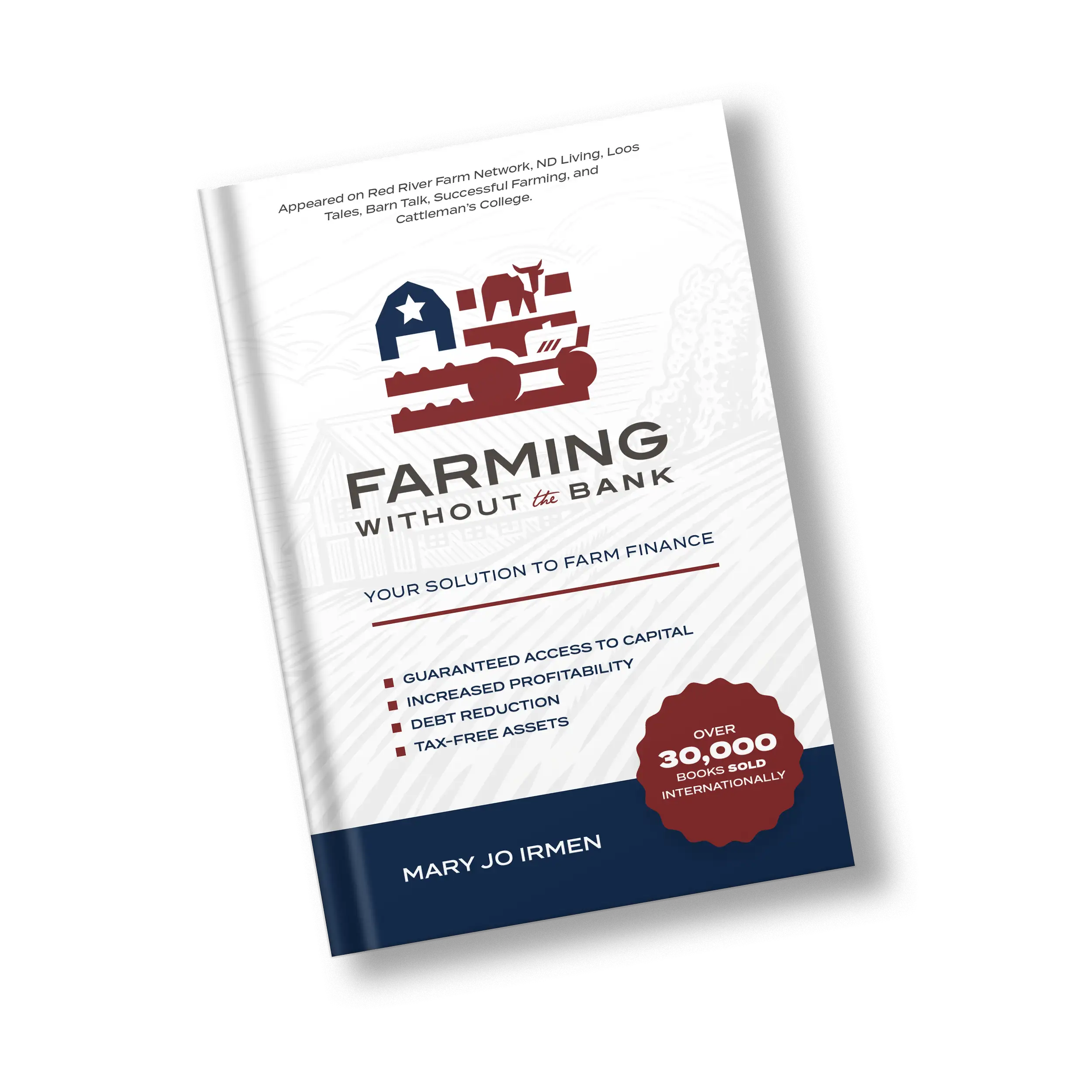
Your farm’s financial independence starts with one book.
30,000 farmers and ranchers have already made the shift. The only question is how long you’ll keep paying interest you could be keeping yourself.